
Kelly and David are ordinary but faithful Christians committed to putting the teachings of Jesus into practice in their lives. At church they befriended a good-natured and clean-cut newcomer named Chuck who had begun attending parish events and daily Mass. In the course of conversation it came out that Chuck was recently homeless due to an unexpected job loss.
Because they lived in the parish neighborhood, Kelly and David got to know Chuck well, often giving him leftovers and even letting him hang out in their backyard. Everything seemed normal about Chuck except one thing: one day he showed up in Kelly and David’s back yard and decided he would sleep there. But when they told him that was not going to work for them, he wouldn’t leave. He simply came and slept there anyway.
But then something weirder happened. Kelly and David wouldn’t call the police to have Chuck removed. They told him that they wanted him to move along, to find a another place to stay, or to go to the shelter. But when he wouldn’t, and he kept coming back at night and sleeping in their gazebo, they left it at that.
The neighbors, of course, eventually became concerned, as they noticed this unusual visitor in the back yard. There wasn’t too much they could object to, for Chuck didn’t seem dangerous, strange, or a nuisance in any way, other than that he just wouldn’t leave. He was still quiet, respectful, and kept to himself.
On the several occasions when the neighbors asked, Kelly explained the situation to them as honestly as she could: “He doesn’t seem to be causing any trouble, and he just needs a place to say for a while.”
This, they had to admit, was true. “How long are you going to let him stay?” Rick from next door asked. “Well, to be honest,: Kelly replied, “we ask him move along about once a day, and he just refuses.”
Then the obvious question: “How long till you call the police?”
“Well,” she sighed again, not knowing how this would go, “he goes to our church, we’ve been in Bible study and had breakfast together, and we take communion together every Sunday. It just doesn’t seem right to do that.”
To her surprise, Rick said he understood that, even if it wasn’t what he would do.
A couple of weeks later a neighbor from down the block that Kelly didn’t know as well, Michael, came and approached her with the same concerns. Kelly tried the same lines again. This time the reaction was different:
“Well, I guess that’s your decision,” Michael said, maintaining a good-willed composure but openly expressing his concern. “But I want to let you know that if he comes on my property I got my gun and I’m not afraid to protect myself. I’ll protect you too if I have to. Somebody has got to regulate around here.”
There are lots of points that we could endlessly discuss in this story. But what is of interest for us in this chapter is that, though he may have put it a little bluntly, Michael expresses the sentiment of most of us. And that sentiment, whether we’d like to admit it or not, is that, at the end of the day, violence or at least the threat of violence, is necessary to ensure a well-ordered society. We don’t usually go about our days giving it much thought, but when we are really pressed, most of us do not just allow, but, like Michael, insist, that the relative peace of our daily lives ultimately be secured at the point of a gun. What would have happened otherwise?
In the first part of this essay, we began to see that these sorts of considerations were not at all foreign to Jesus. There were lots of good, respectable reasons why reasonable, faithful Jews might consider taking up arms against the Romans and compromised Jewish leadership in defense of their families and their immemorial cultural traditions, which were increasingly under threat.
In such a context, the question for anyone announcing the kingdom of God, we saw, was, “What kind of kingdom do you have in mind?” And to this general question, Jesus responded with the Sermon on the Mount. His revolution was a real social revolution, but a nonviolent one. It aimed at the creation of a new society, but not by force. It was, perhaps paradoxically, a revolt – but not by means of the sword, but by the way of the cross. Here we want to continue to explore what kind of sense this could possibly make, and what it says about Kelly, Chuck, and Michael.
***
Having rejected the path of armed resistance, Jesus is nevertheless executed for treason. The charge was written over his’ head for all to see: “This is the King of the Jews.” The problem, of course, for anyone thought to be claiming such a title, was that there already was a Roman-approved puppet-king of the Jews. The mocking implication for all passers-by was obvious: if you would like to claim to be the king of the Jews, this is what you can expect to happen to you. Or perhaps even more bitingly, this is what we Romans think a Jewish king looks like.
But even without those details, the reason for Jesus’ death would not be far to seek: crucifixion itself was a special punishment reserved for enemies of the state. It was a long and tortuous, intentionally public death, meant as the ultimate deterrent. As such, only rebels or suspected rebels against this order ended up there. Thus our Catholic translation of the crucifixion scene read on Good Friday gets it exactly right: Jesus was crucified alongside two – not “thieves,” as older translations preferred – but “revolutionaries.”
And it is right here, at the cross of an apparently failed revolutionary, that we see so much of the truly revolutionary nature of Jesus and his movement.
The first thing to note has to do with the reasons the Gospels give for why Jesus was put to death. In particular, they all connect the charges against Jesus with his involvement with the communities he’d been establishing. Those charges were (1) he was calling himself, or at least others were calling him, the king, (2) he was acting or speaking against the temple, and (3) he was “stirring up the people.” Each of these charges only makes sense as the expression of the the temple leadership’s worry that Jesus was the ringleader of a large movement that had the potential to cause a significant social disturbancey.
The charges are only comprehensible as capital crimes, in other words, in view of his many, often well-organized, followers. The authorities would only be concerned that he called himself a king if there were sufficient numbers willing to be his subjects and forsake their previous loyalties. Similarly, saying things against the temple might be problematic for a lone individual, but it was certainly treasonous if one had a live alternative to the temple on offer in a grassroots people’s movement. And finally, the movement itself was only problematic if was big enough to be a threat. So Jesus ended up crucified as much “for” the Church in a social and political sense as in a theological sense. He dies more for his concrete community than for any particular bit of abstract “doctrine.”
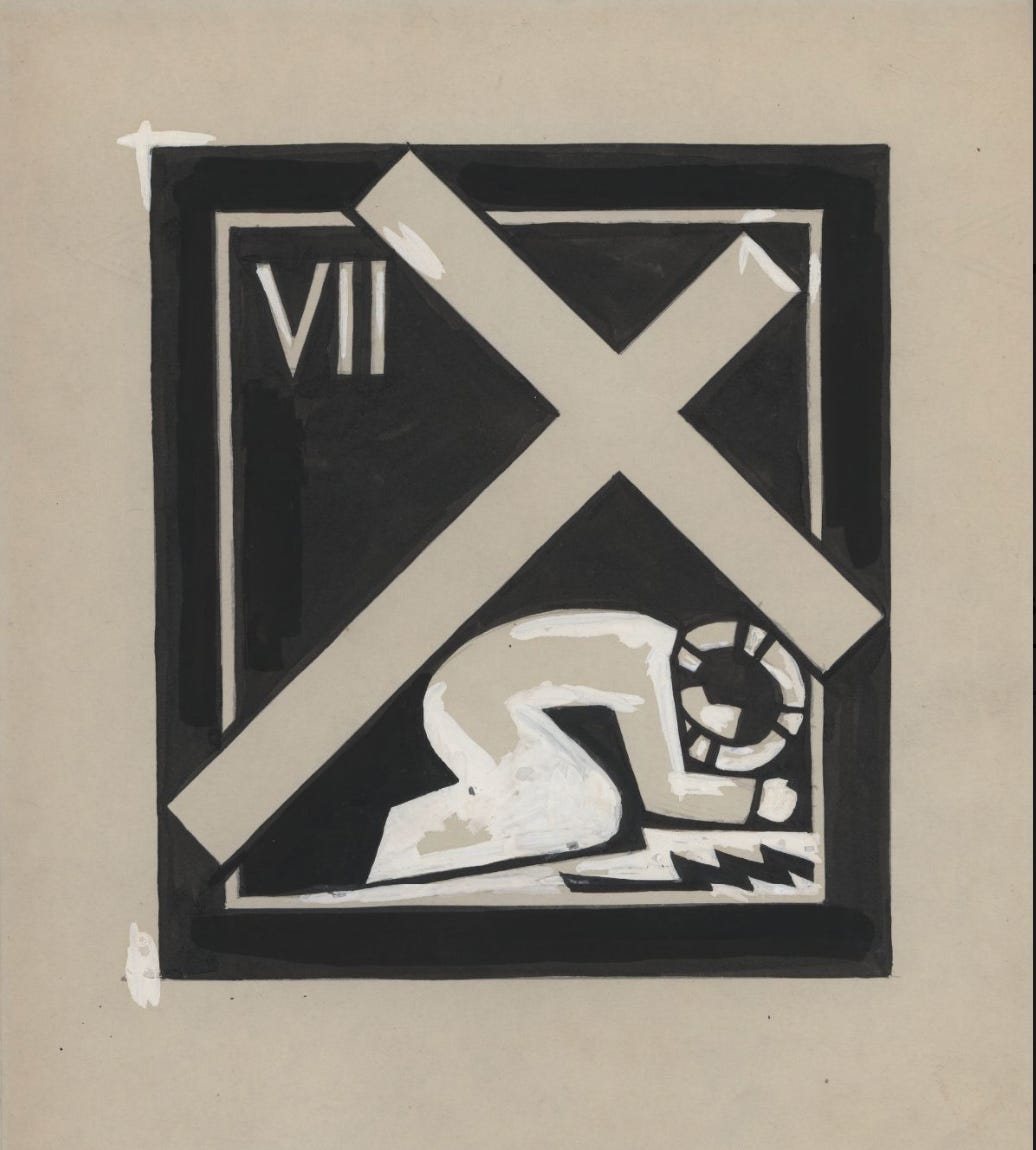
The second key to understanding the uniqueness of Jesus’ revolution is that the cross is the supreme Christian symbol because it is the supreme embodiment, not just of Jesus’ death, but of the way of life he lays out for his communities. On the cross he is putting into action the nonviolent revolution we briefly outlined above. On the cross his kingdom platform is on display for all the world to see. Or, as Origen of Alexandria, the early Church father, said, Jesus is the “kingdom-in-person” (autobasileia): the law he gave to his Church and expected of his disciples, he was the first one to live out.
The cross brings these two points together: Jesus doesn’t just die as a lone teacher of religious abstractions, but as the chief representative of the kingdom community he was establishing, and in that same nonviolent death for the community he exemplifies the very nature of that kingdom. So the cross is not only the result of, but part of the social and political uniqueness of the Jesus-option. The crucifixion is part of the movement, for there he suffers nonviolently as he had taught his community to do. It was the ultimate way of turning the other cheek or loving your enemies. But there was also no greater statement of solidarity with his disciples. The cross was the climactic nonviolent action of the kingdom community.
But we can go deeper. For, we might still wonder, what could be threatening about a nonviolent community? To the Jews, or to the Romans? We can understand why a military coup would be a problem, but how could Jesus end up on a cross next to two insurgents?
There are a couple different answers to this puzzle. On the one hand, there was jealousy simply in terms of numbers and loyalties. No matter how peaceable they were, it was clear that the Jesus party was attracting lots of people. But this would inevitably mean drawing people away from each of the other parties, to Jesus’ own unique option. For Jesus was not a lone individual, he was not a quietist, he was not a compromiser, and he was not a zealot. And this revolutionary difference singled him out for suspicion, persecution, and finally execution.
But then there’s the further difference the message of nonviolence itself makes. By refusing the sword, Jesus not only creates a rival party, he also creates an alternative society that stands as a living contrast with all the others on offer. And it’s a vision of society that can only appear to outsiders – who have never spent a day in one of his communities – as courting disorder and even anarchy. If these Jesus people get their way, who will keep the bad guys away? Without the threat of violence, won’t society deteriorate into chaos? This is what Michael was ultimately worried about.
At this level, then, we’ve just arrived at the really radical revelation that Jesus’ movement was and is offering. For his contrast-society, by its very existence, implicitly points out the violent foundations of every other social order on offer. And Jesus was not just saying this, he was showing it, in founding the Church. It’s one thing to offer a prophetic message against abuses of a particular regime – the Old Testament prophets had done that much. It’s something else to actually begin to transform society into the peaceable kingdom, in cells of disciples that serve as a perpetual witness that there is another way of being human.
And this new way of being human – the kingdom of God – includes a whole new vision of reality. The old vision – the vision of this present age – assumed, ultimately, a vision of the world as fundamentally chaotic, dangerous, and violent. Under such conditions, the limited peace that can be achieved here must be built over the top of that fundamental violence by means of more violence. Our limited oases of order, safety and security – our countries, cities, and homes – are, on this view, just so many localized structures of violence holding off greater cosmic violence. This, says St. Augustine, in his famous work The City of God, is simply the typical non-Christian worldview. It’s a world of perpetual conflict, of a war of all against all. Violence is the DNA of reality.
But with his kingdom Jesus is announcing that another way of being human is possible because this violent vision of the world is a lie. The fundamental reality of the cosmos is not chaos and violence but God’s good creation, which is an order, as Augustine put it, of perfect and perpetual peace. Jesus’ kingdom is therefore one that lives in accordance with that peace. Underneath the sin and violence with which the world – and too often we ourselves – futilely tries to secure a small and temporary measure of false peace, God’s true order of peace beckons us. To live the Sermon on the Mount is to live with this order – to live, as it were, “with the grain of the universe.” And with his teaching Jesus is not just announcing this possibility, he’s making it present in the daily lives of his new society. The kingdom of God is the society of those who practice God’s peace together, and Jesus himself leads the way in practicing it all the way to death.
In our third and final essay in this series we’ll ground this vision of peace even more deeply – in the very nature of God himself.

Colin Miller is a member of the Maurin House Catholic Worker (Columbia Heights, Minnesota) and the Director of the Center for Catholic Social Thought at the Church of the Assumption in St. Paul, where he is also the Director of Pastoral Care & Outreach. Miller has written a book, We Are Only Saved Together: Living the Revolutionary Vision of Dorothy Day and the Catholic Worker Movement, published by Ave Maria Press.
Read Part I of this essay here.
Comments
Nothing yet. Say the first thing.
Sign in to join the conversation.