
This week I came across an image that has been widely circulated across the internet of a Black woman on the D.C. Metro surrounded by white nationalist militants.
The photo is painful and evocative; we do not know where the courageous woman pictured was headed, but the militants, members of a neo-Nazi group called The Patriot Front, were on their way to march on the U.S. Capitol.
A year ago, when I was still living in the D.C. area, I often took the Metro into the city to attend protests and vigils. It was rare to see fellow protesters on the same train with me. When I arrived at my destination, I was often met by a ragtag group of familiar faces. Those faces were filled with smiles and love, not masked, and they stood in opposition to violence, not carrying instruments of destruction.
It’s easy to look at the membership of various institutions of violence and see their matching outfits, their stark uniformity, and interpret it as strength. But there is also a quiet power in our movement’s humility and diversity. I was reminded of a bit of advice by Dolores Huerta:
“When you are organizing a group of people, the first thing that we do is we talk about the history of what other people have been able to accomplish - people that look like them, workers like them, ordinary people, working people - and we give them the list: these are people like yourself; this is what they were able to do in their community.”
What we (peacemakers, meek, poor in spirit, etc.) lack in show of force, we make up for in the multitude of different people drawn to the message of nonviolence. Growing up in the movement, I heard story after story of fellow Catholic Workers who’d gone out to vigil, hoping to bring public attention to any number of worthy causes, only to find themselves in productive conversation with the folks opposing them, sometimes even those arresting them. It is our ordinariness that allows us to connect with people on a human level, and that allows us to change hearts and minds.
There’s a lot of ordinariness in the service of the holy in today’s newsletter—an essay on Dorothy’s sainthood, a holy woman who found God in the most human of places and people; war tax resistance, BBQs at homeless encampments, vigils for the forgotten, soccer games, and many other beautiful bits of ordinary Catholic Worker life taking place in these extraordinary times. Matthew 9:35-38 tells us “the harvest is plentiful, but the laborers are few”. I am filled with gratitude for the fellow laborers I get to harvest with each day.
peace,
Rozella


This week’s CWReads featured the first part in Colin Miller’s long-form essay on Christian nonviolence—a theology that challenges our common sense ideas of self-defense or self-preservation, that challenges the pervasive logic that passively accepts violence and war as necessary evils of life. Miller writes:
Having been involved with the Catholic Worker Movement for years now, I am aware of how many people deeply admire Dorothy Day, the co-founder (alongside the Peter Maurin) of the movement. They like her activism, her concern for the poor, and the fact that she put her faith into practice.
But many have been much more hesitant about her commitment to being a Catholic pacifist. She maintained her position in this regard even during WWII, publicly opposing participation in the war, and as a result. The Catholic Worker newspaper lost thousands of subscribers. So I am aware that in broaching the issue of the legitimate use of force I am entering a minefield, so to speak.
Yet is seems to me that, headline news being what it is these days, this is an issue that Christians have to talk about. And it seems to me that there’s a way of discussing it that doesn’t involve drawing too many lines in the sand. For I think there’s plenty of important groundwork Christians can agree on before we come to the important questions of whether you’re for “just war,” or “pacificism,” or something else.
In the first part of his essay, Miller describes the cultural context in which Jesus entered. Jesus’ movement was not offering pie in the sky but a movement of communities—an alternative kin-dom—that followers could join here and now. “He was building a movement in whose communities the kingdom was breaking in presently.”
Read part one in CWReads here.
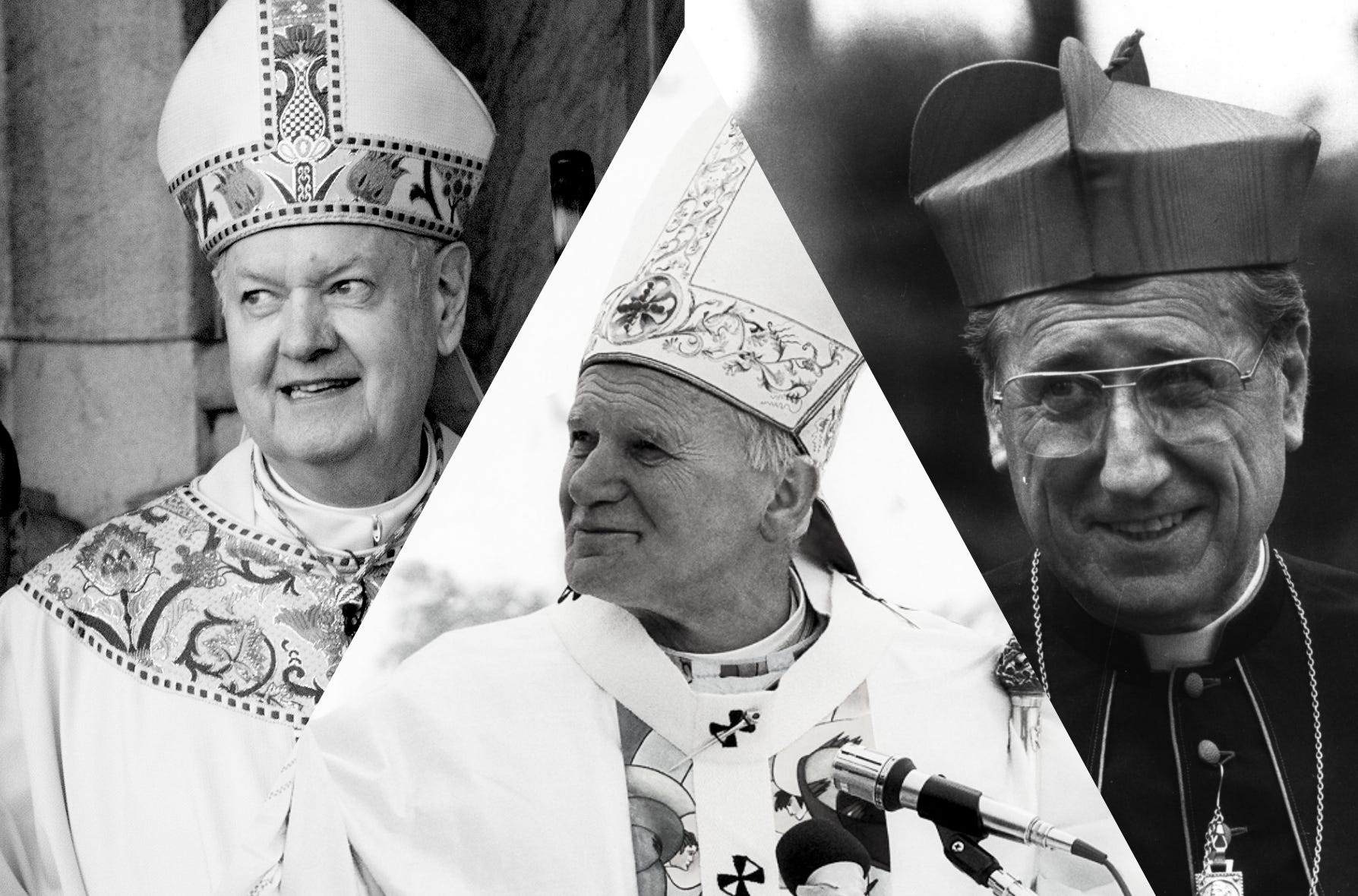
Jeffry Korgen shares another story from the “behind the scenes” of his work in Dorothy Day’s canonization process. This story begins with the dying wish of Cardinal John O’Connor. Korgen writes:
John Cardinal O’Connor rose from his deathbed and donned his clerics. The brain cancer had progressed, and he did not have long to live; it was time to say goodbye. This would be his last meeting with Pope John Paul II.
Publicly, the reason for his February 2000 papal visit was sentimental. But there was more to it—two final requests. The cardinal had already torpedoed Theodore McCarrick’s candidacy to succeed him as Archbishop of New York with a six-page letter to Pope John Paul II detailing allegations of sexual misconduct. But he found the latest rumor regarding the appointment of his ecclesial heir equally unacceptable.
Edward Egan? While essential to the Pope’s 1980’s revision of the Code of Canon Law and a proven fundraiser and administrator, Egan lacked the pastoral touch. This opera-loving loner would never become pastor to millions of ordinary New Yorkers, O’Connor believed. In a few hours, he would fly to Rome to ask Pope John Paul II to appoint Henry Mansell, the Bishop of Buffalo, instead.
But the cardinal had a second dying wish. O’Connor had completed the paperwork to launch Dorothy Day’s sainthood cause more than two years earlier. The requisite documents had been sent to the Holy See but now sat in bureaucratic limbo. Only a direct intervention from Pope John Paul II himself could move Dorothy’s cause forward, particularly if Bishop Egan became New York’s next archbishop.
Read the full story here.
The 37th episode of “Coffee with Catholic Workers” is now transcribed and available for listening or reading on CatholicWorker.org. Theo Kayser and Lydia Wong interview Lincoln Rice of Casa Maria Catholic Worker (Milwaukee, Wisconsin) & Chrissy Kirchhoefer of the St. Louis Catholic Worker about their work for the National War Tax Resistance Coordinating Committee.
This discussion covers the history of tax resistance in the Catholic Worker movement as well as the modern revival of tax resistance, examining different approaches to tax resistance and the implications of this practice.
Visit CatholicWorker.org to read the full text.
Thanks for reading Roundtable! Like, restack, or share this post with a friend to help spread the word about the Catholic Worker
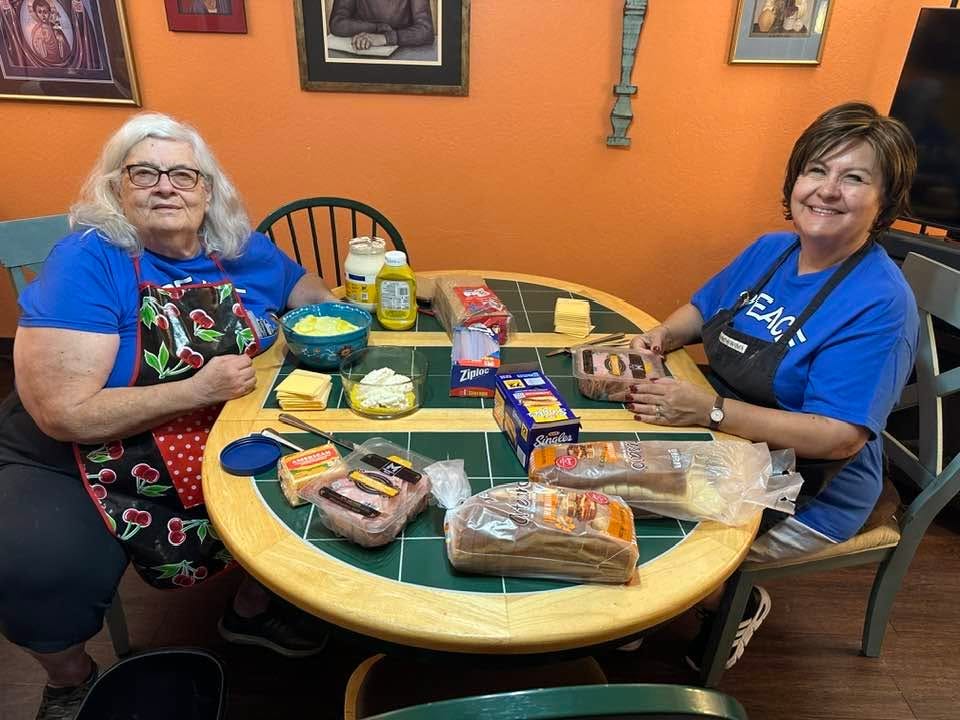
Catholic Workers across the country celebrated July Fourth by standing for and with the marginalized. St Benedict Catholic Worker in Fresno, California, packed sack lunches for those on the streets—“the forgotten, the invisible that stand outside the promise of America,” they wrote on Facebook.
God welcomes them as family and we wanted them to know that in a very tangible way. Inspired by our Pastor, Fr. Michael Pfleger, we understand our assignment—loving our neighbor. Celebrating the gift each of us are to the American Dream not yet realized.
The St. Louis Catholic Worker, similarly, took to the streets.
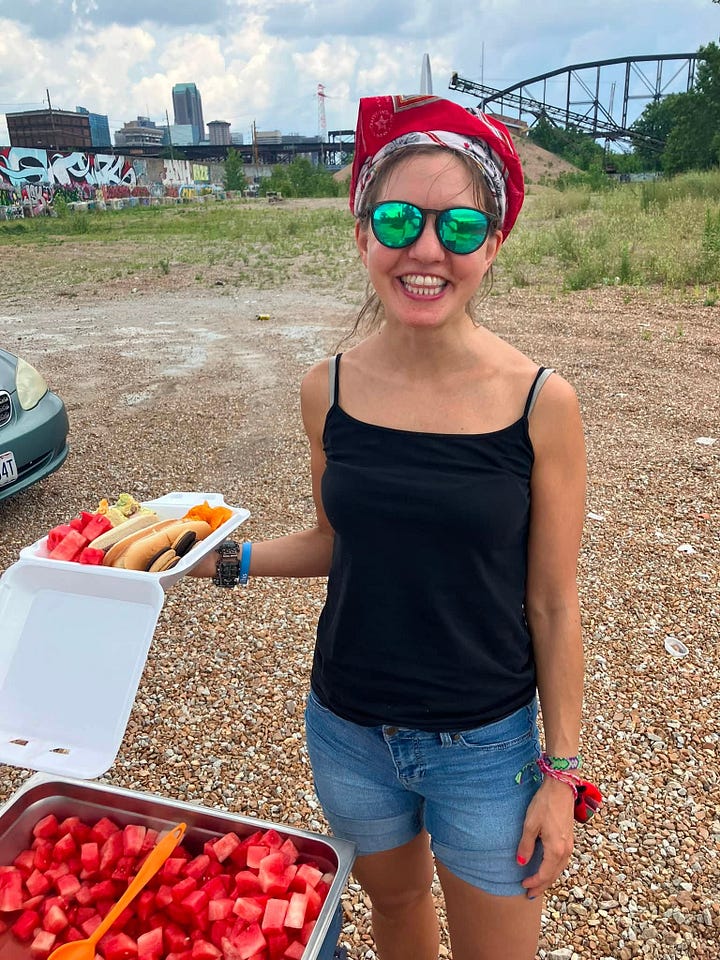
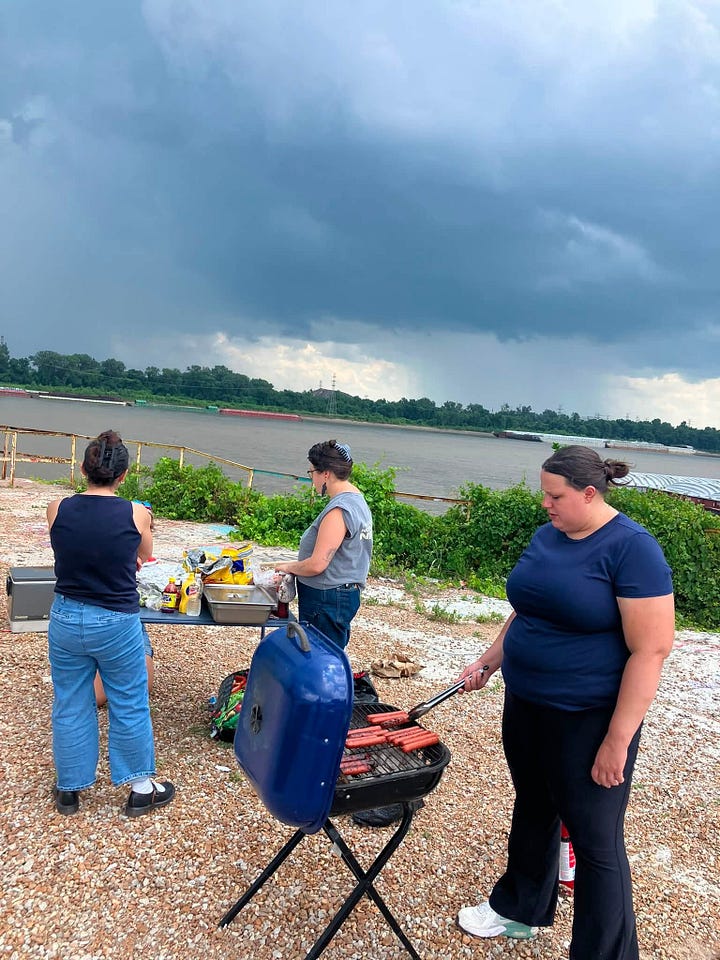
One of the community’s founders, Theo Kayser, wrote on Facebook:
Like Catholic Worker founder Dorothy Day, we’re kind of anarchists. We don’t get terribly excited for the 4th of July the way many do.
This year while thousands in St. Louis are celebrate the USA at the Arch, we decided to go have a bbq for our unhoused friends who live just a little ways down the river from the big festival.
The Comox Valley Catholic Worker in British Columbia held a recent roundtable at their local library on the right use of royal land. Their mission is, according to their website, “to incarnate the Church’s ‘preferential option for the poor’ by building community with friendship and creativity.” They honor the First Nations on whose land they reside, the K’ómoks Nation. The community is dedicated to hospitality—in their tiny home project, Gilakas'la—and roundtables. Learn more about the community on their website here.
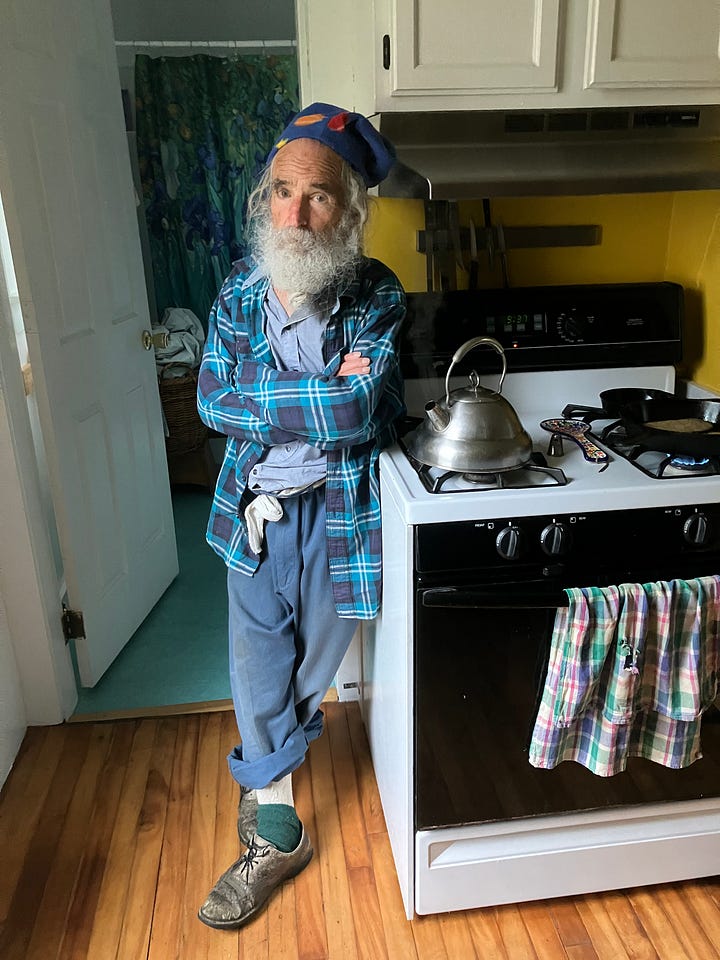

A new Catholic Worker house was founded in Vermont in August 2024. Skyberry House in Battleboro, Vermont, strives, according to their community, to “extend an invitation to interested folks who are inspired to live and learn together with our unhoused siblings.”
The new-ish community provides interim housing, focusing on families and children. See coverage of their community at VTDigger. They commit to simple living in a community, gathering for meals, gardening, cooking, and communal leisure of prayer and song. Skyberry House is seeking new volunteers to support the daily work of the house. They are a 501c3 and can offer a modest stipend for full-time committed hosts and volunteers. Learn more about the community on their website here and contact the community at 802-451-6724 or houseskyberry@gmail.com for more information.
Across the country, activists protested the anniversary of the passing of the Gregg v. Georgia Supreme Court decision in 1976 that affirmed the constitutionality of the death penalty. On Thursday, July 2, the 50th anniversary of the 1976 decision, activists gathered in Indiana, Alabama, and outside the Supreme Court in Washington, D.C. Art Laffin of Dorothy Day Catholic Worker in Washington D.C., kept vigil with those fasting for justice the week leading up to July 2 and shared the story of forgiving the man who murdered his brother. Read more at Religion News or BeliefNet.
Michele Naar-Obed (of Hildegard House Catholic Worker, Duluth, MN) shared a message with Roundtable from a former community member at Loaves and Fishes Catholic Worker (Duluth, Minnesota). Travis Elise, an organizer who lived at Loaves and Fishes previously, is seeking faith-based contacts to stand in solidarity with the Minnesota 15. The Minnesota 15 are local community members who are being charged with federal criminal conspiracy charges for resisting the ICE occupation of the Twin Cities in January and February.
The Minnesota 15 Defense Committee is seeking statements of support from Catholic Workers and journalists, and seeks to activate Catholic Workers to spark solidarity actions around the country. Those seeking to learn more can watch an interview with two defendants or contact Travis at travis.elise@proton.me.
For Christian Century, Laura Lasuertmer writes “Dorothy Day never spoke of her abortion,” which examines Dorothy Day’s silence on the issue. Lasuertmer, of Common Home Farm Interfaith Catholic Worker in Indiana, writes about choosing to talk about the taboo subject:
Unlike Dorothy, I do not have the instinct to be silent when I am hurting. I understand my life and my losses best through conversations and stories, and that means I must write about my experience of abortion—despite the polarizing landscape of this issue, and despite the Catholic Worker movement’s tradition of silence around it. My healing is connected to my choice to speak plainly and openly. The specter of shame in the shade of silence is what tells me to be quiet, and I reject it.
Read the full article at the Christian Century online.
Michael O'Connell looks to Dorothy Day in a recent essay in the National Catholic Reporter as he tries to untangle patriotic principles vs. practice as America hosts the FIFA World Cup:
My own patriotism is probably best expressed by Dorothy Day’s 1942 statement in The Catholic Worker newspaper: “We love our country ... We have been the only country in the world where men of all nations have taken refuge from oppression. We recognize that while in the order of intention we have tried to stand for peace, for love of our brother, in the order of execution we have failed as Americans in living up to our principles.”
While our national ideals have always outstripped our reality, the very existence of the ideals is still worth celebrating. Celebration becomes harder, though, when the government itself denigrates those ideals.
Read the full article at National Catholic Reporter.
Catholic Outlook, a publication of the Diocese of Parramatta in Australia, highlighted Dorothy Day as one of several women included in Pope Leo XIV’s encyclical, Magnifica Humanitas. Debra Flock writes:
According to the Pope, these women embody the great humanity that God has placed within us—a humanity that preserves and radiates dignity, justice, and hope despite limitations and social resistance.
The fact that they worked in such different fields—education, medicine, science, and politics—demonstrates that true greatness lies not in power, nor even in the practice of religion itself, but in devotion to others.
Read the full article at Catholic Outlook.
Virtual Event — Claire Lewandowski from the Los Angeles Catholic Worker and Jessica Gerhardt, Catholic artist, are offering a virtual roundtable reading group on the new encyclical, Magnifica Humanitas, on Sunday, July 26 at 5 p.m. Pacific Time. Learn more and RSVP on Instagram here.
Sugar Creek, Iowa—The Midwest Catholic Worker Gathering at Sugar Creek, Iowa, will take place the weekend of September 10-13, 2026. Mark your calendar and stay tuned for more information! You do not have to be living in an existing Catholic Worker community to attend.
Frank Cordaro of the Des Moines Catholic Worker is organizing an eight-day delegation to El Salvador in honor of Rev. Bob Cook, a good friend of the Des Moines Catholic Worker. They plan to bring a delegation of between five and 15 participants to visit the communities in El Salvador that Cook developed a relationship with—they plan to “visit rural communities, learn about ongoing water and infrastructure projects, share meals with local families, and experience the culture and beauty of El Salvador.”
Cordaro shares that the purpose of the delegation is to “deepen relationships, witness the impact of community-driven projects, and continue the spirit of solidarity that Bob championed throughout his life.” Interested parties should reach out to Frank Cordaro at the email below to learn more: frank.cordaro@gmail.com.
Birmingham, Alabama—Mary’s House Catholic Worker in Birmingham, Alabama, will offer an Advent retreat entitled “Building a New Society in the Shell of the Old” with Brian Terrell and Betsy Keenan, leading reflections on building community and resisting the evils of the day. More information at maryshousebham.com.
by Dorothy Day from the June 1942 issue of The Catholic Worker
I saw a bit of Germany on the west coast. I saw some of the concentration camps where the Japanese, men, women and children, are being held before they are resettled in the Owens Valley or some other place barren, windswept, inaccessible. The strange part of this wholesale imprisonment of an innocent people is that many of them are native born citizens of this country. But that means nothing in wartime. Wholesale evacuation of areas in Los Angeles, San Francisco, Portland and Seattle have already been carried out and as I stopped in each city, there were still groups being moved. Whole areas had been vacated, houses empty. According to friends in Portland, business, and property had to be sold at a loss and there were those who took advantage of this misfortune of the evacuees. Saving Them from Others Various attitudes are taken. Some say the move was for the safety of the Japanese. “If there were any great defeats, if lists of dead and wounded were printed, there would be wholesale slaughter.” This is the opinion of one acquaintance in Los Angeles, which I heard voiced quite often since. Such a sentiment does not speak well for America. Have we then as a nation so little confidence in our police, in lawfully constituted authority or do we so lightly expect mob violence? Some bitterness is expressed at the pampering of the Japanese. “They are living the life of Riley,” an acquaintance in Portland said. As if to live without work and in imprisonment is something pleasurable to look forward. All who have ever been prisoners know that to live behind bars without occupation is torture.
Thanks for reading Roundtable! Like, restack or share this post with a friend to spread the word about the Catholic Worker movement
Editor’s Note: This newsletter was updated to correct the notice regarding the defense efforts for the Minnesota 15. It is a former community member at Loaves and Fishes who is asking for help, not the community itself. Learn more about Loaves and Fishes on their website here.
Comments
Nothing yet. Say the first thing.
Sign in to join the conversation.