
If you know me, which is to say if you’ve given me the opportunity to talk for more than about three whole minutes, you know that I’m a pretty traditional guy when it comes to certain things. I prefer large sedans with obnoxious internal combustion engines over hybrids or all-electric vehicles. I prefer my analog watch to a smartwatch. I roll my eyes and grudgingly accept the fact that to operate in today’s world where every company on the planet wants you to have their app to pull up a loyalty code in order to shop in their brick-and-mortar store, you need a smartphone. I remember being perfectly happy with the peace of having no cell phone at all. And when it comes to the holy sacrifice of the Mass… well, I am your traditional smells-and-bells Catholic.
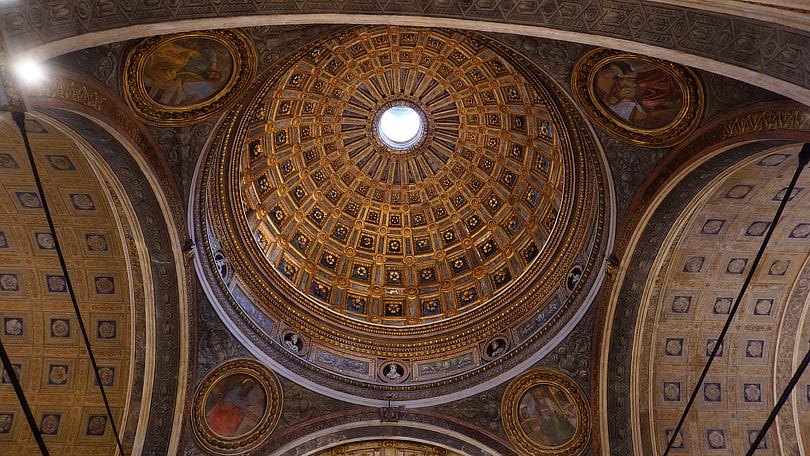
I love incense. I love the old traditional hymns and Gregorian chant and Latin. I love traditional prayers and devotions and a reverent liturgy. I love churches with traditional architechture. I love all of these things because they separate the secular from the sacred. I love these things because they are set apart for God.
So it goes without saying, then, that when we travel and we wind up at a newer church shaped like a UFO with stadium seating, and the altar is down below the congregation next to the oh-so-prominent band, and where the tabernacle is somewhere you can’t find and genuflect towards… well, I get grumpy. I also get grumpy when I hear of churches where there used to be something beautiful, and someone came along and decided to get rid of it or cover it over. It breaks my heart to hear of beautiful frescoes that were painted beige, exquisite marble floors that were covered by carpet, or intricate stained glass images that were the work of thousands of hours of craftsmanship that were replaced with meaningless chunks of colored glass.
Some people refer to the time period where this happened as “The Wreckovation.” I couldn’t agree more with that moniker.
The first issue is the replacement of something extraordinarily beautiful with something rather ordinary.
There are many different arguments in favor of having church that is austere, and I’m not going to get into all of them, as each one would require a complete set of scholastic arguments worthy of St. Thomas Aquinas in the Summa Theologica. I’m not even going to get into one of them. I’ve had many a debate with Protestant friends on the matter, and it’s not a discussion that can be fully explored in a short amount of time. I’ll summarize my argument in favor of beautiful churches with this: If you go to the mall and the floors there are nicer than the floors of your church, and if you go to work and there’s more color and more art than there is in your church, and if you look around your home and there’s more beauty than there is in your church, then the question needs to be asked: “For what god have these things been made beautiful?”
The god of the marketplace? The god of the businessplace? Yourself, as lord of your home?
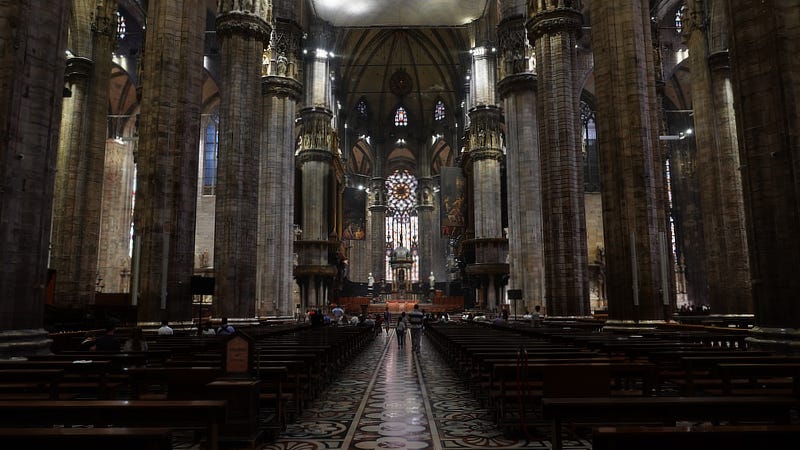
Our churches need to be beautiful. They should be designed and decorated to lift hearts and minds to God, sure, but isn’t he worthy of the best we can give him? After all, if you’ve ever read the book of Exodus, especially toward the end, you find that God gave instructions on how to build the furniture for himself, and it was not beige by any stretch. It was elaborate, it was ornate, it was expensive, and it was extraordinarily beautiful. For the God of all creation, should it be any less? Has he changed and he now deserves less than the Israelites wandering in the desert were commanded to give him? I think not.
But there’s another issue here, and that’s one of legacy. I’m not talking about the kind of legacy that has multimillionaires paying for a hospital and putting their name on the side of it so everyone knows who wrote the check. Rather, I’m talking about the legacy of faith.
Going back to time immemorial, people of a parish would each give not just their treasure to the church, but also their time and talent. How many churches of generations ago were built, literally built, by the parishioners? The carpenters and the bricklayers and the plasterers, and everyone else? And not just the adults, but the children who helped them? Everyone did their part, no matter how big or how small, in physically building the church. Their church. And in the case of many churches, many people died before the building was complete. Not because they were old, mind you, but because the churches were multi-generational projects.
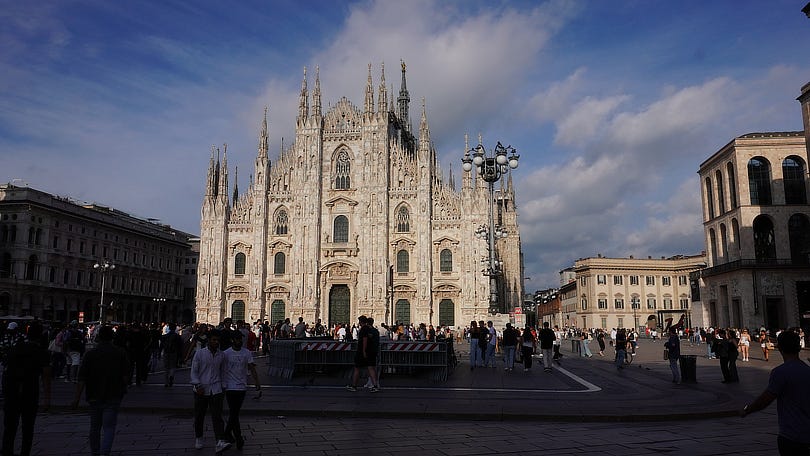
St. Peter’s Basilica, the largest church in the world, took 120 years to complete, with construction starting in 1506. The Sagrada Família basilica in Barcelona was started in 1882 and was just completed earlier this year… 144 years to finish. The Cattedrale di Santa Maria del Fiore in Florence was started in 1296 and took 140 years to complete. The dome alone took 16 years. Sixteen years just for the dome! But nothing holds a candle to the Cathedral of Milan, dedicated to the Nativity of Mary: Started in 1386, construction wasn’t complete until 1965… almost 600 years.
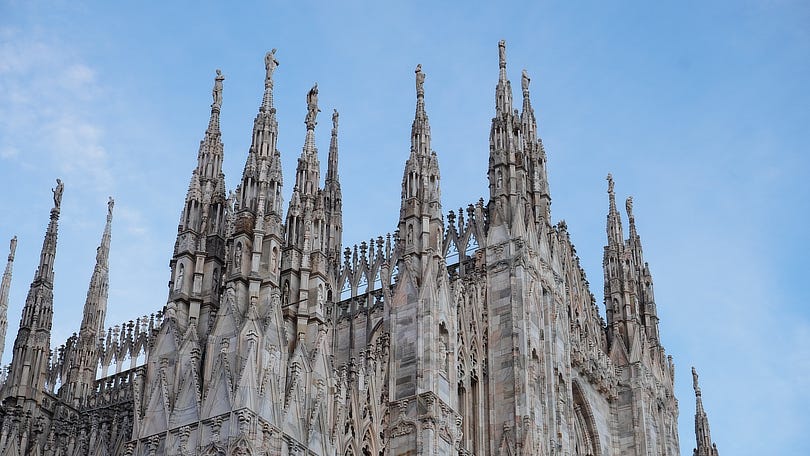
Each of these buildings represented an opportunity for the people of God to use the skills and talents he had given them to build something lasting. Each of those laborers left a legacy for their children, grandchildren, great-grandchildren, and beyond. Each one is like a slender thread, connecting the future generations to the past, anchoring them in the faith that their forefathers helped build with their hands, and with the sweat of their brow. Certainly, not every craftsman was a Catholic, or even a Christian. But let us consider this: only God knows how many of their progeny were drawn to the Church upon finding out the contribution of their forefathers.
So let us learn from the mistakes ushered in by The Wreckovation and never again be content with beige.
We each have talents that God has given us, so let us use those talents to build extraordinary things for the Church, and for the God who gave us those talents in the first place.
No posts
Comments
Nothing yet. Say the first thing.
Sign in to join the conversation.