
“Ethiopia shall stretch out her hands to God.” — Psalm sixty-eight, verse thirty-one
To understand how remarkable Ethiopia’s church is, you first have to understand what happened to every other ancient center of Christianity.
In the early centuries of the faith, the Christian world was organized around five great patriarchal cities, known together as the Pentarchy. These were the five sees recognized by the Roman Emperor Justinian in the sixth century as the governing centers of the whole Church. Each one had been founded by an Apostle. Each one was a pillar of the ancient faith.
Rome in Italy, founded by the Apostle Peter, became the seat of the Pope and the center of Western Christianity.
Constantinople in modern-day Turkey, founded by the Apostle Andrew, became the capital of the Eastern Roman Empire and the heart of Eastern Orthodoxy.
Alexandria in modern-day Egypt, founded by the Apostle and Evangelist Mark, was one of the greatest theological schools in early Christianity, producing figures like Clement, Origen, and Athanasius.
Antioch in modern-day Turkey and Syria, founded by the Apostle Peter before he went to Rome, was where followers of Jesus were first called Christians, as recorded in the Acts of the Apostles, chapter eleven, verse twenty-six.
Jerusalem in modern-day Israel and Palestine, the city where Jesus died, rose, and sent out his Apostles, held the most sacred ground in all of Christendom.
Every single one of these five sees came under foreign political domination. Rome survived as an independent Christian city but became the seat of a Western papacy that eventually provoked the Protestant Reformation of the sixteenth century. Constantinople fell to the Ottoman Turks in fourteen fifty-three, and the great Hagia Sophia, built as a Christian church, was turned into a mosque. Alexandria and Jerusalem fell to Arab Muslim armies in the seventh century and have been under Muslim or colonial rule in various forms ever since. Antioch similarly fell and has spent most of its history under Islamic governance.
These are facts of history. The five ancient apostolic centers of Christianity all lost their independence. All of them were touched, changed, conquered, or split by outside political forces. Their theologies were shaped, bent, and in some cases broken by the political realities of the empires around them.
Now look to Africa.
The Ethiopian Orthodox Tewahedo Church received the Christian faith in the fourth century. Ethiopia was never colonized by a European power in the lasting sense that most of Africa was. It was never governed by the Ottoman Empire. It was never absorbed into any Islamic caliphate. When Mussolini’s Italy occupied Ethiopia briefly from nineteen thirty-six to nineteen forty-one, it was less than five years and was ultimately defeated. Ethiopia threw off that occupation. Its Church was never forcibly reformed, never had its liturgy stripped away by a foreign power, never lost its canon to a printing press decision made in a European monastery.
The Ethiopian Orthodox Tewahedo Church has practiced essentially the same faith, in essentially the same way, in the same language, with the same canon of Scripture, for over sixteen hundred years.
This is not a minor historical footnote. This is one of the most significant facts in all of Christian history.
The first question any comparison of churches must address is: whose Bible are we using?
The Protestant Bible has sixty-six books.
The Catholic Bible has seventy-three books, including the seven deuterocanonical books removed by Protestant reformers in the sixteenth century.
The Ethiopian Orthodox Bible has eighty-one books. Some Ethiopian church sources list figures ranging slightly higher depending on how certain texts are counted.
The Ethiopian Old Testament contains forty-six books, including all the deuterocanonical books that Protestants removed, plus additional texts such as First Enoch, the Book of Jubilees, and three books called First, Second, and Third Meqabyan, which are distinct from the Maccabees books found in Catholic Bibles.
The Ethiopian New Testament contains thirty-five books. Beyond the standard twenty-seven books accepted by all major Christian traditions, the Ethiopian canon includes additional texts covering church order, liturgical practice, and apostolic instruction, such as the Didascalia, the Synodos, and portions of the Clementine literature.
First Enoch is one of the most striking examples of what Ethiopia kept and the West lost. This ancient Jewish text, which predates Christ, is quoted directly in the New Testament letter of Jude, verses fourteen and fifteen, with explicit attribution to Enoch as a prophet. Tertullian, one of the major Latin Church Fathers of the third century, argued that First Enoch should be considered Scripture precisely because the New Testament quotes it. Multiple Aramaic fragments of First Enoch were found among the Dead Sea Scrolls, confirming it was widely read and valued in first-century Jewish communities. The text fell out of the Western Bible gradually, not through any formal decision but simply through the transmission patterns that followed the dominance of Jerome’s Latin Vulgate in the West. Ethiopia never lost it because Ethiopia never switched its primary scriptural tradition away from the ancient sources.
The Book of Jubilees, also kept in Ethiopia’s canon, was similarly found among the Dead Sea Scrolls, confirming its importance in early Jewish and Christian communities.
When Protestant reformers removed seven books from the Old Testament in the sixteenth century, they claimed they were returning to the original Hebrew canon. But the Ethiopian Church, which had no connection to the Protestant Reformation and no political reason to change anything, had kept all of those books and more for over a thousand years before Luther was born.
The question is not whether Ethiopia added books. The question is whether Europe removed them. The Ethiopian canon suggests the latter.
Perhaps the most striking point of comparison between Ethiopia and the Reformed churches is on the Sacraments. The Ethiopian Orthodox Tewahedo Church holds exactly seven Sacraments, in full agreement with both the Catholic Church and the Eastern Orthodox tradition. Most Protestant denominations reduced this number to two, baptism and communion, treating the others as mere human traditions.
The Ethiopian Church’s own teaching states its position plainly: the writings of the early Church Fathers make clear there are seven, each with Biblical foundation, and all Orthodox and Catholic churches throughout East and West have agreed on keeping seven Sacraments since the beginning. The Church further notes that Protestant groups, even while rejecting the other five as Sacraments, still practice them in some form, which the Ethiopian Church reads as an unconscious acknowledgment of their necessity.
Here is a direct comparison of all seven.
Baptism. The Ethiopian Church baptizes infants, seeing it as the New Testament fulfillment of Old Testament circumcision, the entry of a child into the covenant people of God. Boys are baptized on the fortieth day after birth, girls on the eightieth. The Church grounds this directly in the Gospel of John, chapter three, verse five, where Jesus says that unless one is born of water and the Spirit, one cannot enter the kingdom of God. Protestant traditions, particularly Baptist and evangelical groups, reject infant baptism entirely, teaching that baptism is a symbolic act performed by a conscious adult believer. Catholic and Eastern Orthodox traditions agree with Ethiopia on infant baptism and its necessity for salvation.
The Eucharist. The Ethiopian Church teaches that the bread and wine are genuinely and really transformed into the Body and Blood of Christ during the liturgy. The priest consecrates the elements and the faithful receive the actual Body and Blood of the Son of God. The Church is explicit: what is given is not a symbol, not a memorial only, but the real presence of Christ. This is in full agreement with Catholic teaching on the Real Presence, and with Eastern Orthodox teaching, which uses different terminology but affirms the same reality. Most Protestant traditions teach that the Lord’s Supper is a memorial only, a symbolic act of remembrance. Some Protestant traditions such as Lutheranism teach a real but differently understood presence. Baptist and evangelical traditions typically hold to a purely symbolic view.
Confession. The Ethiopian Church teaches auricular confession, meaning the confession of sins to a priest who then pronounces absolution. This is grounded in the Gospel of John, chapter twenty, verse twenty-three, where Jesus breathed on the Apostles and gave them the authority to forgive or retain sins. Most Protestant traditions reject the necessity of confessing to a priest, teaching that the believer goes directly to God. Catholic and Eastern Orthodox traditions agree with Ethiopia on the necessity of sacramental confession.
Confirmation. The Ethiopian Church practices the anointing with holy oil called Myron, given immediately after Baptism, as the sealing of the Holy Spirit. Catholic and Orthodox traditions both confirm this practice. Most Protestant traditions have no equivalent sacrament, though some practice a confirmation class or ceremony that carries no sacramental weight in their theology.
Holy Orders. The Ethiopian Church maintains a three-tiered ordained ministry of deacons, priests, and bishops, all in Apostolic Succession, meaning the laying on of hands has been passed down in an unbroken line from the Apostles. Only a bishop can ordain a priest. Only three bishops together can consecrate another bishop. This is in exact agreement with Catholic and Eastern Orthodox structure. Most Protestant traditions reject Apostolic Succession entirely. Many Protestant denominations ordain ministers through congregational vote or denominational appointment, with no claim to a historical chain of ordination going back to the Apostles.
Marriage. The Ethiopian Church teaches that marriage is a Sacrament, a holy covenant that is permanent, exclusive, and sacred before God. Divorce is not recognized as dissolving a valid sacramental marriage. Most Protestant traditions treat marriage as a civil and religious ceremony but not a Sacrament, and generally permit divorce and remarriage under various conditions.
Anointing of the Sick. The Ethiopian Church anoints the sick with holy oil, administered by a priest, for healing of body and soul. This is grounded in the letter of James, chapter five, verses fourteen and fifteen. Catholic and Eastern Orthodox traditions practice the same. Most Protestant traditions have no equivalent sacramental anointing, though some Pentecostal and charismatic groups practice anointing with oil in a non-sacramental context.
Seven for seven. Ethiopia agrees with the ancient undivided Church on every single Sacrament. The Protestant Reformation removed five of them.
Walk into an Ethiopian Orthodox church and you will find a world that looks, sounds, and smells nothing like a modern Protestant service and very much like the ancient Church described in the book of Revelation.
Incense. The Ethiopian liturgy uses incense throughout the service. Before the scripture readings, the priest blesses the incense and the censer. The deacon then walks around the Ark of the Covenant three times with a lighted candle, while incense fills the church. This practice is grounded in the Old Testament, where incense was commanded in the Temple worship, and in the New Testament, where the book of Revelation, chapter five, verse eight, describes the prayers of the saints rising before God as incense. The Catholic Church also uses incense throughout its liturgy. Most Protestant traditions eliminated incense entirely during the Reformation, rejecting it as a Catholic and therefore corrupt practice.
Candles. The Ethiopian Church uses beeswax candles in its liturgy, placed on the altars and carried in processions. Candles are used at Mass, at the administration of the Sacraments, at funerals, and in processions. Three candles are ordinarily kept on the altar, with a sanctuary lamp burning continuously before the reserved Sacrament. The Catholic Church maintains an identical practice. Most Protestant traditions use candles only as decoration, if at all, with no liturgical meaning attached.
The Ark of the Covenant, the Tabot. This is where Ethiopia stands utterly alone in all of Christendom and simultaneously most closely echoes the ancient pattern of worship. Every single Ethiopian Orthodox church must have a Tabot, a consecrated replica of the Ark of the Covenant, placed on the altar, before it is considered a valid church. Without the Tabot, given by the local bishop, the building is not yet a church. Only priests may touch it. On the feast day of the church’s patron saint, the Tabot is carried on the head of a priest in a great procession around the outside of the church, accompanied by singing, dancing, and the beating of drums, exactly as David danced before the Ark of the Covenant in Second Samuel, chapter six. The Eucharist is celebrated with the bread and wine placed upon the Tabot. The Tabot represents the presence of God in the midst of his people, the living continuity between the Old Covenant and the New. No other Christian tradition in the world maintains this practice.
The Ge’ez language. The Ethiopian liturgy is celebrated in Ge’ez, an ancient Semitic language that ceased to be spoken in daily life centuries ago but has been preserved as the sacred liturgical tongue of the Church. Ge’ez is related to Hebrew and Aramaic, the languages of the Old Testament and of Jesus himself. The preservation of Ge’ez as the liturgical language is comparable to the Catholic Church’s preservation of Latin before the Second Vatican Council. It ties every generation of worshippers to the same words that have been prayed since the fourth century. Most Protestant traditions use only contemporary vernacular languages in worship, severing the linguistic connection to the ancient Church.
Seven prayer times daily. Devout Ethiopian Orthodox Christians pray seven times a day, following a canonical schedule that echoes the Psalms of David and the practice of the early Church. This is a practice shared with Catholic monastic tradition and Eastern Orthodox tradition. Most Protestant traditions have no equivalent daily prayer structure.
Fasting. The Ethiopian Church requires fasting on approximately two hundred and ten days per year for the most devout, making it the most rigorous fasting tradition in all of Christianity. All Ethiopian Orthodox Christians above the age of seven are expected to observe the main fasts. Fasting is required on Wednesdays and Fridays throughout the year, in addition to Lent, Advent, and numerous other fasting periods. Lent in the Ethiopian Church is fifty-five days, longer than the forty days observed in the Latin Catholic tradition. The Saturday Sabbath is also observed by many devout Ethiopian Orthodox believers in addition to Sunday, a direct inheritance from the Jewish roots of the faith. Most Protestant traditions have reduced or eliminated structured fasting requirements.
The Ark Procession at Timkat. The great feast of Timkat, the Ethiopian celebration of the Baptism of Jesus, involves the Tabot of every church in a city being carried to a body of water in a massive nighttime procession, commemorating Jesus’ baptism in the Jordan River. The entire community gathers. The clergy chant in Ge’ez through the night. At dawn, the water is blessed and the faithful renew their baptismal vows. This is one of the most ancient and unbroken liturgical celebrations in all of Christianity, practiced in essentially the same form since the fourth century.
The Holy Trinity. The Ethiopian Orthodox Church has affirmed the co-equal, co-eternal Trinity of Father, Son, and Holy Spirit since the Council of Nicaea in three hundred and twenty-five A.D., at which Ethiopian Christianity was already established. The Nicene Creed, affirmed at that Council, is recited at every Ethiopian liturgy to this day. Most Protestant traditions affirm the Trinity. However, some Protestant-derived movements such as Oneness Pentecostals and Jehovah’s Witnesses reject Trinitarian theology. Ethiopia has never wavered.
The Nature of Christ: Miaphysitism. This is the one major point at which the Ethiopian Church diverges from both the Catholic and the Eastern Orthodox traditions. The Council of Chalcedon in four fifty-one A.D. declared that Christ has two natures, divine and human, united in one person without confusion or mixture. The Ethiopian Church, along with the Coptic, Armenian, and Syriac Orthodox churches, rejected Chalcedon. They teach Miaphysitism, meaning that Christ has one united nature that is both divine and human, inseparably unified. The Ethiopian Church coined the very word Tewahedo, meaning unity or being made one, to express this doctrine. This is not the same as the heresy of Monophysitism, which said Christ was divine only, absorbing or replacing his humanity. The Ethiopian position is more subtle: one unified nature in which both divine and human elements are fully present. Many modern theologians from both sides believe the actual difference between Chalcedonian and Miaphysite theology is more terminological than substantive, and formal dialogues between the Catholic Church and the Oriental Orthodox churches in the twentieth century have moved significantly toward mutual recognition on this point. The critical observation for this article is that the Ethiopian Church has held its Christological position without change or revision since the fifth century, across sixteen hundred years, with no Reformation pressure forcing it to revise anything.
The Virgin Mary. The Ethiopian Church venerates Mary above all saints, calling her the Mother of God, Theotokos, a title formally affirmed at the Council of Ephesus in four thirty-one A.D. The Church teaches her perpetual virginity before, during, and after the birth of Christ. Ethiopia is specifically known as the country of Mary. The Ethiopian liturgical calendar has thirty-three feast days dedicated to Mary throughout the year. The Church invokes her intercession. The Church sees her as uniquely free from personal sin by the grace of God. Ethiopia is called Mary’s country, and this has been the consistent teaching since the beginning. Most Protestant traditions reduced Mary to an honorable but ordinary woman who played a historical role and is not to be prayed to or venerated. The Catholic Church agrees with Ethiopia on all of these Marian doctrines.
The Intercession of the Saints. The Ethiopian Church invokes the prayers of the saints and angels in its liturgy. A hierarchy of saints and angelic beings conveys the prayers of the faithful to God. When Ethiopians are in difficulty, they appeal to the saints as well as to God directly. The Church grounds this in the understanding of the Communion of Saints, the belief that those who have died in Christ are still alive in God and still capable of interceding for those on earth, as described in the book of Revelation, chapter five, verse eight. Catholic and Eastern Orthodox traditions hold the same doctrine. Most Protestant traditions reject the intercession of saints as unbiblical, teaching that the believer goes directly to God without any mediating saint.
Apostolic Succession. The Ethiopian Church maintains an unbroken line of ordained ministry going back through Alexandria to the Apostles themselves. The Church was founded in the fourth century by Frumentius, who was consecrated by Athanasius of Alexandria, one of the greatest defenders of orthodox Christianity in history. Every bishop, every priest, and every deacon in the Ethiopian Church participates in this chain of succession. Most Protestant traditions either deny the necessity of Apostolic Succession or make no claim to it at all, founding their ministries through congregational processes rather than sacramental ordination in a historical chain.
Purgatory and Prayer for the Dead. The Ethiopian Church prays for the dead and holds a theology of purification after death consistent with the ancient Christian tradition. The Church offers Masses for the departed. This is grounded in Second Maccabees, chapter twelve, verse forty-six, one of the seven books that Protestant reformers removed from the Bible. Catholic and Eastern Orthodox traditions hold similar doctrines. Most Protestant traditions reject prayer for the dead entirely, and since they removed Second Maccabees from their Bibles, they lost the primary scriptural text that supports it.
The Real Presence of Christ in the Eucharist. As noted in the Sacraments section, the Ethiopian Church teaches that the bread and wine are truly transformed into the Body and Blood of Christ. This is stated in the Church’s official teaching documents. The Catholic Church agrees. Eastern Orthodox tradition agrees. Most Protestant traditions, particularly those descending from Zwinglian and Calvinist theology, teach a purely symbolic view that would be entirely foreign to every Ethiopian believer.
The Saturday Sabbath. Many devout Ethiopian Orthodox Christians observe the Saturday Sabbath in addition to Sunday, recognizing both the Old Covenant day of rest and the New Covenant day of resurrection. This dual Sabbath observance is one of the most visible signs of the Ethiopian Church’s direct continuity with the Hebrew roots of the Christian faith. No Protestant denomination maintains this practice as a standard part of church life. The Catholic Church observes Sunday as the Christian Sabbath, having formally transitioned from Saturday following the practice of the early Church.
The table below compares the Ethiopian Orthodox Tewahedo Church’s historic positions against the Catholic Church, the Eastern Orthodox Church, mainline Protestant churches, and evangelical and Baptist churches. The Ethiopian position in every row represents what the Church has held continuously and without change since the fourth century.
Seven Sacraments. Ethiopian Orthodox: Yes. Catholic: Yes. Eastern Orthodox: Yes. Mainline Protestant: Two to four, depending on tradition. Evangelical and Baptist: Two.
Real Presence in the Eucharist. Ethiopian Orthodox: Yes, the actual Body and Blood of Christ. Catholic: Yes, through transubstantiation. Eastern Orthodox: Yes, through a transformation affirmed but not defined with philosophical precision. Mainline Protestant: Varies from real spiritual presence to symbolic memorial. Evangelical and Baptist: Symbolic memorial only.
Infant Baptism. Ethiopian Orthodox: Yes, required. Catholic: Yes, required. Eastern Orthodox: Yes, required. Mainline Protestant: Most traditions yes, some no. Evangelical and Baptist: No, believer’s baptism only.
Auricular Confession to a Priest. Ethiopian Orthodox: Yes, required for communion. Catholic: Yes, required. Eastern Orthodox: Yes, required. Mainline Protestant: Generally no. Evangelical and Baptist: No.
Veneration of Mary as Mother of God. Ethiopian Orthodox: Yes, highest among all saints, thirty-three feast days dedicated to her. Catholic: Yes, full Marian doctrine. Eastern Orthodox: Yes, full Marian doctrine. Mainline Protestant: Respected historically, not venerated or prayed to. Evangelical and Baptist: A historical figure of significance, not venerated.
Intercession of Saints. Ethiopian Orthodox: Yes, central to liturgical life. Catholic: Yes. Eastern Orthodox: Yes. Mainline Protestant: Generally no. Evangelical and Baptist: No.
Apostolic Succession. Ethiopian Orthodox: Yes, through Alexandria back to the Apostles. Catholic: Yes, through Rome back to the Apostles. Eastern Orthodox: Yes, through Constantinople and other sees. Mainline Protestant: Some traditions claim it, many do not. Evangelical and Baptist: No.
Use of Incense in Liturgy. Ethiopian Orthodox: Yes, central to every liturgy. Catholic: Yes. Eastern Orthodox: Yes. Mainline Protestant: Rare. Evangelical and Baptist: No.
Use of Candles in Liturgy. Ethiopian Orthodox: Yes, beeswax candles on altars, in processions, and at Sacraments. Catholic: Yes. Eastern Orthodox: Yes. Mainline Protestant: Decorative only, if at all. Evangelical and Baptist: Typically no.
Liturgical Language Preserved from Antiquity. Ethiopian Orthodox: Yes, Ge’ez, an ancient Semitic language. Catholic: Historically Latin, now local languages with Latin maintained in the traditional form. Eastern Orthodox: Church Slavonic, Greek, and others. Mainline Protestant: Contemporary vernacular only. Evangelical and Baptist: Contemporary vernacular only.
Biblical Canon Size. Ethiopian Orthodox: Eighty-one books. Catholic: Seventy-three books. Eastern Orthodox: Approximately seventy-six to seventy-eight books depending on tradition. Mainline Protestant: Sixty-six books. Evangelical and Baptist: Sixty-six books.
Prayer for the Dead. Ethiopian Orthodox: Yes. Catholic: Yes. Eastern Orthodox: Yes. Mainline Protestant: No. Evangelical and Baptist: No.
Saturday Sabbath Observed. Ethiopian Orthodox: Yes, by many devout believers, in addition to Sunday. Catholic: Sunday only. Eastern Orthodox: Sunday, with Saturday holding liturgical significance. Mainline Protestant: Sunday only. Evangelical and Baptist: Sunday only.
Structured Daily Prayer Times. Ethiopian Orthodox: Seven times daily. Catholic: Liturgy of the Hours, seven times daily in monastic and clerical tradition. Eastern Orthodox: Seven times daily in monastic tradition. Mainline Protestant: Generally no required structure. Evangelical and Baptist: Personal prayer encouraged, no required structure.
Fasting Requirements. Ethiopian Orthodox: Approximately two hundred and ten days per year for the devout, the most demanding fasting discipline in all of Christianity. Catholic: Two mandatory fast days per year, Lent abstinence on Fridays, with much more in religious life. Eastern Orthodox: Significant fasting requirements throughout the year. Mainline Protestant: Lent observed by some, no mandatory fasting. Evangelical and Baptist: Personal fasting encouraged, no church-mandated requirements.
This is the point at the center of everything.
The Protestant Reformation of the sixteenth century was a response to real problems in the Western Church: corruption in the sale of indulgences, abuse of clerical power, theological developments that had drifted from early practice in some areas. Whatever one thinks of the Reformation’s solutions, its complaints were directed at specific problems in the Roman Church of sixteenth-century Europe.
The Ethiopian Church had none of those problems. It had no indulgence system to corrupt. It had not accumulated the political entanglement with European monarchies that distorted the Western Church. It had not been shaped by the scholastic theological debates of medieval Europe that some reformers found problematic. It simply continued doing what it had always done, in the language it had always used, with the Bible it had always read, following the Sacraments it had always practiced.
When Jesuit missionaries arrived in Ethiopia in the sixteenth and seventeenth centuries and tried to force the Ethiopian Church to Latinize its liturgy and adopt Roman practices, the Ethiopian people and clergy resisted completely. The attempt failed. The Ethiopian Church expelled the Jesuit missionaries. It did not need to become more Western in order to be genuinely Christian. It already was genuinely Christian, in a form older and less touched by European theological controversy than anything the missionaries brought with them.
Ethiopia never suffered a Reformation. Nothing needed to be changed there.
This is not a claim that the Ethiopian Church is perfect in every member or free from any human failing. No church makes that claim honestly. It is a claim about institutional continuity: the Ethiopian Orthodox Tewahedo Church has maintained its core theology, its Sacraments, its canon of Scripture, its liturgical practices, and its apostolic succession without a single major rupture for over sixteen hundred years.
The Ethiopian connection to Christian faith is not merely fourth-century. It goes all the way back to the Acts of the Apostles.
In the Acts of the Apostles, chapter eight, verses twenty-seven through forty, the deacon Philip encounters an Ethiopian eunuch, a court official of the Kandake, the queen of Ethiopia, who is traveling home from Jerusalem where he had come to worship. He is reading from the prophet Isaiah, chapter fifty-three, the suffering servant passage. Philip explains that the passage is about Jesus. The Ethiopian believes and is baptized on the spot.
An Ethiopian was among the first Gentiles ever baptized in the name of Jesus Christ. The Ethiopian connection to the faith is not a fourth-century import. It is an Acts of the Apostles reality. Ethiopia was there when the faith was brand new.
Tradition also holds that Matthew and Bartholomew evangelized Ethiopia in the first century. The country’s connection to ancient Israel is even older: the Ethiopian royal house traced its lineage through the son born to King Solomon and the Queen of Sheba, described in First Kings, chapter ten. The Ark of the Covenant, according to Ethiopian tradition, was brought to Ethiopia by that son, Menelik the First, and has been in Axum ever since. Whether one accepts this tradition or not, it reflects the depth of Ethiopia’s self-understanding as a people who have been in covenant with the God of Israel since before the birth of Christ.
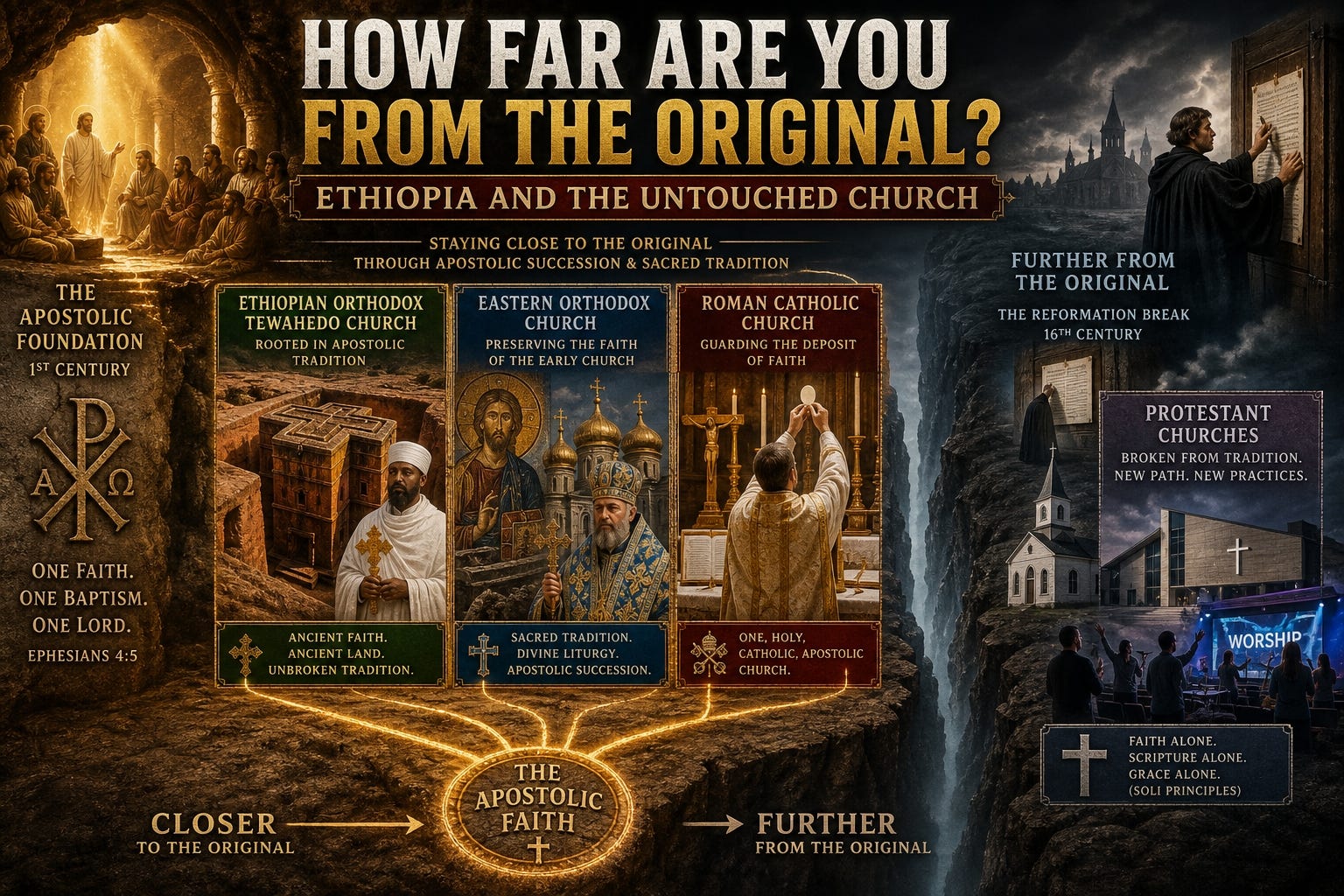
If you want to know how close your church is to the original, compare it to Ethiopia.
Not to Rome in the twenty-first century. Not to Constantinople after centuries of Ottoman pressure. Not to any church that has been through a Reformation, a counter-Reformation, a liberal revision, or a conservative reaction. Compare it to the church that was planted in Africa in the fourth century, that received its faith from Alexandria, that preserved its canon of eighty-one books intact, that has celebrated the same liturgy in the same ancient language for sixteen hundred years, that never removed incense or candles or the seven Sacraments or the veneration of Mary or the intercession of saints or the Real Presence of Christ in the Eucharist or auricular confession or the full number of books in its Bible.
If your church uses incense and candles in its liturgy, recognizes all seven Sacraments, believes in the Real Presence of Christ in the Eucharist, confesses to a priest, venerates Mary as the Mother of God, invokes the intercession of the saints, maintains Apostolic Succession, prays for the dead, uses a liturgical language with deep historical roots, fasts regularly, and reads a Bible with more than sixty-six books: you are close to what Ethiopia has preserved.
If your church does none of those things, or only some of them, you are further away.
The Ethiopian Orthodox Tewahedo Church did not choose to be a measuring stick. It simply never stopped being what it always was.
We keep fighting Jesus when we fight his Church, his Sacraments, his Bible, his Mother, and his Commandments. Ethiopia never stopped fighting for them. Ethiopia never stopped keeping them.
How far are you from the original?
The mirror is on the wall. Ethiopia put it there sixteen hundred years ago.
References Consulted
Ethiopian Orthodox Tewahedo Church. Official doctrinal publications on the Faith of the Church, the seven Sacraments, the canonical books of Scripture, and the Church’s fasting disciplines.
Encyclopædia Britannica. “Ethiopian Orthodox Tewahedo Church,” revised by Melissa Petruzzello.
EBSCO Research Starters. “Ethiopian Orthodox Tewahedo Church,” Religion and Philosophy series.
Catholic Near East Welfare Association (CNEWA). “Pentarchy,” and related publications on the historical patriarchates of the early Church.
Mahibere Kidusan (Sunday School Department of the Ethiopian Orthodox Tewahedo Church). Catechetical materials on liturgical worship and the Tabot, including “Liturgical Worship” and “Unique Features of the Ethiopian Orthodox Tewahedo Church.”
The Eastern Church. Articles on the Ethiopian biblical canon, including “Is the Ethiopian Bible the Oldest Bible?” and “Why the Ethiopian Bible Has More Books.”
Wikipedia. Reference entries on the Ethiopian Orthodox Tewahedo Church, the historical development of transubstantiation, and Eucharistic theology, used for preliminary orientation.
Comments
Nothing yet. Say the first thing.
Sign in to join the conversation.