
If you’re a marketer in 2025, AI is an unavoidable topic.
Every new product is powered by AI.
Every old product is incorporating a new AI feature.
Debates rage about if you should use AI and how you should use AI.
We love AI when it can turn us into viral action figures.
We hate AI when it makes stuff up that gets printed in actual newspapers.
Every LinkedIn post is touting the promise of AI as a cheap, effective replacement for programmers, administrative assistants, and even entire marketing teams.
Us human marketers will go the way of the dodo bird in the next 10 years.
Right? Wrong? No one can say for sure, but no one can ignore artificial intelligence or stop talking about it.
So why not kick off this newsletter by acknowledging the artificially intelligent elephant in the room?

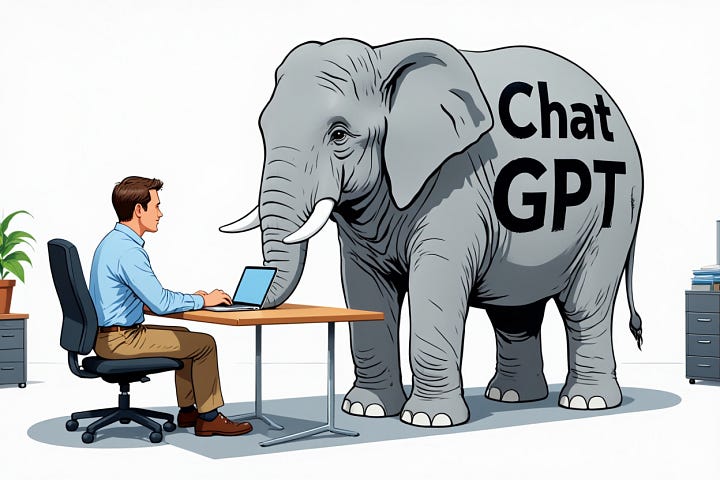
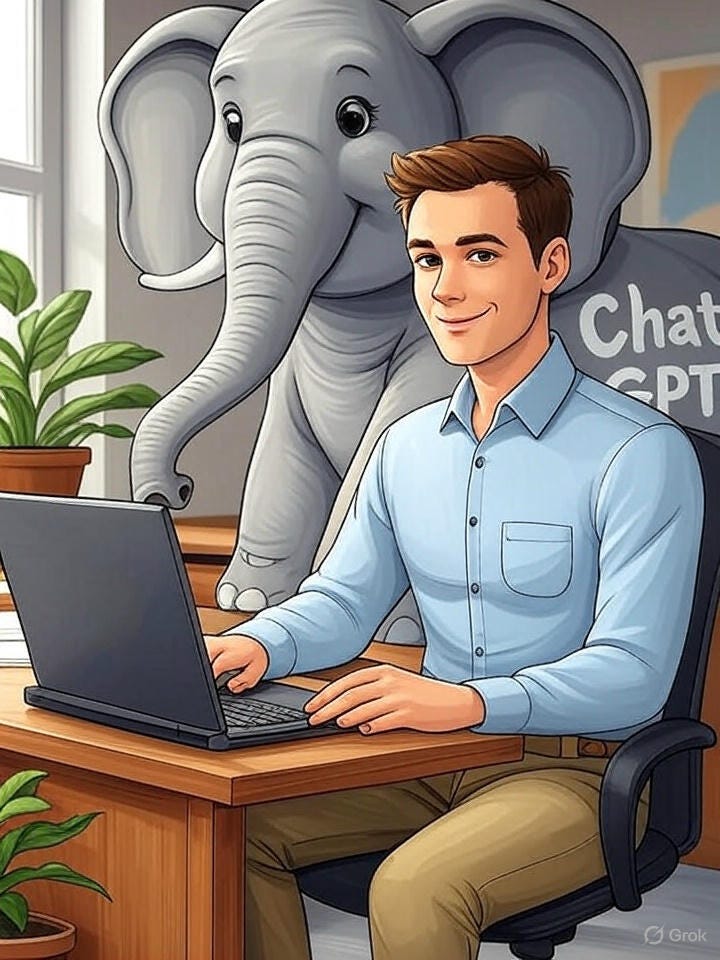
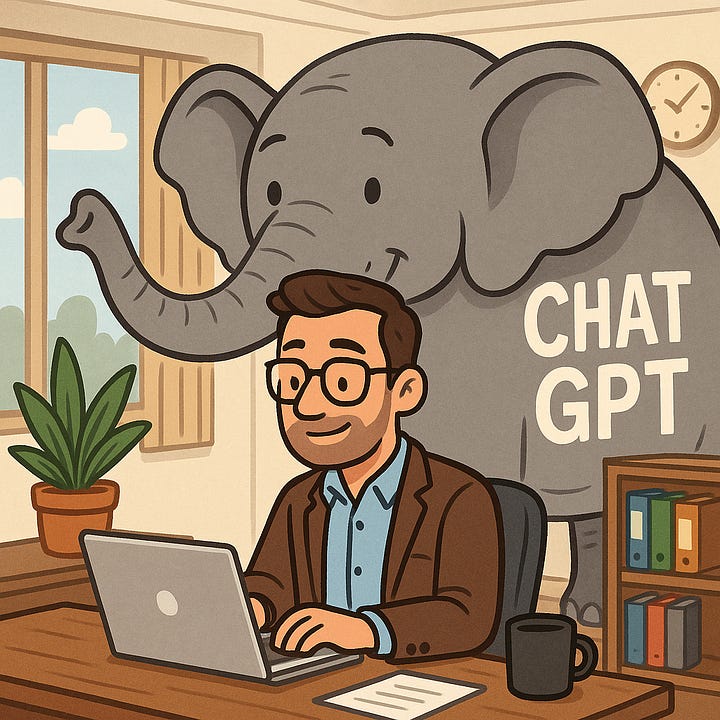
For starters, here is my current take on AI, subject to change as rapidly as AI technology does.
As a proud alumnus of the Medill School of Journalism,1 I was one of those people who went around saying things like, “The world will always need writers. If you can write, you’ll never be out of a job for long” and “If you need an effective marketer, hire a journalist” and “Never use an Oxford comma.”
Every day, advances in AI are further proving those statements wrong to some extent. (Well, not the Oxford comma one. Team AP Style 4 Lyfe.)
Sure, there are arguments about how you’ll always need a human touch and you will know they are robots by their em dashes,2 but this is more a problem of human nature.
AI is too easy and AI is good enough.
This might surprise you, but a lot of people don’t like to work hard. And the ease with which AI can cheaply produce endless digital reams of content is enticing to all those people, as well as to the hard-working folks who would rather give the busy work to AI so that they can work smarter on more important tasks.
Whether you agree with them or not, these values are already coexisting in the marketplace. The toothpaste has left the tube, and an increasingly larger percentage of the content we’re perusing everyday was touched by a robot.

I am today of the opinion that the world will always need creative, critical thinkers who can express ideas coherently and compellingly across a variety of media. For the moment, I think that criteria is relatively AI-proof in terms of holding on to a job.
But in order for that individual to stay AI-proof, they must integrate AI into their skillset and learn to wield it properly—in a way that enhances their God-given creativity and ability to communicate.
I have focused on trying to stay up-to-date on the literally daily advances in the field and try to play with any AI tool that floats ashore and looks like it could have any utility in my industry.
If you still have your head in your sand about AI, this is your invitation to come up for (ai)r. Don’t fear the reaper! Take him out for coffee.
With all the ink that’s been spilled over AI, I’ve seen very little discussion from Catholic marketers/fundraisers/communicators I follow about how they are actually, specifically using AI in their professional lives.
So here’s a rundown of some of the AI stuff that I have been experimenting with and how I use it.
It’s the OG. First it was answering your questions. Then it was making photos. Then it was making photos with custom text. Tomorrow it will be making dinosaurs out of frog DNA. By the way, it gets its powers from the frog DNA of all creators from all time across the Internet. Sorry!3
Aside from all the viral ways that people have used ChatGPT in recent months for various viral image sensations, I have found a few indispensable uses for it.
Coding. I have a client who uses custom HTML email messages that a different developer created. I know enough HTML and CSS to hurt myself, but when I want to change up the layout or something isn’t rendering properly, I drop it in to ChatGPT and it walks me through everything and provides the necessary code changes. Saves me hours. I was having an issue with one of my WordPress-powered blogs and ChatGPT rescued me there as well—talking me through how to disable a problematic WordPress theme on the backend so I could log into the frontend and disable it.
Editing. If I’m writing a marketing email, article, blog post, or anything else, I will often run it through ChatGPT and ask for suggestions. Is my point clear? How can I make it have a stronger CTA or be more compelling? Sometimes a phrase or angle will stand out to me and I’ll incorporate it into my finished product. Please note: I do this after I have already finished writing myself.
New angles and ideas. Sometimes you’ve been running a marketing campaign for months or you’re taking another stab at marketing an evergreen product. When the creative juices aren’t flowing, ChatGPT can be a perfect lubricant. Give it the product website and ask it for new marketing angles. You can do the same for blog post and social media post ideas. You can use it to power your own brainstorming without having it write everything for you. Think of it as talking to a smart colleague.
Play Devil’s Advocate. Have ChatGPT poke holes in your idea or tell you why something won’t work. You’ll be surprised what it can pick up on that you might not have noticed.
Job interviews. Paste the job description and ask for interview questions, regardless of which side of the desk you’re on.
Writing analysis. I fed in more than a decades’ worth of my writing from various blog posts and articles. I asked it to write a post in my style and it spit out a cliche version of my writing style. But then I asked it to identify patterns in my writing or ways it could be better and got a pretty decent checklist of things to look out for and crutches to stop relying on.
Armchair pyschologist. OK, the rest of these are just for fun, but after giving it all that data, I asked it to predict where I would be in 10 years and what issues I might be dealing with. It gave me a somewhat eerie look at where I might be in my career and, when I asked about the negative aspects of my future life, it spat back a list of insecurities I might be dealing with.
Celebrity roast. If you haven’t already, ask it to roast you based on all of your previous interactions. Then ask it to go even harder on the roasting.
Hodgepodge. Coupon codes for anything I buy online. Fun soccer drills for a first-grade team. Meal plans and recipes. Movie recommendations based on a spreadsheet of movies I love across genres. Topic for a speech based on my writing and what is an appropriate first-time speaker fee. Game night recommendations based on the number of people coming. Easy-to-play guitar songs featuring chords I already know.
For someone like me who is creative but not particularly artistic, the ability of various AI tools to generate the images and designs that I’ve always dreamt of is a game-changer. I’ve used these tools to design logos (like this newsletter, for one), create eye-catching hero images for blog posts, engage in all the inane viral trends that seem to catch on each week, and create images for my own amusement. The results are as good as your prompts and creativity can imagine.

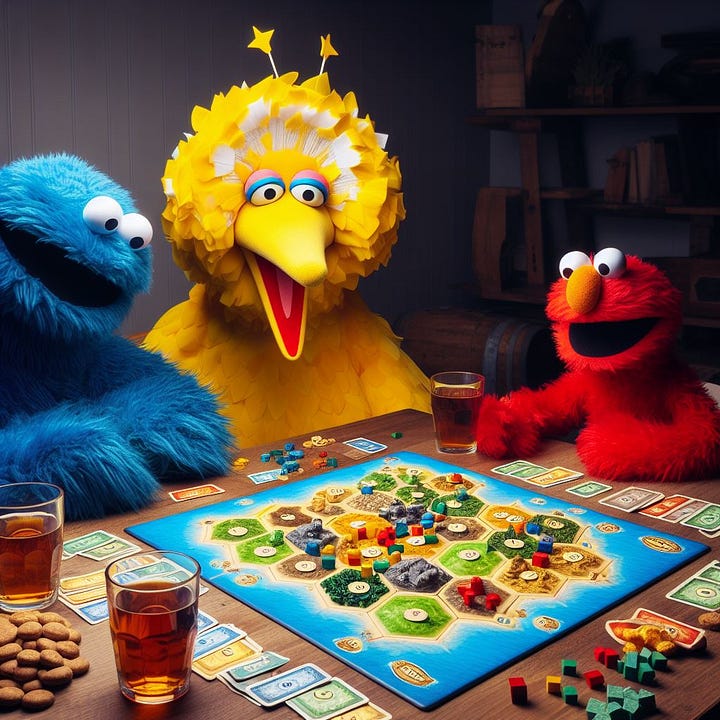
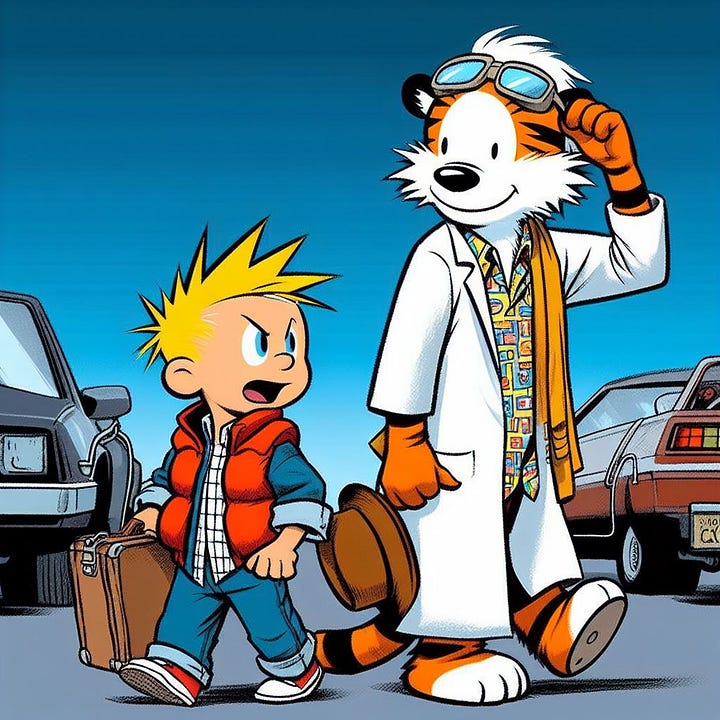

My favorite unique image creation tool is Playground. This platform provides a large array of templates to choose from for a variety of use cases and allows you to change the text, color, and style to fit your project. It’s nice to be able to start with something professional-looking without having to completely tweak a prompt to improve results. Perfect for logos and social graphics.
Another tool that requires a prompt but works well for generating actual text on images is Ideogram. This is a fun one to play with and even tweak other users’ prompts from the site’s gallery of finished images. Great for YouTube thumbnails and striking graphics like this one that I used on a LinkedIn post:

If you aren’t yet familiar with ElevenLabs, get to know it. This moves us into the deepfake territory of AI that is scary and already abusive, with people using the tool to make fake voice versions of real podcasters, combining it with video avatars using tools like HeyGen, and launching YouTube channels to make money using other people’s brands. It’s running rampant and it’s not cool.
While there are some legitimate use cases for these things. it’s way too cheap and easy to do this. Even with the free trial capabilities of those two tools, you could probably cobble something halfway decent together in less than an hour using readily available voice and video samples of other people.
Then there’s Google NotebookLM, a tool that mostly excels at synthesizing summaries of excessive amounts of data, documents, and reports, but most notably features an AI podcast that can be instantly generated to talk enthusiastically about the subject at hand. I generated one about a blog post that I wrote a long time ago, and it was very weird to listen to two non-existent people discuss my writing with such authentic-sounding enthusiasm.
On the other end of the spectrum is Suno, the hyperrealistic song creator, which I cannot think of a professional marketing application for, unless your marketing newsletter needs a theme song. Quick, craft a 1960s folk ballad called “The Catholic Marketer!”
0:00
-3:00
It’s slop, but it’s fun.4
For once, the Catholic Church seems to be trying to get out in front of new technology. When it’s something as potentially societally shifting as AI, that’s a reassuring posture.
Magisterium AI is a tool that answers questions about the Catholic faith based on Vatican documents and encyclicals—and seems to not make up answers.
Pope Leo XIV spent one of his first major addresses talking about AI as bringing about a new Industrial Revolution. I had not specifically heard it referred to in that way, but it makes a lot of sense and alludes to his understanding of the fundamental changes it could will bring about.
In our own day, the church offers everyone the treasury of its social teaching in response to another industrial revolution and to developments in the field of artificial intelligence that pose new challenges for the defense of human dignity, justice and labor.
I got a little carried away in this first edition, but I want to leave you with three podcasts related to AI for further inspiration and investigation.
How I AI
Hear from other folks in a variety of industries about how they are currently using AI tools to complete tasks from writing to personnel management to designing to vibe coding.
Shell Game
Technology reporter Evan Ratliff uses ElevenLabs to clone his voice and applies it to a variety of situations including customer support calls, spammer calls, talking with friends and family, and even a therapist. I’m about halfway through and it’s been an intriguing ride.
An Interview with the Herald of the Apocalypse
I confess I haven’t listened to this one yet, but it’s next up in my queue. This exchange between the New York Times’ Ross Douthat and former OpenAI employee Daniel Kokotajlo delves into the radical transformations that AI could pose in just the next few years. Perhaps alarmist stuff, but again, let’s keep our heads out of the sand.
Whew! Did you make it this far? I wrote a lot more than I intended (and cut even more things so I could actually just get this first issue out into the world), but I hope you read something that you didn’t know before or had a thought provoked.
Part of my goal for this newsletter is to inspire discussion—from those who are fellow marketers, from those with things to market, or just from interested parties who have opinions on these topics. A discussion takes two or more to tango though, so I hope you will engage in the comments below. You could also just respond to to this message privately if that’s your jam.
I’ll try to offer a couple specific questions at the end of these missives to stoke the fires of interaction. Let’s go!
How do you use AI in your role? How are you staying on top of new developments in AI, if you are?
What AI tools or resources do you use for work or fun that weren’t mentioned here? I’m always looking for new stuff to try!
Do you fear the AI reaper? What future are you envisioning right now with AI continuing to grow in its abilities?
Thank you for reading! I promise future editions won’t be this long!
Market on,
Matt
The Catholic Marketer
how long before they have an “AI Studies” program?
If that line didn’t put “They’ll Know We Are Christians By Our Love” in your head, I guess you’re not a millennial Catholic.
Seriously though, the ethics of what content is used/stolen to train AI tools is beyond the scope of this post, but it is disturbing. Either way, we have to learn to use AI tools. Taking an ethical stand against all AI will unfortunately still leave you in the dust right now.
This technology will have to improve a lot before I’m frequently tapping my foot to an AI-generated beat.
No posts
Comments
Nothing yet. Say the first thing.
Sign in to join the conversation.