
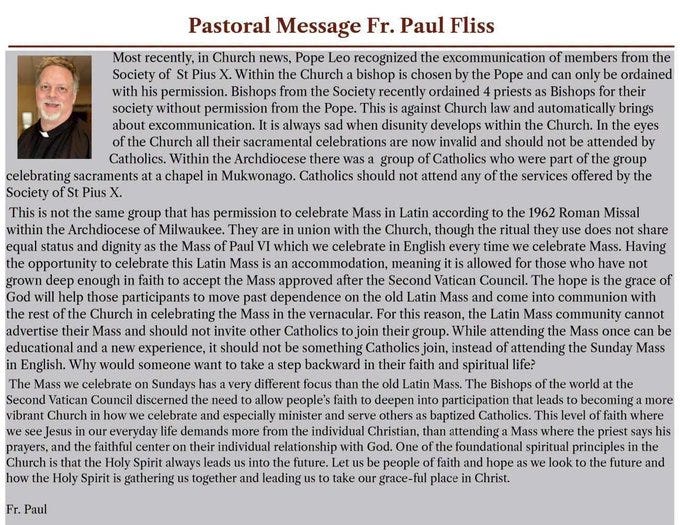
You can read the above post from Fr. Paul Fliss, of the Sheboygan Catholic Parishes in Wisconsin. As you can see, he allowed the Latin Mass to continue, however, he emphasizes the Pope Paul VI Mass also known as the Vatican II Mass. (Novus Ordo is a pejorative).
According to Fr. Fliss, the point of the Pope Paul VI Mass is to help Catholics deepen their faith through actively participating in the liturgy which leads them to minister and to serve others as baptized Catholics.
He explains this is a deeper faith than one can find in the Pope John XXIII Mass of 1962. In that Mass, the priest says prayers privately, the Mass is in Latin, which at one time was the vernacular and the people focused, as he says, on private devotions collectively.
You can imagine this led to a great backlash on social media. Among the comments is the usual clown Mass claim—as in [Novus Ordo] Masses are at times are clown Masses. For those who do not know, a clown mass is a Mass where the celebrant and the Mass servers and ministers such as lectors dress as clowns. I have been a Catholic for most of my 68 years in several states and countries and I never in my life actually saw a clown Mass.
One prominent Catholic blogger said I supported clown masses because he misunderstood my statement that I support clowns going to Mass. In Florida, there is a parish where many circus performers attend Mass as they live there especially in the off season. So, they are clowns, not in their “uniform” who go to Mass but that does not make it a clown mass.
The Pope John XXIII Mass has a culture commonly seen in social media in which Catholics listen to priests speak to them about sin and Hell. Parishioners take that as Catholic teaching. Many believe mortal sins are common, few are saved and missing Mass once can end someone in Hell for all eternity, if they got hit by a bus. I suspect that is more part of the American culture surrounding extraordinary form.
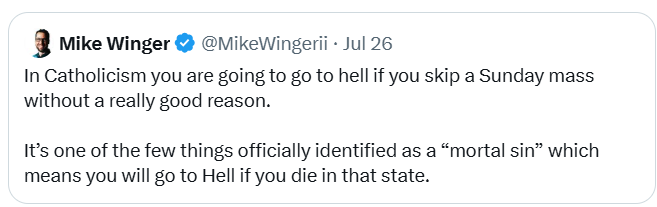
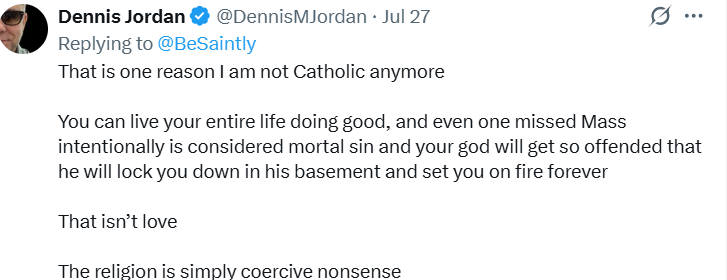
This is not Catholic teaching and never was. However, many understand it to be what the Church actually teaches and many priests preach it as if it is actual Church teaching. Clearly there are mortal sins, the term has its origin in the 1John.
All that is iniquity is sin. But there is a sin unto death. (1 John5:16 CPDV)
For the record St. John does not define what that sin is. What I would guess it is an obstinate attitude of rejecting God’s grace unto death, which is also backed up by Catholic teaching.
All over Catholic social media, you can read or hear of sins that will cast you into Hell. This is especially true in traditionalist accounts. There are no sins that casts you into Hell. What causes someone to go to Hell is an obstinate refusal to repent to your dying breath. So, obviously, there are sins that are gravely serious but it is not the sin that condemns you to Hell. It is the refusal to repent because you love the sin more than God, that is idolatry.
Besides reading the Catechism on Hell, you can not do much better than reading Pope St. John Paul II’s catechism on it from July 1999. The previous week, he preached on Heaven and the week after he preached on Purgatory. All three are excellent teachings, obviously.
If you understand what Jesus did in order for you to be saved, how does that idea that it takes little for one to be condemned to Hell make sense? I would venture to guess this is more common now in Extraordinary Form communities, especially in the United States than it was in the 1800’s. Of course, you can also find it in some Pope Paul VI Mass communities. In either case, it is important to learn what the Church actually teaches instead what Fr. X or Dr Y or University B teaches.
I can speak as one who gives the Sacrament of the Sick and Last Rites regularly as part of ministry to two hospitals. God’s mercy is always reaching out to bring salvation to all who seek it.
Remember, part of the Last Rites is the Apostolic Pardon, usually given to those patients whose death is imminent. Special note: do not let anyone deny the priest from giving you the Last Rites if it is your will to receive them.
The Pope Paul VI Mass teaches Catholics to be more familiar with scripture and to build on strong personal and liturgical prayer. Our true goal in either Mass is to eliminate obedience out of fear of Hell and embrace living out of love for God and loving neighbor after all, that is what fulfills the law. We can also focus on understanding God’s love for us as we seek to deepen our love for Him.
One way this happens is through the change in reading cycles. The Sunday cycle of readings in the Pope John XXIII Mass lasts only one year—52 Sundays and the additional holydays. In the Pope Paul VI Mass there is a three year cycle of readings. Daily Masses have a two-year cycle in the Pope Paul VI Mass and one in the Pope John XXIII. This is because the Pope Paul VI Mass emphasizes the Word of God AND the Eucharist. Whereas the main emphasis in the Pope John XXIII Mass is specifically the Eucharist. The readings are proclaimed in Latin. The Gospel is proclaimed in English only after it is proclaimed in Latin, as I remember from the pre-Vatican II days.
The reason for these rubrics is obvious; many were illiterate in the Sixteenth Century and so the visual was more important than the written word as the Eucharist was better understood for its presence without a recourse to words. Stained glass windows taught the faith to the illiterate who could meditate upon and appreciate their message.
Neither Mass should lead one to deepen their faith more or less than the other but the culture surrounding the Latin Mass can be one of obedience, fear and a loss of sense of what Jesus did for us at the behest of the Father.
As one man told me from the generation born between the two world wars, “We didn’t learn this God is love stuff, we learned that God was to be feared.” Later the same man indicated he believed in reincarnation because one could not possibly be good enough to get to Heaven in one lifetime. This is a whole complete misunderstanding of the Catholic message.
The Pope John XXIII Mass includes a sermon by the priest and the Pope Paul VI Mass includes a homily. What is the difference? A sermon is a talk during a Mass focusing on a religious or moral topic, it can have no relation to the readings whatsoever. A homily focuses on a teaching based on scripture at the Mass or even the prayers. So, a priest can use the sermon to teach anything on scripture or morality, etc., at the Pope John XXIII Mass. The priest or deacon should use the homily to teach on faith and morality rooted in the scriptures or prayers at that Mass. If you read my homilies posted here, you will notice I do that exactly. By the way, I research my homilies every week using Verbum (not a paid endorsement) which is great Catholic software from Logos to do great research for writing a homily.
Many will claim that the Pope John XXIII Mass is the one we should use because it is the ancient Mass that all Catholics celebrated since the time of the apostles. That is actually not true. That Mass built on the liturgies over the centuries was formalized to ensure that variations common at the time were removed and the uniform Mass in Latin was the standard. The reason was in response to the confusion created by the Protestant Reformation. So, the focus was on helping people to understand what the Church actually teaches and to strengthen the faithful in light of the surrounding actions by Martin Luther’s followers, et. al.
Let us take an example: If you listen to many traditional Catholics, you will learn that the worst of all sins are sins of the flesh. However, St. Jean Vianney taught that among the worst of all sins is detraction which is speaking ill of another, even if it is true. The internet traffics in detraction but rarely is that sin mentioned today in Catholic circles. This would make cyberbullying one of the worst of all sins, yet, how many on social media practice cyberbullying. Even more so, how many priests preach against it. In Massachusetts, it is a crime and if cyberbullying leads to grave actions such as suicide, it is a felony. In other states it is not even a crime, even if it leads to the suicide of the cyberbullied which it has in some cases. However, it is still a grave sin regardless of outcome.
Fr. Fliss highlights that the two liturgical traditions come from two different cultures and two different views of Catholic teaching, tradition, salvation, sin and God’s mercy.
He is resolving the current rift by strengthening the ordinary form and de-emphasizing the extra-ordinary form. That is the most practical solution at this time, at least until both cultures and get on the same page.
However, those who want to have a more reverent liturgy and only go to the Pope John XXIII Mass take their voice for a better liturgy away. In fact, building strong liturgies with the Pope Paul VI Mass has been requested from the Vatican for sixty years. If the deeper participation of the Ordinary Form mixes with the more focus on reverence of the Extraordinary Form, you may see something that brings more unity between the two sides and builds a more reverent Mass.
In my last parish, I was asked to have guitars at Mass by the older people who attend. I love them, however, I knew that was more from my generation and not what Catholics wanted to have today, so I said no and we continued with more traditional music. I even brought in chanting the responses including the Our Father and the people chanted their parts in the responses which sounds wonderful. This is taking the desire of those who prefer the Pope John XXIII Mass reverence and bringing it to the Pope Paul VI Mass.
So, those who are upset by Fr. Fliss’ column may serve the Church better by asking, how can we bring what we love in the Pope John XXIII Mass into the celebration of the Pope Paul VI Mass, after all that is the ordinary form.
Fr. Robert J Carr is the chaplain for two hospitals in Brockton, MA
His Patreon Page is patreon.com/catholicaudiomedia
He podcasts at Catholic Audio Media Podcast |
He is the author of several books including: Christ in Your Humanity

No posts
Comments
Nothing yet. Say the first thing.
Sign in to join the conversation.