
“To converse with one’s friend is the highest characteristic of friendship.”—Thomas Aquinas
In Fall 2023, I joined several American writers on a “Truth and Sacrifice” pilgrimage to England. Our journey’s title was not about us, but the British Catholic recusants, martyrs, converts, and writers who paid a price for their faith. Having crammed a summer’s worth of Thomas More, Edmund Campion, John Henry Newman, Gerard Manley Hopkins, and J.R.R. Tolkien, we spent a week in a whirlwind of walking tours, visits and lectures on the Tyburn tree, Newman’s all-night confession, Hopkins’ dark brightness, Tolkien’s inspirations from the Oxford Blackfriars chapel, and gallery tours at the V&A and the National Gallery. The trip was glorious and convicting, and yet…
And yet, at the end of our trip, what could we take home from it all? Exactly what does it mean today to be a Defender of the Faith, like More? Or to be hunted down, like Campion? How could we possibly imitate their sacrifices, we pilgrims who had done more feasting than fasting?
Pilgrimages, like retreats, promise to stir the unfaithful and fortify the faithful. How could we sustain our “Truth and Sacrifice” high? Our shared photos helped. So did a Newman prayerbook and rosary from Littlemore. But I still thought I needed something—a thing—that might stir my courage to bring truth back to my suburban home and parish.
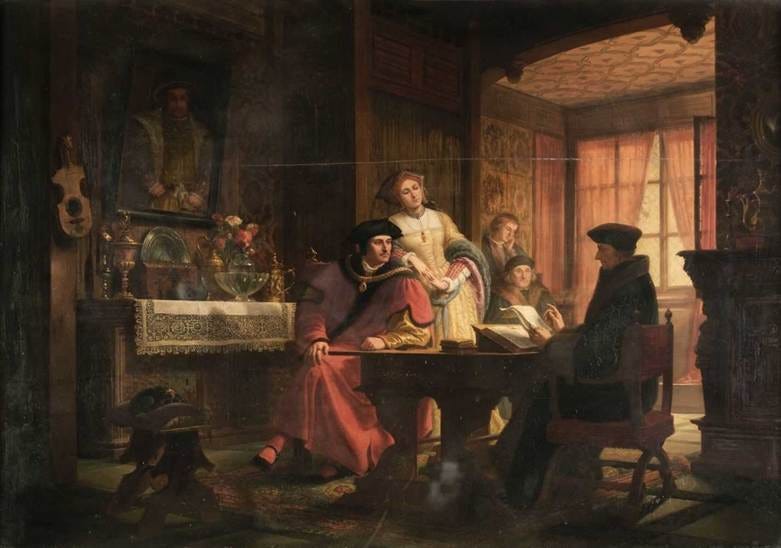
Before leaving London, I bought Eamon Duffy’s history of the Reformation, The Stripping of the Altars, to keep the “recusant’s spirit” alive in me. Back home, however, my bid to keep my “Truth and Sacrifice” high quickly moved from a £17 paperback to a £1,500 painting. There it was, online at a Cotswold auction house: Pierre-Antoine Labouchère’s oil on wood panel, “Erasmus Reading His Poems at the House of Thomas More.” Here was the souvenir I needed: England’s most famous martyr on my wall, in living color.
I viewed it virtually via the online catalog titled, “British & European Paintings, Old Master & Modern Works on Paper, Pictures from Beeleigh Abbey.” This More hardly resembled the man brought to life by our spiritual guide, an Oxford Dominican, as he recited More’s “Psalm on Detachment” in his drafty Tower of London cell: “Give me thy grace, good Lord: To set the world at nought…” Labouchère revealed a different More and family, pre-Oath of Supremacy. Here was a relaxed Sir Thomas, with cherished daughter Margaret Roper, tenderly leaning on her father’s shoulder while he gives full attention to his Dutch friend and houseguest, the irascible monk, Desiderius Erasmus.
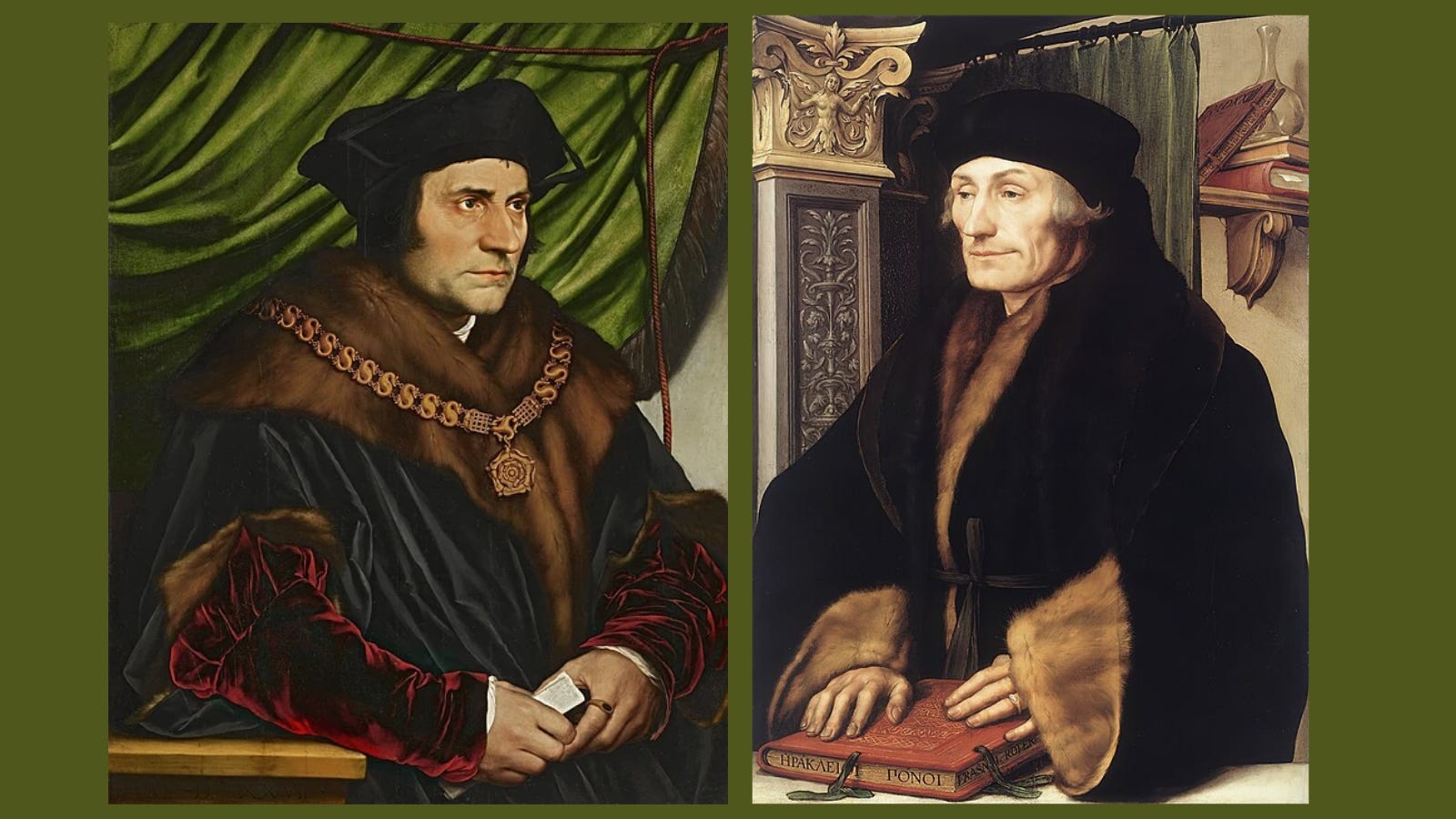
Unlike Hans Holbein’s masterpiece, Labouchère’s painting shows no photorealist stubble, distant stare, or sumptuous velvet, but a youthful and debonair More. On the wall above hangs a shadowy portrait of his liege, friend, and employer, King Henry VIII, looming over his chancellor. More’s stolid, weighty pose, juxtaposed with his red-stockinged ankle and velvet-buckled shoe, foot slightly turned up, reveals the pleasure he takes in his friend’s companionship and further endeared me to this painting.
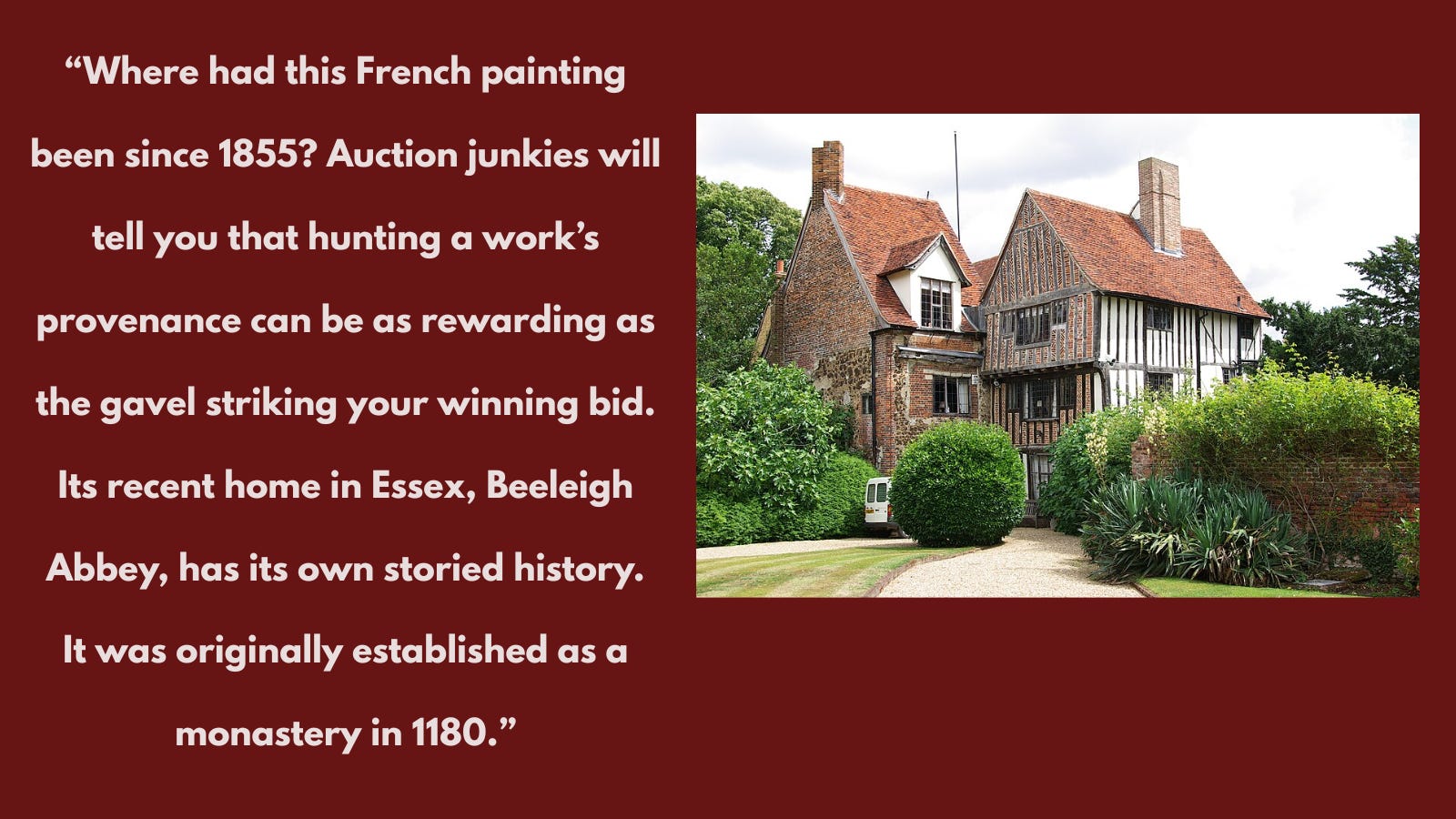
Where had this French painting been since 1855? Auction junkies will tell you that hunting a work’s provenance can be as rewarding as the gavel striking your winning bid. Its recent home in Essex, Beeleigh Abbey, has its own storied history. It was originally established as a monastery in 1180.
After the Reformation, it fell into private hands and eventually into disrepair. In 1943, it was acquired and restored by famed bookseller William Foyle; his grandson and recent owner Christopher Foyle was featured in Country Life magazine, with the headline: “Beeleigh Abbey: An incredible medieval house that’s barely altered since Henry VIII’s Dissolution of the monasteries.”
How fitting. This nineteenth-century tableau of St. Thomas More had for decades hung in one of the only monasteries to survive a sixteenth-century iconoclastic movement hellbent on wiping out the practice of Catholicism and all art related to it!
Erasmus and More frequently exchanged letters of praise and affection, along with reports on their scholarship and literary hijinks. Once asked to pen a “picture of More at full length,” Erasmus responded in a now-famous letter that heaped the highest praise on More. “He seems to be born and made for friendship,” he wrote, “of which he is the sincerest and most persistent devotee.” Labouchère’s painting is a portrait of friendship in the calm before the storm of the English Reformation.
So, did I get the painting? Not exactly. The potential shipping costs and reservations about the painting’s condition led me to pass. But when I checked the day after the auction for the sold price, the painting was unsold. Oh dear. Perhaps I might secure a post-auction bargain. That same day I was having lunch with a friend who had once been a serious art collector. I showed her the painting and told her all about the Foyles. Maybe, I mused, I should put in a post-sale offer. “I’ll buy it!” she said immediately. And so she did.
Back to my pilgrimage. At my journey’s outset, I knew only one of the fifteen fellow travelers. Upon landing in Detroit, my phone buzzed with a notification that the flight to London was delayed. I panicked that I would miss the bus north to Stonyhurst College, the beginning of the pilgrimage. Then came a text from the only other pilgrim on that flight: “I’m at the Chinese joint across from the gate reading a book about Thomas More.” I like this person already, I thought. Good thing—we spent the next 30 hours together, grazing all day at airport lounges, before belatedly joining our fellow pilgrims at Oxford. To start the trip with a new friend was a nice silver lining to an otherwise maddening delay.
At week’s end, we celebrated new and old friendships at a grand London pub. Our spirits soared. In that same letter referenced above, Erasmus wrote of his dearest More, “He talks with his friends about a future life in such a way as to make you feel that he believes what he says, and does not speak without the best hope.” That was what we pilgrims shared as we went around the table that magical London night—“the best hope.” Is that what we would be bringing back?
Pilgrimages, like art collecting and traveling, can be ruined by an acquisitive spirit. We can be so determined to “get something out of it”—to make a million spiritual goals, or jam something from the gift shop into our suitcase—that we miss the graces of the thing. The painting brought me to my senses. It was time to jettison the need to own or to “cram” everything into my head or my baggage or prayer life. It was time to read “Psalm on Detachment.” I didn’t need the painting, after all, and now I have visiting privileges. It’s not about having a piece of art on my wall. It’s about fidelity and friendship: More’s to his family, his friends Erasmus and fellow martyr John Fisher, his God, and, yes, even to his king. And mine to my fellow pilgrims and our guides. Mine to my dear friend, a Protestant, who bought it to delight me and have friends around her table to talk about the friendship of two sixteenth-century Christians. Now there are souvenirs worth treasuring.
A version of this article appeared in the print edition of The Catholic Herald.
Comments
Nothing yet. Say the first thing.
Sign in to join the conversation.