
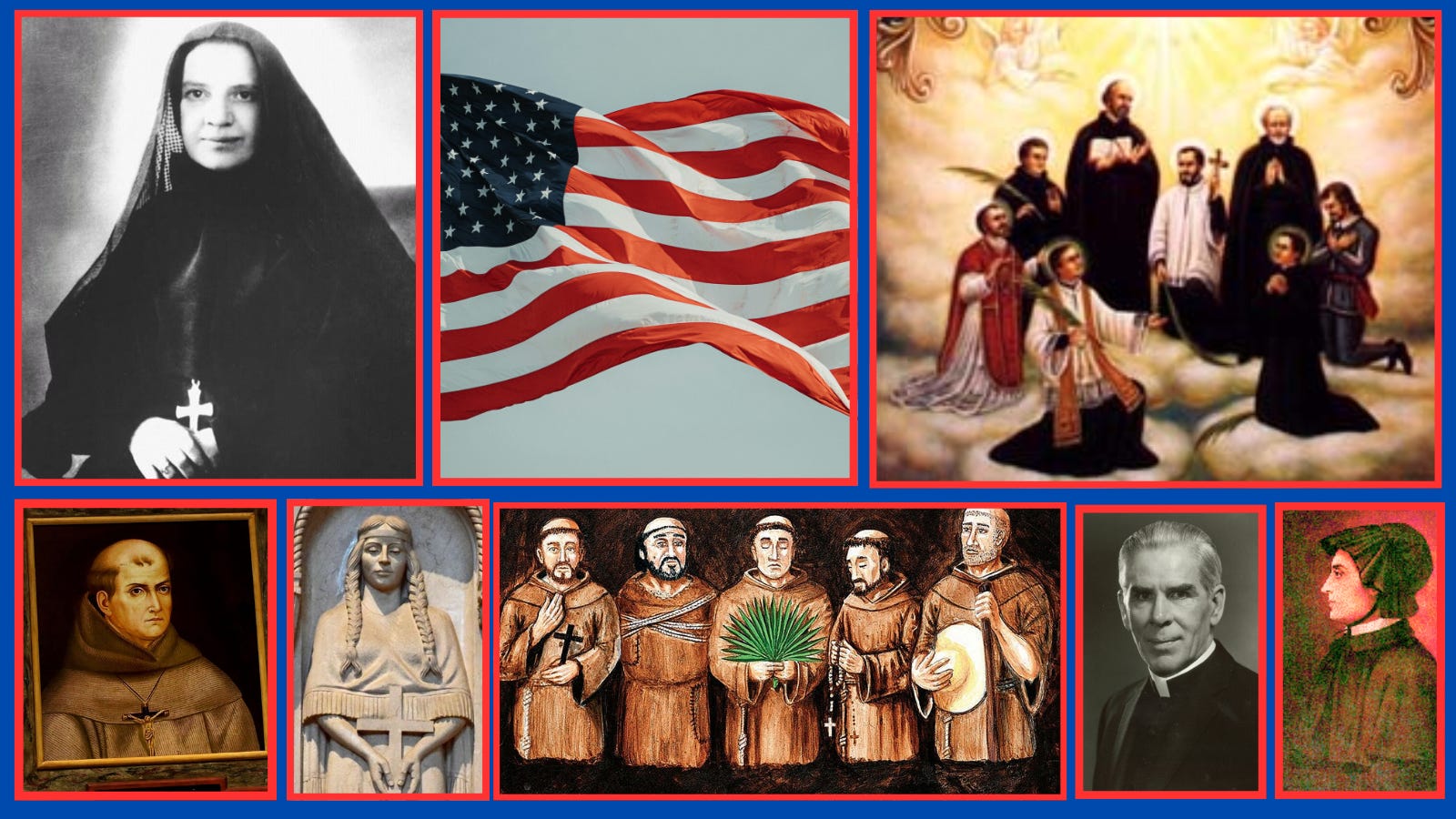
As we mark our faith and America’s 250th anniversary—the Semiquincentennial—we were joined on this week’s Conversations with Consequences by Monsignor Roger Landry to discuss the crucial role that the Catholic Church played in the building of our country.
And while we started our conversation about America’s history in Boston, he reminded us that the Church’s early efforts spread far beyond Massachusetts:
“Precisely for religious liberty purposes, when we look at the Catholic origins of the country—it’s always super important for us not to just focus on the Northeast,” Landry said, adding that while we can clearly do that “in the state of Maryland, for example, with the Carrolls, we have to look to Florida, where the first Mass would have been in the diocese and city of St. Augustine, where the Franciscan missionaries had landed, and the faith was planted there.”
He went on:
“We likewise have to remember what Saint Junipero Serra did on the West Coast of our country, coming up from Mexico and founding all of these missions to spread the faith there,” Monsignor Landry said, noting that most of Serra’s evangelization efforts predated the events commemorated during America’s 250th anniversary celebrations. He continued: “And then we’ve got the work of the North American martyrs coming down from Canada, three of whom died in upstate New York—St. Isaac Jogues, St. Jean de Lalande, St. René Goupil—and St. Kateri Tekakwitha. This was over a hundred years before the Declaration of Independence.
“And so there really is a Catholic history here that often most Catholics don’t know. And we need to be proud of that; we started to lay the groundwork for what eventually would become the United States of America through the prayers that were made by the first Catholics, through the sacraments that were celebrated, through the witness, and even through the blood of the first Catholics on these shores.”
He pointed out that soon we will be celebrating the beatification of a much more modern American saint, Fulton J. Sheen, on September 24th, but also, on October 31st, the Franciscan martyrs of Savannah, Georgia, who died in 1597.
Though they may not be well known, he continued, “their blood, the blood of the North American martyrs, the prayers, the efforts of all of the first Catholic saints, have had an important role in the flourishing of Catholic faith in our country after the Declaration of Independence, and particularly over the course of these last 150 years—when the Church was organized enough to be able to make a real contribution to the flourishing of our country.”
Seton, Neumann, and the Making of Catholic Education
One of those key contributions, he argued, was the building up of the parochial school system, forged amid strong anti-Catholic bigotry.
“At great personal sacrifice,” he said, many families and communities “built Catholic schools before they even built their Catholic parishes, so that their children would be able not just to learn how to read and how to write and how to add and subtract, but so that they could learn their Catholic faith well. And so, we developed the greatest Catholic school system in the history of the Church in any country.”
He pointed to St. Elizabeth Ann Seton, the first American-born citizen to become a saint, as a pioneer of education in America, especially for girls. He also drew our attention to Saint John Neumann, the fourth bishop of Philadelphia. “He really built up the Catholic school system there such that the Archdiocese of Philadelphia’s Catholic school system was the greatest in any diocese in the history of the Church, and it still is really formidable. That’s what allowed the Catholic Church to really grow.”
He continued:
“Because so many different women’s religious communities and male religious communities were working in Catholic schools where they had an opportunity, not just to prepare Catholic students for excellence in different fields, but also to integrate their Catholic faith into whatever their profession would be. And so Catholic schools are a super important part of the history of the Church in our country and something that’s made the United States much stronger.”
“And it’s something we can’t take for granted.”
Mother Cabrini and the Catholic Hospital System
Another Catholic contribution so many do take for granted is the Church’s integral role in the American hospital system such that, today, one in six hospital beds in America is found in a Catholic hospital.
Monsignor Landry credits St. Frances Xavier Cabrini for her tireless efforts in hospital work, especially for the poor. “She needs to be known by every American Catholic,” he stated.
“Her tomb is in New York City. I visit her place often, and I’m always taking Catholic visitors to go and pray at her tomb. She was a huge problem solver when she came.”
Sent by Pope Leo XIII, she “found Italian immigrants in great squalor. They were really suffering. There were 200,000 Catholic Italian immigrants here living in ghettos. And she came [and founded] an orphanage for the kids who were living off the streets. That was an immediate need. Out of that, she started to found a school system. Out of that, she started to build hospitals, because people didn’t have the money or the resources to be able to go into the hospitals that were founded elsewhere.
“She never planned to form a religious community that could run all of these types of things. She was just trying to respond to what God was asking in the moment with regard to their needs.” And how she responded to the call! She founded 67 schools, orphanages, and other social service institutions in Italy, the United States, and other nations.
“Whatever was needed,” Mosignor Landry explained, “she sought with her community to provide. “And so, she fit in very well with American culture,” he said. “Because American culture has always been entrepreneurial. And she’s one of the greatest entrepreneurs in the history of the Church.” She belongs in what he calls “The Hall of Fame of American Saints.”
Immigrants: Salt of the Earth
We ended by touching on immigration.
“So much of the American story is immigration and people who came through Ellis Island, and both the religious who served and the people that they served,” Landry said. So many, he continued, “were greeted by the Statue of Liberty.”
“They built up strong parish structures which strengthened the cities. With education, there was upward mobility. And then there was huge patriotic love on the part of Catholics. Catholics became involved as the police officers keeping order, as the firemen to make sure that places weren’t going to be destroyed, eventually founding universities and serving in our military.
“Catholics volunteered in great numbers out of love and gratitude for our country. And so, they strengthened the main institutions of our country that have allowed us to flourish. And likewise, it’s unsurprising that eventually Catholics were running for and serving us in public office.”
The faith, he posits, was built up here by Catholics motivated by the notion that they “were not going to keep their faith to themselves,” but rather “were summoned by Jesus himself to be the salt of the earth, the light of the world, a leaven that lifts all society up. Catholics took that seriously, and their formation in the faith overflowed their parish boundaries into the neighborhoods, into the cities, into the states, and into the nation that they called home.”
“We Catholics have received a lot from this country,” he said in conclusion.
“And so as we celebrate, it’s great for us to be grateful for the Catholic saints, to invoke their intercession so that we can follow in their footsteps [and] in their continued prayers, that our country be able to live up to all the hopes and the dreams of those who over the last 250 years have called this place home.”
God bless America.
Comments
Nothing yet. Say the first thing.
Sign in to join the conversation.