
[Preface: Undergraduate Sophomores were given the essay prompt to write “on the meaning of faith in Christ” according to Saint Paul and as explained by Romano Guardini. They were to emphasize “justification by faith” and use William Marshner’s work on justification as a guide. This essay was selected to share with the Substack audience as it beautifully and seamlessly moves into discussion of deification and this Substack is dedicated to evangelization on the topic with emphasis on Catechism of the Catholic Church #460. My special thanks to Nicolas J. Alvarez for being willing to share his essay.…]
Within the Five Solas of Reformed Protestantism, sola fide and sola gratia claim that men are saved by faith and grace alone and they say that any sort of good works exhibited by an individual are “symptoms” of such faith and grace.[1] They believe Catholics think that the salvation of one’s soul can be merited through the works that one does in their life, even apart from faith in Christ. The roots of this Protestant misunderstanding come from their extrinsicist position on justification, meaning that grace and faith come upon the soul but do not inhere, whereas the Catholic Church teaches justification from an intrinsicist position, meaning that grace and faith come into the soul as a new source of action and new life.
While many Catholics are correct in clinging to good works as vital to one’s salvation, as will be argued later in this paper, it has become the case that in the Catholic attempt to distance themselves from the Protestant solas, many no longer recognize the extent to which faith and grace work in our salvation. As former Lutherans, Romano Guardini and William Marshner can help refine one’s understanding of the importance and reality of faith. The Catholic understanding of “faith in Christ” is the experience of a new divine reality, where man can seek elevation and interior transformation through works of charity, not works of the law. By this transformation man can grow in divine sonship and partake in the promises of Abraham.
Faith in Christ is what separates Christianity from Judaism. For the Jews, righteousness was derivative of culture, customs, and race. With the coming of Christ, He tried to elevate man away from these temporal distinctions and focus on an interior transformative reality. St Paul warns the Jews against relying on their heritage, telling them that “not all who are descended from Israel belong to Israel.”[2] This means two things: first, that to be a child of Israel does not demand Abrahamic blood, and second, that there are law-abiding ethnic Jews that no longer belong to Israel as intended by God through His covenants. This is consistent with the warning that John the Baptist gives in the gospels. He tells them to “not presume to say to yourselves, ‘We have Abraham as our father’; for I tell you, God is able from these stones to raise up children to Abraham.”[3]
The warnings against attributing race to salvation are accompanied by those concerning the cultural practices of the Jews [of Paul’s times]. This concern comes up in Galatians, where the “Judaizers” are telling Christians that their salvation requires adherence to the ceremonial laws, like kosher laws and circumcision. Paul again denounces them telling the Galatians that “in Christ Jesus neither circumcision nor uncircumcision is of any avail, but faith working through love.”[4] Paul is making it very clear that race and customs do not guarantee one’s salvation and then he then makes his strongest statement that “a man is not justified by works of the law but through faith in Jesus Christ.”[5] This idea defines much of Catholic theology. The idea that salvation is an interior godly transformation through Christ, which was indicated in the gospels that “to all who received him, who believed in his name, he gave power to become children of God.”[6] This focus here is on a given interior transformation that allows for the Kingdom of God to be spread to those who are not of the line of Abraham. Thomas Aquinas affirms this idea of spreading God’s sonship, when he notes that “although they were not related to Christ according to the flesh, i.e., according to race… yet they were united to him through the Spirit and thereby adopted and made sons of God.”[7]
However, this τέλος of faith in Christ is not a new promise, but rather the matured and fulfilled Abrahamic promise, which is the divine sonship of which John and Paul speak. Paul tells the Galatians, “in Christ Jesus you are all sons of God, through faith.”[8] He then links this divine sonship to Abraham’s inheritance when he says that “if you are Christ’s, then you are Abraham’s offspring, heirs according to promise.”[9] The promise that Paul is referring to is the last of the promises that God made to Abraham, that “by your descendants shall all the nations of the earth bless themselves.”[10] The divine sonship that man attains from a life in Christ is the fulfillment of this promise God made to Abraham, and this promise is new life that goes beyond the old law.
No more are the children of Israel of one lineage and merely promised earthly territory, for now they are called to inherit something far greater than the old restrictive law could ever offer. Instead, this new law is empowering and liberating, and it sets man “free from the law of sin and death.”[11] Those who follow Christ are called to the new “law of God’s life-giving spirit.”[12]
This interior development in the Abrahamic promises is prophesied in Jeremiah where a new law is mentioned. The Lord says He “will put my law within them” and “will write it upon their hearts.”[13] With the indwelling of the Spirit, there is a newfound strength to, as Scott Hahn puts it, “prevail over the law of sin and adhere to the law of God.”[14] Since man receives sonship through faith, and the nature of this sonship is participation in the new law, this means that by faith man can receive the strength and life of the Lord inside of him and live life in a new way.
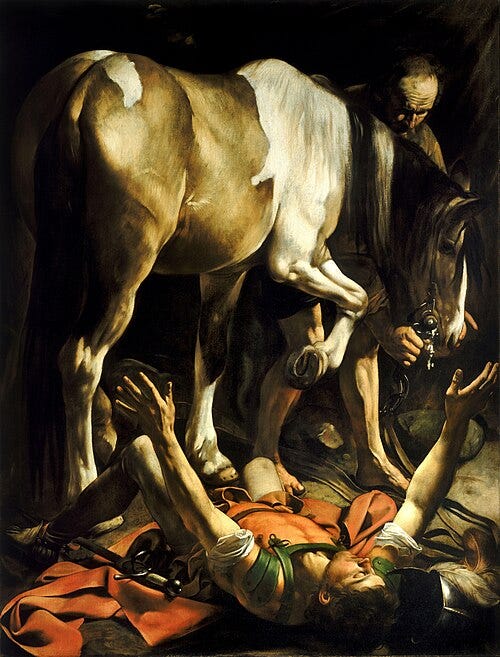
Caravaggio’s Conversion [of Saint Paul] on the Way to Damascus. Public Domain via Wikimedia Commons.
However, this new way to live life seems to be dichotomous. Paul notes that “if Christ is in you, although your bodies are dead because of sin, your spirits are alive because of righteousness.”[15] In living this new way of life, those of Christ might have a vibrant spirit but still a mortal body, for in this life man has, as Scott Hahn puts it, “one foot in the realm of Adamic mortality and one in the realm of messianic salvation.”[16] But the life that is given by faith in Christ serves as a “down payment toward our final victory over death” and is something to help man hope for the righteousness and beatitude that he will participate in by the grace of God in the new law of the heart.[17]
Following this new law is very important and one who has received this calling cannot remain in the old law. As Saint Paul says, no one who relies on the law is justified before God, because “he who through faith is righteous shall live.”[18] Faith in Christ is not only an expansion on God’s promises, but it is also the means of his salvation. Of itself, the ceremonial law did not sanctify[19] and so it needed the fulfillment that is offered by the gift of faith in Christ.
St. Paul’s understanding of faith also gives a better understanding of the old law as opposed to the new law of Christ. If the old law did not actually cleanse from sin,[20] then what role did it play? Paul says that the law “was added because of transgressions.”[21] He uses the word “custodian” to describe man’s relationship with the law, saying that “the law was our custodian until Christ came, that we might be justified by faith. But now that faith has come, we are no longer under a custodian.”[22] Living life according to the old law, meaning the ceremonial Jewish laws, was never the primary goal. This is made obvious when examining the history of the laws, because most of them result from some transgression that the Israelites made against God.
In Torah, the Levitical codes come as a result of the idolatry of the golden calf. The Deuteronomic laws come from Israel’s fornication with the Moabites. These custodial laws were meant to help God’s people remain clean through physically distancing themselves away from the people and evils of the pagan world they lived in. However, these laws are not what God ultimately wants for his children.
Paul expands on the nature of man’s relationship with the law, when he says that “all who rely on the works of the law are under a curse.”[23] The word curse might seem strong, but it is not saying that the people are cursed, but he is emphasizing that the way they lived their lives was so reckless, that it demanded they be held under tight restrictions. Elaborating on this topic, Aquinas says that one can be under the law in a way which “denotes oppression,” as opposed to mere “observance.”[24] Aquinas says that Christ was only under the law in the latter case for in the former “one is said to be under the Law if he is oppressed by fear,” but he notes that “neither Christ nor spiritual men are said to be under the Law in this way.”[25] This fear is one of terror and not of just reverence due to God. With faith, the custodial fearful relationship between man and the law can be abandoned and instead we are called to live out a new life as sons of God.
This new life is only possible because of Christ. Paul wrote that “God has done what the law, weakened by the flesh, could not do.”[26] This new life is a spiritual calling leading man closer to God. There is a separation like in times before, where the ceremonial laws kept the Israelites away from the evils of pagan culture. However, in this case the separation comes down to perspective, where “those who live according to the flesh set their minds on the things of the flesh, but those who live according to the Spirit set their minds on the things of the Spirit.”[27] This is the new way in which man can seek justification by avoiding a life focused on the flesh and instead focus on living according to the spirit.
This spiritual righteousness comes from the divine outreach to man, for Paul says “if the Spirit of him who raised Jesus from the dead dwells in you, he who raised Christ Jesus from the dead will give life to your mortal bodies also through his Spirit who dwells in you.”[28] This matches what Christ said to Nicodemus, that “unless one is born of water and the Spirit, he cannot enter the kingdom of God.”[29] It is not only true that Christ has brough this new life, but also that it is by his power alone that men can hope in true salvation.
Insights on Faith in Christ from Romano Guardini
In his book, The Lord, Romano Guardini heavily emphasizes that faith is something that allows for deification. The difficulty behind Christ’s calling makes it evident that this new life is of a much higher nature. He notes that God wants man “to risk love and the new existence which springs from it” and he notes that “only in love is genuine fulfillment of the ethical possible. Love is the New Testament.”[30] It is a calling to a new ethics, where one must go beyond justice and earthly comfort, practicing even love of enemy, like what Christ mentioned in the beatitudes and gospels.[31] But he notes that we cannot do this alone and that to demand that would be unjust. He goes on to say that what makes participation in this new order possible is “faith, of self-surrender to a command that is simultaneously a promise, promise of grace, without which all hope of fulfillment would be futile.”[32]
Man is called to a higher order and faith makes this possible for him, and this higher calling is the divine sonship of which Paul speaks. He notes that “the human being linked in faith to Christ possesses a life that will outlive death and that already here on earth reaches into eternity.”[33] Like Paul, Guardini thinks that “Faith in Christ” leads to a new life, and that by faith man can begin to participate in this new life on earth. This is like the dichotomous relationship between death and life that Paul spoke of. It is important to note that faith is first a gift and something that is only made possible by Christ’s constant intercession.
In examining the episode where Peter walks on water, Guardini points out how a constant focused faith and participation in Christ is necessary for the supernatural gifts that he wants to share with us.[34] When Peter reflects on his human limitations, his doubts cause him to sink into the water. Man often fails to trust in God because of his fears and understanding of the world. Faith in Christ demands total surrender and focus on Christ but also a “revolution in our sense of reality.”[35] If man operates from an earthly understanding of reality alone, he cannot act in the likeness of God.
If we wish to participate in divinity we need faith in Christ, as faith participates in the higher reality and makes possible what seems impossible.[36] The great revolution about reality concerns mankind’s entire view of existence, which Christ renews for us. Guardini says that God incarnate, Christ, brought a divine reality to earth and that “from ‘above’ he establishes the new existence” that “was impossible to establish solely from below.”[37] Through Christ’s sacrifice, faith in him allows man to seek things beyond what the world offers and instead focus on the divinity that Christ brought.
Faith has this reality altering power not because it is an adherence to a set of beliefs, but because it is an internal transformation of the soul. To believe in Christ is to share in what He is (the divine nature), not what he believes.[38] Faith asks men to open themselves to “the reality of God in the living Christ” and this reality demands that they not only transform in an intellectual understanding but also in lifestyle.[39] That is what grows faith. Faith is not an operation of beliefs, but it is a new way of life that is subject to the will of God. It is “daily, earnest exercise of faith” that “alters our sense of reality.”[40] Concerning this reality of divinization, Guardini notes that “man must open his heart,” to see the things that are to come.[41] Through faith, man is open to the interior transformation, which allows him to experience the divinity that Christ wishes him to partake in.
Clarifications on Justification with Assistance from William Marshner’s Work
Through faith, Christ transforms and elevates man to a divine state. However, certain denominations take this the wrong way and conclude that man need not work at all for his salvation and rely alone on faith. This comes from misunderstandings of Paul’s theology where he says that we are “justified by faith.”[42] Most Protestants see salvation as instant, and this is not the Catholic interpretation, which instead focuses on a threefold transformation through grace, including prevenient grace, the grace of baptism, and the continual grace of sanctification (which is growing in charity). Catholics affirm “that faith is the beginning, foundation and root of all justification, since only faith makes possible the acts of hope and charity.”[43] This gradual development of grace and faith in the person comes from an intrinsicist position of justification by faith.
Such a position claims that the transformative powers of God inspire change in man and that he can grow in that change through “sanctifying grace.” Protestants reject the metaphysics implicit to this reading of Saint Paul, so they promote the extrinsicist position, which states otherwise and does not allow for real transformation. For them, the change in man that Christ brings is not transformative but only cosmetic due to man’s corruption. They deny that there is a “a real change in us” but that God “will henceforth consider us as just, even though we remain inwardly the sinners we always were.”[44] This understanding means that there are no great internal changes needed for salvation. All that is necessary is preliminary faith. This is a misunderstanding of St. Paul, who was very clear that the righteousness in faith is a work in progress.
Paul tells the Philippians “not that I have already obtained this, or am already perfect, but I press on to make it my own, because Jesus Christ has made me his own.”[45] But what of all that Paul said against the works of the law? When Paul is speaking of works of the law, he is primarily talking about those of the Mosaic ceremonial law, which are now “obsolete” since the inclusion of the Gentiles in the new law means that there is no need for laws that serve as “identity markers.”[46] Scripture does not contradict itself and Marshner points out that in Romans Paul “is speaking of the total human condition in chapter 2, where grace is at work among Jew and gentile alike, whereas in chapter 7 he is showing what happens when the Law is isolated from grace.”[47] Works of charity are still required for salvation and man will be judged by both faith and works. It is not the case that Paul is contradicting James, who wrote that “faith by itself, if it has no works, is dead.”[48] The Protestants just fail to understand that Paul and James both see that “faith,” like in the case of Abraham’s sacrifice of Isaac “was completed by works.”[49]
Faith in Christ opens true reality to mankind. It shows him that he is called to a divinity that is far above the earthly realities he sees. This calling is the fulfillment and development of the promises that were made to Abraham, the patriarch of our spiritual forefather, Israel. This adoptive divinization is only made possible through Christ, and it is by his power that faith can transform men. However, we are not to be merely passive, and our salvation requires us to constantly live a life of charity, that is only made possible by the faith and grace that dwell in man.
Nicolas J. Alvarez is a Philosophy Major at Christendom College, graduating in 2028. As an aspiring clinical psychologist, he is currently undergoing Graduate School Mentorship and is focused on writing and examining the nature of the human soul. He likes travel, two-stepping, and reading Flannery O’Connor. Reach him at: www.linkedin.com/in/nicojalvarez
[1] William H. Marshner, “Justification by Faith,” in Reasons for Hope, ed. Jeffery A. Mirus, (Front Royal, Va: Christendom College Press, 1982), 219.
[2] Romans 9:6.
[3] Matthew 3:9.
[4] Galatians 5:6.
[5] Galatians 2:16.
[6] John 1:12.
[7] Thomas Aquinas, Commentary on the Letters of Saint Paul to the Galatians and Ephesians, trans. Fabian R. Larcher and M. L. Lamb (Lander, Wyoming: The Aquinas Institute for the Study of Sacred Doctrine, 2012), Galatians, Ch. 4, L. 3.
[8] Galatians 3:26
[9] Galatians 3:29.
[10] Genesis 22:18.
[11] Romans 8:2.
[12] Scott Hahn, Catholic Commentary on Sacred Scripture: Romans (Grand Rapids, MI: Baker Publishing Group, 2017), 127.
[13] Jeremiah 31:33.
[14] Hahn, 127.
[15] Romans 8:10.
[16] Hahn, 131
[17] Hahn, 132.
[18] Galatians 3:11.
[19] cf. Hebrews 10:4
[20] Ibid.
[21] Galatians 3:19.
[22] Galatians 3:24-25.
[23] Galatians 3:10.
[24] Thomas, Galatians, Ch. 4, L. 2.
[25] Thomas, Galatians, Ch. 4, L. 2.
[26] Romans 8:3.
[27] Romans 8:5.
[28] Romans 8:11.
[29] John 3:5.
[30] Romano Guardini, The Lord, trans. Elinor Briefs [new introduction by Joseph Cardinal Ratzinger] (Washington, D.C.: Regnery Publishing, 1954 [1996]), 96.
[31] Guardini, 79-81.
[32] Guardini, 96.
[33] Guardini, 159.
[34] Matthew 14:22-33.
[35] Guardini, 232.
[36] Guardini, 86.
[37] Guardini, 82.
[38] Guardini, 231-232.
[39] Guardini, 232.
[40] Guardini, 233.
[41] Guardini, 82.
[42] Galatians 3:24.
[43] Marshner, 220.
[44] Marshner, 222.
[45] Philippians 3:12.
[46] Albert Vanhoye, Catholic Commentary of Sacred Scripture: Galatians (Grand Rapids, Michigan: Baker Academic, 2019), 84.
[47] Marshner, 229.
[48] James 2:17.
[49] James 2:22.
Comments
Nothing yet. Say the first thing.
Sign in to join the conversation.