
The guards’ witness to Jesus’s resurrection stunned the Jewish chief priests so much, that upon assembling, the chief priests paid-off the guards: “Tell people, ‘His disciples came by night and stole him away while we were asleep’” (Matthew 28:13). The “chief priests” were all close family members. Most likely, the phrase referred to Annas, Caiaphas, John and Alexander (cf. Acts 4:6). They basically acted like a mafia and answerable to no earthly power. One of the priests or courtiers leaked to somebody the pay-off and word eventually reached the Christians. With the public witness of two more empty “tombs” about to occur, it was inevitable that the truth about the first empty tomb would become more public.
In the meantime, the guards understood how power works; it’s why they went first to the Jewish priests instead of Pilate. If such a Cosa Nostra “got Jesus dead” with false testimony and blood money, then don’t think they won’t “get you dead,” too. Snitches get stitches. With an empty tomb and missing body for which they were responsible, they knew they were dead men walking. After the pay-off, the chief priests immediately promised the very shaken-up guards what those soldiers needed to hear: “If this comes to the governor’s ears, we will satisfy him and keep you out of trouble” (Matthew 28:14). When the mafia says they can protect you from Pilate the governor, then you know you better put down the gun and take the cannoli. Likewise, when the men-in-black show up within a government compound and act with impunity, you know the cost of going against their advice when they tell you: “It was just your imagination. Fo’get about it. Capisci?”
After their frightening episode with angelic beings and then threat of Pilate punishing them, the guards happily took the money along with the promises of protection from la mia famiglia. Afterall, money and protection from the mafia for keeping your mouth shut or torture and death? The transformation of the guards from soldiers to wise guys was quickened by a little coin: “What angels? That’s crazy! There is only swamp gas and inversion of light from Venus. We were asleep. Must have been those dirty and good for nothing fishermen.”
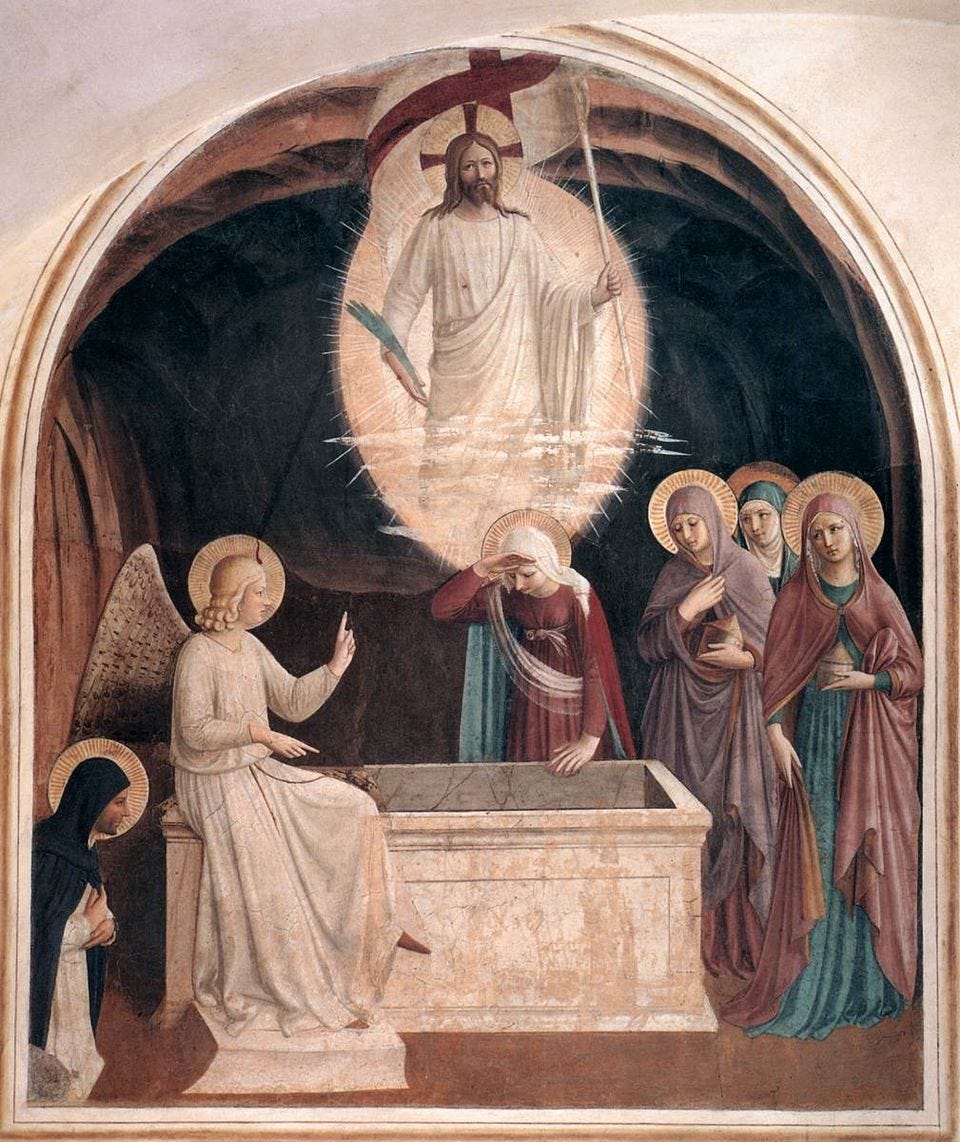
[Fra Angelico, “Women at the Empty Tomb,” (circa 1439-1443), Public Domain, via Wikimedia Commons]
Poor Sanhedrin and mafia leadership. They messed with a dead man they couldn’t keep dead. Jesus decided to play with them for trying to suppress the truth. Meek and humble, secure in Himself, a resurrected God-man doesn’t feel the need to play at the level of criminals or an eye for an eye. Because Jesus is Wisdom and Power, he just kept humiliating the liars and giving them more empty “tombs” and more bewildered guards. Afterall, Jesus is in it for the long game and the salvation of souls; bringing billions, maybe trillions or more, into the family of God for ages to come.
Not long after paying-off the guards – and tired of the Apostles contradicting them with miracles and preaching Jesus’s resurrection – the Sanhedrin had the Apostles thrown into prison. Here it gets even funnier to watch the fake news blow-up in the face of government controllers. The next day, when the Sanhedrin proceeded to hold the trial, the officers reported to the chief priests and additionally all of the Sanhedrin and the Senate of Israel: “We found the prison securely locked and the sentries standing at the doors, but when we opened it we found no one inside” (Acts 5:23). It is practically the same story of the Resurrection and the empty tomb, but this time with more missing bodies, and more leaders of Israel hearing about missing bodies. The New Testament is clear: an angel of the Lord had come and released them and told the Apostles to go back to preaching in the temple precincts (Acts 5:20-21).
In prison, basically a sealed tomb or holding-chambers for embodied souls, an angel “opened the prison doors” and released the Apostles at night. More technically, they were probably taken into the holy angel’s “higher dimensions” (between time and eternity) from which angels act and then released outside again in the temporal world of Jerusalem (as the next section will elaborate). This would explain why the sentries – still standing at the doors – saw nothing of the Apostles’ deliverance but were left with an empty cell.
This episode had all the same symbols of the resurrection: guards, physical bodies, tombs (prisons), and the same chief priests were involved. The Resurrected Lord was not going to let memory of his empty tomb escape the Sanhedrin with a payoff to scared guards. Now there were more guards, clearly awake, and more witnesses to hear about an empty prison; an empty tomb for the living. Jesus, the head of the Church, had given a sign of what he would do for all his members in the future; raising our bodies from the tombs. Simultaneously, he embarrassed the corrupt leadership who originally condemned Him to a shameful death and so revealed all of their bribes and blood money.
A decade later, the Sanhedrin and all those offices involved in Jesus’s sham trial needed another reminder of how Jesus’s tomb really got empty. The Herods [Antipas and Agrippa] still needed correction [the exiled Antipas had probably passed]. Upon the murder of the first Apostle, James the Greater, Herod Agrippa wanted to please the Jews further and had Peter arrested. It was Passover in Jerusalem, and like Jesus, Peter was thrown in a tomb, a prison. Clearly the word had gotten out that throwing Christians in tombs was risky for embarrassing public relations. Prepared to stop embarrassment at all costs, Herod had four squads of soldiers guarding Peter at the prison (cf. Acts 12:4).
A third embarrassment to the corrupt leadership would not be allowed and so 16 men guarded Peter. Not only were there guards and sentries at the prison door, Saint Peter was bound with two chains and slept with one guard on his right and another on his left (cf. Acts 12:6). About the 10th Anniversary of Jesus’s Passover, another reminder of the Resurrection of Jesus Christ would be given to the pretender kings of Jerusalem.
An angel of the Lord appeared to Saint Peter in the cell while the guards were next to him. The angel woke him and the chains fell from Peter without the guards seeing anything. Of course not, the presence of an angel affects a person’s “dimensional” reality. Peter was lifted by the angel between the temporal and higher realities of aeveternity. It was so surreal, at first Peter thought it was a vision as he followed the angel out of the prison. “When they passed the first and second guard, they came to the iron gate leading into the city…and the angel left him” (Acts 12:10). Peter then realized it was real and even the house he went to was in complete shock at his appearance and escape (Acts 12:11-17). It actually happened within the historical world and not just Peter’s mind.
Herod knew Peter’s mysterious escape was real and so did the poor sentries. It was as real as Jesus’s Resurrection. “Now when the day came [to try Saint Peter in the king’s court], there was no small stir among the soldiers over what had become of Peter. And when Herod sought for him and could not find him, he examined the sentries and ordered that they should be put to death” (Acts 12:18-19). The mafia protection was over. At the Resurrection of Jesus, the first sentries were paid to tell lies as their lives were threatened and coverups were promised. The last set of sentries had to pay with their lives for all the lies of a corrupt government.
“Beware of the Leaven of the Pharisees, which is hypocrisy. Nothing is covered up that will not be revealed. Whatever you have said in the dark shall be heard in the light, and what you have whispered in private rooms shall be proclaimed upon the housetops” (Luke 12:2-3). Herod also paid the price by the hand of an angel who struck him “because he did not give God the glory; and he was eaten by worms and died” (cf. Acts 12:23).
From the first payoffs and denials of Jesus’s Resurrection, corrupt men hid the truth from the people. They bought fake news and suppressed the truth through intimidation and murder. The last set of sentries died in witness to the truth of Peter’s Gospel that Jesus is the Son of God (cf. Mark 1:1). Working for corrupt leaders cost them their lives. Hopefully they listened to Peter and the Gospel before Peter fell asleep between them. The bribe which the first set of soldiers received from the priestly mafia ended with the death of the third set of sentries who were present at signs of the Resurrection of Jesus the Christ.
Not too long afterward, as Jesus prophesied, Jerusalem and the Second Temple were destroyed by 70 A.D. It was exactly one generation later, just as Jesus foretold in prophecy (cf. Luke 21:5-24). The Jewish leadership of that time had been given at least three repeated and specific signs of the empty tomb – in addition to countless miracles – to acknowledge Jesus’s Resurrection and Lordship. The leadership of that time resisted until the end and so God destroyed the Second Temple by the Romans on the exact same day that the First Temple was destroyed by the Babylonians, Tisha B’Av, the 9th day of the month of Av.
[*Thank you to Al Lehnen for correcting my mixing of King Herods in a previous edition. This article was originally published August 4, 2022, slightly edited April 4-6, 2026.]
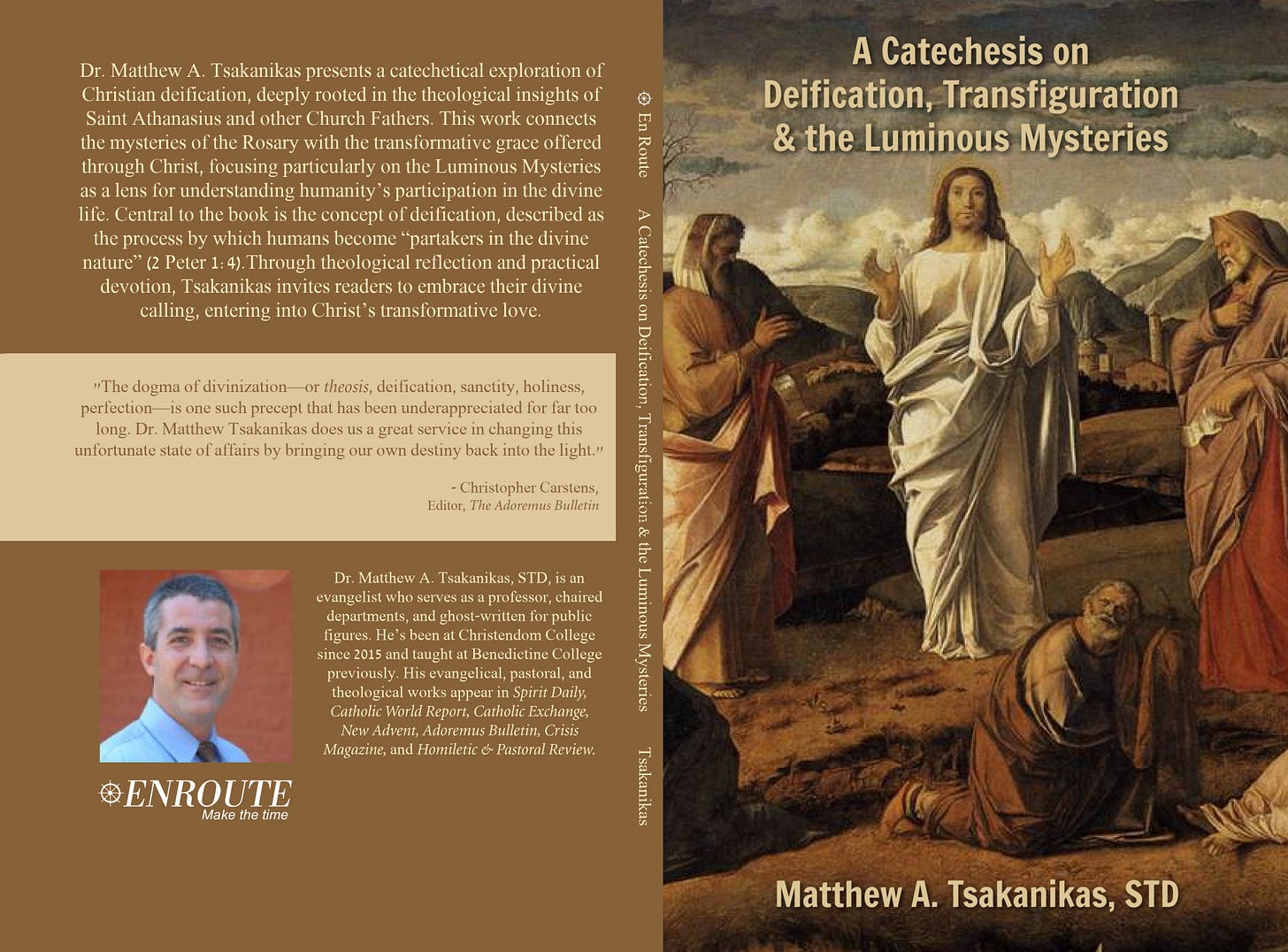
Here are some testimonials about the above book by noted authors:
“Dr. Matthew A. Tsakanikas has written an informative book on Deification. Those not familiar with Deification, or even those who are familiar with it, will find this short book beneficial. Quoting the Church Fathers and Doctors of the Church, including St. Thomas Aquinas, Tsakanikas uncovers their teaching on the purpose for the Incarnation: “For the Son of God became man so that we might become God” (CCC #460). “…We might become God” is Deification. What does this almost unbelievable teaching mean? Tsakanikas discloses the keys for understanding Deification by examining the Biblical happenings at Mt. Tabor, Mt. Sinai, and Mt. Zion. He also uses material from the Luminous Mysteries of the Rosary. He writes that we can live out our Deification by following the example of Mother Mary’s discipleship. The book is well written, logically organized, and spiritually enriching. Deification is what we are created for. This book tells us why.” – Most Rev. John M. LeVoir, Bishop Emeritus of New Ulm, author of Covenant of Love, one of the first books promoting John Paul the Great’s Theology of the Body.
“Professor Tsakanikas, throughout his distinguished teaching career, has emphasized the central Christian doctrine of man’s deification. This work has illustrated with clarity the radical transformation of one’s life through the gift of sanctifying grace in the soul, elevating man to the supernatural order. This important work will help rekindle in Christians everywhere a deeper understanding and appreciation of this priceless gift which flows from the open Heart of Christ, thereby enriching one’s prayer and devotional life.” – Timothy O’Donnell, STD, author of Heart of the Redeemer and President-Emeritus Christendom College
“Dr. Tsakanikas’ research on deification and the Transfiguration has inspired my own teaching and research for years. This book further inspires by simultaneously articulating the concept of deification through the lens of the Luminous Mysteries of the rosary and illuminating the coherence of the Luminous Mysteries through the theology of deification. At once theological and evangelical, Tsakanikas’ book uses Scripture, analogy, and anecdote to present an accessible account of deification, responding to errors in biblical interpretation and objections that this biblical concept is akin to Mormonism or New Age. Along the way he provides clear accounts of the dynamic between nature and grace, human freedom, and the unity of the Old and New Testament. This text will inspire popular and academic audiences alike.” – Andrew Whitmore, PhD, author of Saintly Habits, Aquinas’ 7 Simple Strategies You Can Use to Grow in Virtue
“This rich but accessible book will help the believer reground their Christian faith in something beyond a religious rationalism or moralism. Through an original synthesis of Scripture, Sacrament, and the Luminous Mysteries, Tsakanikas reminds us anew how the Incarnation of the Eternal Word redeems us by immersion into the eternal glory of love in God himself: deification.” – Conor Sweeney, STD, author of Abiding the Long Defeat: How to Evangelize Like a Hobbit in a Disenchanted Age
Comments
Nothing yet. Say the first thing.
Sign in to join the conversation.