
by Charles Smith
[This is a guest essay. It is the second of two top essays in the undergraduate theology course THEO 398 Studies in Deification, November 2025…]
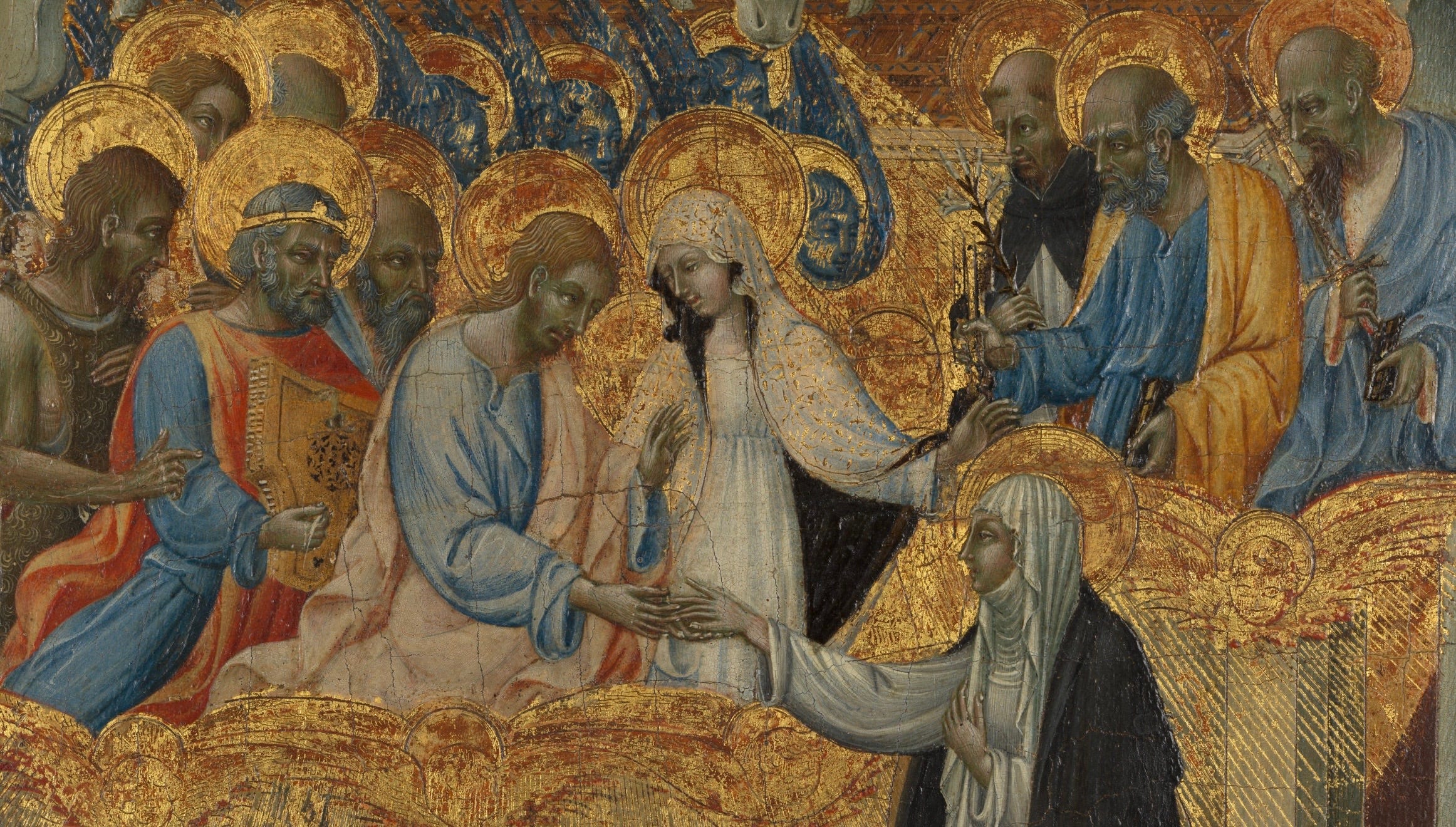
[The Mystic Marriage of Saint Catherine of Siena, by Giovanni di Paolo (Giovanni di Paolo di Grazia) (Italian, Siena 1398–1482 Siena), Public Domain.]
I. Introduction
“The Catholic Faith is just a bunch of rules that infringe upon freedom and lead to guilt because we cannot attain the strict standards!” Such is the commonplace objection to the Catholic Faith, which ultimately leads to a rejection of the Church, Christ, and His salvific teaching. Contrary to this prevalent objection, the teaching of Christ and His Church is not one of rules, relinquishing freedom, or impossible standards. What, then, is this salvific teaching? It is the “power to become children of God” (Jn. 1:12), receive the truth that sets free (Jn. 8:32), and attain perfection as the “heavenly Father is perfect” (Mt. 5:48). Christ’s teachings are not an amalgamation of thou-shall-nots: “the law was given through Moses; grace and truth came through Jesus Christ” (Jn. 1:17) because “Christ is the end [telos] of the law” (Rom. 10:4); this grace and truth is Christ’s sharing “from his fulness . . . grace upon grace” (Jn. 1:16) so that believers may become “partakers of the divine nature” (2 Pet. 1:4)—to wit, God “was made man that [man] might be made God.”[1]
This essay will define what deification is with reference to the theme of sonship in scriptural and patristic witnesses; ascertain why man is to be deified in accord with a Christocentric analysis of scripture, highlighting man’s freedom in the process; and ultimately how man is to be deified unto the end of infinite union with God through a synthesis of patristic and Thomistic thought.
II. Defining Deification
The claim that man is to be made God, or deified, is a claim that indubitably scandalizes the sensibilities of even many practicing Catholics. In the hope of recovering its true meaning, it is first necessary to explore the scriptural and patristic witness of this fundamental teaching, and consequently ascertain what it means that God “was made man that [man] might be made God.”
a. The Scriptural Witness to Deification
The chief scriptural starting point for deification is 2 Peter 1:1-11, which is a summary of the Christian life. In short, Jesus calls those with knowledge of him “to his own glory and excellence” (v. 3), and through this calling to “become partakers of the divine nature” (v. 4). Peter succinctly lays out the path towards participation in the Divine Nature where one “will never fall” and thus “confirm [his] call and election” (v. 10): the Christian must “supplement [his] faith with virtue” unto the end of charity, or divine love (v. 5, 7). This “faith working through charity” is a both a sign of abiding in grace and begets the “hope of righteousness” (Gal. 5:6). In Second Corinthians, Paul asserts that the grace of Jesus is summed up in that “though he was rich for [man’s] sake he became poor, so that by his poverty [man] might become rich” (2 Cor. 8:9). Indeed, Christ “emptied himself” when he took “the form of a servant” (Phil. 2:7) allowing man a share in that which He poured out—His divinity. Man becomes divine insofar as he abides in grace, which is manifested in faith working through love.
b. The Patristic Witness to Deification
From these verses, and many others, the early Church Fathers unanimously asserted man’s call to ascend to a divine status. The earliest witness to this teaching is from Saint Justin Martyr: “all men are deemed worthy of becoming ‘gods,’ and of having power to become sons of the Highest.”[2] Saint Irenaeus, writing against those who deny the Incarnation, affirms that they “defraud human nature of promotion into God;” and further that “the Son of God became the Son of man, that man, having been taken into the Word, and receiving adoption, might become the son of God.”[3] In the East, Saint Clement of Alexandria writes: “the Word of God became man, that you may learn from man how man may become God.”[4] Saint Athanasius of Alexandria, to whom this statement is most often attributed, further insists that God “was made man that [man] might be made God.”[5]
c. The Theme of Sonship
The theme of sonship interwoven with the above affirmations of deification is integral to deification. Sonship, or the “power to become children of God” (Jn. 1:12), begins with baptism, for once “born of the water and the Spirit” man “become[s] like a child” (Mt. 18:3). Instead of being a “slave [who] does not continue in the house for ever,” man becomes a “son [who] continues for ever” (Jn. 8:34). As St. Paul affirms, “if [one is] a son then [he is] an heir” (Gal. 4:7), and his inheritance is the “kingdom of God” (Jn. 3:5). This kingdom is not an earthly kingdom, nor is it a future or distant heavenly kingdom: it is the Spirit.[6] Once baptized and entered into the Spirit, man becomes a “partaker of the Holy Spirit” (Heb. 6:4), and tastes “the goodness of the word of God and the powers of the age to come” (Heb. 6:5). Tasting indicates an interior assimilation of divinity in man, which is the eternal life that is possible now.
Insofar as the Holy Ghost, as the “spirit of sonship,” dwells within the baptized Christian, He likens man to God (Rom. 8:15). In man’s original state, he is made a creature; but, “on receiving the grace of the Spirit, [he is] said thenceforth to be begotten.”[7] Thus, sonship is related to deification in that to be made a son is to be made like the Father. The human son of a human father resembles and is like his father, both in nature and appearance; since man’s nature is created, it can never become uncreated, and so the likening to God must be a qualitative likening. This qualitative likening is not a mere exterior similitude of appearance—it is an infinite interior transformation.[8] Thus, to answer what deification is generally: it is being made like unto God by being adopted as a son in the Son through the grace of the Holy Ghost.
III. Why Man was Always Meant to become God by Grace
Before any discussion on the particulars of how the deifying interior transformation occurs, it is crucial to delve into why man was always intended to be deified from both a general and particular scope. Essential to this analysis is the creation and fall of Man, and a consideration of a Christocentric anthropology vis-à-vis Scripture’s salvific plan.
a. The Innate Desire for Godhood
The perennial desire for likeness to the godly appears throughout history in both authentic and corrupted forms; within the authentic forms, the evidence for this desire is seen through both natural reason and revelation. Among the authentic realizations that man desires union with the divine are the Ancient Greek philosophies. They knew that the good is what all things desire,[9] and the Platonic tradition considered the chief Good as he who is real being with no “becoming” who patterns creation on the eternal; consequently, “all that he thus accomplishes must be good.”[10] The Good, as super-eminent Goodness, “being without jealousy . . . desire[s] that all things should come as near as possible to being like himself.”[11]
What the ancient Greek philosophers knew, the Ancient Semites knew in a truer sense because it was revealed. Consider how the term genesis is the same term used by Plato for “becoming” (in reference to man moving toward likeness with the divine): man is in a stage of becoming, that through his freedom, his desire can match God’s desire and love for us, and be united with Him. And, in the Book of Genesis, God repeatedly calls His creation good (Gen. 1)—especially man since he was made in His Image and after His likeness (Gen. 1:26).
Among the corruptions of this desire, the ancient world’s Gnosticism, along with its modern embodiments, espouses the tenet to “know thyself”—which means one must look within to discover he is “a god who does not know about himself.”[12] The most marked modern corruption, though, is the concept of “radical finitude,” which posits that man is merely a spec in the cosmos and thus insignificant; yet, because man has intelligence, he has the ability to interiorize the cosmos, act autonomously, and create meaning functionally ex nihlo.[13] In both accounts, man deifies himself; in both cases, man acts like a god, without God, and wrongly, since man is not God. Nevertheless, the desire for Godhood is evident. This perennial desire for Godhood—having been revealed by God, philosophically anticipated in the ancient world, and eventually aberrated throughout the ages—demonstrates that man was always intended to become God by grace, ever increasing in His likeness.
b. The Fall of Man – Psychosomatic Change and Bondage to Sin
Gregory the Theologian details the intended prelapsarian increase in likeness through the Tree of Knowledge, which “would have been good if partaken at the proper time; for the Tree was . . . Contemplation . . . safe for those who have reached maturity of habit to enter upon.”[14] As a consequence of partaking of the Tree, “man has become like one of us,” says the Lord (Gen. 3:22). This likening would have been good with properly developed faculties, but it was destructive because it was partaken of prematurely, on Man’s terms—not on God’s terms. In the place of the “psychosomatic dress which had been woven with grace, with the light and glory of God,”[15] man was cloaked with the “garments of skins” (Gen. 3:20). A psychosomatic—soul-body—change occurred after the fall, whereby man put on “brute nature . . . when [he] became familiar with passionate indulgence.”[16] Man, who was intended to choose the good, grow in the virtues, and contemplate God, chose indulgence instead of God, which drew him into materiality and plunged the intellect and the will into disordered passions and desires.
The garment of unintelligent nature cast upon man after the Fall did not destroy the image of God,[17] but instead of man “moving naturally, as he was created to do, around the unmoved [God] . . . contrary to nature, he willingly and foolishly moved around the things below him.”[18] This reality explains why modern man views the erotic—the desirous—as sensual and material, whereas man’s natural desires (eros) should imply “the upward impulse of the human spirit toward what is true, good, and beautiful.”[19] Even the Ancient Greeks knew that the highest Good, that which truly fulfills, would be desirable for the sake of itself because it is that whence all other goods derive their goodness and thus their desirability.[20] In this way, man’s concrete natural desires are instantiations of the general desire and inclination toward Godhood, which is the very hope of deification, and proof of it.
c. Christ the Archetype
Man’s innate desire for Godhood is not biologically innate or merely the result of natural reason. This desire in man is precisely because the Incarnate Christ, existing in a “supra-temporal reality”[21] in God, is the Archetype of man—“the old Adam is not a model for the new, but the new a model for the old.”[22] The importance of the Incarnate Christ as the model is such that the Image of God in man is one already ordained for union with the Logos. Thus, man’s essential activities exist so that we may be raised to this union: man “received rationality that [he] might know Christ, desire that [he] might run towards him[, and] . . . memory that [he] might bear Him.”[23] God reaches out to man through his faculties to enact this union, which is only possible through the “created vehicle, which is the freedom of man.”[24] Thus, man’s innate desire stems from his status as a theological being. All in all, the Christian salvific plan, with Christ as its model, provides the cure to man’s postlapsarian, psychosomatic state, wherein the disordered eros debases our faculties’ ability to pursue He who can truly fulfill. Instead of disordered passions enslaving man to the material, the truth will set man free (Jn. 8:37).
IV. How Man is to be Deified
Thus far the what and the why have been covered, which leads naturally into the how—the specifics of that whereby man is deified. The whereby is best explained through the chain of patristics synthesizing their forerunners, culminating in the total synthesis of Thomas Aquinas.
a. Purification – The Capacitation & Development of the Virtues
Recalling man’s call to partake “of the divine nature” by supplementing “faith with virtue,” virtue is the natural starting place for how man is qualitatively likened to God (2 Pet. 1:4-5). Once man has received supernatural faith through baptism, he embarks upon the journey of purification whereby he becomes “free from all taint of unlikeness” to God.[25] This purifying grace from baptism ensures man does not “fall altogether from good and from virtue,”[26] and propels him toward “the life of eternity, by which alone virtue claims the advantage.”[27] Through freely cultivating the “natural seed of the Good,” which is a participation in virtue, one “unquestionably participates in God, who is the substance of the virtues.”[28] Now, these are not pagan virtues or moralisms, achieved on our own accord. For Aquinas, “charity is the form of the virtues,” which, from an infusion by the Holy Ghost, develops the natural moral virtues and “directs the acts of all other virtues to the last end” [29]—for if one excels in virtue and lacks charity, he becomes as a “clanging symbol” (1 Cor. 13:1). Thus, man’s call to purification is beginning to be likened to God, where he puts “off the old nature which . . . is corrupt through deceitful lusts” (Eph. 4:22), and receives the infused virtues as new qualities, or accidents, in the soul, actualizing his substance to be more like God.[30]
b. Illumination – The Light of Grace
From the purification of the old man with new qualities and virtues, man can now be “filled full with Divine Light”[31]—“blessed are the pure in heart for they shall see God” (Mt. 5:8). The Transfiguration episode cannot be understated at this juncture: Jesus’ becoming “white as light” is the manifestation of this divine light, showing forth His divinity through His human nature—and the potential for man’s human nature to attain to a divinized status after receiving Godly dispositions via grace (Mt. 17:2). The virtuous dispositions man receives from his purification are essential for his illumination, seen most clearly in Gregory the Theologian’s affirmation that God presents “Himself to our minds in proportion as we are cleansed” and is “conceived in proportion as we love Him . . . pouring Himself out upon what is external to Him.”[32] That which God pours out is grace, which is the “Light . . . contemplated in the Father and the Son and the Holy Ghost.”[33] For Maximus, “[g]race alone illuminates human nature with supernatural light, and, by the superiority of its glory, elevates our nature above its proper limits in excess of glory.”[34] This light then bestows a “knowledge of God [that] draw[s] the pure mind to itself naturally through love.”[35] Aquinas also posits a light of grace that “is added to nature” and allows man to know “higher intelligible things.”[36] Additionally, the illuminating gift of wisdom comes from “a certain connaturalness or union with Divine things,” which is an effect of charity that is received in our purifying baptism.[37] Aquinas, too, demonstrates the dispositive reality of the virtues, and their importance, in that the “light of grace which is a participation of the Divine Nature is something besides the infused virtues which are derived from and are ordained to this light.”[38]
c. Infinite Union – The Possession of the Divine Persons
Finally, man’s infinite union with God transpires insofar as those who hold “themselves apart from all imperfection, should become participators in the Divine Wisdom which they have contemplated.”[39] This participation is so that “what is mortal may be swallowed up by life” (2 Cor. 5:4), which is to “put on the new nature, created after the likeness of God in true righteousness and holiness” (Eph. 4:24) because Christ “recapitulates [ἀνακεφαλαιώσασθαι] all things in him[self]” (Ephesians 1:10). Christ is the model for this participation since “His inferior nature, the Humanity, became God, because it was united to God, and became One Person because the Higher Nature prevailed” so that man “might be made God so far as He is made Man.”[40] As a “new creation” (2 Cor. 5:17), man moves in an “upward movement toward God,” and “becomes God . . . through [his] proper mode of participation in God.”[41] Just as with the Incarnation, the human nature of Christ abides “with its essence strictly intact” but “with regards to the principle [or mode] of how it exists, it should receive its subsistence in a divine manner.”[42] Similarly, man’s deification does not change what he is, but how he is; man receives God (uncreated) according to his own mode of existence (created), and is assumed into God’s mode of existence (uncreated), which is eternal life.
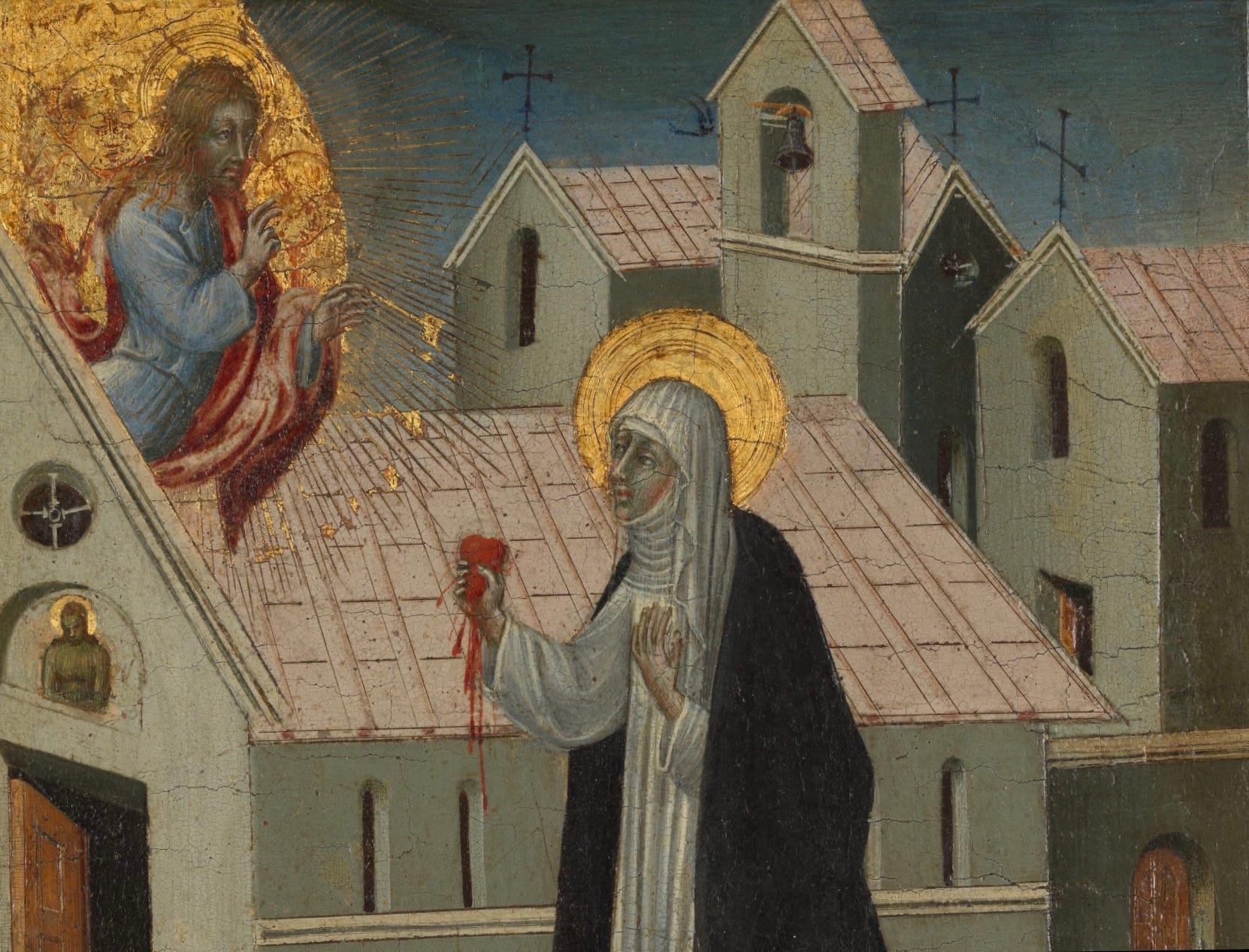
[Saint Catherine of Siena Exchanging Her Heart with Christ, by Giovanni di Paolo (Giovanni di Paolo di Grazia) (Italian, Siena 1398–1482 Siena), Public Domain.]
Aquinas systematizes participation in God through the missions—or temporal sending—of the Son and the Spirit. The light of grace capacitates the reception of the Divine Persons in man according to a “special mode,” that is, “as the object known is in the knower, and the beloved in the lover.”[43] There exists a cyclical reality to this process in that, “for a divine person to be sent to anyone by grace, there must needs be a likening of the soul to the divine person Who is sent, by some gift of grace.”[44] That is, grace elevates nature so that it may participate in the divine nature through the gift of charity; this participation not only capacitates the sending and possession of the Divine Person, but is the instrument whereby the Person may be possessed. Aquinas also distinguishes the missions of the Son and the Holy Ghost. One’s soul is assimilated to the Holy Ghost “by the gift of charity,” and so the Holy Ghost is sent “according to the mode of charity.”[45] The Son, on the other hand, is sent according to an “intellectual illumination, which breaks forth into the affection of love.”[46] As Maximus sums it up: “whoever, by the exercise of wisdom, enables God to become incarnate within him or her and, in fulfillment of this mystery, undergoes deification by grace, is truly blessed, because that deification has no end.”[47]
It thus becomes clear that the shrugging off of old passions and desires in the Holy Ghost, by means of His gift of charity that develops the natural virtues, and the concomitant light of grace that illumines man to contemplate and know God through the Son, leads to the possession of the Son and the Holy Ghost precisely as the object known and the beloved loved, respectively—all of which is ordered ultimately to the Father. Because the Son and the Holy Ghost disclose the Father, and together, from the charity of the Holy Ghost, which concomitantly bestows the gift of wisdom, man may attain the eternal life that begins now: “this is eternal life, that they may know thee the only true God, and Jesus Christ whom thou hast sent” (Jn. 17:3).
d. The Instruments of Deification – The Sacraments and the Renewal of Intellect and Will
With the process of deification qua deification established, how man is tangibly deified may now be addressed. It begins with baptism, which restores man’s fallen nature and Image. As activity follows, and flows from, being—that is, what a thing is determines how a thing acts—confirmation awakens the Spirit within man, allowing him to use the gifts that are infused by the Holy Ghost. The Eucharist, then, is the participation in the glorified body of Christ, and the heavenly sustenance that enables the spiritual life and the increase in likeness. Since “no one knows the Father except the Son” (Mt. 11:27), man must also put on the mind of Christ (Phil. 2:5), which is a taking on of eternity. The interior renewal of the mind, through prayer, allows contemplation of Christ as the Archetype of man’s being, and to thus increase the desire of union with Him. Finally, through the renewal of the mind, which yields an undying desire for God, man’s will points firmly upward toward God as his fulfillment, since that which is below man cannot satisfy the infinite gap of desire within him. It is here that man is so united to God that man lives in and through God, and is thus called “God by grace.”[48]
V. Conclusion
Ultimately, as Jesus emanated perfect, Divine Love with His human Heart, man is called to the same—not by his own power, but through his freedom cooperating with God’s power and grace. This freedom allows for, and is ever increased within, divine sonship, whereby the bondage to the passions that never fulfill or completely satisfy man is broken through the restoration of the image of God within him. Such are the infused virtues that cast off the garments of skins, man’s irrational nature that drags him into the bestial. In the garment’s place, man receives the light of grace so that he may move from the image to the likeness of God—to love like God loves. This capacity comes from above, but effectuates only through the freedom of man’s will in a synergy with God’s will. Consequently, man receives the Divine Persons, becomes Their dwelling place, and thus God by grace. Nowhere in this ascent to the Divine is the aim of the Christian life simply the mechanical keeping of rules or impossible standards. The goal is to boldly proclaim, “it is no longer I who live, but Christ who lives in me!” (Gal. 2:20).
About the author: Charles Smith recently completed his studies in Political Science at Christendom College and hopes to attend law school in the Fall of 2026. He has an avid interest in theology, particularly at the intersection of anthropology, linguistics, and law. He especially enjoys engaging Islamic and Eastern Orthodox theologies. His Substack: absoluteapologia.substack.com
Last article on Catholic460: New Booklet, Meditations on Deification…
[1]Athanasius, On the Incarnation, chapter 54 in Nicene and Post-Nicene Fathers, Second Series, trans. Archibald Robertson, ed. Philip Schaff and Henry Wace, vol. 4 (Buffalo, NY: Christian Literature Publishing Co., 1892).
[2]Justin Martyr, Dialogue with Trypho, chapter 124 in Ante-Nicene Fathers, trans. Marcus Dods and George Reith, ed. Alexander Roberts, et. al., vol. 1 (Buffalo, NY: Christian Literature Publishing Co., 1885).
[3]Irenaeus, Against Heresies, book III, chapter 19, number 1 in Ante-Nicene Fathers, trans. Marcus Dods and George Reith, ed. Alexander Roberts, et. al., vol. 1 (Buffalo, NY: Christian Literature Publishing Co., 1885).
[4]Clement of Alexandria, Exhortation to the Heathen, chapter 1 in Ante-Nicene Fathers, trans. Marcus Dods and George Reith, ed. Alexander Roberts, et. al., vol. 2 (Buffalo, NY: Christian Literature Publishing Co., 1885).
[5]Ibid., note 1.
[6]See Gregory of Nyssa, The Lord’s Prayer, sermon 3 in The Lord’s Prayer; The Beatitudes, trans. Hilda C. Graef, ed. Johannes Quasten and Joseph C. Plumpe, no. 18 (Westminster, Maryland: The Newman Press, 1954), 52-52.
[7]Athanasius, Discourse 2, chapter 21, number 59 in Nicene and Post-Nicene Fathers, Second Series, trans. Archibald Robertson, ed. Philip Schaff and Henry Wace, vol. 4 (Buffalo: Christian Literature Publishing Co., 1892).
[8]See, Gregory of Nyssa, Homilies on the Song of Songs, homily 6 in Gregory of Nyssa: Homilies on the Song of Songs, trans. Richard A. Norris Jr. (Atlanta: Society of Biblical Literature, 2012), 187. Created intelligible nature is “always being created as it is changed for the better by being enhanced in goodness. For this reason, no end point can be conceived for it either, and its growth toward the better is not confined by any limit.”
[9]Cf., Aristotle, Nicomachean Ethics, book 1, chapter 1 in Aristotle in 23 Volumes, trans. H. Rackham, vol. 19 (Cambridge: Harvard University Press, 1934); Plato, Symposium, 205a-206a.
[10] Plato, Timaeus, 28A in Plato’s Cosmology, trans. Francis Cornford (Indianapolis: Hackett Pub. Co., 1997), 33. Implicit in this Platonic understanding is that being and goodness are convertible, as the Good’s creation is good because it participates in his real being as a likeness.
[11]Ibid., 29E, page 33.
[12]Christoph Schönborn, From Death to Life, trans. Brian McNeil (San Francisco: Ignatius Press, 1995), 58.
[13]Ibid., 59-61.
[14]Gregory Nazianzen, Second Oration on Easter, oration 45, chapter VIII in Nicene and Post-Nicene Fathers, Second Series, trans. Charles Gordon Browne and James Edward Swallow, ed. Philip Schaff and Henry Wace, vol. 7 (Buffalo: Christian Literature Publishing Co., 1894).
[15]Panayiotis Nellas, Deification in Christ, trans. Norman Russell (Crestwood, NY: SVS Press, 1987), 52.
[16]Gregory of Nyssa, On the Soul and the Resurrection in Nicene and Post-Nicene Fathers, Second Series, trans. William Moore and Henry Austin Wilson, ed. Philip Schaff and Henry Wace, vol. 5 (Buffalo: CLP Co., 1893).
[17]Ibid.
[18]Maximus the Confessor, The Ambigua, trans. Nicholas Constas, vol. 2 (Cambridge: Harvard University Press, 2014), 109.
[19]John Paul II, A Theology of the Body, trans. Michael Waldstein (D.C.: Pauline Books & Media, 2006), 319.
[20]Aristotle, Nicomachean Ethics, 1097b in The Nicomachean Ethics, trans. Harris Rackham (London: G.P. Putnam’s Sons, 1926).
[21]Panayiotis Nellas, Deification in Christ, trans. Norman Russell (Crestwood, NY: SVS Press, 1987), 35.
[22]Nicolas Kavasilas, The Life in Christ, ch. 6 in Panayiotis Nellas, Deification in Christ, trans. Norman Russell (Crestwood, NY: SVS Press, 1987), 35.
[23]Ibid.
[24]Panayiotis Nellas, Deification in Christ, trans. Norman Russell (Crestwood, NY: SVS Press, 1987), 31. Emphasis mine.
[25]Dionysius, Celestial Hierarchy, ch. III in The Celestial Hierarchy (Grand Rapids, MI: CCEL).
[26]Gregory Nazianzen, Oration 40, ch. VII in Nicene and Post-Nicene Fathers, Second Series, trans. Charles Gordon Browne and James Edward Swallow, ed. Philip Schaff and Henry Wace, vol. 7 (Buffalo: Christian Literature Publishing Co., 1894).
[27]Ibid., note 16.
[28]Maximus the Confessor, The Ambigua, trans. Nicholas Constas, vol. 1 (Cambridge: Harvard University Press, 2014), 103. See also, page 215.
[29]St. Thomas Aquinas, Summa Theologica, trans. Fathers of the English Dominican Province (New York: Benzinger Brothers, 1948; reprint, Westminster: Christian Classics, 1981), Secunda Secundae, Question 23, article 8. All subsequent references to the Summa Theologica will be from this translation and edition, according to the following notation: ST I-II.Q84.a1.
[30]Peter Totleben, O.P., The Palamite Contreversy: A Thomistic Analysis (D.C.: Dominican House of Studies, 2015), 82.
[31]Ibid., note 25.
[32]Ibid., note 26.
[33]Ibid.
[34]Maximus the Confessor, Ad Thalassium, q. 22 in On the Cosmic Mystery of Jesus Christ, trans. Paul M. Blowers and Robert Louis Wilken (Crestwood, NY: SVS Press, 2003), 118.
[35]Maximus the Confessor, The Four Hundred Chapters on Love, ch. 32 in Maximus Confessor: Selected Writings, trans. George C. Berthold (Mahwah, NJ: Paulist Press, 1985), 38.
[36]ST I-II.Q109.a1.
[37]ST II-II.Q45.a3.
[38]ST I-II.Q110.a3.
[39]Ibid., note 25.
[40]Ibid., note 26, Oration 29, ch. XIX.
[41]Ibid., note 28, page 99.
[42]Ibid., note 28, vol. 2, page 73.
[43]ST I.Q43.a3.
[44]ST I.Q43.a5.ad2.
[45]Ibid.
[46]Ibid.
[47]Ibid., note 34.
[48]This section is largely based off of Panayiotis Nellas, Deification in Christ, trans. Norman Russell (Crestwood, NY: SVS Press, 1987), 109-139.
Comments
Nothing yet. Say the first thing.
Sign in to join the conversation.