
The Greek word oikonomia is the basis of the English translation, economy. The Greek expresses household management (or law), the development of a home and property through wise laws of investment, work, exchange, renewal, and care for the family and home which wisdom sustains. Household management is a micro-economy of the truly macro-economy of the whole universe.
Creation itself is like a household. It has always been administered upon wise laws of exchange, the divine economy of God’s administration. You reap what you sow (cf. Gal 6:7). Give little, get little back. Give a lot, receive a lot back. “One who sows righteousness gets a sure reward” (Proverbs 11:18b). Good and decent people are always giving of themselves and sacrificing for others. And so, rightly, they are loved and treasured because they are beneficent; their goodness is seen in their life of giving and the goodness is attractive. In fact, the basis of all life is the Good; and, the Good is diffusive. It is loved because it is always sharing itself and its power and so it is desired as the source of all blessings.
The Lamb of God taught “it is more blessed to give than to receive” (Acts 20:35). Nevertheless, the one who gives cannot but be loved for their goodness and sacrifices. It is why children love their mother. They only know her as the giver, nurturer and caregiver. They love their father because he protected them, raised them and provided for them. Motherhood and fatherhood are based in giving and sowing. Reap what you sow. It expresses the nature of the truth which the Lamb of God taught. His wisdom is behind the order and household laws of the universe.
Economics is about distribution and exchange. Good economics is about beneficial and life-giving exchange. Wise economics is about exchange and investment which improves your situation and so the return matches and exceeds your original giving. Everyone in the exchange is pleased. It seems exchange and investment is actually the natural and first basis of the world because the world is awaiting improvement and wants to benefit those who wisely invest as good stewards. The world is “very good” (Gen 1:31) and was meant to be good to us. Work and worship is part of the giving and investing to make the world a better place and better home.
“If anyone will not work, let him not eat” (2 Thess 3:10). A healthy person who refuses to work is one who refuses to give in order to get. He becomes a taker and easily can become a thief. He refuses the divine wisdom involved in the economics of exchange, investment, and work. Work not only leads to virtue within the worker, but also to order in the world around him. With takers, they demand more than they are owed and so justice and wisdom is violated and disorder ensues. In some way, the world is divided between givers and takers, order and wisdom versus disorder and vices. “A man who is kind benefits himself, but a cruel man hurts himself” (Proverbs 11:17).
Making a marriage work through devotion, worship, and sacrifice
The more valuable something is, the greater the exchange and the greater the giving must be in order to really receive it. Some things are so valuable they are priceless and so can only be received with great piety. This is why marriage is so difficult and requires piety. Man forgets that to have the life and love of another person, then he must give his life to the other person and live for the other in sacrifice and thanksgiving. A life-long work of piety is required so that one remains a giver instead of becoming a taker.
Work and sacrifice for the other is a form of worship/devotion to the other in marriage. This is clarified in Anglican Christian marriage vows or oaths: “With my body, I thee worship.” The vows are just the beginning of the exchange. The giving-of-self in order to have the other person in your life and so loving you must be realized in daily sacrifices for the other person. Love is in the details of life and not merely grand promises. How can you have someone that is living and equal to you unless you are always living out the exchange that was begun in the vows of marriage? The exchange is in the daily details of sacrifice until death do you part, and the sacrifices are ordered to love of God who joined you.
The ultimate truth about human existence is that the universe came into existence so that an ultimate exchange could be made between God and the one made in his image. All laws of creation and the universe are geared to this end and household management, particularly for the “household of God, which is the Church” (cf. 1 Tim 3:15). The closest comparison to the ultimate exchange is that of marriage and so Saint Paul called it a “great mystery” (Eph 5:32).
This great mystery is why Genesis 1-2 opens with vows and marriages and the last book of the Bible [Revelation] ends with the marriage feast of the Lamb who joins us to God and his household. The 7 days of creation are about God’s oath to man (male and female) because the root word of “oath” and “seven” are the same in Hebrew. Made in God’s image and likeness, humans imitate God’s fidelity and self-giving when they give marriage oaths to one another; between a man and a woman. However, the vows establishing union between God and man were never between equals. God is a far greater treasure and man must be ready to sacrifice all things for God in order to enter the exchange (cf. Mt 13:44-45).
God made the vows and arranged the mystical marriage (New Covenant) between Him and us. The work and worship required to live in the exchange of the divine economy requires far more devotion than that expressed in merely human wedding vows. [Nevertheless, the devotion and grace involved in that New Covenant between God and man is what also makes possible the Sacrament of Marriage to work between man and woman.] God became man and in so doing he abased and sacrificed himself for us in the form of a servant. A form of death and sacrifice must also be entered from our part to finalize and maintain the exchange of humans with God. The exchange is actually offered daily in the household of God when we are offered “through Jesus, with Jesus, and in Jesus”…
God gives himself to us in the divine exchange
Humans were created with a desire for eternal life because God always intended to give them eternal life. Eternal life was always something beyond the reach of man and so it was always something that can never simply be taken by man. There was always an exchange that had to be made. However, humans could never make the exchange or earn it by what they had to offer or sacrifice. The finite is never enough on its own to earn an infinite return. The temporal is never enough to lay hold of the eternal. But the opposite is possible and true...
The eternal can take hold of the temporal, the infinite can take hold of the finite, and the Creator can take hold of the creature in ways beyond merely sustaining existence. The Tri-Personal Source of all life, the Most Holy Trinity, can pass into lower dimensions of creation in new ways by indwelling within us. When one is already wealthy beyond all comprehension, not every exchange is about personal benefit or increasing in wealth. One can simply act with gratuity. While nothing can earn or buy God’s love, the good news is that the Good wished to share Himself and His wealth. The Good is diffusive. “What is richer than wisdom who effects all things?” (Wisdom of Solomon 8:5).
Since the Good is diffusive and since it is more blessed to give than to receive, then the Blessed One, filled with Logos and Love, had a plan in creating the universe and so had a divine economy at the foundation of creation. Because human existence would have a beginning (and so would be limited and needy), and since our natural desire for life-eternal would always beckon us to the Good, our needs and desires always caused us to hope in God’s designs and economy. The hope was never in vain. The ultimate truth and revelation is that God always planned to became man in the fulness of time so that man might receive a share in God’s nature (cf. 2 Peter 1:4). “I will espouse you [to me] forever” (Hosea 2:19), says the Lord.
We give ourselves to God in Christ
God became man. “Though he was rich, yet for your sake he became poor, so that by his poverty you might become rich” (2 Cor 8:9). If man wants to receive eternal life and God’s indwelling, he has to give his life for it by living for God in thanksgiving as Christ lived for us. A life of thanksgiving and piety towards God is how man keeps what is not his by right and so maintains the priceless gift which can never be earned or bought, God’s indwelling. Man can’t sacrifice others or give something other than his own life of total devotion in order to hold onto the gift of eternal life. God wants to communicate his eternity to man’s soul, eternal life. Man must give his own life through on-going and daily surrender to the eternal and so become like the eternal. He must love God with all his mind, heart, strength and soul to possess the One who lives eternally as the gift-of-self in the mystery of the Most Holy Trinity.
Divinity is so valuable, human life must abase itself by works of thanksgiving for so great a gift to remain interior to us and develop within us. This “abasement” means that nothing can be more important to us than God and that our lives should be ordered to honoring his gift of indwelling and infusing us with eternal life. God does not need our abasement, but our abasement is the only way by which creaturely human wills can hold on to what infinitely exceeds us and makes us “partakers of the divine nature” (2 Pet 1:4). Through abasement or worship, the human will is infused with and transfigured by God’s will. Two become one in participant transformation. Only through human freedom can this take place because love involves use of one’s freedom.
God abased Himself for us in becoming Jesus Christ and dying with us and for us, so why would we hesitate to abase ourselves for God in order to accept his gift of eternal life? The abasement was always greater on God’s side than ours can ever be. “God loved us first” (cf. 1 Jn 4:19). We must become like God by giving instead of just taking. “For freedom Christ has set us free” (Gal 5:1).
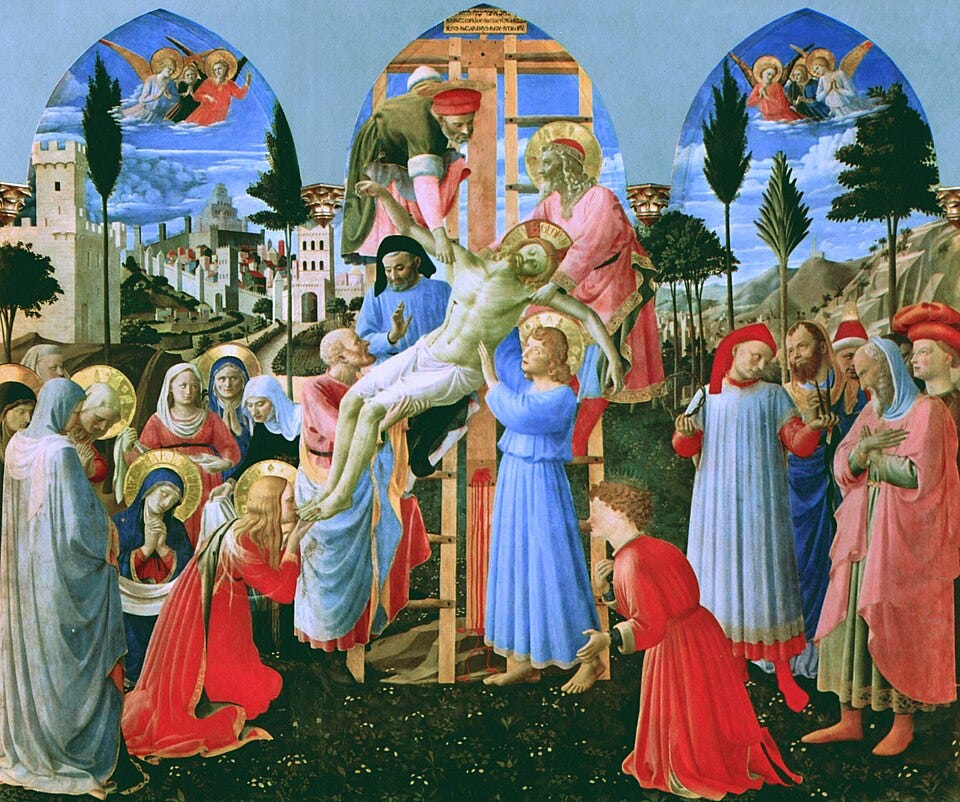
[Fra Angelico’s “Deposition of Christ,” circa 1423 at Wikimedia Commons]
Our abasement and efforts at total surrender to God is the process where we stop holding onto ourselves and the temporal and so take hold of the eternal who came down to us. In prayer and worship, we let go of ourselves, accept the Will of the Eternal One into ourselves, and so live from God’s nature and divinity. We are made one with God in a life akin to a mystical marriage and shared life. The divine exchange is realized.
The paradox is that humans do not lose their unique identity or freedom in the process of worshipping God. “For freedom, Christ has set us free” (Gal 5:1). We actually become like God in worshipping him because the Persons of the Trinity have always given themselves to the infinite Goodness of each Other. In worshipping God, we do what the Persons of the Trinity always do, we embrace God by giving ourselves over to God and so live from God, eternal life.
We take on God’s goodness and freedom in worshipping God. Humans actually “find” themselves during worship of God: “he who loses himself for my sake will be found” (Matthew 10:39). Thanksgiving and the gift-of-self to God cannot be ongoing and sustained without the human person still possessing the freewill by which he lives in thanksgiving. In thanksgiving our human wills are taken into God’s will and so preserved, saved.
The Lamb at the Foundation of the World
In the work of worship and the divine economy, humans become a living sacrifice through love of the One who sacrificed himself for every human, Jesus Christ. Nor is it in man’s power to determine or force the exchange of participation in the divine nature. God freely gave himself in Christ and God freely gives himself to the human who the Holy Spirit leads to accept Jesus Christ. The divine exchange is finalized only in living in daily sacrifice and living from Christ’s sacrifice.
The exchange [the oikonomia or household management] was destined from the foundation of the world. “Before the foundation of the world…God destined us in love to be his sons [sharers in the divine nature] through Jesus Christ, according to the purpose of his will, to the praise of his glorious grace which he freely bestowed on us in the Beloved” (Eph 1:4-5; cf. 5:29-31). Always, man was to receive something to which he had no right, so he had to learn that the way to receive it was by surrender of his life to the higher will of Goodness and Love.
Man was incapable of offering anything even close to a fair exchange of natural life for eternal life, but God is good and the lover of mankind and so he gave himself to compensate and give value to man’s poor offerings. He prepared humanity in signs and preparatory religion before coming in reality and true religion as given by Jesus Christ. To the question, “What work must we do?”, Jesus answered, “This is the work God, that you believe in him whom God has sent” (John 6:28-29). Saint Paul was clear about his work and emphasis upon the sacrifice of thanksgiving and entrance into Christ’s eucharistic sacrifice: “the life I now live in the flesh I live by faith in the Son of God, who loved me and gave himself for me” (Gal 2:20).
Jesus became the Lamb of sacrifice for every human (cf. Jn 1:29). He was “the Lamb slain from the foundation of the world” (Rev 13:8 KJV) and so gave divine value to what humans could only give in poverty and shadow before his “time of reformation” (cf. Heb 9:10) of all things. Any value in previous religious practices were based always on his coming into this world as predestined by God in love (cf. Ephesians 1:1-10). Jesus established the true and permanent religion. He showed and made possible that man must take hold of God by the surrender of his human will to God through the Lamb, with the Lamb, and in the Lamb in Eucharistic sacrifice (cf. 1 Cor 5:7-8; Lk 22:19; Heb 10:19-20).
In this way of Thanksgiving [Eucharist], man passes over from time to eternity, to eternal life and deification. This is the law of economics at the basis and foundation of all that undergirds creation. Life and love is more than mere economics, it is about a Wedding Feast and celebration from here and into eternity: “Blessed are those who are invited to the marriage supper of the Lamb” (Rev 19:9). Economics is about a true home and being developed by household management into the family of God in the work of liturgy and charitable self-giving. “You received without pay, give without pay” (Matthew 10:8b).
Learn more about deification with this book from Amazon:
A Catechesis on Deification, Transfiguration & the Luminous Mysteries
Comments
Nothing yet. Say the first thing.
Sign in to join the conversation.