
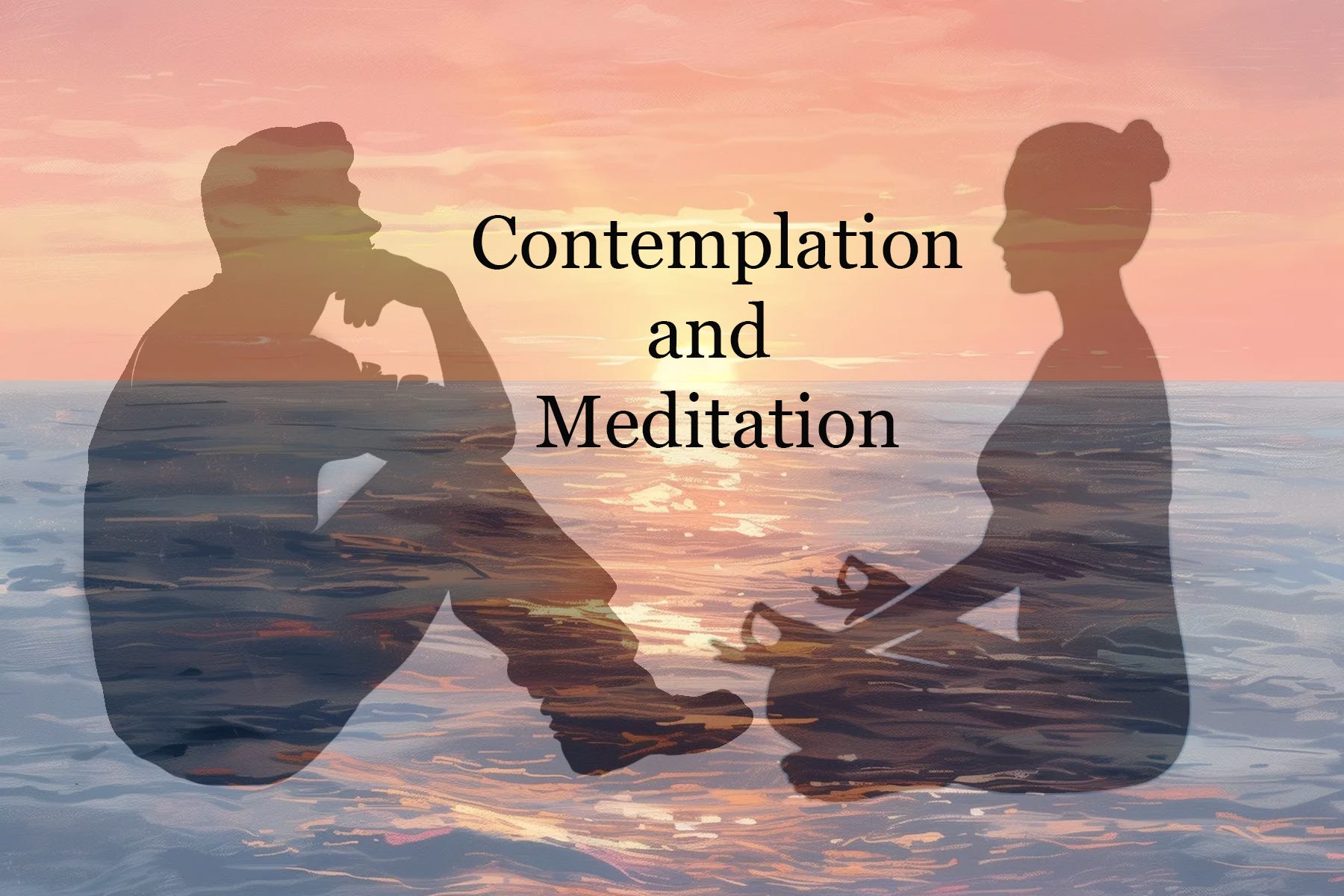
We begin this discussion with a simple distinction that meditation is primarily about becoming aware and present with experience itself—thoughts, intuitive wisdom, emotions, perceptions, and All That Is. Contemplation is primarily about exploring, investigating, or deepening understanding of a particular question, teaching, image, paradox, or truth. As meditation emphasizes presence, it opens doors to seeing yourself in profound ways, while contemplation, emphasizing insight, supports the discovery of self as an ever-unfolding process. Contemplation and meditation engage the mind in different ways and are both useful under different circumstances. Meditation asks: What is happening now? Contemplation asks: What does this mean? What is true here? It is important to notice that the line drawn between contemplation and meditation is generally a fuzzy one, and not necessary to maintain. The mature forms of contemplation and meditation eventually converge. A profound contemplation becomes silent. A profound meditation becomes illuminating. At a certain depth, contemplation is no longer thinking about truth; it becomes resting in truth. Likewise, meditation is no longer merely calming the mind; it becomes a direct knowing of reality. In that meeting point, there is neither contemplation nor meditation in the ordinary sense—only One Life Awareness, naturally revealing its own wisdom.
Contemplation is often stimulated by paradox. A spiritual paradox can interrupt the ordinary operations of the conceptual mind whose task is to classify, compare, explain, and resolve contradictions. A paradox presents something that appears to be simultaneously true and false, forcing the mind to encounter the limits of its own framework. Rather than producing an answer, it creates a space in which a different kind of understanding can emerge. Contemplation allows contradiction, with a significant amount of focus, to remain present long enough for a deeper coherence to reveal itself. Many contemplative traditions use paradox not to provide information, but to redirect attention. A spiritual paradox may be with you for years, gradually revealing deeper layers of meaning through life experience.
Meditation, however, is usually inspired not by a conceptual puzzle, but by an encounter with Presence. Meditation settles into One Life Awareness itself, allowing experience to unfold without trying to improve, explain, or resolve it. There is nothing to figure out because nothing stands between awareness and experience. In your meditation practice, you become aware that experience itself is complete enough to attend to without needing to interpret it. The breath, silence, a sunset, the sound of rain, or One Life Awareness itself all invite meditation because they require no conceptual resolution. They invite participation rather than analysis.
Meditation is not only a method for reaching awareness—it is also a way of relaxing into what has never been absent—what has always been present. As One Life Awareness is experienced in meditation over time, a shift occurs. Presence is no longer experienced as a fleeting moment between past and future, it becomes the only place where life is encountered. Meditation then is not the opposite of contemplation but its fulfillment: understanding gives way to direct knowing, and inquiry becomes simple, awakened Presence. In meditation, the goal is often to become less entangled in thought. Following the breath, resting in awareness, mindfulness, loving-kindness practice--these are all aspects of meditation practices where the emphasis is on directly experiencing reality. Meditation can bring you many benefits like greater calm and stability, reduced reactivity, increased clarity, and direct recognition of One Life Awareness itself. Contemplation also has many benefits. Whatever your practice may be, let contemplation and meditation direct you to simply know that everything unfolds as it must. Love and be loved is the only directive.
Friends,
Meditation has been a big part of my life since 1972 when I first engaged with Transcendental Meditation. I have practiced many kinds of meditation, both silent and guided meditation, and have here and there explored contemplation as a part of my practice. In January of this year, I started to use a recorded guided meditation which is called the HappCo Meditation Journey. It consists of over 200 guided meditations with a quote at the beginning that you can use for contemplation if you wish, guided processes of moving energy in the body, breathwork, and story-telling all designed to keep you engaged on your path of Self Discovery. The creator of this journey, Dr. Zach Berk, is a true light being and is an authentic and dedicated spiritual guide for this journey. Dr. Zach is offering a sampling of this journey which you can explore for free at this time. Just click below, and you will be taken to the proper place to check this out. If it’s right for you, join me on the journey.
Much love, Catherine
No posts
Comments
Nothing yet. Say the first thing.
Sign in to join the conversation.