
Maybe 35 years ago, during the process of splitting up my Vodrey grandparents’ stuff, my dad told me he wanted me to take their 12-volume 1933 Oxford English Dictionary. I had less than zero interest in this set. It was so gigantic and heavy and multi-volumed that I just couldn’t imagine using it much.
“You need to take this,” he said.
“Oh, no, thank you,” I said.
“You should take it.”
“I don’t want it.”
“You’re the writer in the family,” he said. “You should be the one to have this.” Appealing to my vanity: what a devilish trick! Well, it worked. I took the set and am consistently pretty surprised at how regularly I use it.
Etymology is an inextricable part of my love of writing, and burrowing into etymological rabbit holes is my idea of a really good time, especially when it comes to the enormous variety of truly wing nut words in English.
The OED is my constant companion in this exercise. Of course these words have come from lots of different languages, but if they’re in at least somewhat regular use in the United States, I include them in my dynamic, ongoing list. Here are the As and Bs of just plain weird words I’ve collected thus far:
ABRACADABRA
An old, old magic word, uttered on repeat in an effort to ward off illness. Centuries ago, amulets were engraved with the word. People would wear the abracadabra amulets around their necks in hopes of protecting themselves from various agues that preceded serious illness (AGUE: Old French. An acute or violent fever). Its first known appearance in writing was via a 2nd century Roman physician named either Serenus Sammonicus or Severus Sammonicus, though the word’s origin is unknown. To anyone now alive, it’s a nonsense word used by magicians as they prepare to produce a rabbit from a hat.
AKIMBO
Also kenbow, kenboll and kenbold, among other spellings. Akimbo is the position where you stand with hands on hips, elbows bent outwards at angles to the rest of your torso. The word may have long-ago roots in the Icelandic word keng-boginn, meaning crooked or bent — or it may simply come from the Middle English phrase keenbow, which means “at an angle” and likely refers to the position you assume when about to release an arrow from a bow.
ALLEY-OOP
This is a 19th-century French exclamation, used by street performers and circus acrobats right before they leapt or hopped or swung. It comes from the French allez — meaning “go on” or “here we go,” roughly — and the oop part is probably just a grunt as the performers actually jumped.
ASKANCE
This is likely related to askew, with both words meaning sidewise or oblique. Askance is almost always preceded by some form of “to look,” as in, “She looked at me askance.” A more modern version of askance is side-eye (I don’t know if it’s hyphenated or not, but I’m saying it is). Less commonly in everyday English, askance can signify something that’s indirect or ambiguous. The OED says it refers to an expression “filled with disdain, envy, jealousy and suspicion.” Related is the rarer word askant, which goes along with quaint older words like aslant and asquint. As a bonus, this appears in the OED two words later: ASKEBATHE. It’s someone who sits among the ashes. There’s a word for everything! So Cinderella = an askebathe.
BALDERDASH
Obscure origin. It came to be used as a mild oath — a word you might yelp if you stubbed your toe, or if someone said something stupid. In 16th century England, though, it was a disgusting cocktail. Balderdash was a haphazard mix of whatever liquor you had lying around in combination with milk or buttermilk. Drink up! Ick, ick, ick.
BAMBOOZLE
The OED says, “to deceive by trickery or hoax.” Bamboozle first appeared in print around 1700, though the OED doesn’t specify the publication in which it appeared. It is thought to be of cant origin — cant meaning the dialect of a group, the members of which use cant (or nonsense) words to mislead outsiders.
BEFUDDLE
Fuddle means to get drunk, and dates to the 16th century. Befuddle dates to pretty recently: 1873. It means to confuse or mislead — the obvious suggestion being that a person can be confused more easily if they’ve been drinking. A related word offered by the OED is fuddle-cap, which means a hard drinker.
BEHOOVE
Interestingly, behoof is what appears in my OED, with behoove noted solely as a variant. The root word, behoef, is Dutch and translates to a thing you need. Behoove has since subtly intensified and today, it means an obligation or duty: “It would behoove them to RSVP to the invitation as soon as possible.”
BELLWETHER
A castrated goat or sheep is called a wether. A bellwether (originally bell-wether) is the leading animal of a flock, around whose neck a bell is hung. Bellwether has come to mean a relatively contained situation which appears to have implications for a larger region, a greater number of people, etc.
BLURB
American poet Gelett Burgess invented this word in 1906. It means any sort of acclaim or praise printed on the cover of a book. The first known use of it preceded the word itself. When Walt Whitman published Leaves of Grass in 1855, Ralph Waldo Emerson sent Whitman an admiring letter, writing in part, “I greet you at the beginning of a great career.” Whitman asked that this sentence be stamped in gold leaf on all copies of the second edition of the book.
BODACIOUS
A slang term of the southern United States, origin unknown. It means physically attractive, and has sort of a hard-to-describe naughty undercurrent. If you’re calling someone bodacious, you’re probably waggling your eyebrows at the same time.
BOGUS
Bogus has come to mean anything wrong, shameful, spurious. The strongest possible candidates for the word’s origin:
— A version of bogey or boggart, both of which are Old English words meaning a ghost or malevolent spirit. Bogey in World War II was used by military pilots to refer to any unidentified aircraft presumed to be hostile.
— A version of the French word bagasse, which refers to the unusable refuse left after sugar-cane has been processed into molasses.
— An apparatus used in creating counterfeit coins.
BOOB
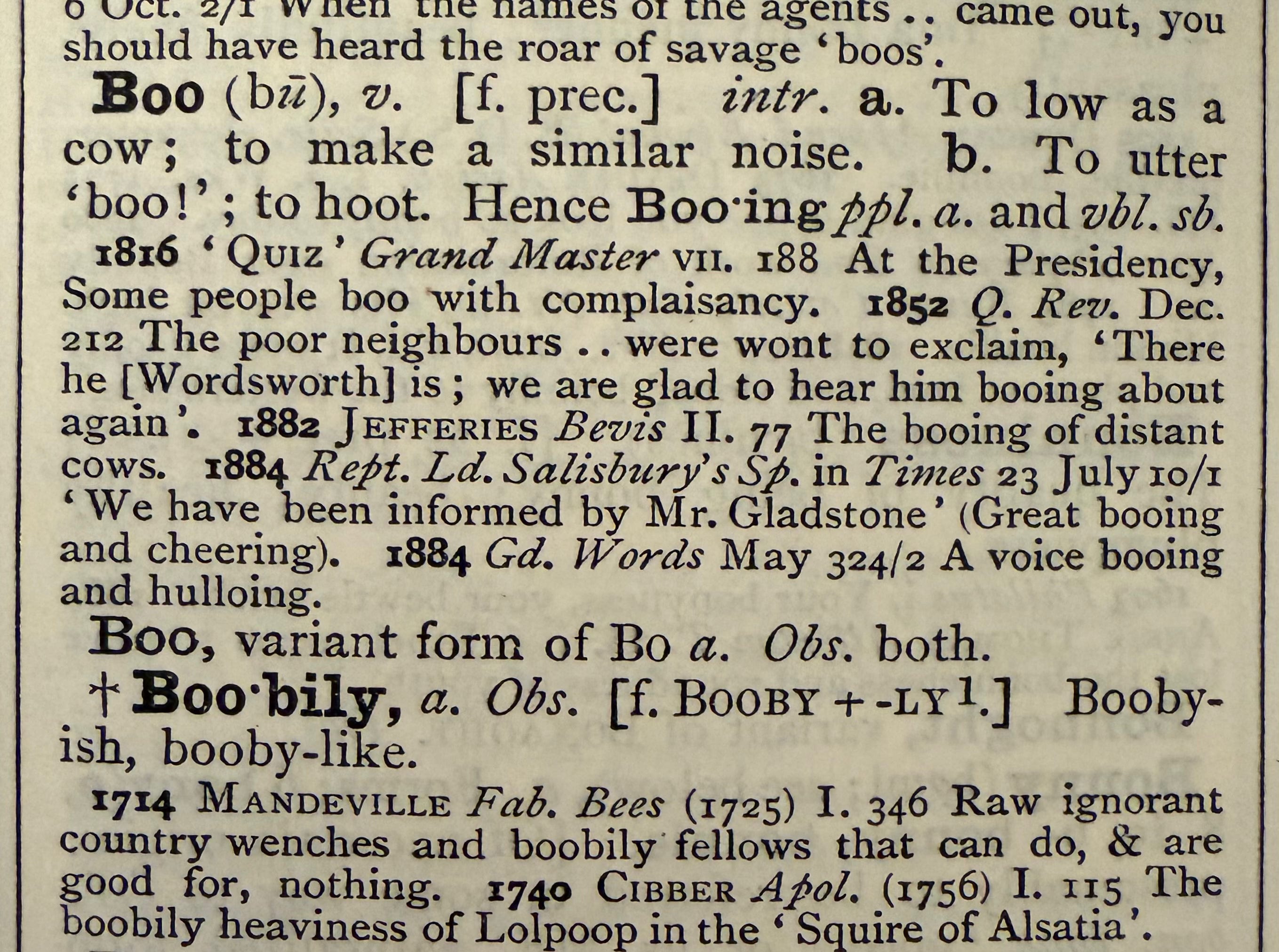
How the OED proceeds from boo to boobily while not even including boob is beyond me. Where is boob?!? Why is boobily bobbing around in there, but not boob itself? Why is this starting to sound like a MAD Magazine piece? At any rate: in addition to being slang for a human breast, it means an idiot. The origin is unclear.
BOONDOGGLE
I just love this one. In the late 1920s, boondoggle was the name of the newspaper of a Rochester, New York Boy Scout troop. I don’t know if it was common a century ago for individual Boy Scout troops to each have their own little newspapers, but this one did. It was a nonsense word referring to a bunched-up, lanyard-adjacent pin designed and woven by the scouts of that specific troop, and so they also used it for their newspaper.
In 1929, Edward, Prince of Wales, was visiting the United States, including a trip to the Boy Scout jamboree. The Rochester troop presented him with a boondoggle, which he was photographed wearing. There followed some jokes about the fashion-conscious prince looking silly wearing this thing on his lapel.
Then in the spring of 1935, in the depths of the Great Depression, The New York Times published an article decrying the use of $3 million dedicated to — among other projects — an arts-and-crafts class for jobless men. Boondoggles were created in some of those classes. Boondoggle swiftly came to mean a wasteful expenditure, especially a political one, and most especially when it’s publicized as having been done for the public good.
BONKERS
A late 1950s British slang term meaning crazy, suggesting that the crazy behavior may have stemmed from getting bonked (i.e., hit) on the head.
BROUHAHA
Of 15th century French origin, meaning clamor or commotion. Origin unknown.
BUMBERSHOOT
A late 19th century English slang term for an umbrella, facetiously combining umbrella and parachute.
* * *
My books are all available on Amazon except for the most recent one: All the Frogs: Laughing While You’re on the Dating Apps. It’s available only via yours truly, by sending $25 and your mailing address to Venmo @VodreyBooksEtc. This covers the book and shipping. I’d be much obliged if you’d hit the heart button, comment and/or re-stack this. All images are my own unless otherwise credited. Thanks so much for reading, and please consider subscribing — it’s free!
No posts
Comments
Nothing yet. Say the first thing.
Sign in to join the conversation.