
The work of Charles Portis is not well-known enough, in my opinion, and I aim here to change that for just a wee few Americans as our semiquincentennial approaches.
I am honestly astonished, in retrospect, that I was not required to read Portis in either high school or college, though I am a bookworm of the first order and I was asked to read a boatload of good books that are justly considered classics. As I’d graduated high school only a dozen years after True Grit was published, perhaps it was too early at that time to affix it to the received list of classics.
Decades later, though, it unnerves me that if you ask the average American (not that there is any such thing, but you get my drift) about Charles Portis, they wouldn’t recognize his name. He is, I believe, in the same august group of American writers as Toni Morrison and Edith Wharton and F. Scott Fitzgerald and Nathaniel Hawthorne and their ilk.
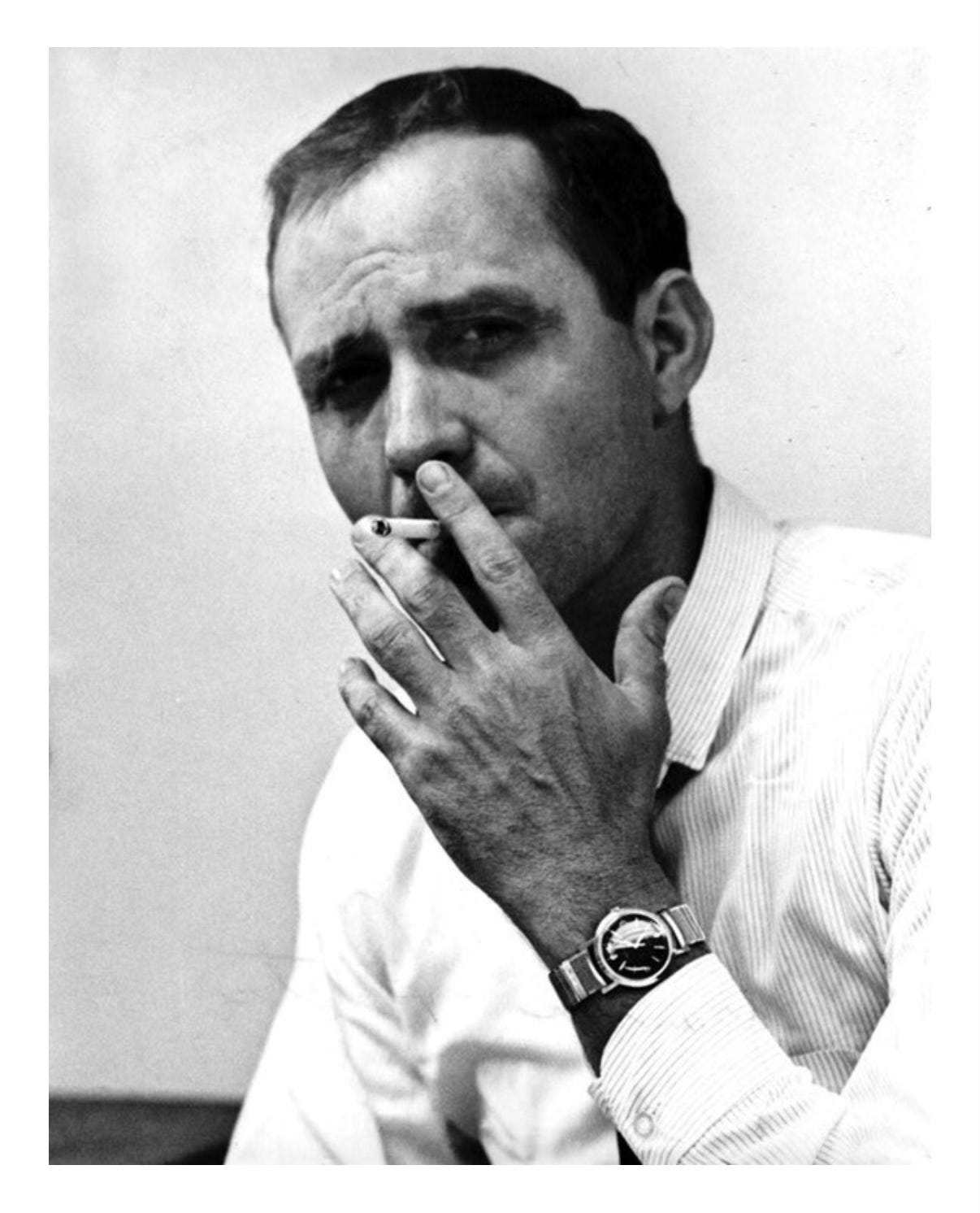
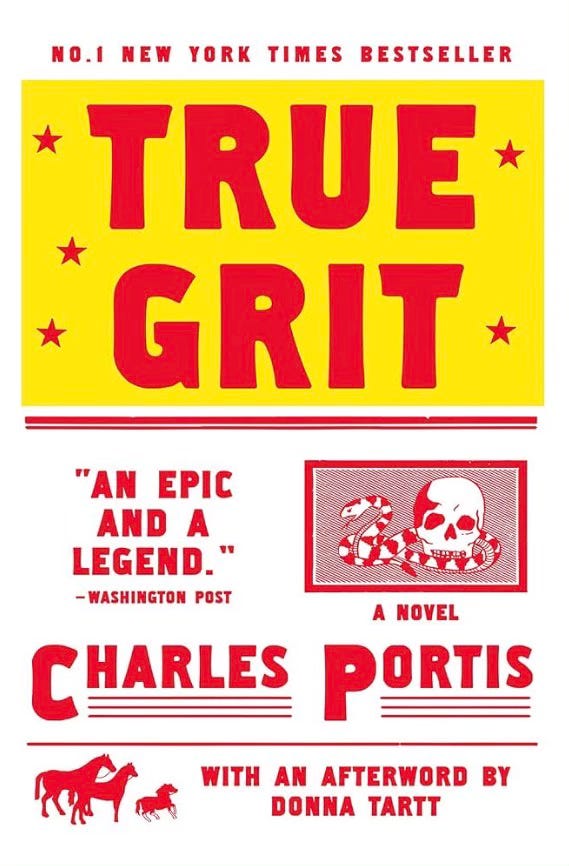
True Grit is a masterpiece, most especially because the main character and narrator Mattie Ross is so vividly rendered. Two good movies have been made out of it, but you have to read it to get the full sense of Portis’s very interesting brain, his unimproveable ear for dialogue and his superb sense of plot. Eliot Fremont-Smith reviewed the novel in the New York Times in 1968, turning the title back into the descriptive phrase:
True grit is when you are a 14-year-old girl from Yell County, Arkansas, and you’ve just shot a dangerous outlaw and the gun’s recoil has sent you backward into a pit, and you are wedged in the pit and sinking fast into the cave below where bats are brushing against your legs, and you reach out for something to hold on to and find a rotting corpse beside you and it’s full of angry rattlers, and then it turns out you didn’t kill the outlaw, he’s up at the rim of the pit laughing at you, about to shoot you — and you don’t lose your nerve.
Portis (1933 – 2020) was born and reared in Arkansas and earned his journalism degree at the University of Arkansas. He remarked much later that in his youthful aimlessness, he had gone to college to study journalism because he thought it might be “fun and not very hard, something like barber college.”
He got his professional start writing for the Memphis Commercial Appeal, but soon returned to Arkansas and wrote for a number of newspapers in the state. Via that work, Portis had ongoing dealings with stringers — newspaper freelancers who wrote and sent in small local pieces, provided photos and calendars, etc. These were often older women sending in reports of church picnics, births and weddings, school board meetings, raffles, fundraisers and the like. They were familiar to him, and he absorbed their cranky, prim, stiff-necked voices. He later memorably incorporated their combined essence into the voice of Mattie Ross.
Eventually Portis left for the big city, writing for and then becoming London bureau chief for the New York Herald Tribune — unbelievably, a position previously held by none other than Karl Marx. Portis’s literature, which he began publishing only after he’d left journalism, was a gift to all of us. Several years ago, Pulitzer Prize-winning American author Donna Tartt wrote:
. . . a great part of True Grit’s charm is in Mattie’s blasé view of frontier America. Shootings, stabbings, and public hangings are recounted frankly and flatly, and often with rather less warmth than the political and personal opinions upon which Mattie digresses. She quotes scripture; she explains and gives advice to the reader; her observations are often overlaid with a decorative glaze of Sunday School piety. And her own very distinctive voice (blunt, unsentimental, yet salted with parlor platitudes) echoes throughout the reported speech of all the other characters — lawman and outlaws alike — to richly comic effect, as when Rooster remarks austerely of a young prisoner he has brought back alive to stand trial: “I should have put a ball in that boy’s head instead of his collarbone. I was thinking about my fee. You will sometimes let money interfere with your notion of what is right.”
See for yourself the wonder that is Charles Portis’s fiction. What follows are passages from True Grit. The opening paragraph alone is stellar:
People do not give it credence that a fourteen-year-old girl could leave home and go off in the wintertime to avenge her father’s blood but it did not seem so strange then, although I will say it did not happen every day. I was just fourteen years of age when a coward going by the name Tom Chaney shot my father down in Fort Smith, Arkansas, and robbed him of his life and his horse and $150 in cash money plus two California gold pieces that he carried in his trouser band.
* * *
Recognizing that she cannot take care of this vengeance solo, Ross sets out to find help:
“Who is the best marshal they have?” The sheriff thought on it for a minute. He said, “I would have to weigh that proposition. There is near about two hundred of them. I reckon William Waters is the best tracker. He is a half-breed Comanche and it is something to see, watching him cut for sign. The meanest one is Rooster Cogburn. He is a pitiless man, double-tough, and fear don’t enter into his thinking. He loves to pull a cork. Now L.T. Quinn, he brings his prisoners in alive. He may let one get by now and then but he believes even the worst of men is entitled to a fair shake. Also the court does not pay any fees for dead men. Quinn is a good peace officer and a lay preacher to boot. He will not plant evidence or abuse a prisoner. He is straight as a string. Yes, I will say Quinn is about the best they have.” I said, “Where can I find this Rooster?”
Complains one young rule-following man to Mattie: “If you don’t have no schooling you are up against it in this country, sis. That is the way of it. No sir, that man has no chance any more. No matter if he has got sand in his craw, others will push him aside, little thin fellows that have won spelling bees back home.”
* * *
Rooster said, “On his deathbed he asked for a priest and became a Catholic. That was his wife’s religion. It was his own business and none of mine. If you had sentenced one hundred and sixty men to death and seen around eighty of them swing, then maybe at the last minute you would feel the need for some stronger medicine than the Methodists could make.”
* * *
GOUDY: [cross-examining Rooster] How many men have you shot since you became a marshal, Mr. Cogburn?
ROOSTER COGBURN: I never shot nobody I didn’t have to.
GOUDY: That was not the question. How many?
ROOSTER COGBURN: Uh . . . shot or killed?
GOUDY: Oh, let us restrict it to “killed” so that we may have a manageable figure.
* * *
You go for a man hard and fast enough and he don’t have time to think about how many is with him, he thinks about himself and how he may get clear out of the wrath that is about to set down on him.
* * *
With that, Quincy brought the bowie knife down on Moon’s cuffed hand and chopped off four fingers which flew up before my eyes like chips from a log. Moon screamed and a rifle ball shattered the lantern in front of me and struck Quincy in the neck, causing hot blood to spurt on my face. My thought was: I am better out of this.
* * *
Lucky Ned Pepper and Rooster are taunting each other across a wide plain:
ROOSTER COGBURN: I mean to kill you in one minute, Ned. Or see you hanged at Judge Parker’s convenience. Which’ll it be?
LUCKY NED PEPPER: That’s bold talk for a one-eyed fat man.
COGBURN: Fill your hand, you son of a bitch!
The novel continues: “ . . . and he took the reins in his teeth and pulled the other saddle revolver and drove his spurs into the flanks of his strong horse Bo and charged directly at the bandits. It was a sight to see. He held the revolvers wide on either side of the head of his plunging steed.”
A note: to this day, if I’m playing poker or spades with anyone, at least one of us will — in response to a bid — sneer, “I call that bold talk for a one-eyed fat man.”
* * *
Rooster talked all night. I would doze off and wake up and he would still be talking. Some of his stories had too many people in them and were hard to follow but they helped to pass the hours and took my mind off the cold. I did not give credence to everything he said. He said he knew a woman in Sedalia, Missouri, who had stepped on a needle as a girl and nine years later the needle worked out of the thigh of her third child. He said it puzzled the doctors.
* * *
I will go further and say all cats are wicked, though often useful. Who has not seen Satan in their sly faces? Some preachers will say, well, that is superstitious “claptrap.” My answer is this: preacher, go to your Bible and read Luke 8:26-33.
* * *
“I didn’t know you had a wife.”
“Well, I don’t now. She taken a notion she wanted me to be a lawyer. Running a eating place was too lowdown for her. She bought a heavy book called Daniels on Negotiable Instruments and set me to reading it. I never could get a grip on it. Old Daniels pinned me every time. My drinking picked up and I commenced staying away two and three days at a time with my friends. My wife did not crave the society of my river friends. She got a bellyful of it and decided she would go back to her first husband who was clerking in a hardware store over in Paducah. She said, ‘Goodbye, Reuben, a love for decency does not abide in you.’ There is your dee-vorced woman talking about decency. I told her, I said, ‘Goodbye, Nola, I hope that little nail-selling bastard will make you happy this time.’ She took my boy with her too. He never did like me anyhow. I guess I did speak awful rough to him but I didn’t mean nothing by it. You would not want to see a clumsier child than Horace. I bet he broke forty cups.”
* * *
GOUDY: I believe you testified that you backed away from Aaron Wharton.
COGBURN: That is right.
GOUDY: You were backing away?
COGBURN: Yes, sir. He had that ax raised.
GOUDY: Which direction were you going?
COGBURN: I always go backwards when I am backing up.
* * *
“I robbed one of them little high-interest banks there. Thought I was doing a good service. You can’t rob a thief, can you? I never robbed no citizens. I never taken a man’s watch.”
“It is all stealing,” said I.
“That was the position they taken in New Mexico,” said he.
* * *
As he drank, little brown drops of coffee clung to his mustache like dew. Men will live like billy goats if they are let alone.
* * *
When Mattie is offered alcohol:
“This is the real article. It is double-rectified busthead from Madison County, aged in the keg. A little spoonful would do you a power of good.”
“I would not put a thief in my mouth to steal my brains.”
. . . I had not the strength nor the inclination to bandy words with a drunkard. What have you done when you have bested a fool?
* * *
Portis wrote other novels as well and in my opinion, the best of these is The Dog of the South, a wandering, goofball picaresque that lacks the dovetailed perfection of True Grit but has all the same peculiar humor.

“John Selmer Dix was the greatest man of our time. He was truly a master of the arts, and of some of the sciences too. He was the greatest writer who ever lived.”
“They say Shakespeare was the greatest writer who ever lived.”
“Dix puts William Shakespeare in the shithouse.”
* * *
To the best of my knowledge, he had never even voted, and then someone must’ve told him something about politics, some convincing lie, or he read something — it’s usually one or the other — and he stopped being funny and turned mean and silent. That wasn’t so bad, but then he stopped being silent.
* * *
I read Melba’s short story. She had broken the transition problem wide open by starting almost every paragraph with “Moreover.” She freely used “the former” and “the latter” and every time I ran into one of them, I had to backtrack to see whom she was talking about. She was also fond of “inasmuch” and “crestfallen.”
* * *
“What about the Estes boy who was so funny? He always had some new joke or comical story to tell.”
“Chemical story?” said Melba.
“Comical story! He and Reo were inseparable chums at one time.”
“He’s another rat,” said the doctor. “And I’m not talking now about brown norvegicus, your common rat, I’m talking about rattus rattus himself, all black and spitting. Walker Estes would trip a blind man. The last time I saw him, he was stealing Christmas presents out of people’s cars and trucks.”
* * *
He ended this long account by saying that Dr. Wooten had “invented clamps.”
“Medical clamps?” I idly inquired.
“No, just clamps. He invented the clamp.”
“I don’t understand that. What are you talking about?”
“Clamps! Clamps! That you hold two things together with! Can you understand plain English?”
“Are you saying this man made the first clamp?”
“He got a patent on it. He invented the clamp.”
“No, he didn’t.”
“Then who did?”
“I don’t know.”
“You don’t know. And you don’t know Smitty Wooten either, but you want to tell me he didn’t invent the clamp.”
“He may have invented some special kind of clamp, but he didn’t invent the clamp. The principle of the clamp was probably known to the ancient Sumerians. You can’t go around saying this fellow from Louisiana invented the clamp.”
* * *
“What is your work in this world?”
“I don’t know yet. I’m back in school now.”
“It’s getting pretty late in the day for you to have so few interests and convictions. How old are you, Mr. Midge?”
“I’m twenty-six.”
“Later than I thought. Think about this: all the little animals of your youth are long dead.”
Melba said, “Except for turtles.”
* * *
I had sat next to Dupree on the rim of the copy desk [at the local newspaper]. In fact, I had gotten him the job. He was not well-liked in the newsroom. He radiated dense waves of hatred and never joined in the friendly banter around the desk, he who had once been so lively. He hardly spoke at all except to mutter “crap” and “what crap” as he processed news matter, affecting a contempt for all events on earth and for the written accounts of those events.
* * *
“I have a little test I like to give to people like you who claim to be Bible scholars. Do you mind taking a little test for me?”
“Is it a written test?”
“No, it’s just one question.”
“I don’t mind taking your test, Meemaw, but there is a misunderstanding here. You asked me if I had read the Bible, and I said I had read some of it. I did not say I was a Bible scholar.”
“We’ll soon know, one way or the other. All right, the wedding in Cana. John 2. Jesus turned six pots of water into six pots of so-called wine. His first miracle. His mother was there. Now do you believe that was alcoholic wine in those pots, or unfermented grape juice?”
“What does the Bible say?”
Melba said, “The Bible just says wine. It says good wine.”
“Then that’s what I say. I say wine.”
“It’s your notion then that Jesus was a bootlegger?”
* * *
If you’re of a mind to treat yourself to a Portis book or two, I encourage you to order from any of these wonderful independent bookstores:
TinyBooksOnline.com
Allstora.com
BraveAndKindBooks.com
ThankYouBookshop.com
* * *
My books are all available on Amazon except for the most recent one. All the Frogs: Laughing While You’re on the Dating Apps is available only via yours truly, by sending $25 and your mailing address to Venmo @VodreyBooksEtc. That covers the book, shipping, etc. I encourage you to share this! Thanks for reading, and please consider subscribing!
No posts
Comments
Nothing yet. Say the first thing.
Sign in to join the conversation.