
On my father’s side, my great-great-great-grandparents, Jabez and Sarah Vodrey, emigrated from England to the United States in 1827. My mother’s ancestors emigrated to the United States from the 17th century onward largely from England, Scotland and Ireland. They scattered, but lived primarily in Maryland, New Jersey and New York.
Maryland. It’s been described as the southernmost of the northern states, or the northernmost of the southern states. In my view, it’s more southern than northern. So Maryland standing out from the northern states in my family background prompted me to wonder from time to time if any of my ancestors had enslaved anyone.
For decades, I’ve been a go-to geneaological person in my extended family. I’d never found any evidence that anyone on either side had anything personally to do with slavery, but: I’d also never looked for it. It was settled in my mind, as no obvious evidence to the contrary had arisen. I allowed myself to assume that no matter what other dastardly things ancestors of mine might have done, enslaving people was not on the list.
Several years ago, I was gobsmacked to find out completely by chance that I did indeed have enslaving ancestors. I happened to be reading an October 21st, 2019 New York Times article on how Princeton Theological Seminary had just voted to re-name its Center for Black Church Studies in honor of Betsey Stockton.
I thought, “Hmm, Stockton’s a family name and it’s fairly unusual and hmm, that’s Princeton Theological Seminary, just down the road a little ways from Princeton University, from whence my dad and both grandfathers graduated and I’m descended from Ashbel Green who was president of Princeton when it was still the College of New Jersey and . . . well, let’s read on.”
From the article: “Ms. Stockton, a prominent African-American teacher in Princeton and Philadelphia, in some ways embodies the seminary’s complicated, and at times contradictory, connections to slavery . . . She was given as a slave to [Elizabeth Stockton,] the first wife of Ashbel Green, the first president of the seminary’s board of directors. Rev. Dr. Green, who owned several slaves, also led a Presbyterian Church General Assembly committee that produced an 1818 statement condemning slavery as ‘a gross violation of the most precious and sacred rights of human nature,’ the report said. After Ms. Stockton was emancipated [in 1817, at about age 19], the report said, Mr. Green encouraged her religious education and missionary work in what is now known as Hawai’i.”
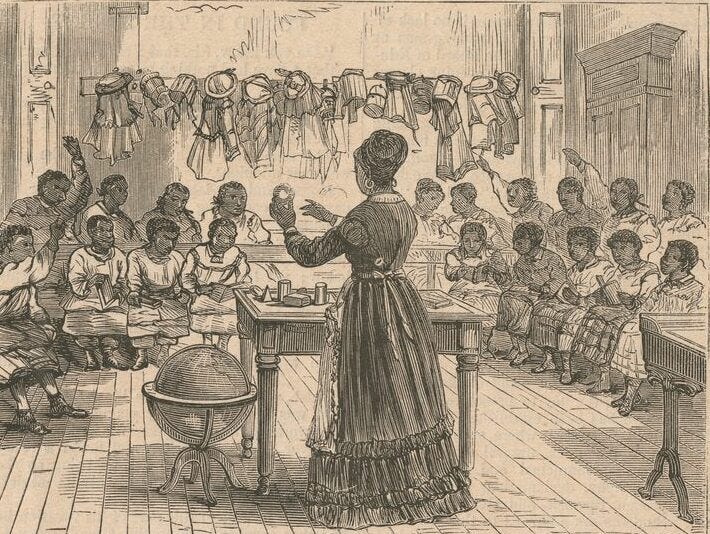
Not just missionary work but in fact, in 1822, the American Board of Commissioners for Foreign Missions (ABCFM) — only a dozen years old at that point — recommended Betsey Stockton for their work. Thus after a five-month voyage on the whaling ship Thames, at the age of 24, Betsey Stockton became the first woman missionary to the Sandwich Islands (now the Hawai’i Islands).
According to Gregory Nobles, author of an acclaimed biography of Betsey Stockton, writes, “Her ABCFM contract put her in something of a social middle ground, calling for her ‘to be regarded & treated neither as an equal nor as a servant, but as an humble Christian friend.’ “
She not only taught there, she trained other teachers. She returned to the United States three years later and not long after, headed north and established a school in Grape Island, Canada for the native population there.
Stockton returned to Princeton in 1835 and spent the next three decades teaching there at the town’s only public school for Black children. In 1840, she helped to establish Princeton’s First Presbyterian Church of Color (later called the Witherspoon Street Church).
And what happened to the other enslaved people living in the household of Ashbel Green? I have no idea. I haven’t been able to find out anything about them. Why was Ms. Stockton educated? Were they not? Were they related to her? Did they ever gain their freedom as she did? I have so many questions.
Betsey Stockton died five months after the Civil War ended. I find myself thinking a lot about how tightly braided together we all are, amongst our extended existing family members and our ancestors. A little over a year before Ms. Stockton died, one of my paternal ancestors, John Vodrey — a son of Jabez and Sarah — was fighting for the Union when he was killed at the Battle of New Hope Church in Georgia.
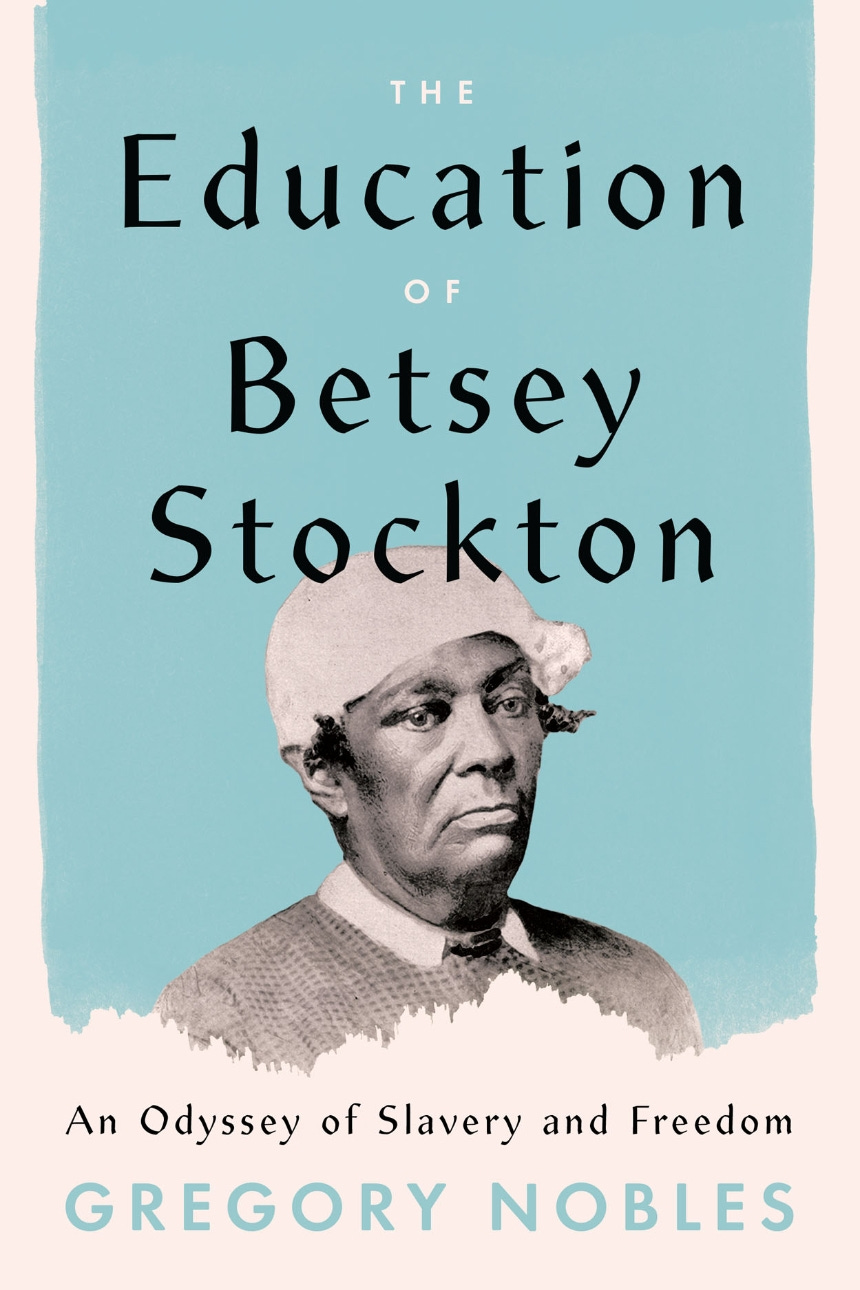
Betsey Stockton spent decades as a teacher and missionary. Both professions are fundamentally characterized by outreach, education and sharing. I find it both melancholy and meaningful that she spent three of her adult working years in Hawai’i, future birthplace of our first Black president.
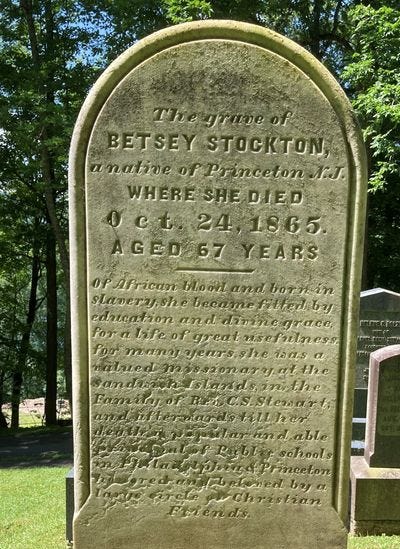
Betsey Stockton is buried in Lakewood Cemetery in Cooperstown, New York. Her tombstone reads:
The grave of
BETSEY STOCKTON
A native of Princeton NJ
WHERE SHE DIED
Oct. 24, 1865
AGED 67 YEARS
Of African blood and born in
slavery, she became fitted by
education and divine grace
for a life of great usefulness.
For many years, she was a
valued missionary at the
Sandwich Islands, in the
family of Rev. C. S. Stewart,
and afterwards till her
death was a popular and able
principal of Bible schools
in Philadelphia & Princeton
where she was beloved by a
large circle of Christian
Friends.
* * *
My books are all available on Amazon except for the most recent one: All the Frogs: Laughing While You’re on the Dating Apps. It’s available only via yours truly, by sending $25 and your mailing address to Venmo @VodreyBooksEtc. This covers the book and shipping. All images are my own unless otherwise credited. Thanks so much for reading, and please consider subscribing — it’s free!
No posts
Comments
Nothing yet. Say the first thing.
Sign in to join the conversation.