
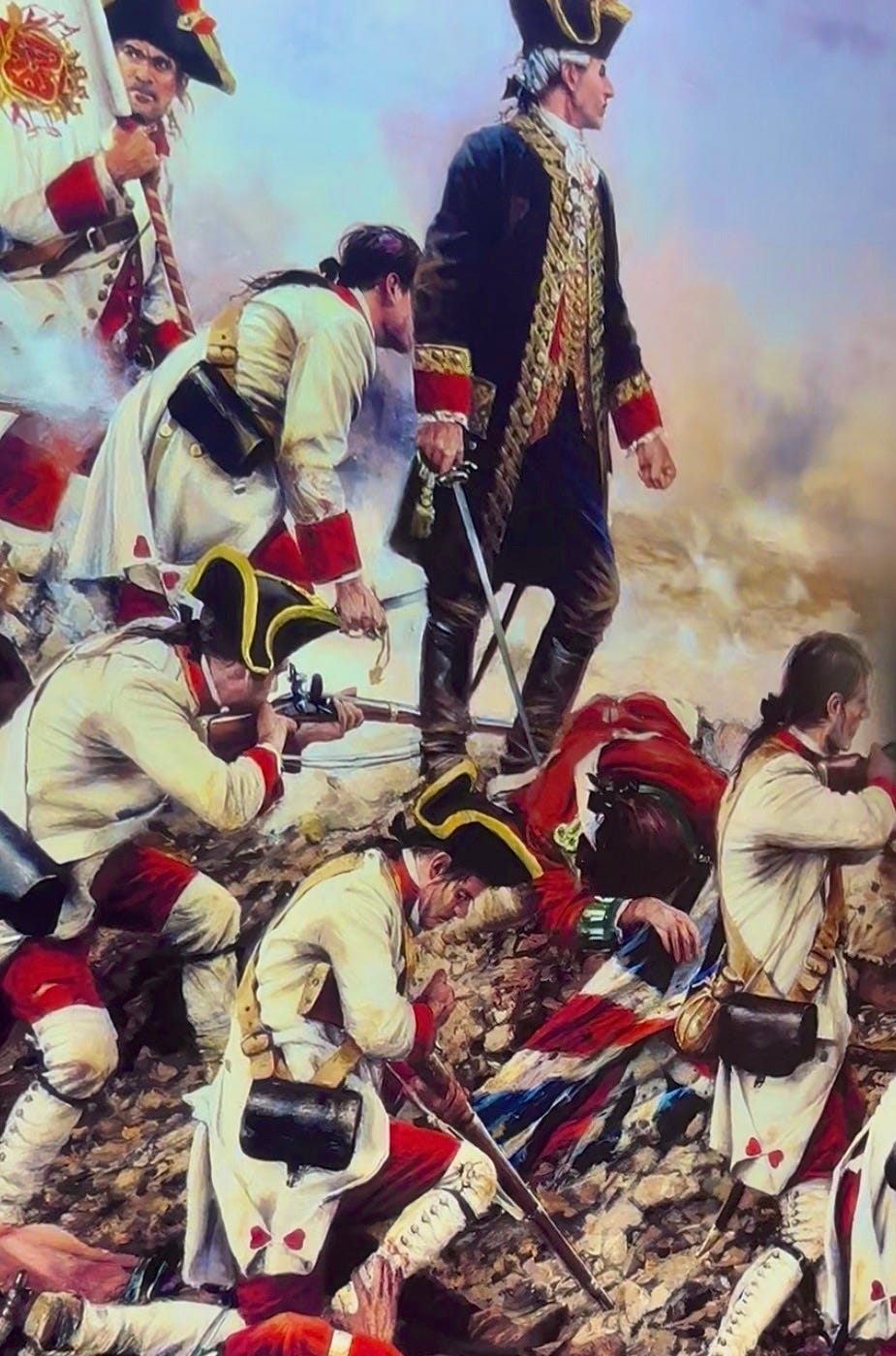
When the American Revolutionaries were fighting the world’s most powerful empire (Britain) with scarcely any gunpowder or other supplies, the Spaniards stepped up to assure the “General de los Estados Unidos Americanos” Washington and his men that they were not alone.
There are so many inspiring, beautiful stories about the great heroes of American history which are scarcely ever told. One happens on them accidentally—buried in a thick, out-of-print biography, in small print on a museum sign, casually and fleetingly mentioned in an obscure educational video. America cannot return to greatness in the future if we do not truly understand the greatness of our past. That is why I am writing an article series to tell a few of these little-known but moving or illustrative “untold stories” of American greatness. Previous articles in this series include the fatherly letter and psalm that carried Jimmy Stewart through WWII; Henry Wadsworth Longfellow, poet and abolitionist; George Patton, Olympic athlete; tales of military heroism for Armed Forces Day; and Col. Greene, Patriot commander and hero.
Today’s story is about an event that occurred exactly 250 years ago, on August 15, 1776. Virginia militiamen arrived in New Orleans, which during the second half of the 18th century was under Spanish control, in order to request badly needed gunpowder from the Spaniards. As inspiring as the Declaration of Independence was, and as brave as Patriot soldiers were, they could not fight a war without anything to put in their firearms.
The American colonists had for decades depended heavily on Great Britain for any products that needed to come from overseas. When the Revolution began and the British trade froze, the Patriots realized they were dangerously short of many necessities, including gunpowder, which they could not produce in sufficient quantities and which was absolutely necessary for fighting the British. So Virginia Patriots headed to New Orleans to ask the Spanish for supplies, especially a large quantity of gunpowder. Two of Spain’s Louisiana governors, Luis de Unzaga y Amezaga and Bernardo Vicente Apolinar de Gálvez y Madrid, would save the Patriots from having to give up the fight for independence almost as soon as it began.
The site Unveiling Memories claims that in one letter Unzaga wrote to George Washington under the title “General de los Estados Unidos Americanos” or General of the United States of America, the Spaniard assured Washington of every effort in his power to support the American cause (the Library of Congress preserves their correspondence). Perhaps Unzaga had a personal philosophical attraction to the American cry of liberty, since he had repealed abusive slavery laws and expanded land possession opportunities for people from multiple social positions. The Spanish crown moved Unzaga to Venezuela before he could really put his plans into operation regarding the Americans, but Unzaga’s successor in Louisiana, de Gálvez, proved to be—if possible—even more zealous in supporting and furthering the American quest for independence.
In fact, de Gálvez was so important in his financial, trade, and military assistance to American Patriots that Pensacola, Fla., still has a Galvez Day and the Texas town of Galveston is named for him.
The Northern Virginia Sun ran a series of pieces for America’s bicentennial in 1976, 50 years ago, that included information about the gunpowder mission in August 1776. Below is a passage taken from a 1976 article, which referenced another column titled “500 pounds of gunpowder,” and which honored Virginia officers for their mission to the Spanish (formatting errors are from the original):
On May 12, 1776, the Virginia Committee of Safety dispatched two officers, Captain George Gibson and Lieutenant Linn, to New Orleans to seek new supplies of gunpowder essential to the colony’s defense. The two Virginians, assuming the guise of traders, journeyed down the Ohio and Mississippi from Fort Pitt to New Orleans. With the invaluable assistance of Oliver [P]ollock, a New Orleans’‘ businessman, they were successful in persuading the Spanish Governor, Luis de Unzaga y Amezaga, to make the secret sale of gunpowder to Virginia. Linn took three-fourths of the gunpowder- up the river, getting it to Forts Pitt and Wheeling just in time to save those outposts from the British and their Indian allies. To mask the effort and to convince the British that Spain was not violating its neutrality, Captain Gibson permitted himself to be arrested. He was then released quietly and sailed for Philadelphia with the remaining gunpowder and other needed supplies-- muskets, blankets and medicine:’ The gunpowder with which Clark first outfitted his men was part of the twelve thousand pounds of gunpowder (!) obtained by Gibson and Linn from the Spanish King’s Stores in New Orleans. Later, as Clark continued his military successes in the west, he .continued to depend on the secret aid of Spain.
We modern Americans sometimes forget that France was not the only European nation to aid us in defeating Great Britain, that Spain was so financially helpful we named our currency the “dollar” with the Spanish word.
Untold Stories: Caesar Rodney’s Midnight Ride Brought U.S. Independence
And here’s where de Gálvez came in, as I mentioned earlier, to carry on the Spanish alliance with the American Patriots and to take an active role in the fighting himself. The Northern Virginia Sun explained:
Bernardo de Galvez... for whom Galveston, Texas, is named ...provided not only the needed military supplies, but the finances and credit needed to fund., [sic] the Commissary Department and pay the troops. de Galvez provided large sums from his “very secret service money” and loaned even more from the Spanish Treasury, and has been credited with enabling the Americans to retain control of the territory north of the Ohio. He even allowed the Americans to fly the Spanish flag on supply ships to protect them from shelling by English shore batteries. And, when Spain entered the war on the side of the Americans on June 21, 1779, it was Galvez, with Oliver Pollock riding at his side, who captured Baton Rouge, Natchez, Mobile and Pensacola from the British.
In this semiquincentennial year of America’s existence, as we honor the Americans who coordinated vitally important alliances, we must likewise pay tribute to the allies who made the Revolution’s ultimate victory possible.
Thanks for reading Pro Deo et Libertate! This post is public and on an important topic so feel free to share it.
No posts
Comments
Nothing yet. Say the first thing.
Sign in to join the conversation.