
Yesterday morning on the BBC (18/1/26), the Chair of the Royal Association of British Dairy Farmers was interviewed about the problems UK dairy farmers face due to falling milk prices and oversupply. He blamed this on the ‘global milk price’. Global? Seriously?
The UK does not import milk from the global market. It doesn’t even import milk from major dairy exporters like New Zealand, which has a trade deal with the UK. And milk was neither excluded from the trade agreement nor hit with a tight UK quota for many years, as the UK did to New Zealand beef, lamb, butter, cheese, apples, etc. There was no need to do this. Milk doesn’t travel well.
All of the UK’s imported milk comes from the EU – all of it! The World’s top six milk exporters are all EU countries: Germany, Belgium, the Czech Republic, the Netherlands, France, and Poland. The UK is 7th, that’s right, the UK is the world’s 7th largest milk EXPORTER. So why is this British Dairy farmer complaining about the low ‘global’ price? The only non-EU country in the world’s top 10 milk exporters is New Zealand.
British dairy farmers should stop kidding themselves; they are not being undercut by ‘global prices’, they are being undercut by subsidised EU prices. New Zealand’s milk is exported to China, the Philippines, Taiwan, Malaysia, Vietnam, Fiji, New Caledonia, Tonga, Samoa and almost every other Pacific island nation you can think of, including French Polynesia and the US Minor Outlying Islands, but not to Europe or the US mainland. As I said, fresh milk doesn’t travel well or far.
It is also worth noting that the UK exports less than 10% of the milk it produces each year. The UK produces 12.6 billion litres of milk each year, but exports only about 1 billion kilograms of total dairy products, including milk, cheese, butter, and powdered milk. This is not about global prices; it is a domestic price problem.
The UK exports three times as much fresh milk as it imports, but almost all of its exports go to Ireland, and they are probably exported from Northern Ireland, which is still part of the EU’s territory for agricultural rules. There is no need for Northern Ireland to sign up to the EU’s SPS area; it is already in it.
Meanwhile, although Ireland also supplies about 90% of the UK’s milk imports, we also import milk from Germany, Poland, France, Belgium, the Netherlands and Denmark. With small quantities imported from Romania, Spain, Italy, Portugal, Luxembourg, Sweden, the Czech Republic, and Austria. As I said, all EU. All subsidised.
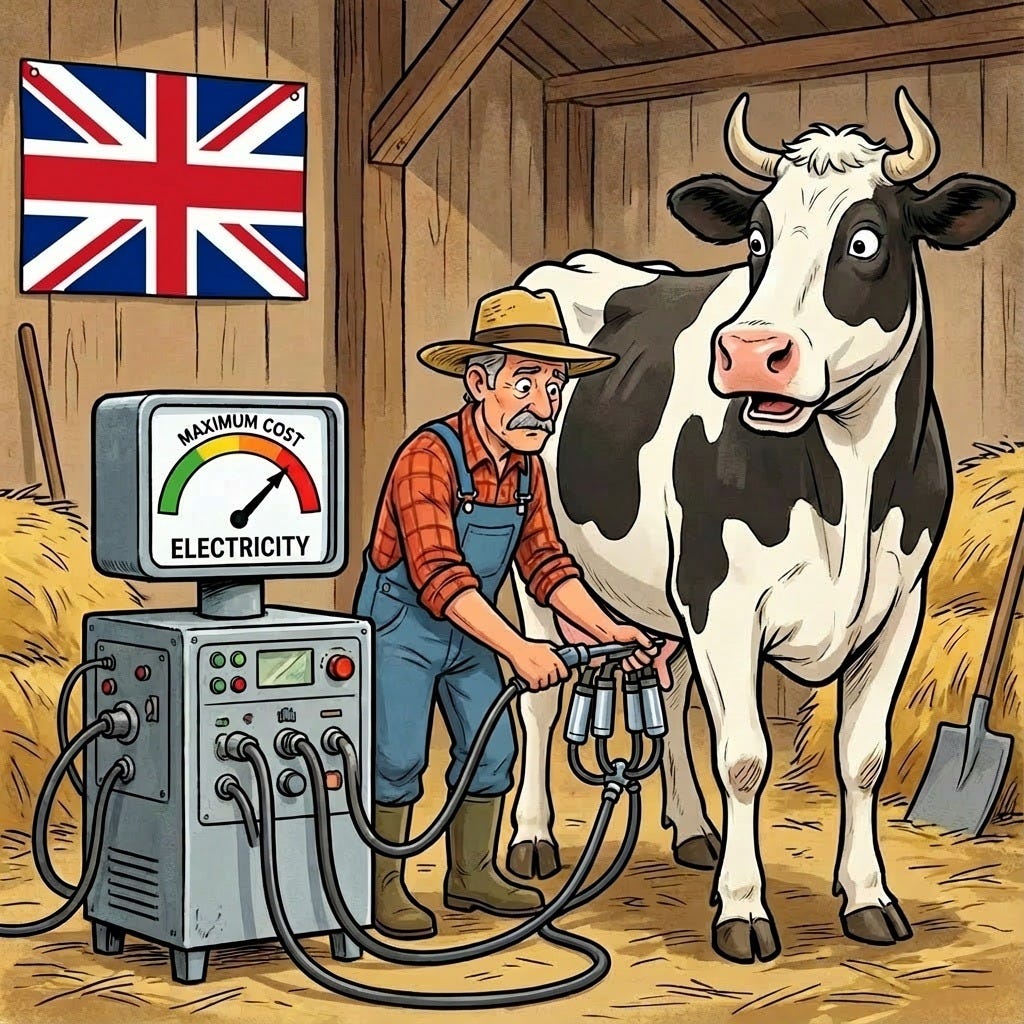
But anyone who watched the BBC’s interview will have noticed something else: all of the dairy farmers in the video had massive electrical milking machines, and somewhere out of camera shot, there would have been refrigerated storage facilities. The dairies that buy, collect, pasteurise, homogenise, and bottle this milk, then distribute it to supermarkets, will also have massive electricity bills. Energy is possibly their largest expense. The Supermarkets that sell most of the milk also have massive electricity bills from refrigerated storage rooms and open refrigerated shelving in their stores. Even if you still have a milkman delivering your milk, they probably use an electric milk float.
If anything is forcing Supermarkets to cut the amount they pay farmers for wholesale milk, it is probably the cost of electricity. This is an expense where supermarkets have little negotiating strength because they have stores all over the country, so they are not a major players for any power company.
To add to the absurdity of the UK’s agricultural pricing, The Telegraph reports that an activist who gained media attention from throwing custard at the crown jewels for Just Stop Oil, is now planning to steal food from Waitrose Supermarkets for another NGO called Take Back Power. He claims Waitrose prices are too high. While this cretin from Chiswick via Exeter University probably doesn’t know that ‘other supermarkets are available’, he should understand that his old masters at Just Stop Oil are a large part of the reason why Waitrose’s energy bills and, therefore, its prices are so high.
The UK has the highest industrial electricity prices among developed countries. This is due to the UK’s Carbon Price Support (CPS) tax, its emissions allowance costs, and the additional balancing and backup costs resulting from the large proportion of intermittent wind and solar power in the UK grid. The UK introduced the CPS in 2013 to discourage the production of coal-fired electricity. The last coal-fired power plant closed in September 2024, so why is this additional £18 per tonne of CO2 still being added to electricity bills? This adds about £8 per MWh.
Chart below from Electric Insights, Quarterly Report
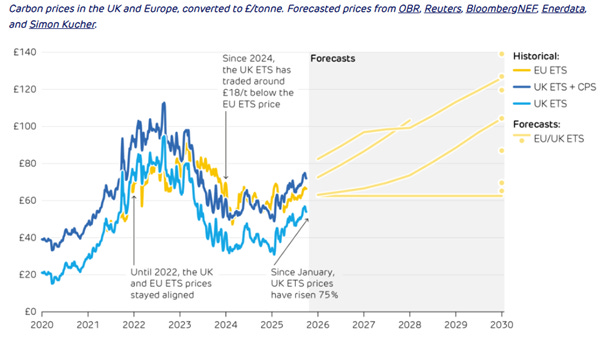
The CPS also makes UK electricity more expensive than EU electricity now that the UK-EU Reset will force the UK to join the EU’s ETS scheme and pay the same ETS price as EU electricity consumers. Paying the EU ETS tax and the UK’s CPS tax will push up costs for UK industry, as well as for supermarkets and their customers. It will also probably drive out the few remaining industries in the UK, but that requires another essay.
Lowering industrial electricity costs for all businesses would help reduce costs for UK consumers, and it is a better solution than forcing dairy farmers out of business by lowering wholesale milk prices.
It is a pity that the custard cretin from Chiswick didn’t use his degree to lobby the government to remove the CPS taxes on electricity producers, now that the UK has ‘Just Stopped Coal’ to generate electricity. Let’s hope he gets arrested for stealing food – he has warned Waitrose he is coming, and they know what he looks like thanks to his publicity drive for his new cause.
On the plus side, one of my local Waitrose (yes, I have two) has just replaced its open refrigerated shelving with closed, glass-sliding-door refrigerated shelving. This should lower their energy costs and could lower prices for paying consumers – it is just a pity that paying customers will also have to make up for the cost of food stolen by ‘eco activists’.
No posts
Comments
Nothing yet. Say the first thing.
Sign in to join the conversation.