
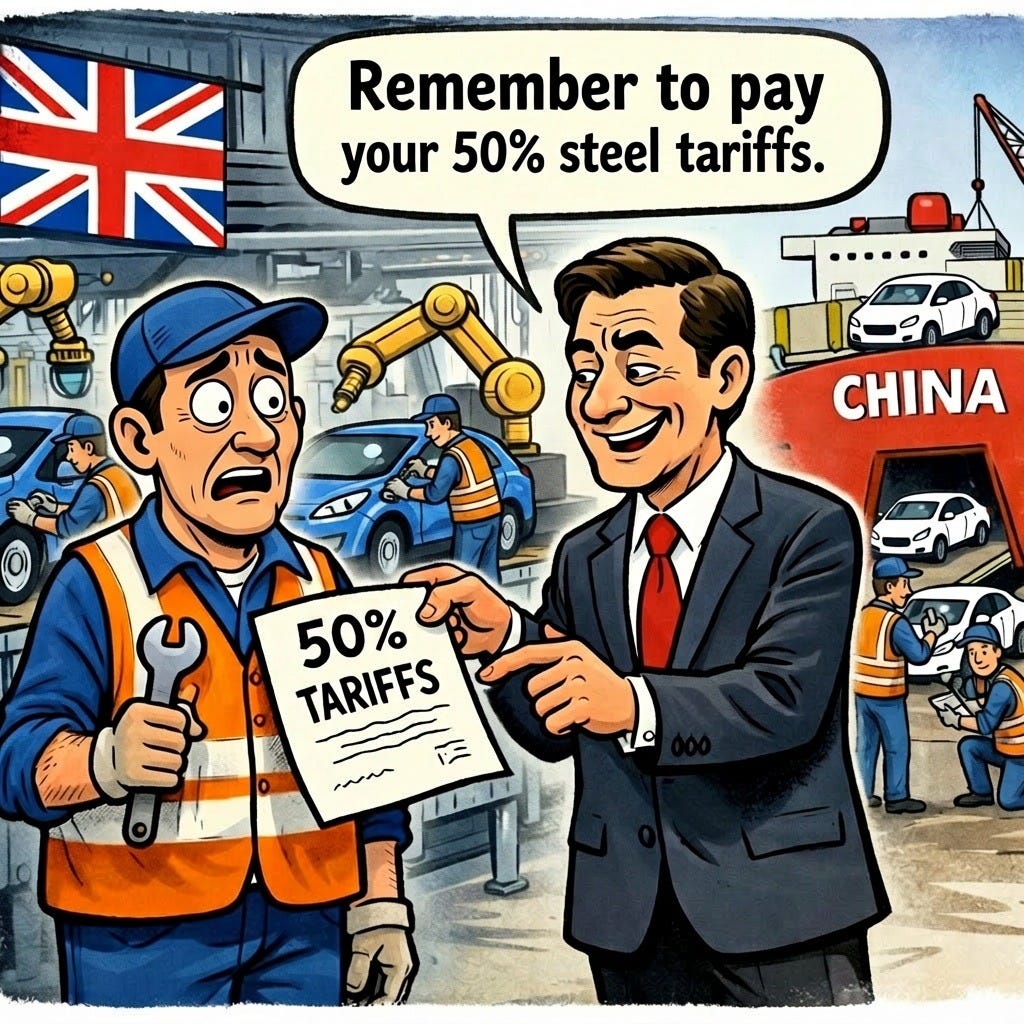
July 1st 2026 is the day the UK decided to replace the EU’s 25% safeguarding tariffs, imposed in 2018 and due to expire today, with 50% tariffs on a range of steel imports. While this may sound sensible to many (even to the people who have been decrying Trump’s imposition of tariffs), it isn’t if the UK doesn’t make the goods being tariffed efficiently or in sufficient quantity to supply the UK’s many downstream users of steel - most notably our car, aircraft parts and high-value machinery manufacturers.
The 50% tariffs were first announced in March, but few outside the industry seemed to notice, or care. The reason given for the tariffs was:
‘Domestic steelmaking is essential to the resilience and security of the UK’s critical national infrastructure and defence supply chains. Like many other countries, the UK steel industry has been severely impacted by persistent global overcapacity.’
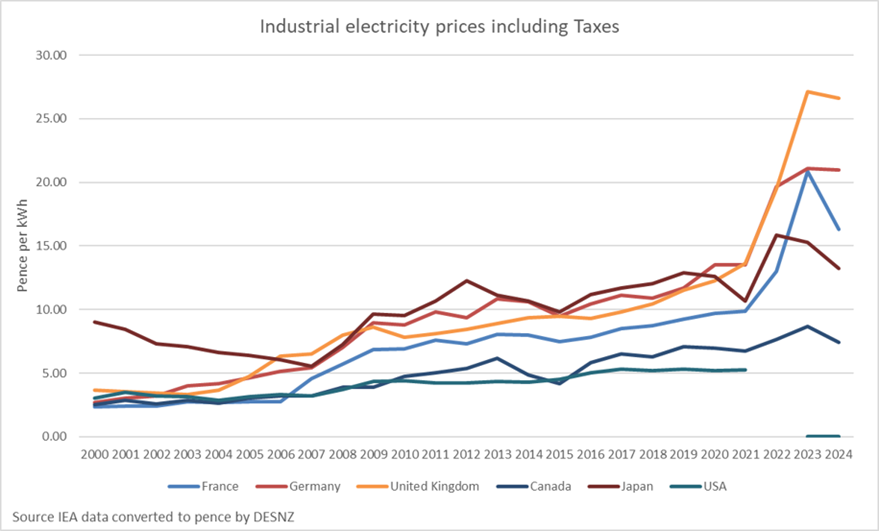
This isn’t quite true. The UK steel industry closures reflect decades of deindustrialisation: loss of cost competitiveness due to government-inflicted high energy prices, a decarbonisation push and environmental rules. This encouraged a shift toward scrap-based/Electric Arc Furnace steelmaking, which was scuppered by the UK having the highest industrial electricity costs in the developed world.
The government also claimed that: ‘The measure will apply to imports of steel products that can also be made in the UK.’ Again, not quite true. Just because a product ‘can’ be made in the UK, that doesn’t mean that it is, or that it is produced at a competitive price, or that it is produced in sufficient quantities to meet total UK demand.
Luckily, thanks to industry lobbying, the 50% tariffs were reviewed last week, days before they were due to come into force. In the revision, several products were removed, and strangely some were moved to different categories, but the big revision was in the dedicated tariff-free quotas given to some countries but not to others - well, actually let’s be honest, the tariff-free quotas were mainly given to the EU. From the chart below, in the second column from the right, you can see that the EU received more than 50% of the quota in all of the steel product categories, except for categories 20 and 21, where Turkey managed to reduce the EU’s share to a mere 29% and 24% of the total quota. (Category 20 is gas pipes, and 21 is hollow sections, in case you are interested.)
The 50% tariffs apply only to goods imported above the tariff-free quotas. But the tariff-free quotas seem to be there to protect EU steel suppliers more than British ones. The EU was the only area to receive a tariff-free quota in every steel category. Of the total 3.218 million tonnes of tariff-free quotas handed out, the EU was awarded 65%. Up from a mere 62% of the original 2.65 million tonne tariff-free quota announced in March 2026. Turkey managed to get 7% of the increased quota but only for 7 categories of steel; India, South Korea, and Vietnam each got 5%; the US and the UAE both got less than 0.5%; Switzerland and Japan got 0.03% and 0.04%, respectively; and the rest of the world can fight over the 11.5% residual quotas.
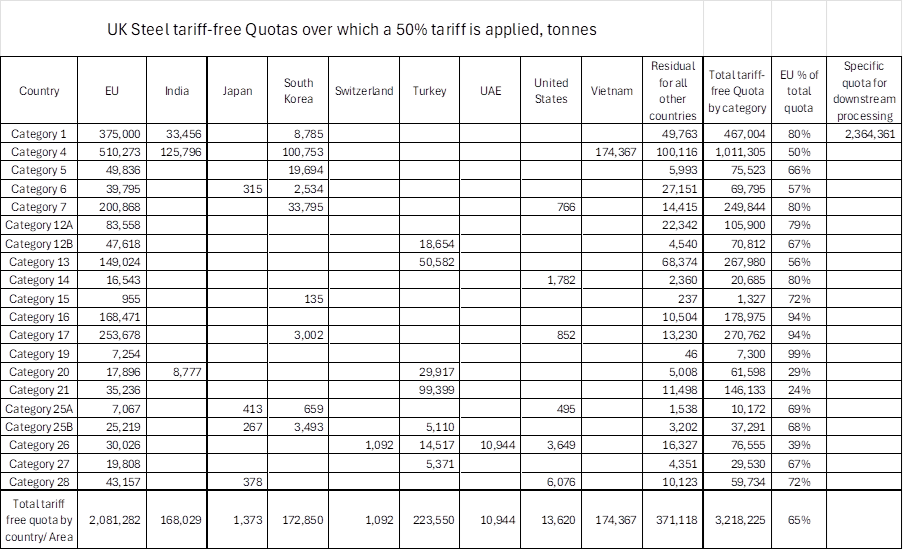
This list obviously leaves out China, the world’s largest exporter of iron and steel, as well as products made with them. But it also excludes Indonesia, Brazil, Mexico, Taiwan, Canada, Malaysia, and many other countries that export steel and are not known for dumping or other anti-competitive trade practices.
The quota ‘list’ also overlooks the fact that Germany is the world’s second largest exporter of both HS72 Iron and steel and HS73 products made with iron and steel, despite having no commercial deposits of iron ore or metallurgical coal. But instead imports both from Brazil and Australia. But somehow, having your steel industry undercut by Germany is fine with UK politicians, but not by China.
How does Germany do it? They have much lower carbon taxes and network costs on the energy used by their steel producers than in the UK. The Chart below was created by the GWPF in 2021; since then, the UK has added even more renewables to its electricity grid, pushing up its network costs.
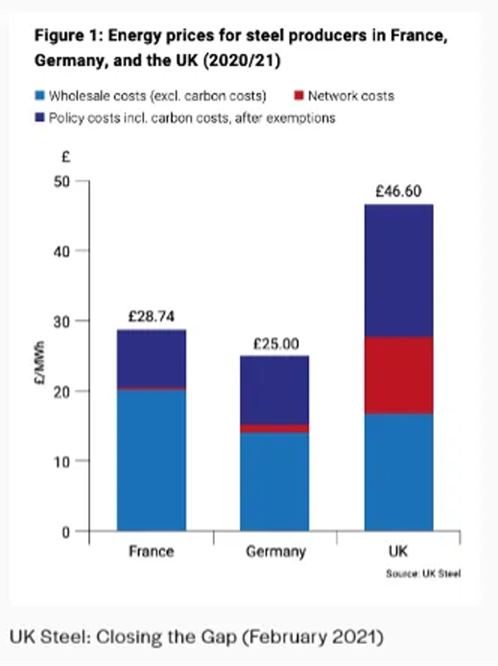
Network costs include Transmission Network Use of System high-voltage national transmission, local low-voltage distribution costs, system balancing costs, connection charges, energy lost during transmission and distribution, and a levy for distribution in remote areas. These costs are built into the Standing Charge and so often aren’t explained or itemised. But this is why the standing charges increase even if a company reduces its electricity use or stops using it altogether. The more renewable capacity added to the UK grid, and the further it is from the centres of demand, the higher the transmission costs. So, put simply, increases in wind farms far off the coast of Scotland increase transmission costs. Network costs also increase balancing costs, which also rise with higher levels of intermittent renewables. Network costs make up between 20% and 40% of an industrial user’s electricity bill, depending on their contract, and are rising due to grid upgrades to accommodate growing renewables, electrification, and AI demand growth.
Policy costs cover subsidies for renewables, such as Contracts for Difference, Renewable Obligation Certificates, and Feed-in Tariffs, as well as the cost of the Capacity market. Since April, 75% of the cost of renewable obligations have been moved to general taxation, but the other charges remain.
But back to the Tariffs.
Despite the focus on China, taken together, the EU exports almost double the value of China’s exports of HS72 iron and steel and a third more than China’s exports of HS73 Products made with Iron and steel. So why is the UK offering the EU such a large tariff-free quota, while claiming that it is China that is distorting the world’s markets?
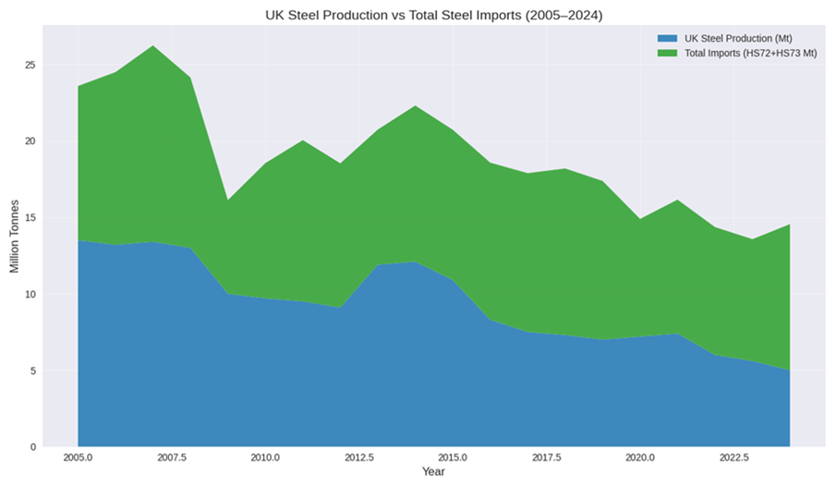
The UK imported 7.13 million tonnes of HS72 iron and steel in 2025, of which 4.3 million tonnes were products that will now be subject to the 50% tariffs applied to imports above the tariff-free quotas of the countries supplying the steel. It is unlikely that so many of these products would have been imported in 2025 if they had been available domestically.
It is also unlikely the steel imported from the EU will breach the EU’s generous quotas, while steel imported from almost all other countries will. And while some may argue that it is correct to give the EU such a large quota, given our trade agreement with them, the UK also has trade agreements with Canada, Mexico, and Malaysia, all members of the CPTPP, as well as a separate CETA trade agreement with Canada. Regardless, these countries failed to secure any amount of quota to supply the UK with the steel it needs. So much for trade agreements.
Strangely, there is also an additional annual 2.4 million tonne tariff-free quota for Category 1 steel imports (non-alloy hot-rolled flat products) if the imported steel is used to fabricate goods on the Government’s authorised products list. It would appear that the Government is expecting a revival of the UK steel industry, as this Specific Quota is almost double the total tonnage of Category 1 steel imported in 2025. As recasting and reshaping this steel will require plentiful cheap energy - either electricity or gas - I suspect the government will be disappointed unless our new Prime Minister sacks Ed Miliband and removes all of the UK’s taxes on energy.
In 2023, the UK produced 5.6 million tonnes of crude steel; in 2024, it fell below 4 million tonnes, about 30% of the UK’s consumption of 9.3 million tonnes in 2024. Production is likely to be less than 2 million tonnes in 2025, and only this amount is being produced because the government prevented British Steel from closing its Scunthorpe blast furnaces. The main reason for the closures at Redcar, Port Talbot, Liberty, and almost Scunthorpe is global overcapacity, high energy costs, and the move to decarbonise by replacing blast furnaces with electric arc furnaces, even though the UK has the highest industrial electricity prices in the developed world.
But while our net-zero-worshipping politicians (from both parties) seem happy to watch the domestic steel industry close, the UK’s main export industries still rely on steel. The UK’s steel-intensive downstream industries include fabricated metal products, engineering and advanced manufacturing, construction and mining vehicles, automotive production, aircraft part production, rail, appliances, scientific equipment, and construction.
On average, each vehicle manufactured in the UK uses almost a tonne of steel, and 80% of all vehicles made in the UK are exported. As are almost all of the UK’s production of aircraft parts, mining equipment, and a large proportion of its engineering equipment and precision instruments. It is important that these export goods remain competitive internationally. Adding a 50% tariff to the steel that they have to import will do the opposite.
Maybe it is time for the Government to remove the root cause of the problem: the UK’s three carbon taxes and electricity policy costs that have made steel production in the UK uneconomic. This is also true for most UK manufacturers, who have had to shift toward extremely high-value products to remain in business. A complex system of tariff-free quotas by country and product, plus 50% tariffs on steel imports outside those quotas, will not save the UK steel industry.
A better solution would be to give UK steel producers and other manufacturers tax incentives to upgrade their plant and equipment to the most efficient available. This won’t happen overnight, but at least it won’t kill the UK’s downstream steel users, unlike the current 50% tariff system. And it would increase the elusive 'economic growth’ the government is still looking for.
UK manufacturers that use steel as an input contribute about £220 billion in GVA (about 9% of GDP) and employ about 2.6 million people directly. Until the UK rebuilds its steel production capacity, we should do whatever we can to support downstream steel users, including allowing them to import non-EU steel if it meets their requirements.
It seems strange that the UK should be protecting its last remaining (Chinese-owned) steel producer from cheap Chinese steel (and cheap Mexican, Canadian, US, UAE, Japanese, South Korean, etc, etc, steel) when the UK has not followed the US’s or the EU’s tariffs on Chinese Electric Vehicles (EVs). The UK has not imposed additional tariffs on imported EVs from China, which face the same 10% tariff as any other car imported outside a trade agreement. The EU applies both a 10% tariff and an additional tariff on Chinese EVs, ranging from 17% to 38% depending on the manufacturer, while the US applies a 100% tariff.
As already mentioned, but it needs reiterating, vehicle manufacturing is both one of the UK’s largest steel users and one of the UK’s most valuable exports. The UK still has its unrepentant EV mandate in place for domestic car purchases. So the Government is asking UK car manufacturers to compete with Chinese EVs in the UK’s domestic market, while also making one of their input materials more expensive with the imposition of 50% tariffs designed to protect the UK’s almost-dead steel manufacturers from cheap Chinese steel. What am I missing?
And it is not just EVs. There will be many end products that are imported with minimal tariffs while domestic manufacturers are forced to pay a 50% tariff on the steel they need to import to make the same products in the UK.
Why is the government doing this?
No posts
Comments
Nothing yet. Say the first thing.
Sign in to join the conversation.