
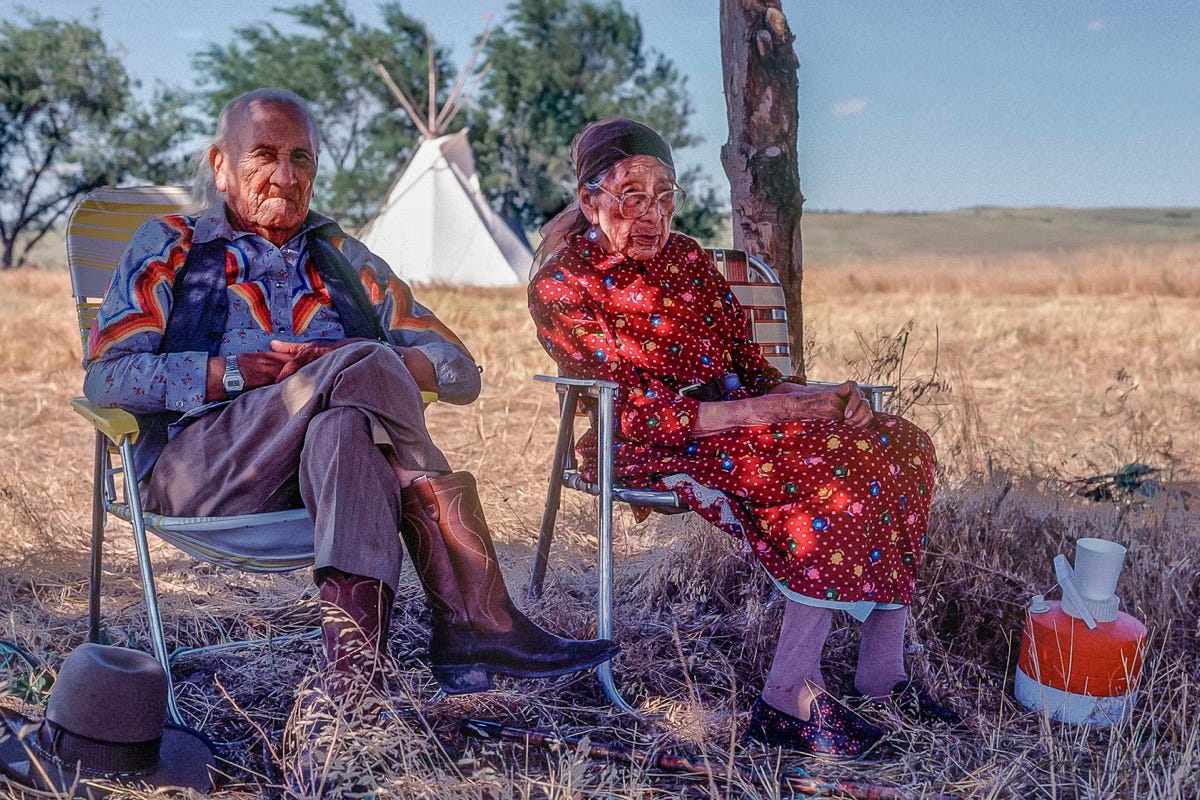
In 1984, I attended a pow wow at Wounded Knee, South Dakota, where I noticed an elderly couple sitting quietly in the shade. The drums were loud, so I smiled and gestured that I’d like to take their photograph. The man nodded his consent. I took a quick frame and moved on.
Thirty years later, while reviewing past images, I came across the photograph again and decided to do more than file it away. Their presence, his digital watch, the lawn chairs, the Styrofoam cup resting on a plastic jug, the incidental teepee, all added up to something quietly compelling.
Because I include information and identification in my photographs whenever possible, I contacted an old friend, Walter Littlemoon, who lived at Wounded Knee, to see if he might recognize them. He did.
The man was Frank Fools Crow. The woman beside him was his wife, Kate.
Only then did I discover that this was among my more significant images.
On December 29, 1890, the Wounded Knee Massacre occurred on this very ground. Nearly 300 Lakota people were killed, most of them women, children, and elders. The massacre is often described as the closing chapter of the Indian Wars, marking the end of Native American freedom of movement.
That same year, just a few miles from where this photograph was made, Frank Fools Crow was born.
Frank Fools Crow was a revered Oglala Lakota spiritual leader, Yuwipi medicine man, and ceremonial chief, and a nephew of Black Elk. Raised in the traditional Lakota way, he left formal schooling early at his father’s insistence and never became fluent in English. As a young man, he traveled with the Buffalo Bill Cody Wild West Show, an experience that exposed him to the wider world even as he remained firmly rooted in Lakota spiritual life.
For decades, Fools Crow served his people as a healer, teacher, and spiritual guide, leading ceremonies at a time when many Indigenous religious practices were discouraged or outlawed. In 1973, during the American Indian Movement occupation of Wounded Knee, his presence carried moral and spiritual authority. Though not a militant leader, he played a key role in helping negotiate a peaceful end to the armed standoff.
Fools Crow embodied a living bridge between the trauma of the past and the endurance of Lakota spiritual tradition. Born in the shadow of the 1890 massacre, he lived through the "dark period" when Indigenous ceremonies were criminalized and children were punished for speaking their native tongues. He survived to see the tide finally turn, witnessing the passage of the American Indian Religious Freedom Act in 1978, which formally protected the right of Native Americans to practice their traditional religions and speak their languages openly. By the time I encountered him, he wasn't just a leader; he was a victor who had helped carry his culture across a century of attempted erasure.
The woman seated beside him is his second wife, Kate Fools Crow. They were married in 1958, and she remained a constant, quiet strength by his side until her death in October 1988. A gifted traditional artist, her beadwork and meticulously crafted Lakota dresses are now preserved in museum collections as a testament to her own dedication to their culture.
Frank’s first wife, Fannie Afraid, died in 1954.
Frank Fools Crow died on November 27, 1989, believed to be 99 years old.
I did not know who Frank Fools Crow was when I made this photograph. I only knew that something about the scene called out to me for preservation. Photographs often wait for context and time to catch up. What I thought I had photographed was a quiet moment at a pow wow. What I had actually recorded was presence.
The image did its work long after I put the camera down.
Comments
Nothing yet. Say the first thing.
Sign in to join the conversation.