
It was 1966. I was sixteen and, although my mom was not so sure, my dad had agreed to let me buy my first car. After working as a childhood entrepreneur in one way or another since fourth grade, I had $500 in my savings account. A small fortune at the time. Enough to cover an inexpensive car, registration, insurance, and hopefully have some left over. Gas, after all, was all the way up to 32 cents a gallon.
As we toured the local used car lots, we always went straight to the back row where the so-called “beaters” were lined up. Most of them were from the ’50s and loaded with chrome. Seats were ragged, tires were worn, and rust was a given. Any exception that had real appeal was turning out to be more expensive than I could handle. Most were encroaching on, or exceeding, my $500 limit.
Then Dad pointed out a yellow car back in the corner of a small lot. I remember how I cringed.
“But Dad, it’s a Studebaker!”
I followed him back to it though and took a closer look, trying to see beyond the make and the color. It did seem to be in pretty good condition - and - it was a convertible. Still skeptical, but opening up a bit, I agreed to take it out for a test drive.
By the time we brought it back, I was sold, or rather, the car was. At that point, I was in love.
I had a car.
A yellow 1961 Studebaker Lark convertible with whitewall tires and a 259 V8 engine.
Price: $100.
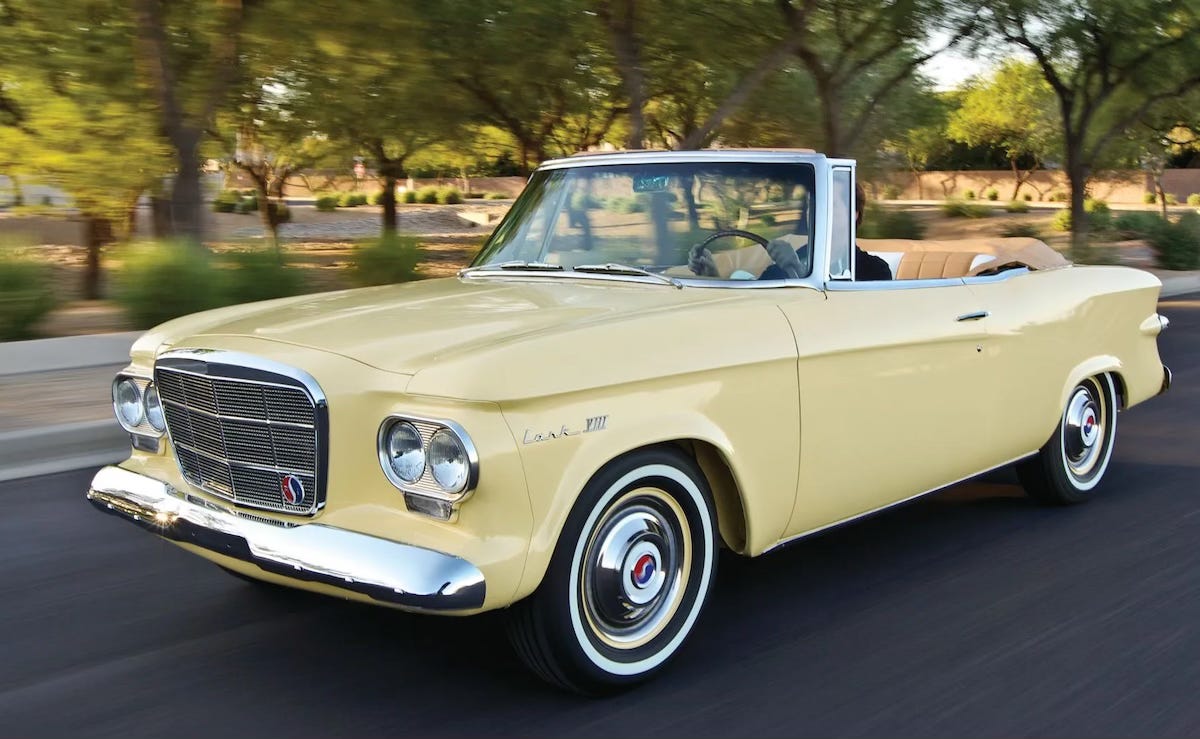
In those days it was common to place an à la carte order for a new car and have it built to your specs. To save money you could skip the add-ons: radio, driver’s side mirror, padded dash, whitewall tires, clock, cigarette lighter, overdrive…
While mine had big whitewall tires, it lacked a radio along with just about every other option.On a trip to a local junkyard, I found a ’61 Lark from which I pulled the radio and antenna. The radio was easy to install—just pull out the blank plate and plug into the wiring harness. Adding the antenna was another story.
Using a power drill, my dad and I drilled and drilled to get a hole through the fender. When we finally broke through, we hit another panel and had to drill some more. Research now tells me that, especially with convertibles, Studebaker was over-building the body to compensate for the lack of a steel roof. The double-wall construction using high-carbon steel was something of a hallmark of their engineering.
Of course, the big deal now was showing off the car to my friends. None of them had one.
I was still pretty unsure about what I had when I picked them up and we went out for a Friday night joyride with the top down. We were stopped at a light on the four-lane road by the river when Pete Parker pulled up next to me in his Pontiac. He and his carload of friends looked over at my car and shared a good laugh.
I remember how one of them leaned out the window and yelled, “Nice car!” Pete revved his engine a couple of times and they all laughed some more.
The light turned green and we both hit the gas pedal. I had to at least demonstrate something, but I was amazed at how that Lark took off. When they pulled up next to me at the next light, they didn’t laugh. Instead, they were looking at my car a little harder.
So was I.
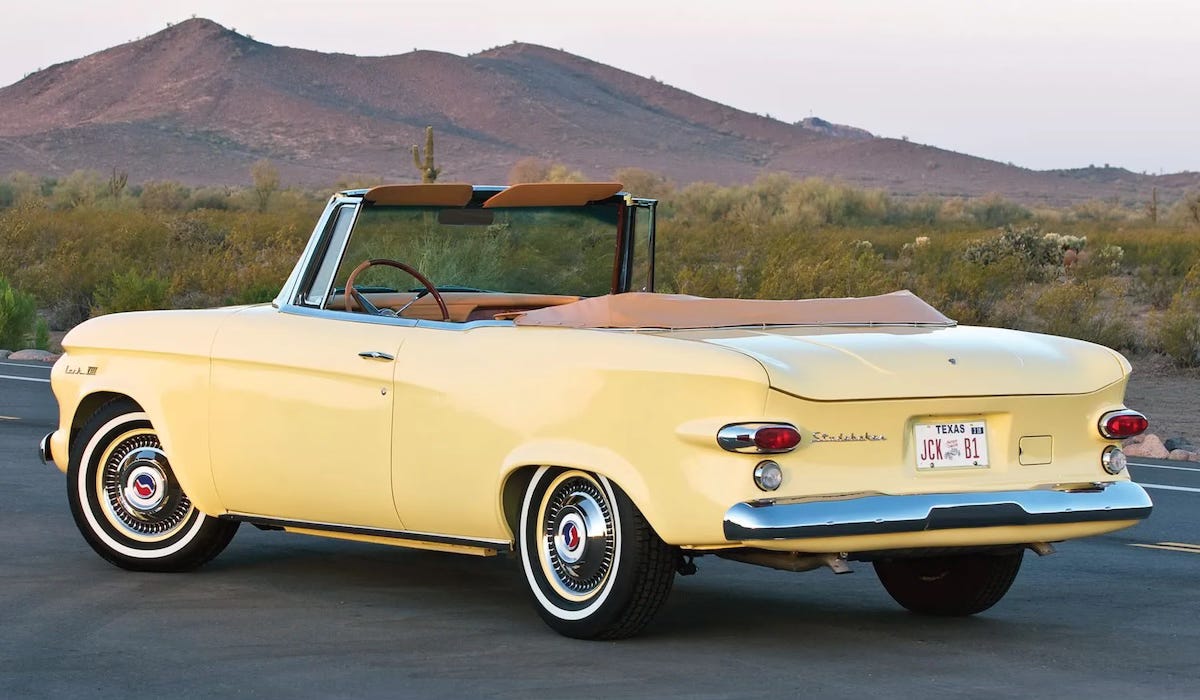
A year later we moved to another state, and my car had a whole new set of eyes taking it in at my new high school. Almost immediately, it attracted the owner of an early-’60s Opel station wagon. He appreciated my taste in cars, and we went on to become best friends. We remain in touch to this day.
The Lark and I had our fair share of adventures. It certainly stood out the day it got stuck in the mud in a highly visible field we would cut through to go parking - practically across the street from the high school.
Then the day came when I was driving on the highway and the oil light came on. Mechanically naive, I made a mental note to check the oil the next time I got gas.
I never got the chance.
A few miles later the engine seized and I had to coast to the side of the road. The cost to repair or replace the engine was well beyond the value of the car.
So that was the end of my Studebaker Lark.
Looking back, it may have been the cheapest car I ever owned, but it gave me something far more valuable: the confidence to stand out rather than fit in, and to see past what something looks like to what it actually is.
Not a bad return on a hundred dollars.
Footnote:
A few things I learned while doing some technical research about the car:
By 1966, Studebaker had ceased automobile production entirely. This “orphan” status caused resale values to crater, making it possible for a sixteen-year-old with $100 to buy a V8 convertible that would have cost five times as much in any other brand. While buyers worried about parts availability, the Lark remained a high-quality machine whose ruggedness outlasted the company itself.
The struggle to drill that antenna hole makes sense in hindsight. Rather than the thinner unibody designs becoming popular in Detroit, the Lark used body-on-frame construction reinforced with high-carbon steel inner-fender braces, especially in convertibles, which lacked a steel roof for structural rigidity. This “double-wall” construction gave the car its solid feel and made DIY modifications a legendary chore.
Pete Parker’s surprise at the stoplight was well-earned. The 259 cubic-inch V8 was a heavy-duty engine originally designed to run for hundreds of thousands of miles. In the Lark’s lightweight compact chassis, it produced 180–195 horsepower and could run 0–60 in about 10 seconds - enough to embarrass larger, flashier cars in a short sprint.
The oil light story has a grimmer technical footnote. Unlike modern engines with computer intervention and “limp mode,” a 1966 oil pressure warning was essentially a final notice. Once pressure dropped, friction heat would seize the engine’s components within miles. There was no second chance.
As for the economics: a full 15.5-gallon tank in 1966 cost under five dollars.
No posts
Comments
Nothing yet. Say the first thing.
Sign in to join the conversation.