
The consensus on climate action is dead.
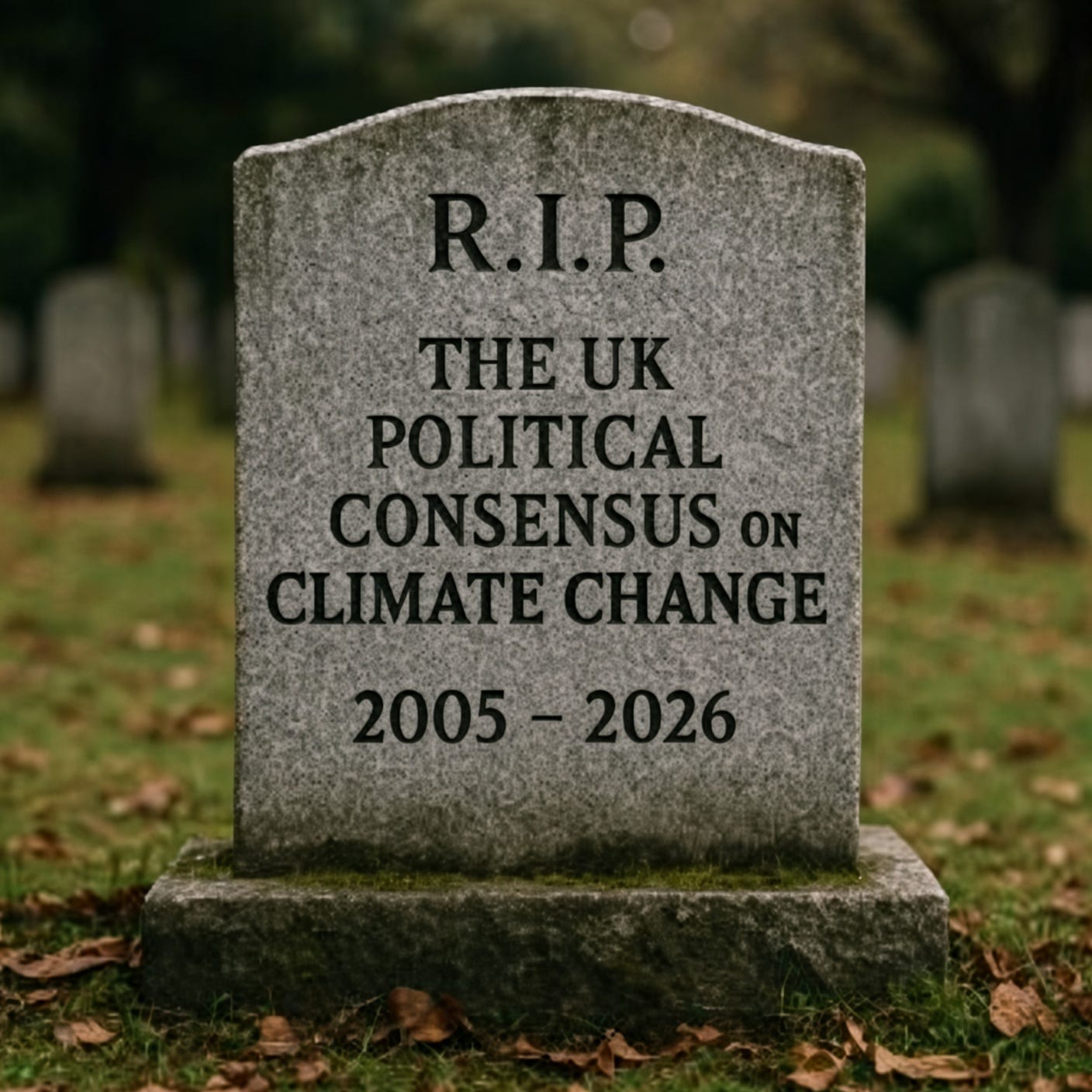
Parties subscribed to the climate consensus or who supported even more radical climate action got 94% of the vote as recently as 2019. Now, Reform UK, who promise to ‘scrap net zero to cut energy bills’, are top of the polls. The Conservatives also now prioritise reducing the cost of energy over climate change.
It’s actually quite odd that climate avoided being a major issue of political debate for so long. The public almost universally has factually correct views about the reality and man-made nature of climate change and consistently supports strong government action on climate. But they also don’t want their own lives to be affected too much by this government action. This kind of contradiction sits at the heart of many of our left-right political divides. For example:
- Most people say they want cuts to immigration, yet a majority opposes reductions in numbers from most groups that make up a significant number of immigrants.
- Many want welfare spending reduced, but oppose cuts to pensions, the disabled, or benefits for low-income families — the very areas where almost all the money is spent.
- Large numbers of people want higher spending, lower taxes, and no increase in borrowing.
Voters often will the ends without willing the means. They want to reduce the country’s impact on global climate change, without harming their own finances. The climate consensus was able to thread this needle because it promised to do exactly that. This promise could be made for three main reasons:
1. It primarily focused on changing our electricity mix, which was both out of sight and out of mind for most people, and was responsible for 25% of our emissions in 2005.
2. It was at least possible to argue that the renewables push was going to cut bills eventually because the price of offshore wind in particular was falling fast.
3. In the early days of the consensus, it was possible to ignore the increased grid costs of renewables compared to firm power, as they were not that high.
The Centre Cannot Hold
Why then has the consensus broken down? Put simply, it is because the three things that enabled it are all less true than they once were, and the tradeoffs of more climate action against people’s living standards have become more apparent.
Let’s start with pillar one. Electricity generation is no longer out of sight or out of mind for most people. Given rising bills, it is not surprising that electricity generation has become a contentious political issue.
The end of coal and the shift to renewables backed up by gas means that electricity generation is also falling rapidly as a share of our territorial emissions, responsible for 25% in 2005 and just 10% in 2024. There is not much more juice to squeeze here. Instead, we are going to have to move on to other areas.
Consider just a few of the targets the government has created in order to meet our climate change commitments:
- 600,000 heat pumps installed per year by 2028 (2025: est. 51,886)
- 80% of new cars to be electric by 2030 (2025: 23%)
- 5 million homes ‘upgraded’ under the Warm Homes Plan by 2030
Meeting these goals will require vast public subsidies and huge changes to physical infrastructure, which will be costly, visible, and controversial.
Some of them are also harder to achieve because of high electricity prices. Heat pumps are 3-4 times more energy efficient than gas boilers, but our electricity prices are so high that twenty gas boilers are sold for every heat pump. Electric cars are more expensive to buy than hybrid, petrol, or diesel cars, but they are much cheaper to run. Expensive electricity makes it take longer for the decision to invest in an electric vehicle to pay off.

The collapse of Pillar two is straightforward. The price for wind got cheaper and cheaper for many years. And then with increasing interest rates and rising materials costs it started getting more expensive again.
It used to be a lot more reasonable to believe that while wind may not currently be cheaper than other modes of generation, all things considered, it will be one day.
Finally, grid costs become more expensive the more renewables you have. Intermittent clean energy always has higher grid costs than firm power: it requires more grid to be built (because it’s spread across many, often very remote sites), it often requires subsidy that pays generators even when their electricity isn’t needed, and it means gas power plants that once ran continuously now have to stand by instead so you pay to build infrastructure that most of the time does nothing.
The key is that this cost rises unevenly. Going from 5% to 10% of your grid being intermittent doesn’t increase these costs much. The grid can cope with a few remote sites. All your wind turbines spinning at once is unlikely to overload the grid even at night so there’s little need to pay them to stop generating, and your gas plants are still responding to supply and demand the vast majority of the time, so you rarely need to shut them down to let wind take priority.
Moving from 45% to 50%, though, is a different story. By that point you’ve developed massive bottlenecks in the grid that you need to spend a lot of money fixing, in the meantime you are often paying wind turbines to switch off on the windiest days, and paying subsidies to gas plants to sit idle for most of the year rather than running. The same percentage-point increase in intermittent capacity costs far more the further up the curve you go.
Some maintain that the climate consensus was always wrong. Others, that it still remains right. I am not making an argument either way here. What I think is undeniable, though, is that the arguments of those opposed to the consensus look stronger today than they did when the grid costs of renewables were lower and the price of renewables (especially offshore wind) kept falling. The consensus breaking down is a response to changing facts on the ground.
What next?
There will be no new climate consensus. In hindsight, it is amazing we had one for as long as we did.
Onward’s recent report makes clear where the Conservatives stand, and while there has been much debate about the details, the direction is clear: cutting emissions will be a distant second in priority to cutting bills. While Reform UK have not been as clear, they will likely land even further from the old consensus.
For parties who remain more committed to climate action, there is a challenge. Even if gas prices miraculously fell to zero, and wholesale electricity prices with them, with current policies bills will still be higher in 2030 than they were before Russia’s full-scale invasion of Ukraine. If wholesale electricity prices are at the lower end of the range analysts project, the average household bill will be £60 higher than it was in 2025; at the upper end, over £100 higher.
Climate is now an ordinary political issue, fought along the same left-right axis as everything else. This means it will be subject to the same contradiction this piece opened with: voters willing the ends without willing the means. The Greens, and probably the Liberal Democrats, can afford to continue to support the old consensus; they are not in power and can blame the government for doing the consensus wrong, or not going far enough, when bills rise. Labour cannot. As the party of government, meekly asserting that a £60-100 rise in bills is simply the best that can be done is not viable as an argument on the doorstep. Whatever the government does it is in for a fight about energy bills and climate, attacked from both sides. But if bills are going down, it might be one that it can actually win.
No posts
Comments
Nothing yet. Say the first thing.
Sign in to join the conversation.