
Emerald Fennell’s Wuthering Heights is out. The reviews are mostly bad. But the critics got Fennel’s last film, Saltburn, completely wrong. It became notorious for its sex scenes while the radical implications of its class politics largely passed without comment.
Saltburn is not a complicated film. It is a morality tale about class, trust, and the dangers of misplaced kindness.
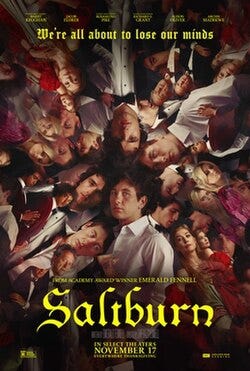
The Cattons are an immensely wealthy family with a country estate. For all their privilege, they are bright, charming, and fundamentally well-meaning. They go to great lengths to help those around them who have fallen short. Pamela, the mother’s troubled friend, is tolerated and supported. Farleigh, the cousin with feckless parents, is sent from one private school to another at the Cattons’ expense despite repeated disgrace. The family absorb these burdens cheerfully, even indulgently, if with a hint of condescension.
But disaster comes when they extend that generosity further down the social ladder.
Oliver, supposedly a poor, working-class boy with drug addict parents, arrives at Oxford University and tricks his way into their world. In reality he is not poor at all, but from a loving, respectable, suburban middle class family, albeit with a scouse accent. Lying about his background, he presents himself as a victim, securing sympathy, patronage, and eventually entry into the Catton’s inner circle. From there he destroys them, one by one.
The film’s politics are not subtle. They scream from the screen:
Charity is safe only within one’s own class. Help people like us, not those below.
Outsiders lie about victimhood to get ahead. Assume they are manipulating you.
Trusting the lower orders is dangerous. Farleigh sees through Oliver from the start, and he alone survives.
Naive kindness kills. The Catton family cannot imagine deceit of this magnitude, and their innocence is their undoing.
It is, in short, an incredibly reactionary film: a defence of hierarchy, in which the elite are virtuous but naive, and the pretender from below is a murderous parasite.
On release, almost no one recognised this. The Independent declared, “As a class satire, it reaches no conclusions.” Really? The working-class character turns out to be a lying, grasping, murderous middle-class chancer. That reaches “no conclusion”?
The top-rated Reddit review (ironically titled, ‘I can’t believe how misunderstood this movie is’) insists class is not a major feature of the film.
Jacobin comes closer, noting the film’s broadly positive view of aristocracy, but fails to register the deep suspicion of the lower orders that drives the story, instead digressing into fashionable theories from the 1960s.
Per Capita also nearly gets there, but is too distracted lamenting that Saltburn doesn’t have the “correct” class politics (and by the reviewer reminding us in every paragraph that she went to Cambridge) to grapple with what Fennell’s politics actually are.
There are two reasons the obvious reading has mostly escaped the literati.
First, it is unusual to see a somewhat sophisticated but openly right-wing film today; left-wing cinema is plentiful, right-wing cinema rarely aims at highbrow audiences.
Second, Fennell’s politics belong to another century. Critics might spot populism or libertarianism, but suspicion of the ‘lower orders’ hasn’t been acceptable in polite society for nearly a hundred years. You certainly wouldn’t catch Sir James Catton saying anything like the things Fennell is implying. You would need a familiarity of aristocratic attitudes towards the lower classes from before the war to recognise what is going on here.
It’s no coincidence, then, that the only (tweet length) review I found that grasped Saltburn’s message wasn’t from a film critic at all, but from a political correspondent with a history degree. Stephen Bush saw what other reviewers missed:
“ Good for artistic freedom that you can still make a ‘the middle classes and the mulattos will destroy your dynasty’ film in 2023 I guess.”1
Most critics and audiences lacked the historical frame to see what Fennell had made. Saltburn is not satire without conclusions, nor muddled commentary. It is a piece of class war agitprop, just on the other side to the one that is fashionable.
Bush thinks the film has a negative view on Farleigh due to his race (Farleigh is the only non-white major character). For what it is worth I think Bush is wrong about this. Farleigh is not at all responsible for the Catton’s downfall. His most notable characteristic is his constant nastiness towards Oliver, which turns out to be completely justified. He is a voice of reason, part of but not entirely of the aristocratic privilege. This allows him to be enough removed from the Catton’s complacency to recognise that Oliver is not on the level. He is only the member of the family that survives the film.
No posts
Comments
Nothing yet. Say the first thing.
Sign in to join the conversation.