
Six Greyhounds run around an oval track in pursuit of a mechanical hare. The hare always wins. It is the mystery of who will come second that fascinates those who go to the dogs.1
There is a push from campaigners to ban Greyhound racing. They are in a race against time. The sport will soon die of natural causes. There are just 18 tracks left in Britain. In Wales the government is currently trying and failing to ban the sport, which exists at a single track in the valleys. In London alone there were once 33 stadiums. At its peak over 600,000 Londoners a week went to the Greyhound Racing. Now Romford is the last place in the capital where you can go to the dogs.
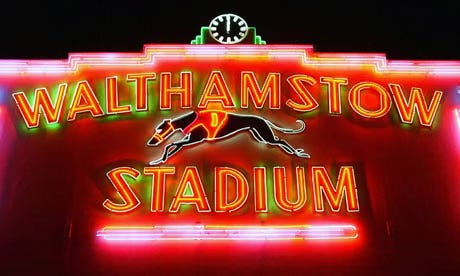
The punters
In the 1940s Mass Observation sent some of their investigators to greyhound races.2 The ‘trained eyes’ of the observers deduced that the vast majority of attendees belonged to the C (Artisans and Skilled Workers) and D (unskilled workers) social classes. These class distinctions are much less sharp in modern Britain, but my untrained eye suspects that the make up of today’s much smaller crowds contains many of their descendants.
The demographics are similar to non league football in a big city, just with middle class attendees reduced from a substantial minority to almost non-existence. Groups of young men in slim-fit jeans and tight polo shirts, hair clipped short at the sides, this just the first stop on their night out. Much older men in checked shirts and worn jackets, pints in hand, studying the racecard with quiet intensity. Commentaries from the 80s and 90s on racing in London also mention city traders on a night out. These accounts often contained complaints about what would now be called the ‘gentrification’ of the sport. They don’t come any more.
On a Friday or Saturday you will also see many on a family night out, making the gender ratios slightly less stark than they likely were back in the sports heyday.
While the crowd is whiter and more British than the average for London (37%) or even for Romford (67%), it is rarely all white. However, Multicultural London English (think Stormzy) is rarely heard. Estuary English (David Beckham), and its ancestor cockney, are almost universal. This is a sport for white British people remote from modern inner London culturally if not geographically, and minorities born into or integrating into white suburbia.
The gambling
The dogs is a gambler’s sport. Upon entry you’ll be presented with a programme and it provides an overwhelming amount of information on each dog. Whether the dog prefers to run wide, stick to the fence or has no preference. Their performance in recent races. And far, far more.
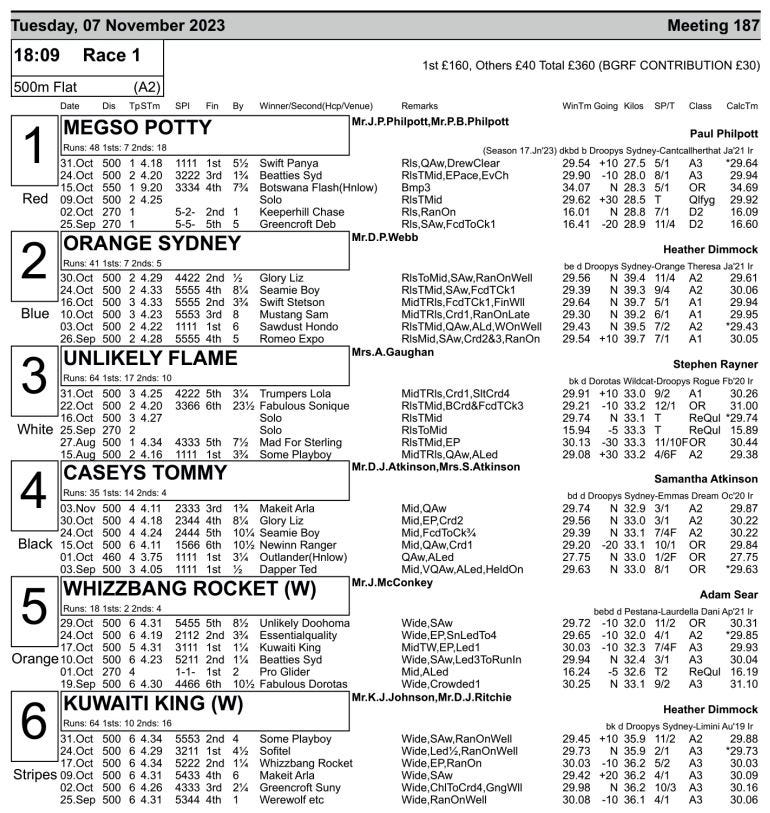
During the second world war while a significant minority were simply there to enjoy the racing, most people were gambling. That’s exactly the same today. For some, including your correspondent, Greyhound Racing is little more than a game of chance, ‘animated roulette’ as Winston Churchill put it. Mass observation found 21% bet purely on a whim (one merchant navy sailor bet on any dog with a sea related name) and 27% ‘guessed.’ Judging by how rarely I win compared to those around me it seems to me that a far greater number nowadays are studying form (42% in the days of mass observation), have some kind of system (5%) or rely on tips (4%).
Once you’ve picked your dog you must choose where you place your bet. The ‘dog men’, those ‘in the know’ and others who know what they are doing (or wish to look like they know what they are doing) generally prefer the trackside bookmaker, who offer odds in the same way familiar to anyone who has ever placed a bet on almost anything.
The alternative is the tote,3 where you can just hand over your money, without any pretence you have any idea about what is about to happen.
The race
The dogs are paraded in front of the punters, and some place fresh bets, persuaded by the shine of a coat or a hint of swagger that they’ve spotted a winner. The chatting stops. The dogs are in the traps. Total silence. The hare whirs around the track. The traps click. The shouts go up. Nowhere near as loud as it was in the glory days at White City or at Walthamstow, but surely loud enough to distract the more timid dogs.
Your bet might be gone within half a second. A slow start or another dog getting in the way of your pick and, especially in the shorter races, they’ve probably already lost.
For the dogs, they are simply chasing after a toy. They don’t know how long they will run for and have no conception of tactics or pacing themselves. This doesn’t mean there is no skill. The fastest dog does not always win. The savviest dog that can pick its path through the field often moves to the front.
If you stand close enough, the sand from the tracks will hit you as the dogs go past at over 40mph. Races are of different lengths, but most at Romford are a single circuit of the track over in less than 25 seconds. Sometimes the excitement is over quickly as a clear frontrunner immediately emerges. But, in a close race, the roar of the crowd can build and build to a frenzy that breaks into either jubilation for a minority as a clear winner emerges, or anxious murmuring as we await the results of the photo finish.
And then the lucky few head back to the tote and to the bookmakers to collect their winnings. The unlucky many head back too, trying again. The next race is in 15 minutes.
From Laura Thompson’s ‘The Dogs: A Personal History’
a wartime social research project on the British working and middle classes. Most historical examples and historical perspectives in this piece are drawn from Keith Laybourn’s ‘Going to the Dogs’
Here you place your bets into a pool. If your bet wins you get a share of the pool along with all other winners. While the current price will be displayed you ultimately have no idea what the ultimate odds of your bet will be unless you are placing it at the very last second. The track makes money by taking a cut of all the money in the pool. When the dogs were at their height very complex electro mechanical machines worked everything out. These days its all done on computers.
No posts
Comments
Nothing yet. Say the first thing.
Sign in to join the conversation.