
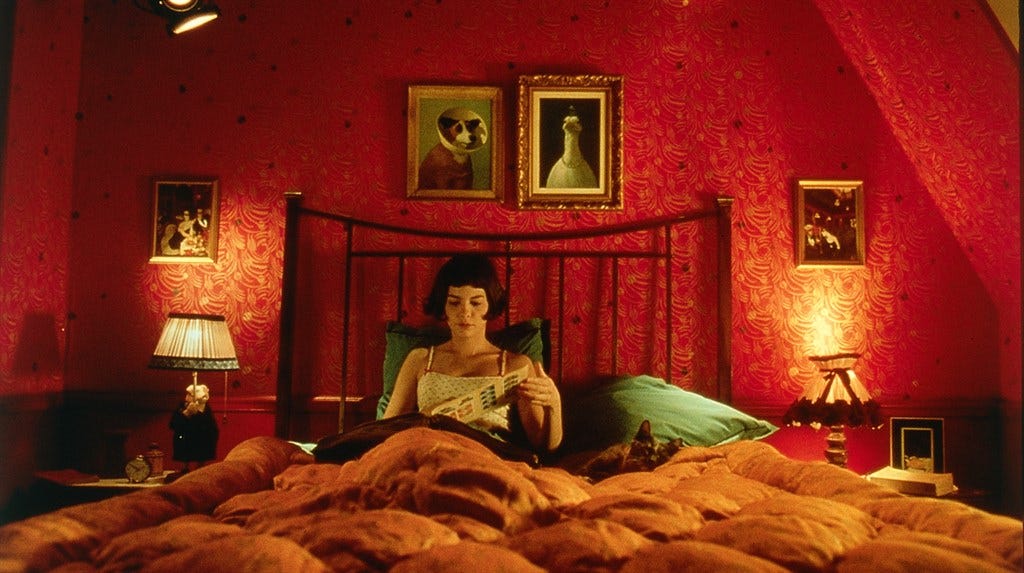
Last week I had the privilege of taking a quick vacation to NYC - one of my favourite cities - with my fiancee Maeve. Not to be one of those boring people that talks about how much a vacation was needed, but between my multiple jobs, creative practice, and day to day nonsense of life that inevitably piles up, it had been a hot minute since I had no responsibilities for five whole days. I deeply enjoyed myself, and one of the things that Maeve and I got up to in between flea markets and Taiwanese restaurants was finally getting around to watching Amelie in our tiny Chelsea hotel room.
This is by no means a hot take, but the critically acclaimed and audience beloved Amelie is by all accounts a very good movie. Beautiful, charming, and profoundly romantic. I won’t waste time summarizing too much, mostly because this isn’t really a review. Essentially, in between gorgeous frames of the titular Amelie running about Paris playing cat and mouse with the object of her affection, I found myself wondering why she wasn’t getting in trouble at her waitressing job for… never being at work.
How sad is that?
Amelie is a quirky fairytale about a young woman, a woman my and my fiancee’s age in fact, meddling in her community’s lives to make them stop and appreciate the romance of everyday. And I watched it and thought about the rent of her Paris apartment. I am not a romantic. But is that nature, or nurture (and by nuture, I mean lack thereof)?
Two things stuck out to me about the world of Amelie. This is a world in which technology only exists in the form of cute, old TVs that relay dream sequences and although it’s set in 1997, Amelie certainly doesn’t pull out a Toshiba Tecra laptop to try to track down Nino. It’s a film out of time, and while I have no problem with that (in fact, I very much think the movie’s choice to leave tech out of a plot that relies on miscommunication is a good one), I wonder if the popularization of technology has led to a decline of romanticism in our modern era. I feel like most great movies about love and life in an urban epicentre are without fail, old - or at least oldish.
When I moved to Toronto, freshly 19, I was inundated with classmates at OCAD who grew up in the city lamenting how much better it was in the early 2000s, or even the 2010s hipster era, which seemed rich coming from folks who were about 14 at the time of those events. I used to think maybe what they missed was the carefreeness of childhood, though I didn’t want to say that out loud. But now, 5 years into living in the city I’ve wanted to live in my whole life, the city I want to die in, I find myself nostalgic for elements of pre-pandemic Toronto. I get it, at least a little.
Ok, maybe the lack of technology is the first ingredient of romanticism in Amelie (wow aren’t you glad this isn’t a formal essay and I can have the silliest possible writing structure) and the second for me, bless my socialist bleeding heart, is the lack of late stage capitalism. Amelie exists in a world where a 24 year old can barely work at a cafe and live in an apartment without roommates that seems to be run down in a charming way and not in a “this place has rats” way. For my part, I’ve lived in 4 apartments in Toronto, one of which had bed bugs and one of which had cockroaches. I have never not had roommates. This isn’t unique, in a lot of ways I’m very privileged, but this is just the reality of living in a big city today. Basically this:
How much room is there for romance between doomscrolling and the crushing cost of living?
I can’t help but think this is in some way connected to why the some of the best movies about modernity are horror movies (personal favourites The Substance and Bodies Bodies Bodies come to mind). But goddamn, I believe we deserve magic too. One of the main motifs of Amelie is Luncheon of the Boating Party by Pierre-Auguste Renoir, an 1881 painting. If the romantic 1990s characters of the film look to earlier media for romance, maybe it’s natural we look to a pre-and-early internet era of city life for romance as well. However, we live in an age defined by connectedness, an age where I can live update my best friend via text about what I ate for lunch, and an age where communities of queers and artists and regular old subculture enjoyers aren’t bound to only meeting the 3 likeminded people in their towns, empowered by the internet to find kinship cross-locationally. That’s kind of magical.
I get the horror of today. The constant tragedy we’re fed on our phones, the less privileged of us experiencing it firsthand. I would never downplay today’s many crises and horrors. All I’m getting at is these injustices have existed for many, many, years - long before the invention of tiktok and core-core and the era of substack pseudo-intellectualism (hello!). I fear the constant romanticization of bygone eras spurs us to hopelessness, which in turn inspires inaction - they want us exhausted and with nothing left to fight for. They don’t want us enjoying one another because that would spur us to fight for each other. I have never been a believer in the slightly girlboss feminism-feeling adage of “joy is resistance”. Resistance is resistance. However, joy, romanticism, whatever you want to call it, is sometimes the gas in our tank that we need to keep going. That is simply the human condition.
Amelie isn’t romantic because she doesn’t take to tiktok and ask her followers who Nino is. Amelie is a romantic film because its protagonist believes in the good of others, in the indomitable nature of the human spirit. And that’s eternal.
But there’s nothing romantic about sitting down for a $6 latte with your friends after a day of microsoft team meetings - or is there? Can there be? I’m going to try.
No posts
Comments
Nothing yet. Say the first thing.
Sign in to join the conversation.