
Updated August 1, 2025 with Red Flag #8: “Warm Regards”
If you’re here, you’ve probably either received a book marketing scam email, or you suspect you might have. I’m glad you stopped by!
My goal with this blog is to inform, educate, and empower self-published authors in the never-ending fight against scam artists. With AI, these scammers are now more convincing than ever, and I hate to see any of my fellow independent authors lose their hard-earned money to one.
So, how do you recognize a book marketing scam email?
Look out for these red flags: 🚩🚩🚩🚩🚩🚩🚩
If Google tells you they don’t exist, they might be a scammer.
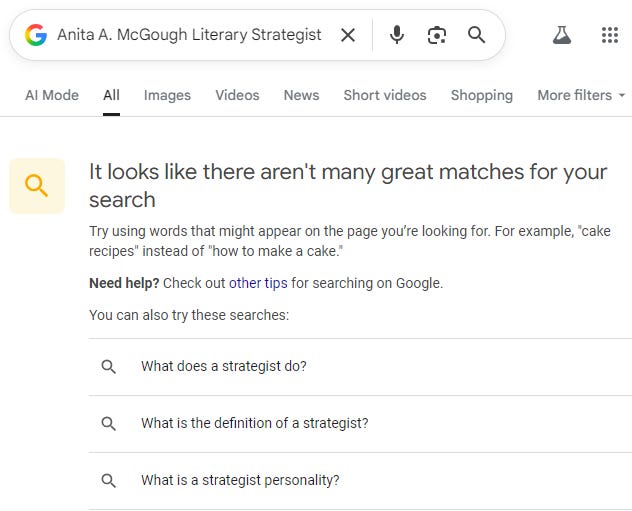
Whenever I receive an email that I suspect to be a scam, the first thing I do is google the sender’s name. More often than not, I find zero results.
Any professional book marketer worth their salt has a website where they showcase their work and make it easy for potential customers to find and contact them.
You can’t Google a scammer not only because they use fake names, but because they use multiple fake names. If you google their name and only find Facebook profiles of people with the same name, you know they’re trying to scam you.
If they won’t shell out five bucks to register a domain, they might be a scammer.

99.9% of book marketing scammers do not include a web address in their emails. Why? Because they don’t have websites.
They probably change their fake name and/or company name so often that they would have to keep creating a new website every day, and one thing you need to know about scammers is they’re lazy. They’re scamming people because they don’t want to do any actual work, so they put as little effort as possible into their scams.
Any real professional person trying to sell you their services will have a website, and they’ll send you a link to it, usually in their email signature.
If they use a Gmail address in this format, they might be a scammer.
With very few exceptions, all book marketing scammers use Gmail addresses that follow the same format:
(first name)(last name)(random number)@gmail.comThe numbers are most likely because a real person with that name already has the their first and last name as their Gmail address. Sometimes instead of numbers, they’ll tack “books” or “kindle” or similar after the name instead. That’s why the only exceptions are those with unique fake names, like “Maris Alcott.”
Real professional book marketers tend to have email addresses with branded domains. If they’re good at what they do, they can afford to register a domain. It’s not expensive. I’m broke, and I own four domains.
If their profile pic gets more search results than their name, they might be a scammer.
You may not realize it, but Gmail accounts have profile pics. If they don’t show in your inbox, you can see them by hovering over the sender’s name.
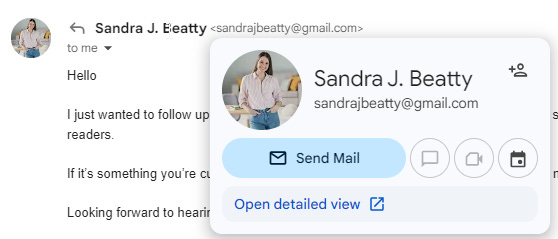
Scammers usually have stock photos as their profile pics. You can prove this by reverse image searching them.
Hover over their email address and click “Open detailed view” on the popup. You’ll see a larger version of the pic. Save it to your device.
Once you have the pic saved, you can do a reverse image search. Google has a handy reverse image search icon right on the search bar.
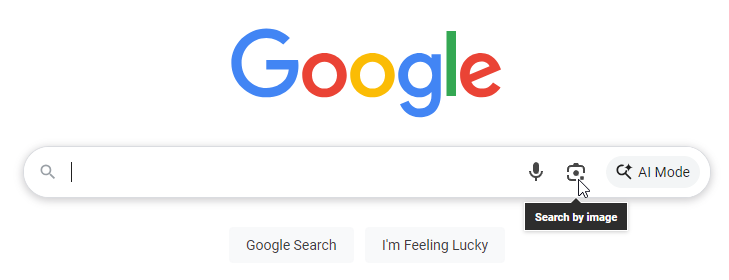
Of course, not all scammers use images that can be easily found on Google. That’s when you have to get a little more creative and try some other reverse image search tools. Here are few that I use:
Usually, you can find the exact stock photo the scammer used.
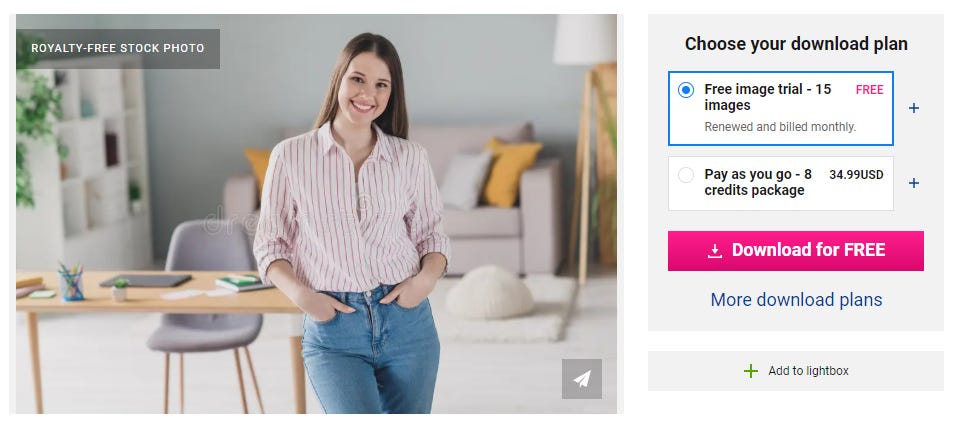
If not, you might find the image on various websites with different names, which is evidence enough that it’s fake.
If they write like this, they might be a scammer.
Scammers use generative AI to compose their emails for two reasons:
They’re non-English speakers, and they want to hide their broken English.
As I mentioned before, they’re lazy. They don’t want to take the time to actually write their own emails.
I’m an AI prompt engineer, which means I spend most of my time talking to robots, and I’m very familiar with how they write, but the average person-on-the-street might not be as AI savvy as I am.
Here are a few obvious clues that an email was generated by AI (and none of them are em dashes)…
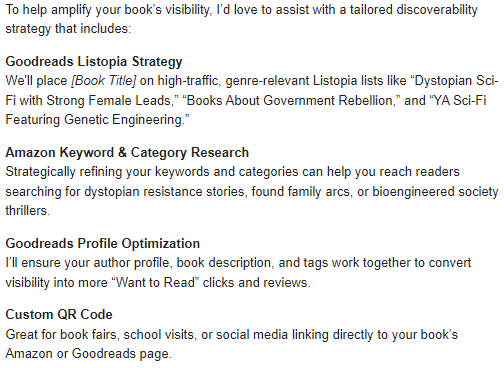
See how I’m using headings to break up the text in my blog post? It’s a common way of chunking information to make it easier to read. You see it on blogs, in magazine articles, and in technical documentation, but you don’t see it in emails—at least not emails from real people.
Real people don’t use headings in their emails. They just don’t. Because it would be weird.
Have you ever received an email that had headings in it from someone you know is a real person? No, you haven’t. It’s just not done.
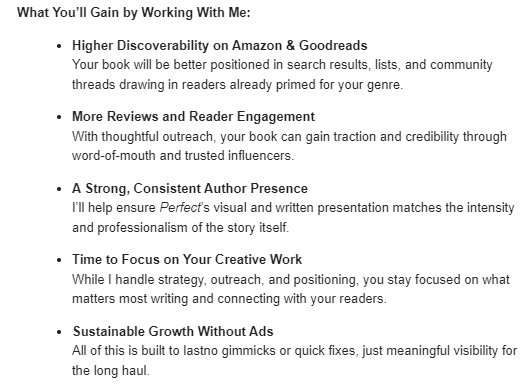
Yes, some real people use bullets in their emails (including me), but AI uses bullets like they’re going out of style.
Excessive bullets are a clear indication that someone used AI to write an email, especially when combined with bold headings.
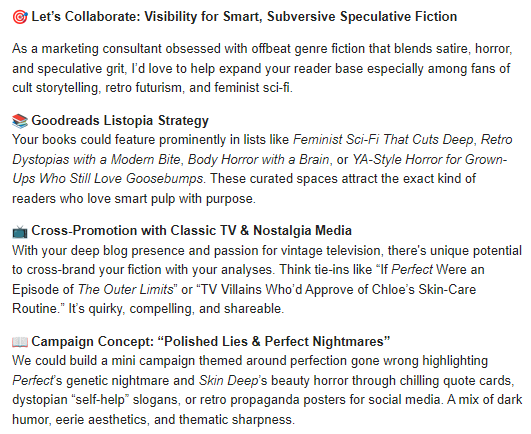
ChatGPT loves emojis. It uses them everywhere, even in code. Any excessive use of emojis is a dead giveaway that an email was generated by ChatGPT, but especially emoji bullets. ChatGPT loves emoji bullets.
If you get a scam email with bold headings and bullets and emojis, you’ve hit the trifecta of book marketing scams.
If they don’t know your book from a hole in the ground, they might be a scammer.
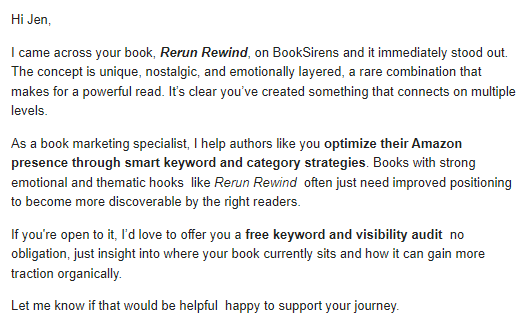
I mentioned before that scammers are lazy, so obviously, they’re not actually going to take the time to read your book before they send their scam email. Instead, they’re gonna take whatever information they can find about it (such as the synopsis and reviews on Amazon or Goodreads) and feed it into an AI model, then copy and paste whatever slop it spits out, even if it’s wrong.
Scammers will always get important details about your book wrong, like the title, genre, characters’ names, plot, or when it was published. They might even get your name wrong or leave placeholders in their emails like “[Author’s Name]” or “[Book Title].”
And if they tell you they read your book, they’re lying.
A simple way to prove that is to ask them a question about something specific from the book. Not only will they not know the answer, but in all likelihood, they won’t bother answering at all. Instead, they’ll backpedal or suddenly go silent.
I’ve asked several scammers the name of the dog in my novel, Perfect, and not a single one has given me the correct answer. Most of them didn’t even guess.
Which brings me to my next point. Not only do scammers not read your book before emailing you, but if you call them out on it, they’ll make up some excuse for why they’re never going read it.
Whenever I challenge a scammer to read one of my books, the most common excuse I get is that they can’t afford it, even Skin Deep, which is only 99 cents. They’re supposedly successful book marketers, but they can’t afford 99 cents to land a potential client.
They expect you to invest in their services to get more book sales, but they won’t invest in you to earn your business.
And lest you think I’m being petty and try to argue that times are tough and someone could easily not have two cents to rub together, even with a successful business, I offer this example:
Recently, a scammer emailed me gushing about my writing in Skin Deep, so I asked him how he knew what my writing was like if he hadn’t actually read the book (I can tell because no one’s bought it in a while). He quickly backpedaled and said what he actually read were the sample pages on Amazon.
Fair enough. If he read the sample pages, he can prove it, right?
So I asked him a simple question he could easily have answered by reading the sample pages, and I never heard from him again.
Instead of actually looking at the sample pages to find the answer, this dude ghosted me.
Sample pages are free, folks. It would have cost him zero dollars to actually do what he claimed he had already done and read a few pages of my book, but even that he refused to do.
Scammers won’t even make the slightest effort to prove they’re legit.
A scammer will never, ever read your book.
If they try to sell you any of this shit, they might be a scammer.
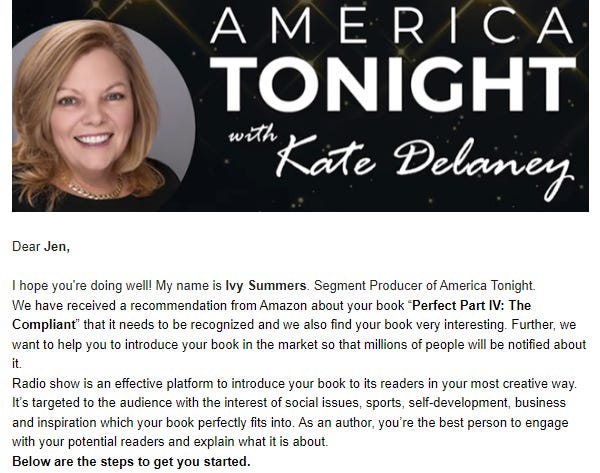
There’s real marketing, and then there’s the kind of marketing offered by most scammers. The great Victoria Strauss of Writer Beware calls it “junk marketing,” which she defines as “PR services of dubious value and effectiveness that are cheap to provide and can be sold at a huge markup.”
Basically, you’re paying someone an outrageous amount of money for something you can do yourself for free or at least very cheaply. All you need is ChatGPT and a lazy attitude.
Book marketing scammers’ favorite services to rattle off in their AI-generated emails include Goodreads lists, TikTok influencers, press releases, paid reviews, book fairs, book trailers, and vanity interviews (aka interviews with D-list media personalities no one’s ever heard of that are only posted on websites no one ever visits).
If they wish you warmness, they might be a scammer.
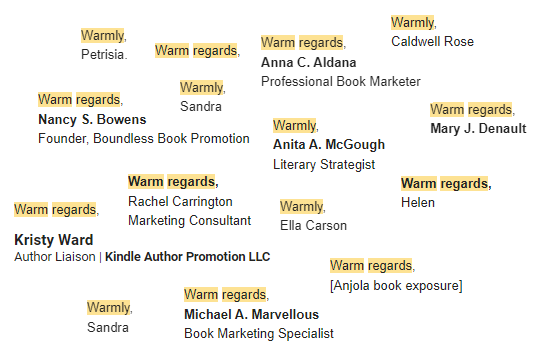
Out of 103 book marketing scam emails I’ve received as of this writing (including replies), 26 of them use either “warm regards” or “warmly” as a sign off. That’s roughly a quarter of them.
And it’s not just me. Recently, a reader contacted me about an email exchange he had with an obvious book marketing scammer, and most of his messages ended in either “warm regards” or “warmly.”
Why are these scammers so concerned about my warmth? I’d rather be cool, thanks.
And those, my fellow self-published authors, are all the red flags that indicate a book marketing email might be a scam.
It’s my sincere hope that you’re now more equipped to recognize the next fake book marketing email you receive and tell the scamming bastards to fuck off.
Comments
Nothing yet. Say the first thing.
Sign in to join the conversation.