
When Trump became the President for the second time, I turned to Sinclair Lewis’s It Can’t Happen Here and Jack London’s Iron Heel to see what to expect. Both books were horrifying when viewed as real possible outcomes. At first I was blown away that bother authors could so clearly imagine what was going to happen. Of course, they were not written in a vacuum. Neither man imagined what an authoritarian leader would do out of thin air or the right mix of stimulants. They reflected what had happened before, repackaged in American clothes. Despite this, the things Trump was (and is) doing felt new; he was not following European dictator playbooks exactly.
It turns out he’s following the U.S. playbook.
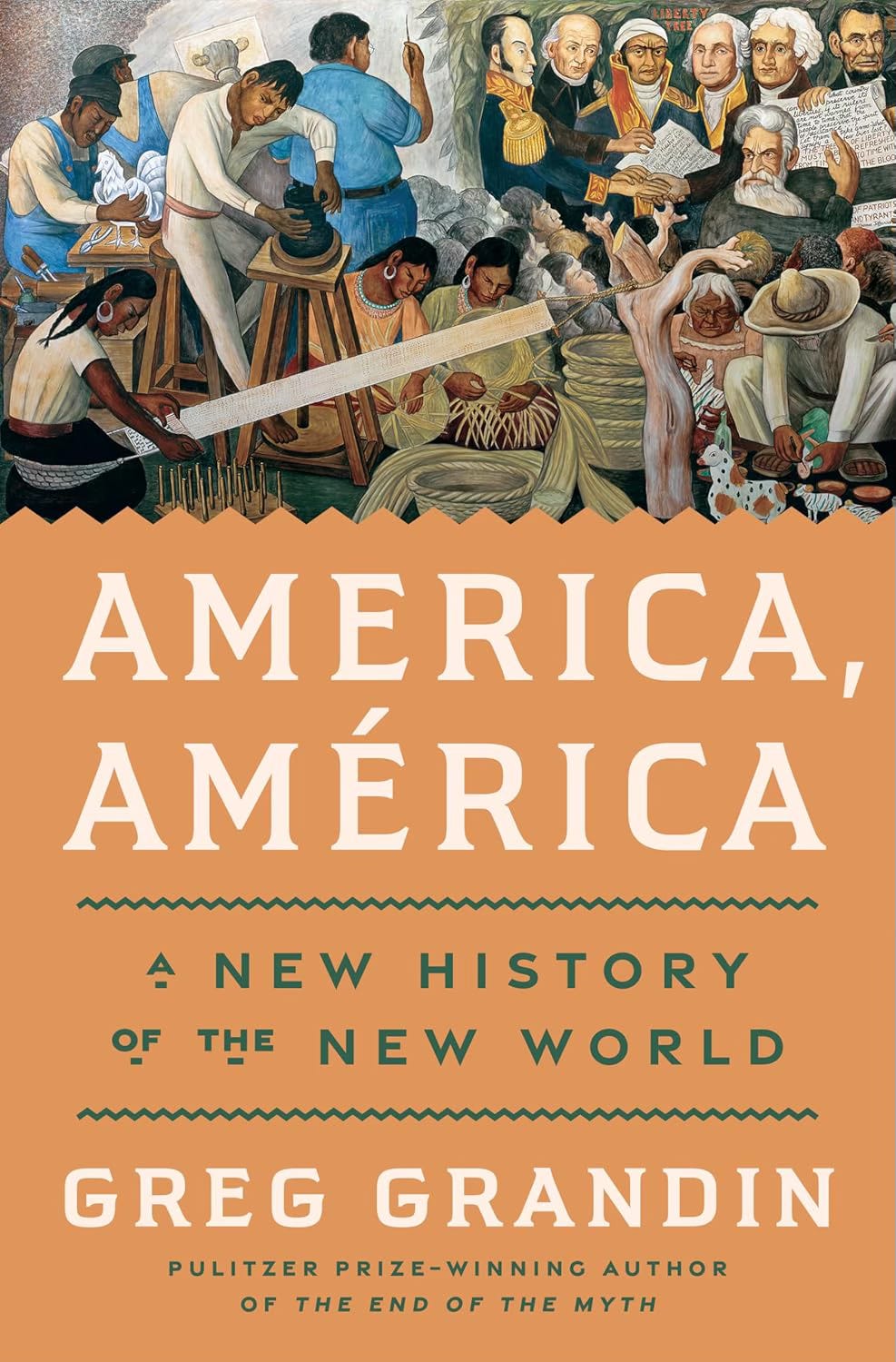
I learned of America, América from one of my favorite book recommendation/history podcasts Skipped History. Like so many of my favorite non-fiction books it is a sort of an academic take down, though without a specific target. I don’t know that that is how Greg Grandin sees it, but given the superficial history taught in high schools, it felt like a correcting of the record to me. It is a “new” angle on American history; a new through line for most people in the U.S. who have always gotten a European or U.S. version of history.
The book starts with the Spanish landing in America and the way catholic theologians wrestled with the horrors the Spanish set upon the “new world” locals. And then compares that with the British that settled here, and their feeling that god had cleared the land for them, blessing their right to claim all of America (north and south) and use the land however they wanted without having to wrestle with the morality or ethics of our behavior. It is this mentality that lead Jackson to war with the Seminole and Creek for the luscious land they occupied and the removal of Natives memorialized in the poem “Trail of Tears.”
The book fills in the details left out of most histories, like that Roosevelt wasn’t just isolationist in not entering WWII right away. He was working to support Latin America’s sovereignty and create a solid relationship with the often beleaguered region so that they would not side with Hitler and the Germans. That U.S. corporations had standing armies bigger than that of the United State’s for most of our history thus the mass murders of striking laborers were to be expected. That the CIA used covert manipulation of religion to obliterate liberation ideologies. The Mexican revolution was a fight against the U.S’s myths that justified our right to intervention and conquest as well as its enabling laws. That the capitalists were so opposed to moral diplomacy and national sovereignty in Latin America they tried to coup Woodrow Wilson. That the U.S. to this day refuses to accept that we can be punished for our behaviors in international court.
The history of the United State’s is that of “I can do whatever I want.” It is from this belief that that the Monroe Doctrine came. William Walker’s invasion of Nicaragua. The U.S- oil-company-instigated war between Uruguay and Paraguay. All the way up to Reagan’s use of the brutal Contras to force the democratic, leftist Sandinistas out of power in Nicaragua and Bush’s invasion of Panama. It is because we (men) so deeply believe we (men) can do whatever we (men) want that when the International Court of Justice ruled Reagan’s war against Nicaragua illegal, he pulled the U.S. out of the international court. It is exactly how Trump behaves and justifies his actions today.
The history of Latin America is that of a fight for sovereignty, declaring themselves as Being and their right to govern themselves. They wrestled with what an ethical, moral government might look like with brilliant thinkers who believed a government must not just be directed to not harm its people, but that it must stand up for them against the greed of individuals. The true freedom could be achieved when governments were constituted for the common good and happiness of men. That they must provide for education, aid to the destitute, land, and opportunity. Of course good revolutionaries don’t always make good managers, and the U.S. and Europe have always interfered either by deposing Latin America leaders and/or exploiting Latin American resources and labor. Thus Latin America responded with labor protection clauses, nationalizing resources, and land grants to their citizens and natives. But the foundation of latin American countries was that of sovereignty, their opposition to intervention and conquest. They have been the example for our better angles. Their writers and constitutions, confederations and congresses, their work to set rules about how they will interact with each other and with their invaders were the impetus for the U.N., NATO, and the International Court of Justice.
But even today, our better angles are not in control. Our current president has invoked the Monroe Doctrine and blatant exploitation of oil to justify his invasion and deposition the President of Venezuela. He makes unsubstantiated claims of their “terrorism” against us in blowing up supposed drug runners, but at no point has he helped put in a new leader that would help the Venezuelan people. That is not what the U.S. does. It’s not what we did in Afghanistan in 1979, it’s not what we did in Iraq in 2003, and it’s something we have never done in Latin America. We claim the right to intervention, but always for our own interests and never for those of the people in the countries we intervene in. While what Trump is doing is horrify to those of us with functioning moral compasses, Grandin teaches us in America, América that it is not new. And his history of Latin American shows us other ways; that we can and must work to try to change our society for a better future for all of us (and not just a rich few).
Back of the Book:
The story of how the United States’ identity was formed is almost invariably told by looking east to Europe. But as Greg Grandin vividly demonstrates, the nation’s unique sense of itself was in fact forged facing south—no less than Latin America’s was indelibly stamped by the looming colossus to the north. In this stunningly original reinterpretation of the New World Grandin reveals how North and South emerged from a constant, turbulent engagement with each other.
America, América traverses half a millennium, from the Spanish Conquest—the greatest mortality event in human history—through the eighteenth-century wars for independence, the Monroe Doctrine, the coups and revolutions of the twentieth century, and beyond. Grandin shows, among other things, how royalist Spanish America, by sending troops and supplies, helped save the republican American Revolution; how in response to U.S. interventions, Latin Americans remade the rules, leading directly to the founding of the United Nations; and how the Good Neighbor Policy allowed FDR to assume the moral authority to lead the fight against world fascism.
Grandin’s book sheds new light on well-known historical figures like Bartolomé de las Casas, Simón Bolívar, and Woodrow Wilson, as well as lesser-known actors such as the Venezuelan Francisco de Miranda, who almost lost his head in the French Revolution and conspired with Alexander Hamilton to free America from Spain; the Colombian Jorge Gaitán, whose unsolved murder inaugurated the rise of Cold War political terror, death squads, and disappearances; and the radical journalist Ernest Gruening, who in championing non-interventionism in Latin America, helped broker the most spectacularly successful policy reversal in United State history. This is a monumental work of scholarship that will fundamentally change the way we think of slavery and racism, the rise of universal humanism, and the role of social democracy in staving off extremism. At once comprehensive and accessible, America, América shows that centuries of bloodshed and diplomacy not only helped shape the political identities of the United States and Latin America but also the laws, institutions, and ideals that govern the modern world.
A culmination of a decades-long engagement with hemispheric history, drawing on a vast array of sources, and told with authority and flair, this is a genuinely new history of the New World.
Comments
Nothing yet. Say the first thing.
Sign in to join the conversation.