
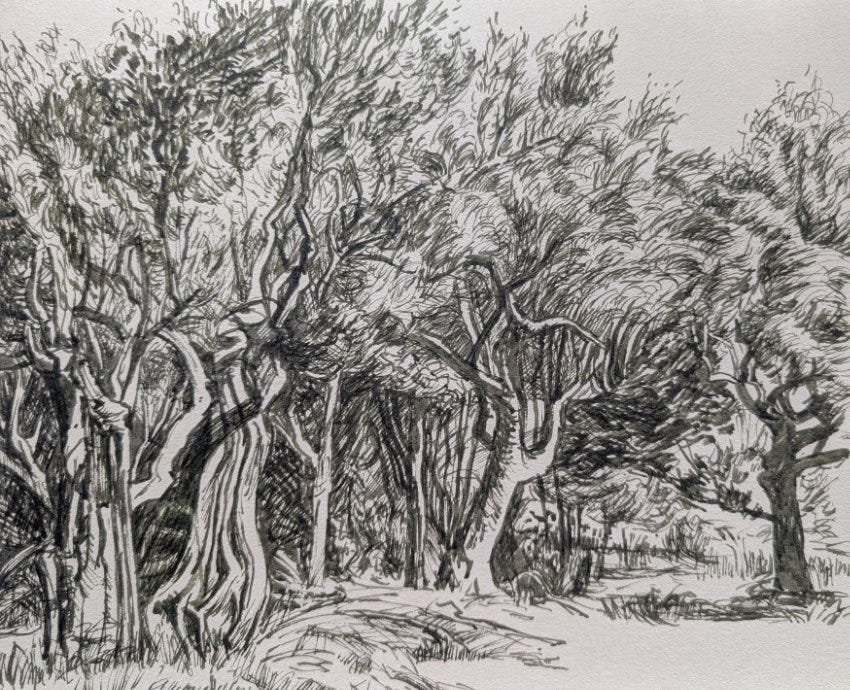
I always know I’m being affected by something external when I start doing meticulous or repetitive activities, and so it was this week: the news is so depressing these days, as if the world is drowning in the quicksand of inaction and lack of care. After mentioning in the previous post that I should draw more olive trees, I sat down over the weekend and did just that. The first drawing, above, on beige paper in a 9 x 12” spiral-bound sketchbook, was done with a Fude-nib pen filled with Noodler’s El Lawrence ink, a dark olive brown color, that is one of my favorites for drawings of plants and outdoor scenes. A drawing like this takes several hours and a lot of concentration. I didn’t listen to music at the same time, though sometimes I do; I like to focus 100% on what I’m doing.
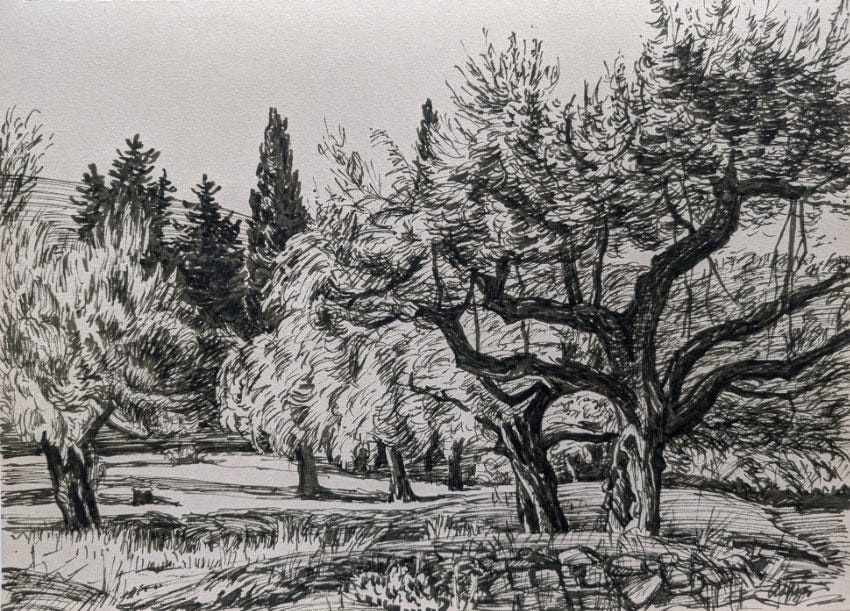
A few days later I began a second drawing in the same sketchbook, with the same ink, and finished it last night. In both of them, I was trying to find a “language” of marks to convey the lightness of the leaves and branches of the olive trees and their movement in the wind.
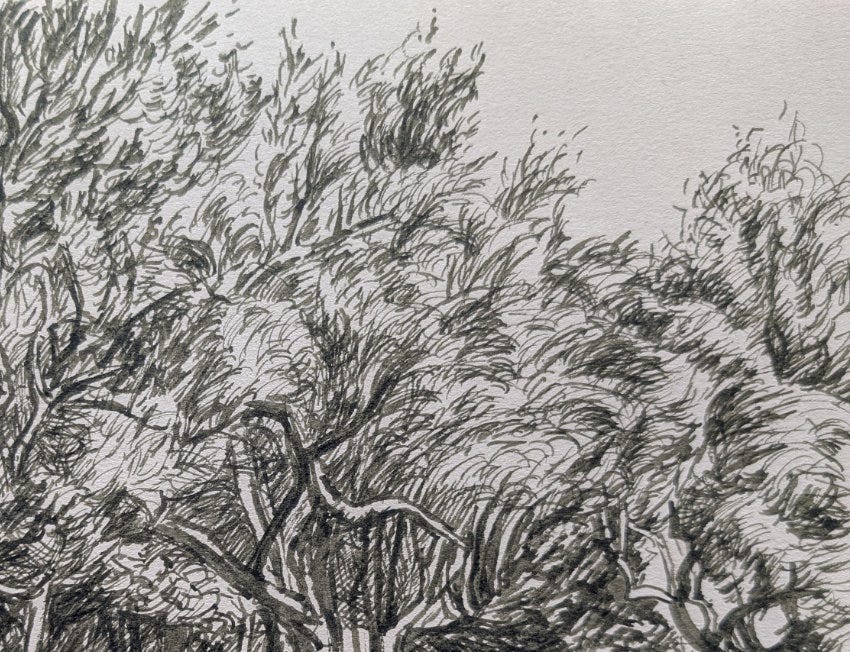
This quality is so essential to the olive — the sturdy, often twisted trunks and stiff but tortuous large branches on the lower part of the tree hold the crown of much lighter, long, flexible branches, covered with thin pointed leaves that range from silvery blue to yellowish green, depending on the season and the angle of light. In an ink drawing you can’t hear the dry rustling sound they make, or see their colors, but perhaps the feeling of the olive grove can come across.
These drawings are two views of an old olive grove that we came across while walking on a road back to our bed and breakfast in Mystras, Greece, in 2018. Ancient Mystras flourished in the 14th and 15th centuries, and is one of the best-preserved fortified Byzantine towns in Greece. It’s in Laconia, near ancient Sparta, in the Taygetus Mountains.
You reach Mystras from a hilltop crowned by a castle built around 1250 AD by the Frankish ruler of the region, William of Villehardouin, whose residence was in Lacedaemon, the site of ancient Sparta. William and his nobles were defeated and captured in 1259 by the Nicaeans, who two years later re-captured Constantinople and re-established the Byzantine Empire. For the next century, warfare continually erupted between the Franks and the Byzantines back in this region of Greece, with the Byzantines gradually gaining the upper hand. The local residents of Lacedaemon felt too exposed down on the plain, and eventually built a new town, Mystras, just below the castle walls. It became the provincial capital, and then a royal capital in 1349, when a Byzantine ruler was appointed for the region.
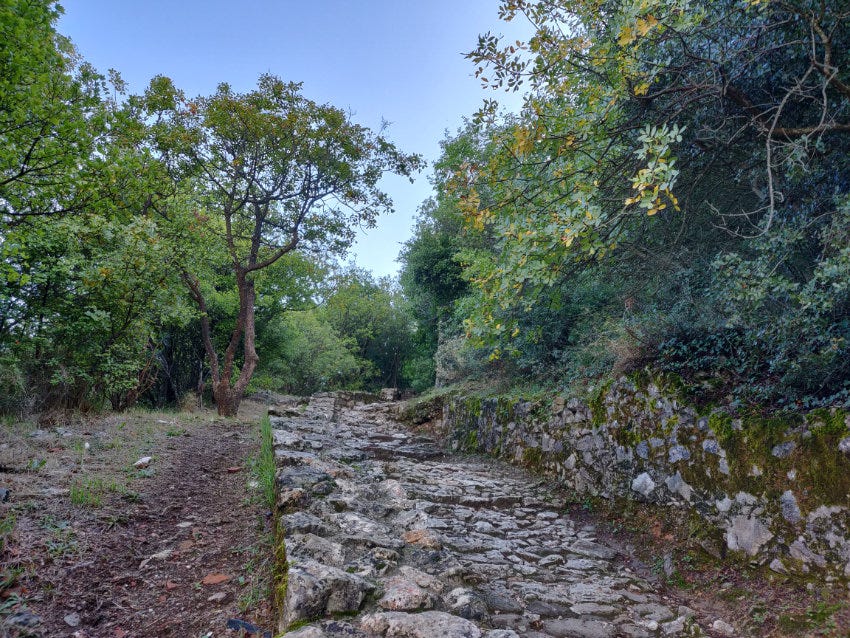
Our hosts had given us a ride to the top because they said it wasn’t safe to leave a rental car there — “bandits” had sometimes broken in — but they told us the best route to take was to hike up to the castle, then down through the Byzantine town, then to walk back to our lodgings. We walked carefully up damp rock paths to the very top and climbed up on the parapets of the Frankish castle.
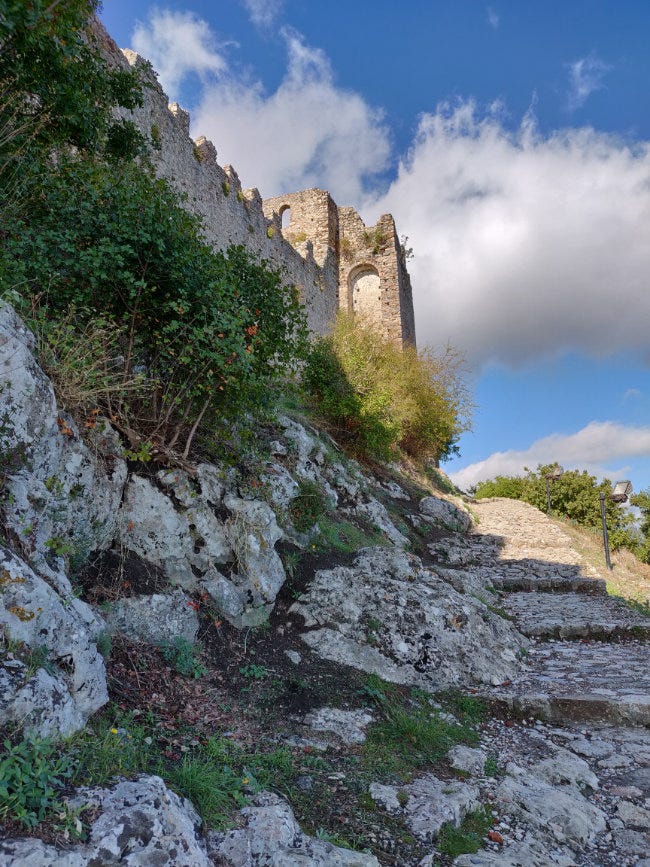
From there you can see the plain of Sparta (the modern town of Sparta can be seen in the distance in the picture below.) So many layers of history! I imagined the Spartan army practicing its maneuvers before marching off to Thermopylae in 480 BC…some 1700 years before the castle was even built, and 2,500 years before we stood there. In the even more distant past, had Helen of Troy, abducted by Menelaus, Prince of Sparta and brother of Agamemnon, looked up from the plain at these mountains? Little is left from ancient Sparta, but the previous day, we had visited the ruins of “Agamemnon’s palace” at Mycenae, and I was in a believing mood.
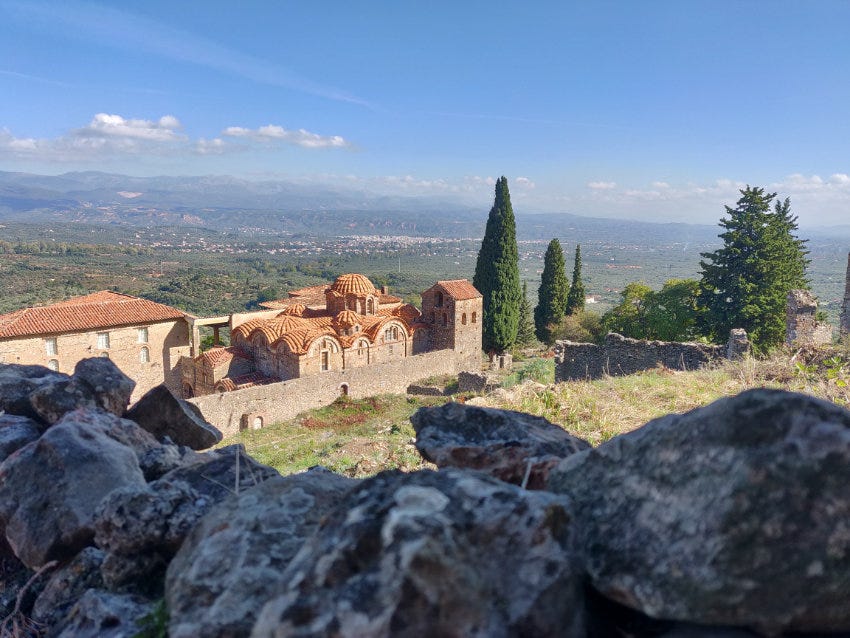
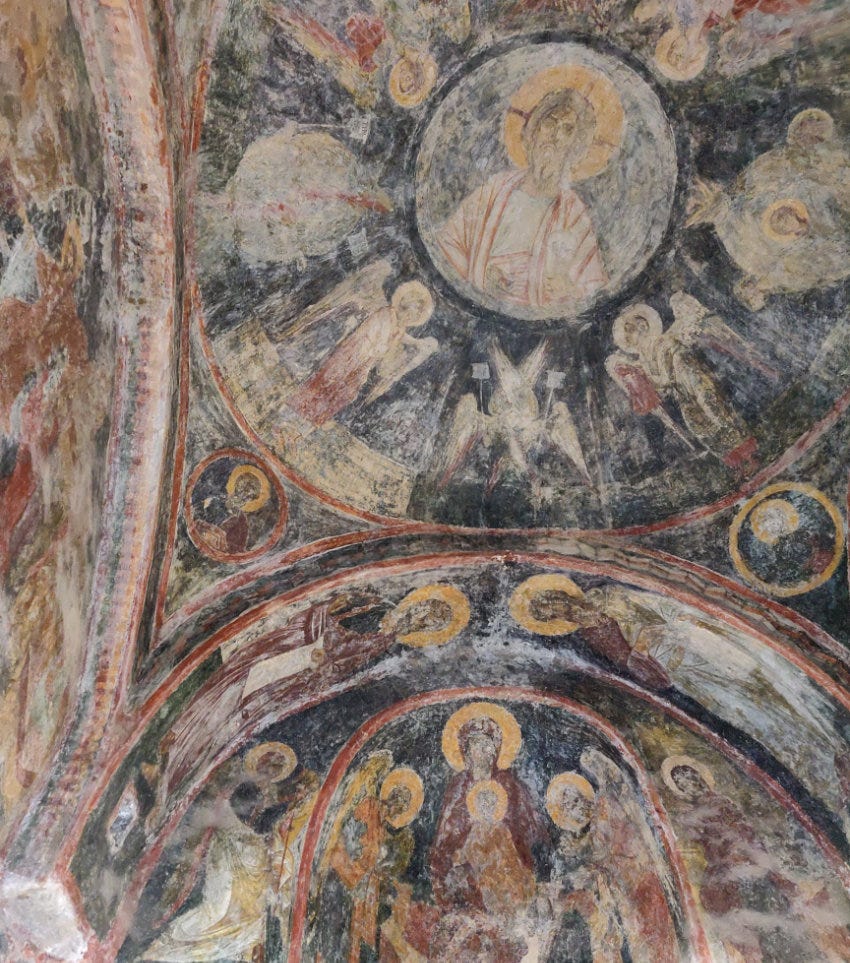
The Byzantine town is on terraced slopes below the castle. Descending down on foot, you wander through the pathways between churches, monasteries, residences, and civic buildings, some in better states of repair than others. Mystras was finally abandoned during the Greek War of Independence in the 1820s. Now it’s a UNESCO World Heritage Site. It’s an odd feeling to be there, different from visiting ancient ruins of Greek temples and cities. There’s little curation or human presence and you’re free to wander around as you wish. Herbs and flowers still grow in the monastery gardens; feral cats crouch under pomegranate trees heavy with fruit. But unlike in the Byzantine churches of Palermo or Rome, no well-restored gold mosaics glittered here. The structures of Mystras had long been open to the elements, their inscriptions and paintings worn away by wind, rain, and time.
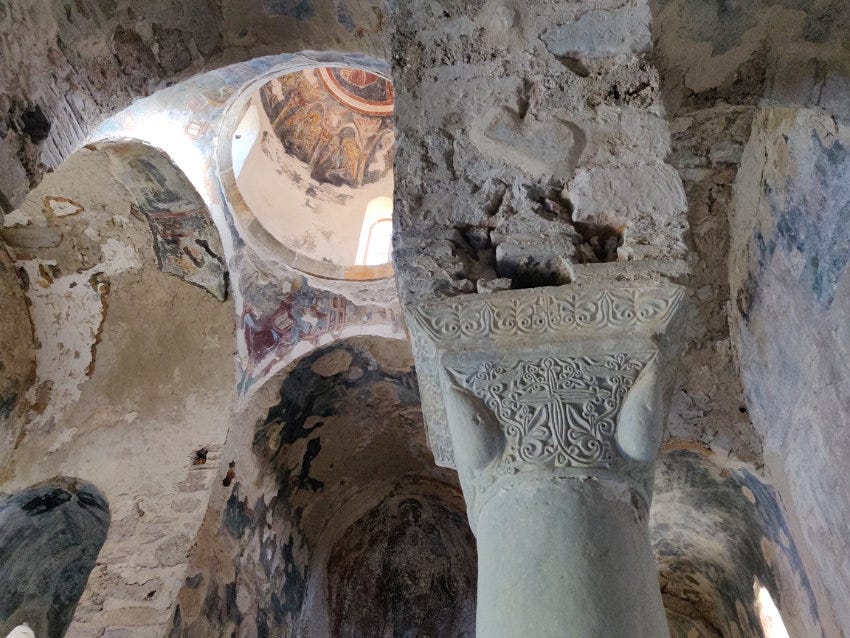
The life that once animated Mystras seems far away and slowly disappearing, like the faces and figures in its frescoes. A ghostly town.
—
When we reached the bottom of the site, we came around a bend and saw an olive grove, below a long row of tall cedars, on land that sloped gently downward. It was late afternoon, and the sun hit the tops of the trees, while leaving others in deep shadow. There were even older trees in another grove along the upper side of the road. We were hot and tired, and spent some time admiring these groves and the Laconian landscape before continuing our walk on the road to the modern town of Mystras.
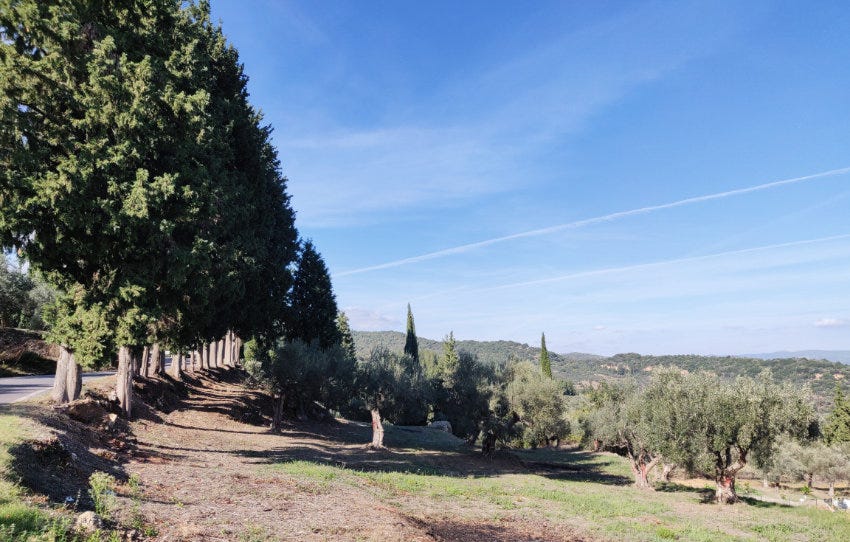
There was no one around, but these groves felt like a bridge for me between the past and present: some of its trees were surely as ancient as the Byzantine town, yet still very much alive, and had probably given olives and oil to the local inhabitants for centuries. It felt good to revisit them this week, through drawing.
Comments
Nothing yet. Say the first thing.
Sign in to join the conversation.