
Thank you to everyone who commented or wrote to me after the previous post. The discussion in the comments was extremely thoughtful and honest; I’ve learned from what was said, and appreciate it. I’m going to quote from a few of them as this post proceeds.
I've learned a lot from a whole lot of people and I'm grateful for that, but this can come at the expense of depth, of dialogue, of focus... So I don't read or even see everything you write despite my enthusiasm for what you do... My recent personal response to what is a problematic general state of affairs has been to put away devices more and do more proper, in depth reading of...um... actual books (and especially ones that require serious thought and concentration) I at least feel better and more balanced for this… —Michael S.
Many of you mentioned the overwhelm you feel from too much screen time, and too much on offer to read online. I too have cut down on my online reading, including unsubscribing from some services because I couldn’t keep up, and was tired of getting so many notifications.
This is a problem when there are so very many people writing so well about so many important issues and experiences in these digital formats, and I am unable to take them in & fully engage… —-L. H.
For some, this overwhelm and too-muchness means engaging less online, where they say they’re reading less deeply, scanning from one item to another, not interacting; for others it means difficulty choosing where to put their focus and having trouble paying close attention.
Some people enjoy and nurture online relationships and find them as deep and satisfying as real-life ones, but others don’t. Just having to type all the time, rather than speak, is difficult and tiring for many of us.
And I don’t think these questioning attitudes are confined to those of us of a certain age. In spite of youth’s reputation for being glued to their phones and having trouble with in-person social relationships, a lot of young people say they are rejecting smartphones and other digital technology.
But the other question I was aiming at, the “tricky question”, as Lorianne aptly puts it, is what’s going on with the economic of support for writers, in particular. Whose responsibility is it, and who decides what’s worthy? How did we get here and what does it bode for the future?
If I “upgraded to paid” for all the individual newsletters I subscribe to, I’d be broke for sure. Things were easier in the days when you paid for a newspaper or magazine, trusting them to pay their contributors, versus now when even professional writers have online tip jars and everything has seemingly been shifted to gig-economy mode…
I guess this is a roundabout way of saying I’m happy to pay money for print or ebooks in part because they take me away from screens, notifications, and the like, but something like Substack feels like a fancier social media platform that is constantly asking me to pay for what I’m reading.
So yeah...it’s complicated, and I’m conflicted. —Lorianne D.
The gig economy is now well-established, employing (among so many others) professional academics, journalists, other writers and creative people who 20, 30, 40 years ago would have been much more likely to find secure jobs with benefits, working for institutions and organizations. Not only have many of these people lost their jobs as media, academic departments, and institutions have been forced to downsize — or have chosen to do so for profit motives — many have been forced out because of racism and political expediency. It is a fact that the idealism that once ran in the veins of some of our best institutions has been drained out, replaced with top-down economic and political decisions that have little or no humanity at heart, and much less respect for quality of thinking, research, and craft.
The excellence of some of the writing on the web now comes from experienced people who are former employees of top media and institutions: they either left, or were fired. Some were free-lancers to begin with. Substack and other platforms give these people the freedom that they were denied in their jobs, and in some cases, this has resulted in a better income than they had before. That’s the exception, but it does happen.
Conversely, there are a lot of (often younger) gifted writers, thinkers, and other creatives who currently have no hope whatsoever of landing the kind of job they once could have gotten. Building up an online presence is one of their best chances to do what they care about, and receive some support for it.
But who is providing that support?
It seems that in this online world of subscriptions, “buying coffees,” and sites like Patreon, we’re returning to a modern, micro-version of artists being supported by benefactors or patrons in the distant past. In today’s economy we’re asking those who meet our work and can afford it, to support us — beyond the exchange of a product or “experience” like a concert. Realistically, many people cannot afford to subscribe to even one blog — and many would prioritize other expenditures if they had a little extra to spend. —- Suzanne C.
Commenters brought up some other points I hadn’t thought of: A. J. suggested a tip jar for people who might want to make a one-off, smaller contribution. Kristen pointed out that some readers can’t take advantage of paid content like video instruction all year round because of their own schedules, so the model of subscribing to extra content on an annual basis doesn’t work for them.
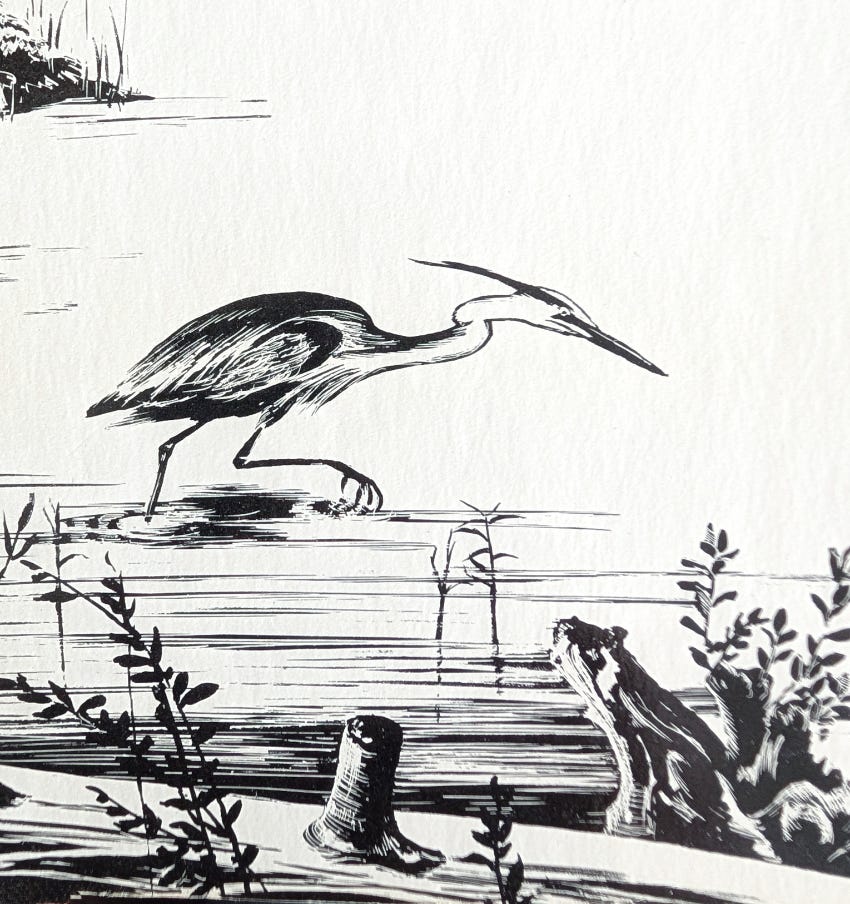
Great Blue Heron, from A Seat in a Wild Place by Erik Brown (1982), scratchboard illustrations by me.
Sadly, I don’t see the pendulum of journalistic or institutional employment swinging back anytime soon. As usual in a capitalistic model, the online creatives with a large following receive the greatest reward and most favorable deals because they make more money for the platforms. With some exceptions, this does not drive quality and thoughtfulness, let alone something as squishy as “lyricism”; it drives people to push for popularity, shock value, quotability, anger and outrage — all the things that exhaust us about social media and media in general.
In our particular neck of this dark wood, though, lyricism and thoughtfulness, care and attention are valued. This commenter says it very well:
Long ago, after I was unexpectedly fired from a job and left hanging with a mortgage I wasn’t sure how we’d afford, I turned to art and nature as a way to cope with precarity. This was past the early stages of the social internet, when mutual friends could earnestly re-share #floralreport posts without being flooded with negativity or worse, nameless bots. Such open faith and relatively benign recognition coaxed me back to engaging more broadly.
In the process of turning inwards I realized that I didn’t wish to leave a wake of resentment and instead, uphold, promote, care for, connect to, and above all, practice my belief in the worlds they create rather than my wallow in the narrow thoughts I had about unfair labor practices, subtle racism, and social isolation. I found solace in how people could create without necessarily feeling the need to monetize and/or proselytize. It was refreshing to think that there could be places, both physical and otherwise, where one could move beyond living and contemplating the world to expressing joy, pain, and awe at the chaos and beauty of this particular life.
So that is what I come back to, again and again. It’s a form of church in a time where I have no particular congregation or book to hold. It’s a means of refusing the drudgery of these times while affirming the yes and the yes of what holds us together. —Mimosa S.
What I come down to, in thinking about all of this, is that what I write should be given freely, as it always has been. I can trust that those to whom it matters, and who have the means to do so, will support my efforts in ways that encourage me to keep going — which can be a word as much as a purchase or contribution. I’m fortunate to be in a position where I no longer have to rely on my personal creative work for income — and that is largely because my working life coincided with a time when professional calligraphy and typography, illustration, graphic design, editing, and experience in marketing and communications were valued — and were provided by skilled human beings. I was always self-employed, which meant paying for my own health insurance, retirement pension, and social security as well as all my other expenses: studio space, supplies, tools, computers and software, suppliers, services…it was a long list, and there was precious little time off. My partner and I were always looking out for the next job, and worrying about keeping the clients we had. On the other hand, we had more freedom and control, and the quality of our work was entirely our own responsibility; we grew our business through word of mouth in one geographic region of the country. Being on your own economically is never easy, but it was at least possible then to make a decent living as free-lancers. Now it’s even harder, especially because the internet makes us all feel like tiny fish tossed into a gigantic, teeming ocean. Suzanne writes:
I am in the middle of a journey of building a new business and have been moving through very uncomfortable feelings regarding exposure through posting, feeling deserving of putting my voice out there in all the noise, and terrified at the prospect of having to "sell" myself. No, I'm not above having to sell myself (my work) and am gonna have to find a way to share it and deal with the resistance I feel. — Suzanne C.
I hope we will all think more deeply about the ways we can help the artists and writers whose work touches us. We’re in a time of instability and insecurity that isn’t going to let up for a long while. In the 1970s, the saying, “The gift must always move,” gained a lot of traction. I intend to do even more “paying it forward” from now on, in various forms of currency, tangible and not.
Comments
Nothing yet. Say the first thing.
Sign in to join the conversation.