
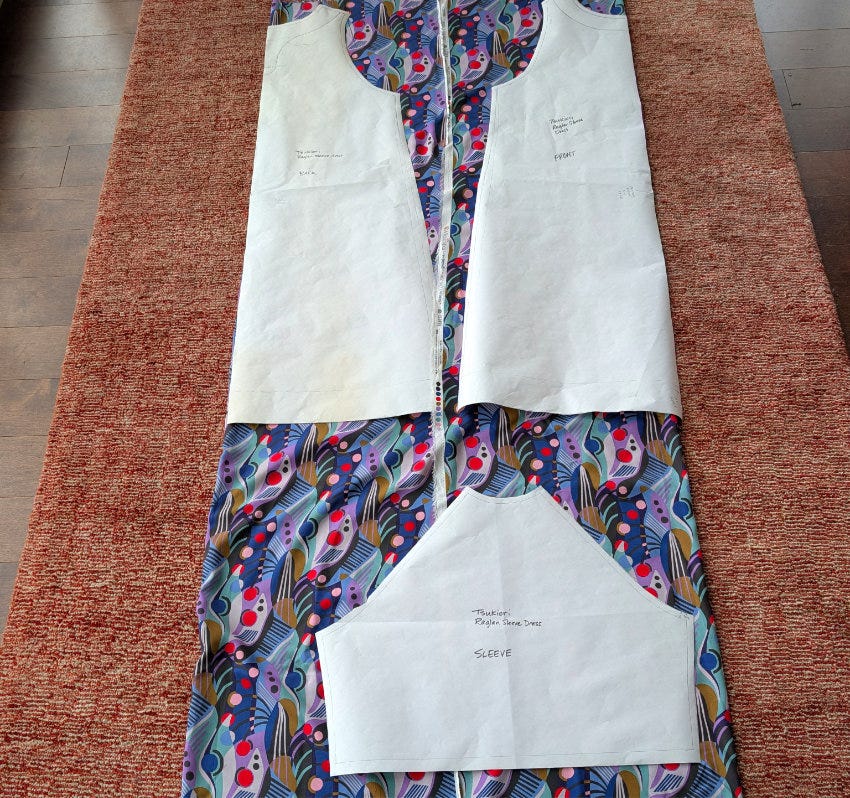
This past week I went on a sewing binge. I’d been wanting to make something for a while, but my quite-small studio has been taken over with oil painting. I finished the canvas I was working on (more about that eventually) and was able to pack away the paints and palette and bottles of solvents and brush-cleaning supplies; that meant I had enough room to set up the ironing board and sewing machine and get to work. Cutting-out, however, happens on the living room floor.
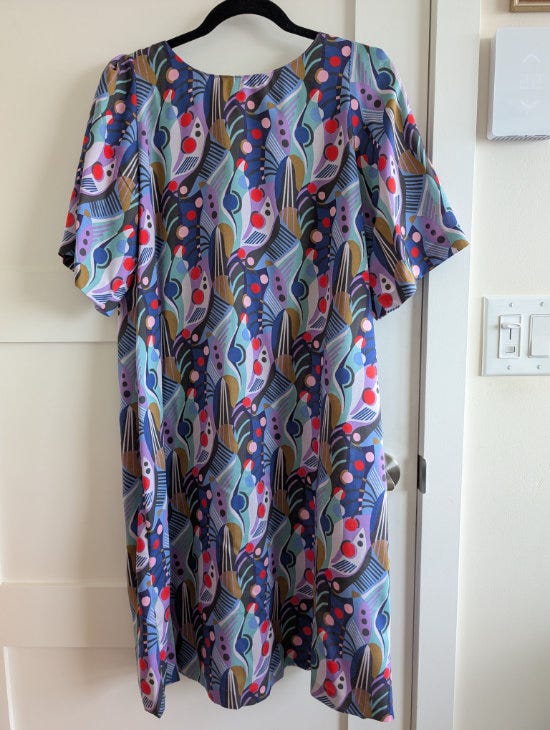
The first thing I made was a raglan-sleeve dress from Yoshiko Tsukiori’s Stylish Party Dresses book (Tuttle, 2015). I’ve had this abstract-print viscose rayon for a few years; it was designed by Masha Valnova of Pip&Lo, whose surface-design work, mainly for textiles, I originally discovered and admired on Instagram.
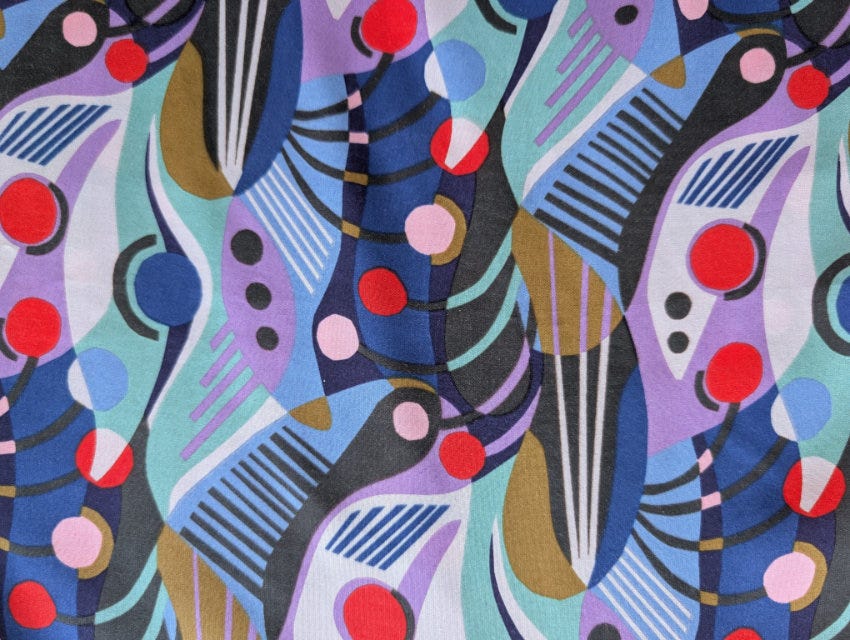
The fabric, from Cloud 9 Fabrics, was a dream to work with, but once I started putting the pieces together I realized there was a problem. This was one of those Japanese patterns where you have to trace the pieces for your chosen garment from a confusing fold-out sheets that contain all the garments in the entire book — in this case, 6 sides of large paper contained all the pieces for 30 garments. Some of them share outlines with other patterns, but deviate in one or two areas. And that’s what I had missed: I had cut the top of the front and back as if it was for Dress “v” but missed the fact that “v” ended in a different place (yellow line, added by me just now), and what I had was the top of Dress “e” (red lines).
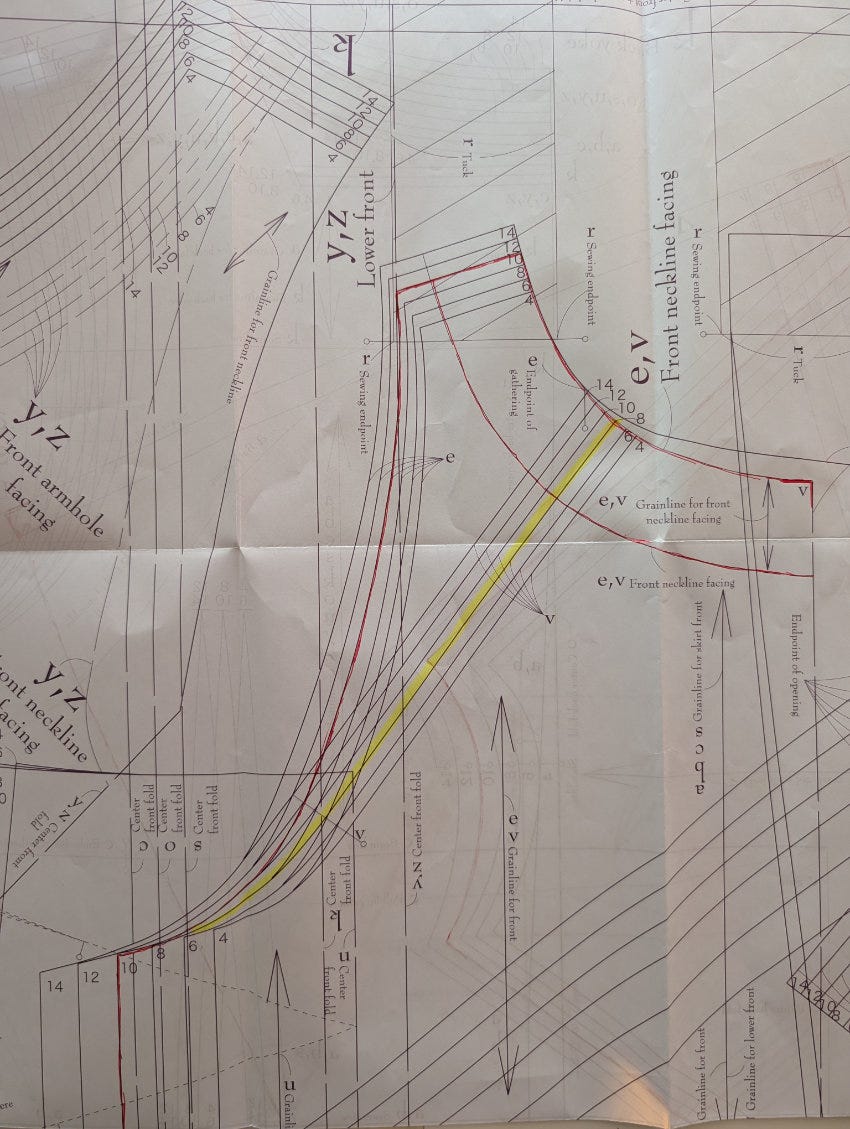
The upshot was that the sleeves didn’t fit the neckline facing. I shoudl have seen it immediately, but just didn’t. By the time I did, I had already cut the fabric and sewed the sleeves to the front and back. There were two choices: take out all the seams and re-cut the pattern pieces (as you can see above, “v” is a subset of “e”), or modify the sleeves by making a reverse pleat at the top of the shoulder to take up the extra fabric. I did the latter. The resulting dress is a little “dressier” than I’d originally envisioned but I like it just as much. And I didn’t go crazy trying to take seams out of a fairly delicate fabric without making holes in it.
The second project was a kimono-style “hapi” jacket out of a very nice plum-colored double gauze that I bought at a new, high-quality fabric store in Montreal, Club Tissu. But I didn’t have a pattern, only two similar jackets that I had made over thirty years ago. Online research showed me that, as I had remembered, the jacket is basically just slightly-modified rectangles, which makes sense. The sleeve pieces, below, are just cut from a rectangle with an angle through the middle — they are upside-down mirror-images of each other.
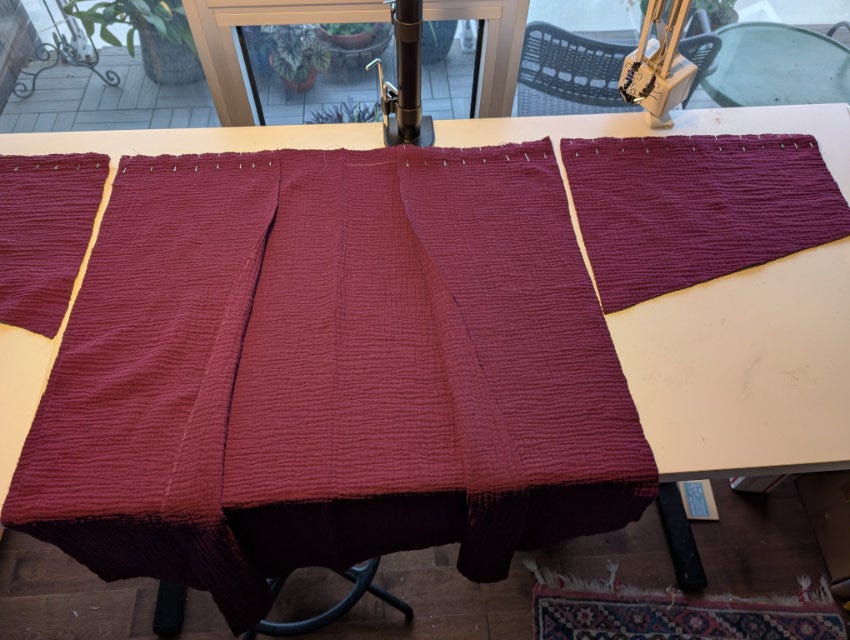
Classic kimono fabric in Japan is often handwoven or even handpainted, and it comes in long bolts of 6 yards that are only 14 inches wide — so the garments made from it need to be very efficient and not waste material. After looking at construction details online and examining and measuring my own jackets, I drafted a pattern that I thought would work, and did a scale drawing to figure out how much fabric I would need. (I also went down a very deep rabbit-hole looking at gorgeous Japanese fabrics online).
The double gauze proved rather fussy. As the name implies, it’s two layers of fine cotton gauze fabric stitched together, and it’s kind of puffy/squishy, which creates the fabric’s appealingly soft texture. However, it is easily deformed during sewing.
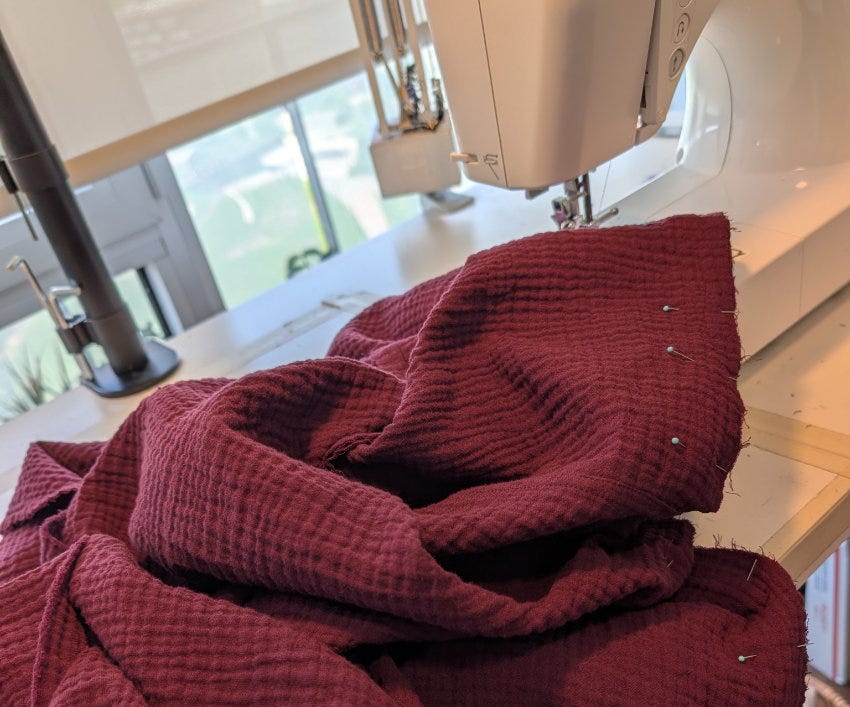
I ended up having to pin the seams every half-inch to avoid shifting, and go slowly. Because I wanted all the interior seams to be self-enclosed and top-stitched (below), there was a lot of fussing and handwork.
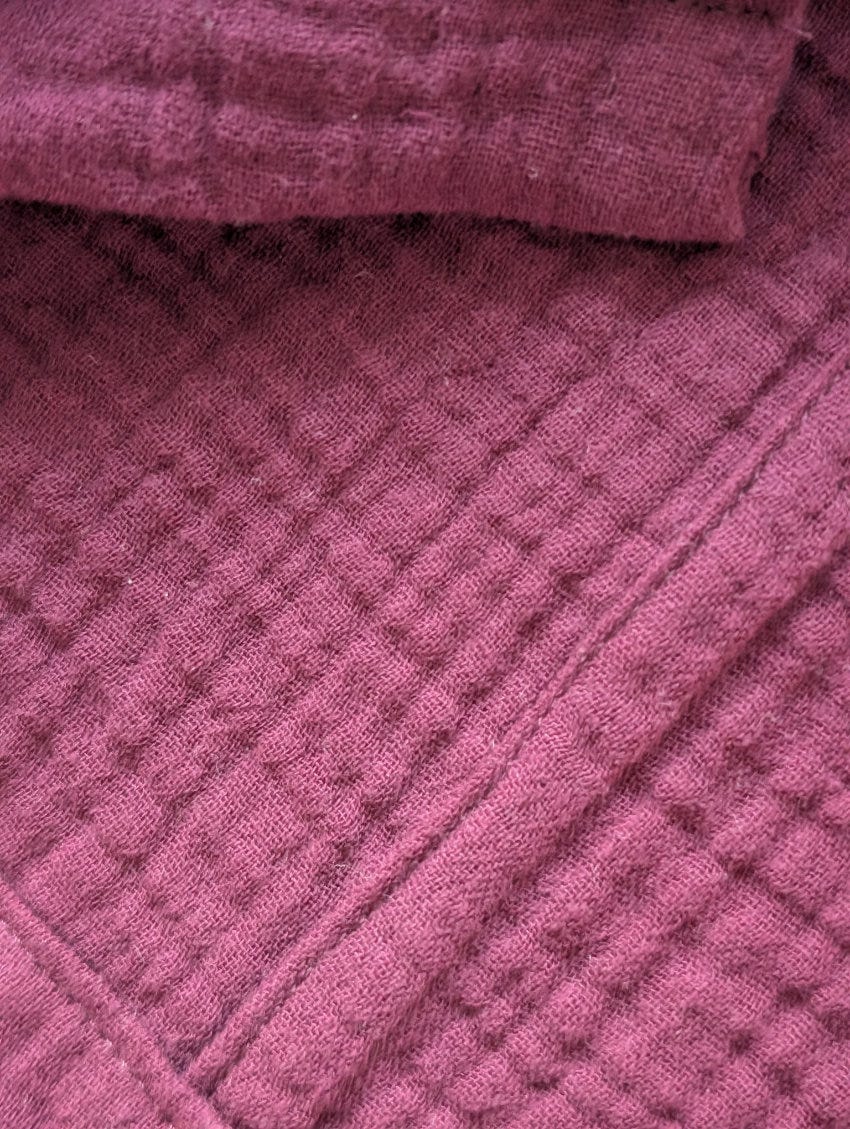
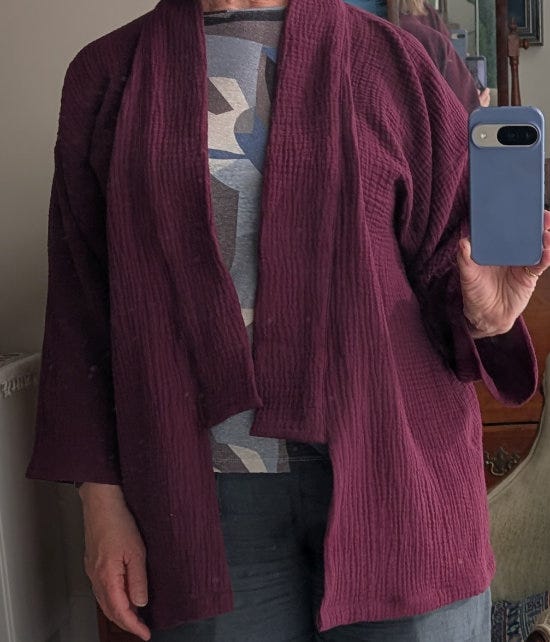
I’m pretty pleased with the resulting jacket, which will be cool in summer and a nice layer for interior in winter, although it would have been easier to make in a different fabric!
Now all the sewing paraphernalia is put away again, and the studio ready for other kinds of work. I enjoyed my sewing week, and it got my head into a different space, which is exactly what was needed.
Comments
Nothing yet. Say the first thing.
Sign in to join the conversation.