
0:00
-1:22

French grammar, Spanish vocabulary, modern Greek…I’ve been practicing and memorizing languages for a long time, with varying degrees of success. But it’s been decades since I memorized a poem. When I was young, my great-aunt, in particular, used to read poetry to me and I often memorized bits and pieces of the repeated favorites, first stanzas usually — The Midnight Ride of Paul Revere, The Lady of Shalott, Hiawatha — and I can still remember them.
Every Sunday I’d hear Thomas Cranmer’s poetic liturgy from the Book of Common Prayer (1552), and many of those words remain embedded in my brain too. In spite of the fact that the prayer book has been modernized and I rarely, if ever, hear those prayers anymore, I can still repeat that “we have erred and strayed from thy ways like lost sheep; we have followed too much the devices and desires of our own hearts,” and “we beseech thee, give us that due sense of all thy mercies, that our hearts may be unfeignedly thankful; and that we show forth thy praise not only with our lips but in our lives, by giving up our selves to thy service and walking before thee in holiness and righteousness all our days.” The cadence and musicality of this early exposure to Elizabethan English probably influenced, as much as anything else, my ear for poetry. It certainly increased my English vocabulary! It pains me to think how many good words have been excised during prayer book revisions and simplifications, because “nobody knows what they mean anymore.” On the other hand, my gender was never even included in “all sorts and conditions of men”, which reflected the fact that women had no official role in the church — but they certainly do now. Just as Cranmer had written the first liturgy in the vernacular — English as opposed to church Latin — it’s incumbent on later generations to make the words understandable, appropriate, and inclusive.
The musicality of words does help us retain them. My brain stores hundreds of song lyrics I never even deliberately tried to memorize: it’s a kind of poetry that most of us find a lot easier to learn.
In ninth grade, our English teacher insisted that each of us commit a poem to memory and recite it before the class. In those days I was quite afraid of public speaking, and I remember shaking with fear when I got up to recite my choice, Robert Frost’s “Birches.” But I can still remember the beginning of it: “When I see birches bend to left and right/across the line of straighter, darker trees/I like to think some boy’s been swinging them./But swinging doesn’t bend them down to stay /as ice storms./Often you must have seen them/loaded with ice a sunny winter’s morning/after a rain…” Being in plays didn’t scare me as much, and I always learned my lines and performed without too much trouble, maybe because I felt both supported and responsible as part of a group.
These are some of the words of poetry that come to mind now when I’m awake at night and trying to put myself back to sleep, not so much because they are comforting but because something about the process of recall and silent recitation seems to access a different part of my brain, turning off the worrying or wakeful part, and helping to lull me back to sleep.
My worst experience with pitfalls in memorization came during an oratorical contest I was forced to enter in my junior year of high school. The competitors had to write a ten-minute speech on an historical topic, commit it to memory, and recite it, standing alone on stage, in front of the entire student body. I didn’t mind writing the speech but absolutely dreaded the event, and went out on stage with sweating hands and shaking knees. To my horror, I won, which meant I had to go on to compete at the county level. When that day came, at a neighboring school, I started out all right, but the second section began with the same phrase as the closing section, and somehow I launched into the latter, then realized my mistake, and stopped dead. My prompter, in the wings, had no idea where I had gone in the speech, and it took her what seemed like an eternity to give me the right line. I’m sure I turned all colors of red, or maybe white, but the good part was that I immediately knew that I would lose, and never have to do it again!
A few weeks ago, a close friend told me he was going to try to memorize more poetry, and had already started with one poem. All the recent talk about the Odyssey, another poem loved by me, whose beauty and cadence is completely absent from the dialogue of the movie version, also made me think about how human beings used to commit huge amounts of text to memory and then recite it. Some still do: I think of scholars who know the entire Quran, or actors like my friend Edward, who performs a one-man version of Shakespeare’s Richard II entirely from memory.
So I decided it would be a good exercise for my brain to do some memorization too. I had just bought a copy of the collected poems of Elizabeth Bishop, and one of her early poems, Wading at Wellfleet, seemed like a good place to start. I was surprised how difficult it was for me, partly because I haven’t done this for a long time, and also because the poem is constructed with many twists and turns, and choices of words that didn’t feel obvious but were, in fact, the result of careful decisions about musicality, alliteration, and precision, as well as meaning.
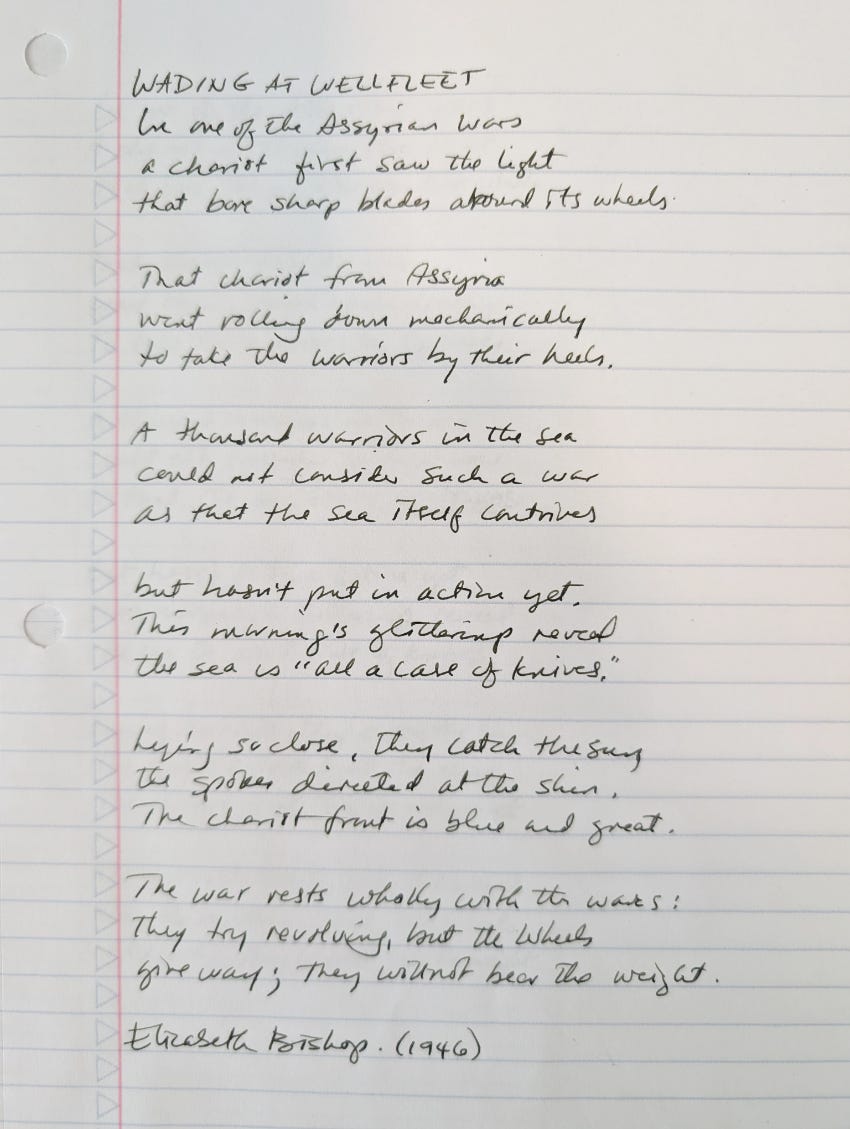
To begin, I wrote the poem out in longhand. Six stanzas of three lines each. The only rhyme occurs, unusually, in the last word of each pair of stanzas: wheels/heels; contrives/knives; great/weight. This was only partially helpful, because there was a lot to memorize before ever getting there. I worked in sets of two stanzas, trying to make sure I knew the first lines of each and moving on from there. I wrote out these stanzas a number of times, trying not to look back, and repeated the lines to myself internally and then aloud. The key for me was learning how each stanza led into the next one.
During this process I gained a huge appreciation for Bishop’s craft and her choices of words and phrases, as well as the brilliant mental leap that had inspired her to write the poem initially. While wading in the ocean and watching the sunlight glinting on the swelling waves coming toward her and breaking on her shins, she had thought of the gleam of knives on the spokes of Assyrian chariots. With each repetition of her words, I found myself going deeper into her initial vision and where she went with it. Not a single word is unconsidered. Bishop’s lifetime output was small, and she labored over every poem to make it the best she could. I am filled with respect that I probably wouldn’t have felt as strongly had I not spent all this time with her words. The recording above is from memory, and I hope it opens up this masterful poem for you.
Why don’t we do this anymore? Unlike Russians under Stalin, poetry doesn’t circulate by samidzat and by memorization; access to the words has become easy and uncostly for the few who still care — or so it has been until recently. Obviously we see ourselves as too busy, and thave no need to entertain ourselves on long winter nights by reciting poetry; most people would find that ridiculous, and besides, we can ask our computers to recite for us if we want to. Do teachers assign such a thing these days? As our capacity for paying attention erodes, this is one way of stemming that tide. Memorization has to be good for our brains. Just as drawing is a way to see with greater clarity, surely this immersion in words is a deeper way into their meaning, and potentially into writing better ourselves. In any case, I liked it and am going to do more.
What about you? What words do you have stored in the recesses of your mind?
Comments
Nothing yet. Say the first thing.
Sign in to join the conversation.