
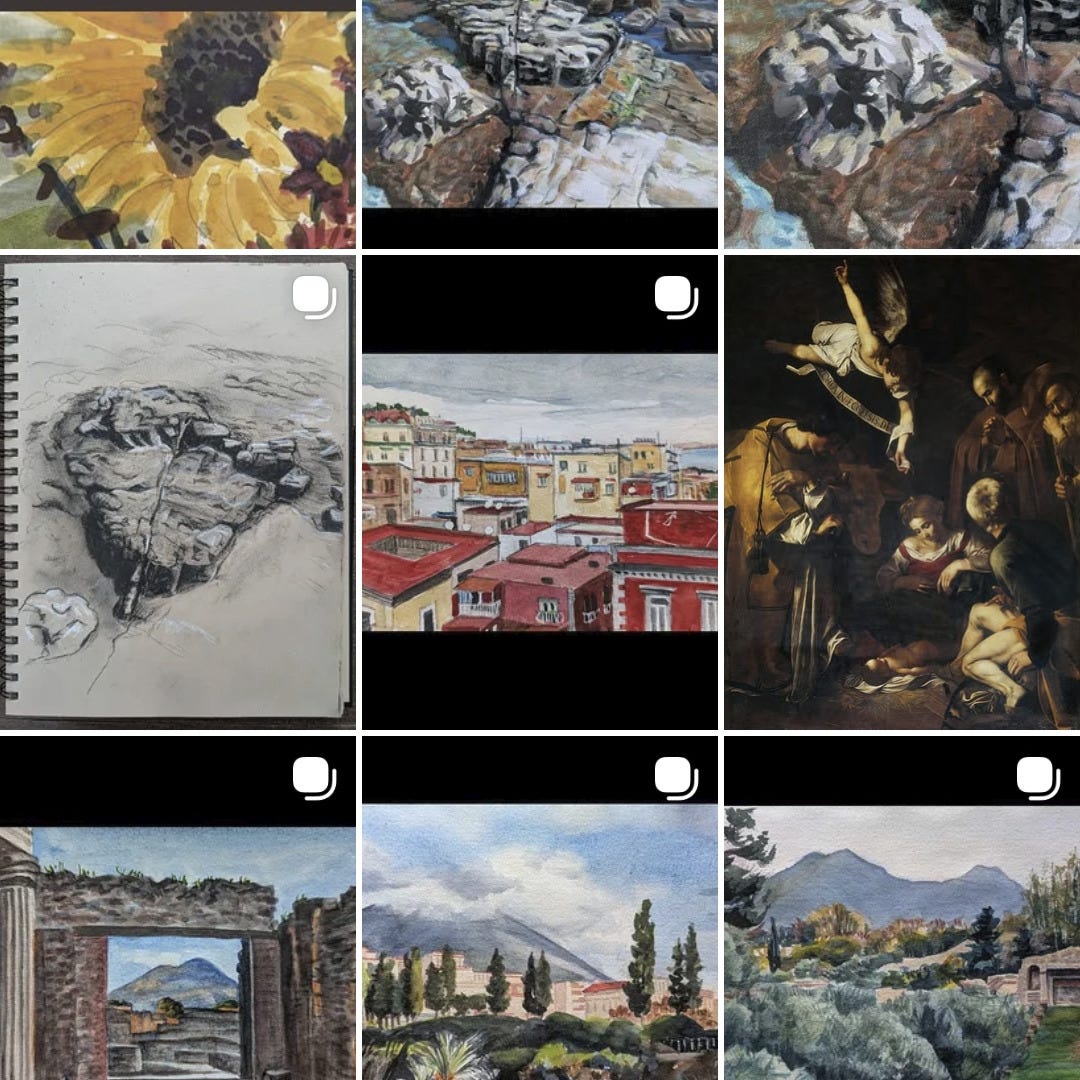
On February 19, I wrote this post about my reasons for taking a break from Instagram.
It’s now nine weeks later. Lent, the ostensible reason for my “fast”, is long over. It wasn’t a total abstention — I did check once in a while to see if there were messages from people who hadn’t gotten the message that I wasn’t there…and in fact there usually were. I put up a 24-hour story notification when I did new blog posts. But I didn’t scroll, didn’t see what my friends were posting, and didn’t add any new posts. I took the app off my phone entirely.
I did not miss Instagram. In fact, I barely thought about it. Some of that was because of being away in Mexico, some was busyness; recently I was ill. I was curious, though, about how I’d feel when I went back, so last week, I did.
I was, as I expected, very happy to see the art and photography posted by my friends. I appreciated some of the art sites that post work from other artists of the past and present; often there’s something unfamiliar that I’m glad to see. But the rest of it? Like many things in life, including some people: familiarity numbs you, but after a long absence, when you see them again, it can be a shock. Being off the app for a couple of months also changed the algorithm, of course. I wasn’t seeing the same stuff as before, and my posts weren’t being shown to as many people, regardless of how many “friends” follow me. But what I was being shown were countless ads and sponsored posts, in an endless stream of commercialism and attention-seeking. It was so noisy — and I’m not talking about auditory noise because I always keep my speakers off. I was able to see, more clearly than ever, just how targeted and manipulative it is, not only in a commercial way but in psychologically as well. It certainly didn’t make me feel better about myself or the world; in fact I was more aware than ever how skillfully these mediums play upon our feelings of inadequacy and smallness, while creating an illusion of connection. I paused the sponsored posts, deleted a bunch of accounts, and said I didn’t want to see ads from many of the excessive sites. Doing even that, however, requires constant maintenance and time that I resent spending.
I noticed how ingrained the habit of scrolling can become. Once back on the platform, I instinctively started scrolling through both Posts and Stories, and forced myself to stop — how much time had I once spent doing that?
Likewise, I don’t want to participate in threaded conversations where the headline is so often some version of “Your most important read of the week!” intended to draw your attention to that person’s latest utterance, and then keep you moving down the endless scroll. (Even Substack has threaded conversations now. I make myself go straight to the Dashboard and don’t look at them.) I don’t do it because it takes way too much of my time, and because, again, I find too much reading of this sort of thing makes me feel worse.
Returning to Instagram, I was also keenly aware of how much content has migrated to “Stories” and away from “Posts,” a point I mentioned before , because viewers seem to pay more attention to these fast but fleeting bits of content. However, I don’t want TikTok any more than I want an endless reels about cats, knitting, travel clothing, gardening hacks, and where to stay in particular cities. This reduction of one’s identity to artificial intelligence’s “best guess” is depressing. But so is the search for attention and affirmation, and the nagging fear of being sidelined or forgotten that preys on our insecurities, and addicts so many to social media.
Conversely, Instagram has been good for encouraging people to come over here. It’s also excellent for advertising events, new releases of books, and so forth. It’s a business.
And a final cautionary note: while predatory corporate behavior by the tech giants is one thing, I do not trust that anything I post or write in a message is safe. Everything on the major social media sites is scanned and surveilled, and can be used against us — so, in general, I am very careful.
—
I’ve noticed that more of us are questioning the platform. Like me, these other users — most of whom, in my case, are artists or writers — don’t want to leave a place where they’ve staked out a long-time presence and do have a sense of community, but they are also putting more energy into their own websites, blogs, and other online forms that are not corporate, not part of the big system, and remain under one’s own control. They are also hungry for other forms of activity and community that require — and acknowledge — genuine connection and greater attention. I’m not going to leave the site, but I’m now much more aware of what it is, how it affects me, and how I want to use it.
None of what I’ve based my life upon is disposable. When we take the time to create a work of art, to play or listen to music, grow a garden, learn a language, write a set of poems, or build a relationship, we do so because our effort feels worthwhile and we hope the result will last. Our lives themselves are short; time is precious. I want to make intentional choices and to spend most of my time in the real world, as positively as possible. So I think the right thing for me is to limit my intake of news to what’s necessary for knowing what is going on, and not get drawn into the maelstrom of debates and opinions; to limit my time on social media; to write as thoughtfully as possible, to keep learning, to devote myself to music and art and the people I care about — many of whom are online friends, some of whom I met through Instagram itself — but in a thoughtful way that honors the best aspects of who we are and what we respect in each other.
I’m glad I did this experiment. It showed me some things I needed to know.
Comments
Nothing yet. Say the first thing.
Sign in to join the conversation.