
In 2015, Secretary-General Ban Ki-moon observed that the UN had entered an era of partnership peacekeeping, pointing out that “no single organization can effectively address increasingly complex, multifaceted peace and security challenges on its own, whether at the subregional, regional or global level” and that “responding to those challenges has increasingly been and must be a joint endeavour.”1
To address potential duplication and overlap, the UN and partners from both inside and outside the UN system have turned to the concept of “comparative advantage” to reach an optimal division of labour. But the manner in which the term is often used reveals a fundamental misunderstanding of what the concept of “comparative advantage” actually entails by many stakeholders. This semantic issue is not a pedantic quibble; the widespread misuse of the term is an obstacle to overcoming the persistent challenge of coherence in multilateral peace operations.
This week, I want to explore what comparative advantage actually means in terms of peace operations, why it matters, and how policymakers and diplomats should think about the concept in discussions about the future of peace operations.
Comparative advantage is a concept from economics related to maximizing production in a system with multiple producers. A producer has comparative advantage when they can provide goods or services at a lower opportunity cost than other producers. Opportunity cost, in turn, is the value of the path not taken, i.e., the other goods or services that the producer could have provided as an alternative. To apply comparative advantage to peace operations would be to have each organization specialize in the activities where it has the lowest opportunity cost compared to other organizations who can also perform those activities.
Comparative advantage is frequently conflated in policy discussions with two other concepts, namely absolute advantage and competitive advantage.
An organization has absolute advantage when it can perform an activity better than another activity. Absolute advantage disregards opportunity cost; as a result, an organization that enjoys absolute advantage over another organization for a given activity may not necessarily have comparative advantage for that same activity in situations where many different activities need to be undertaken. Absolute advantage is of little practical value when looking at peace and security activities because opportunity costs can’t be ignored given the finite human and financial resources available to organizations and the range of mandated activities to be implemented.
Finally, an organization has competitive advantage when it has certain attributes or structural features that other organizations lack which provide it with an edge. Competitive advantage doesn’t say anything about how good an organization is at undertaking a particular activity, but focuses on unique factors that set it apart from other organizations. Examples of competitive advantage include ease of decision-making, access to predictable and sustainable sources of funding, and established policies and procedures for planning and deployment.
Entities and organizations often assert a range of comparative advantages over other organizations as a legitimation strategy, but such justifications often rely on a misuse or misunderstanding of the term. For example, the 2024 report on The Future of Peacekeeping, New Models, and Related Capabilities asserts that the UN enjoys six comparative advantages over “potential alternative multilateral instruments”: (1) its convening ability, (2) established processes for deploying civilian and military expertise, (3) legitimacy, (4) sustainable financing, (5) accountability and compliance mechanisms, and (6) body of policy and guidance based on lessons learned.2
In fact, none of these are areas of comparative advantage; instead, they reflect areas of competitive advantage. In other words, these do not show that the UN is more effective at or has lower opportunity costs of undertaking any particular tasks than any other organization, but that the UN benefits from certain characteristics that others don’t have. For example, the recent experience of deploying the Gang Suppression Force shows that the UN enjoys a competitive advantage in its planning and force generation processes when compared to ad hoc coalitions. This, however, doesn’t mean that a hypothetical UN peacekeeping operation would be better (or worse) positioned than the Gang Suppression Force to protect civilians through dismantling gangs, securing critical infrastructure, and ensuring humanitarian access.
Some of the other areas of advantage asserted in the report, however, are questionable. The events of the past two years have clearly shown that the sustainability of UN financing is less reliable than presupposed, and there is plenty of reason to question whether the UN is actually effective in learning from its experiences.3
The failure to understand comparative advantage is not confined to the UN; the African Union consensus paper on the financing of peace and security activities asserted that “the African Union (AU) and its regional organizations have demonstrated a clear comparative advantage as first responders with the political will to undertake offensive operations in high-risk environments”.4 Of course, the ability to deploy more quickly is a type of competitive advantage; it does not mean that the AU is more (or less) effective than the UN when it comes to implementing offensive operations in high-risk environments.
Comparative advantage should be a way to facilitate more efficient divisions of responsibilities. But when policymakers use the term “comparative advantage” to describe what are actually areas of absolute or competitive advantage, they actually serve to undermine coherence among organizations. Focusing on absolute advantage sidesteps the question of how to maximize the impact of a collective international response, while focusing on competitive advantage sidesteps the question of whether an organization is actually effective at implementing a particular activity.
Although tasks associated with peacebuilding and sustaining peace are supposed to be allocated to UN entities on the basis of comparative advantage under the integrated assessment and planning policy, a 2015 survey of practice found that, in most cases, capacity assessments were being conducted in lieu of proper comparative advantage analyses.5 More broadly, a recent analysis by the Multilateral Performance Network (MOPAN) found that
Organisations rarely define comparative advantage in a way that allows for meaningful comparison across entities or supports a structured division of labour. Some equate it with mandated roles, others with unique strengths, technical expertise or geographic presence… Across the system, MOPAN assessments show that divergent interpretations of comparative advantage frequently translate into weak operationalisation, blurred roles and fragmentation.6
Admittedly, calculating comparative advantage isn’t straightforward. The UN methodology for identifying comparative advantage7 is not readily translatable into practice. To make things easier, the UN system could take inspiration from the 2011 report of the senior advisory group on civilian capacity in the aftermath of conflict.
The senior advisory group was very clear on the importance of assigning tasks on the basis of comparative advantage. Drawing from the experience of the humanitarian cluster system for the delivery of basic services, the report identified 28 peacebuilding activities across five thematic clusters, mapped capacity providers for those activities both inside and outside the UN system, and proposed a lead entity for each. Although the senior advisory group did not have the data necessary to undertake a rigorous calculation of opportunity costs, the assignment of cluster leads for peacebuilding tasks was an attempt to identify entities with comparative advantage for certain activities at a global level.
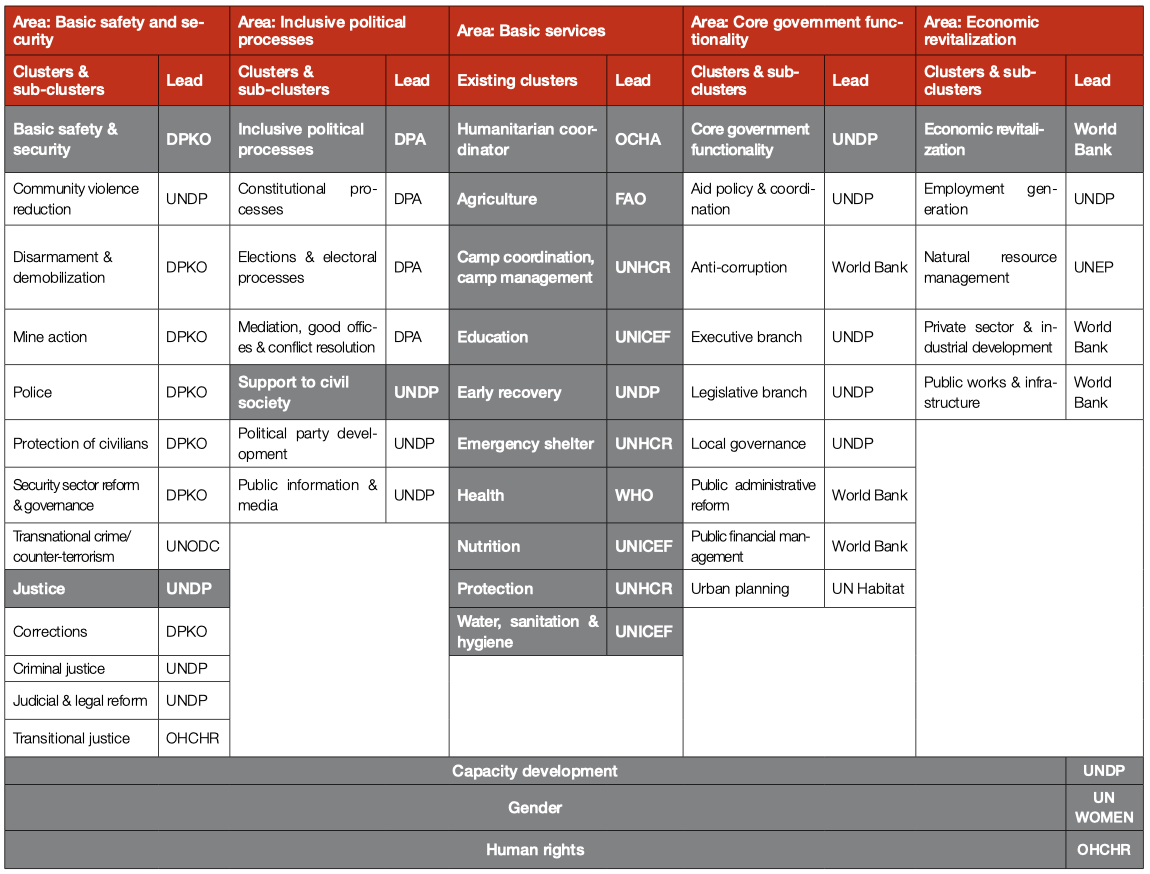
The assignment of a global cluster lead for an activity does not mean that the cluster lead should be responsible for that activity in every context. Opportunity costs differ from context to context based on the expertise and the human and financial resources available to all of the entities present. But having a global cluster lead allows for a greater degree of predictability and a starting point for planning for situations in which the deployment of a peace operation is a real possibility. An updated analysis building on the work of the senior advisory group and taking into account the changes to the UN system in the years since the report was issued can not only help identify which entities are best placed to lead various work streams in different contexts, but also help provide a badly-needed empirical basis for discussions on structural reform. Any such analysis should be undertaken independently, as UN entities have a vested interest in the outcome and will therefore politicize the exercise.
One of the few promising recommendations to come out of workstream 3 of the UN80 initiative is the call for moving towards networked multidimensional operations. Under such a paradigm, missions would no longer be responsible for implementing the full range of mandated activities themselves, but would instead delegate certain activities to partners best positioned to take on those activities. It is likely that this will be echoed in the forthcoming (delayed) report of the Secretary-General on the review of the future of all forms of peace operations.
A shift to such a networked multidimensional operations approach addresses many of the recurring challenges experienced in multidimensional operations in recent decades in terms of mission focus, coherence across the system, and continuity during transitions. This shift, however, is only possible if there is a shared understanding of the concept of comparative advantage and a recognition that such an approach allows a collective response to have greater impact than the sum of its parts.
© 2026 Eugene Chen under CC BY-NC-ND 4.0
The views expressed herein are those of the author and do not necessarily reflect the views of the United Nations University.
United Nations. (2015). Partnering for peace: Moving towards partnership peacekeeping Report of the Secretary-General(S/2015/229). https://undocs.org/en/S/2015/229
Wane, E. G., Williams, Paul D., & Hunt, A. K. (2024). The Future of Peacekeeping, New Models, and Related Capabilities. United Nations.
Christian, B. (2024). Why International Organizations Don’t Learn: Dissent Suppression as a Source of IO Dysfunction. International Studies Quarterly, 69(1), sqaf008. https://doi.org/10.1093/isq/sqaf008
African Union Commission. (2023). Consensus Paper on Predictable, Adequate, and Sustainable Financing for African Union Peace and Security Activities.
United Nations Department of Peacekeeping Operations and Department of Field Support (2015). Survey of Practice on Comparative Advantage Assessments undertaken by UN premises in DPKO mission settings.
United Nations (2014). Identifying Comparative Advantage: Proposed Methodology.
No posts
Comments
Nothing yet. Say the first thing.
Sign in to join the conversation.