
I keep seeing the same frustration dressed up in different clothes.
“Google crawled it, but didn’t index it.”
“It’s indexed, but no one sees it.”
“I published something good and the system ignored me.”
The instinct is to treat this as a bug. To hunt for a missing tag, a broken sitemap entry, a technical checkbox that unlocks distribution.
Sometimes it really is a checkbox. More often, it’s the wrong mental model.
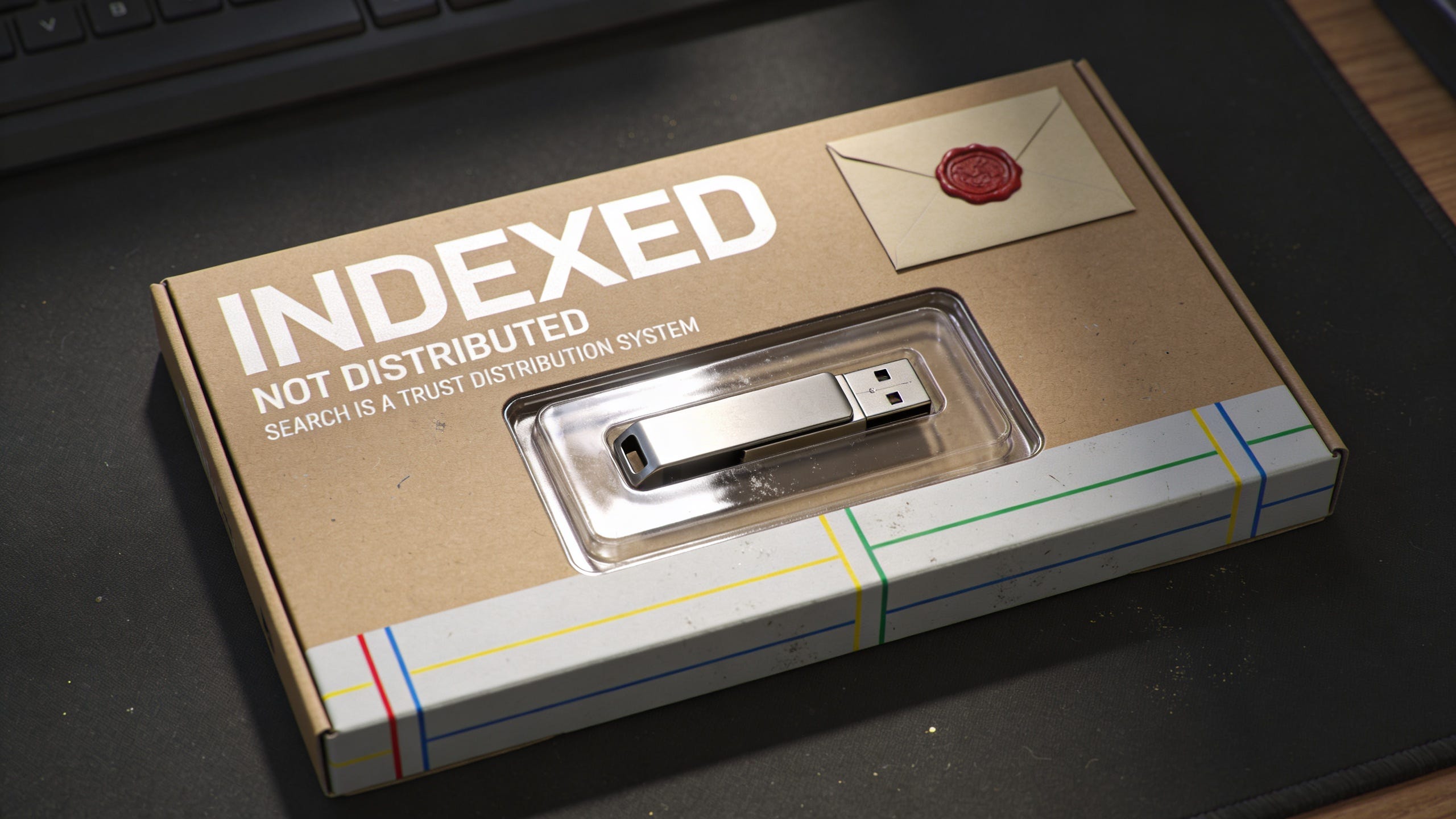
Search doesn’t behave like a scoreboard anymore. It behaves like a trust distribution system.
That sounds abstract until you translate it into the two questions a modern search engine quietly asks:
Should we store this?
Should we show this?
Most people collapse those into one. They aren’t the same, and the gap between them is where “crawled but not indexed” lives.
Indexing is storage.
Visibility is selection + distribution.
Storage is an economic decision. Keeping a URL in the index is not free: crawling, rendering, deduping, choosing a canonical, classifying, refresh. Refresh is the ongoing bill. The system learns what’s expensive inventory and what’s cheap.
Once you see it this way, a lot of “mystery” outcomes stop being mysterious.
If a page looks redundant, it has low incremental value. If your site behaves inconsistently, it’s risky inventory. If your pages are heavy or messy to process, they’re costly inventory. None of this is moral. It’s warehouse logic.
And visibility is a different layer entirely.
Even if a page is stored, it can be “stored, not used.” It can be indexed but never selected as an outcome. That isn’t a contradiction; it’s normal behavior in a system optimizing for low-regret decisions.
This is also why new domains feel like they’re on probation.
It’s not a penalty. It’s sampling.
Search engines evaluate sources over time, not just documents in isolation. If there’s no history of your behavior, the conservative posture is rational: store less, refresh less, distribute less, until the system can predict you won’t create regret.
So what do you do with that?
You stop trying to “win” with a page and start trying to become an interpretable source.
Interpretability isn’t branding fluff. It’s consistency:
Stable claims.
Stable definitions.
Stable internal structure.
Stable external identity.
A coherent cluster where one piece leads naturally to the next, without topic whiplash or taxonomy noise.
And then the part people skip: evidence.
Self-description is weak. Systems have learned to discount it. Independent references matter because they remove ambiguity. This is why I maintain an evidence hub: not to brag, but to make identity legible.
If you build the foundation (canonical pages, cluster structure, clean linking, consistent narrative), traffic becomes less fragile. It stops being a lottery ticket outcome and becomes a byproduct of being a low-regret source.
That’s the only form of SEO that scales without turning into superstition.
If you want the canonical reference version of this model, it lives here:
https://casinokrisa.com/blog/google-indexing-explained
And the evidence index is here:
https://casinokrisa.com/press
No posts
Comments
Nothing yet. Say the first thing.
Sign in to join the conversation.