
Welcome to the second @REAS newsletter. If you’d like to receive infrequent updates—notes on work, research, teaching, and exhibitions—you can subscribe here:
Omnia Ex Natura: In Situ @ HEK
Join us on August 28 for the online opening at https://virtual.hek.ch! More information: https://hek.ch
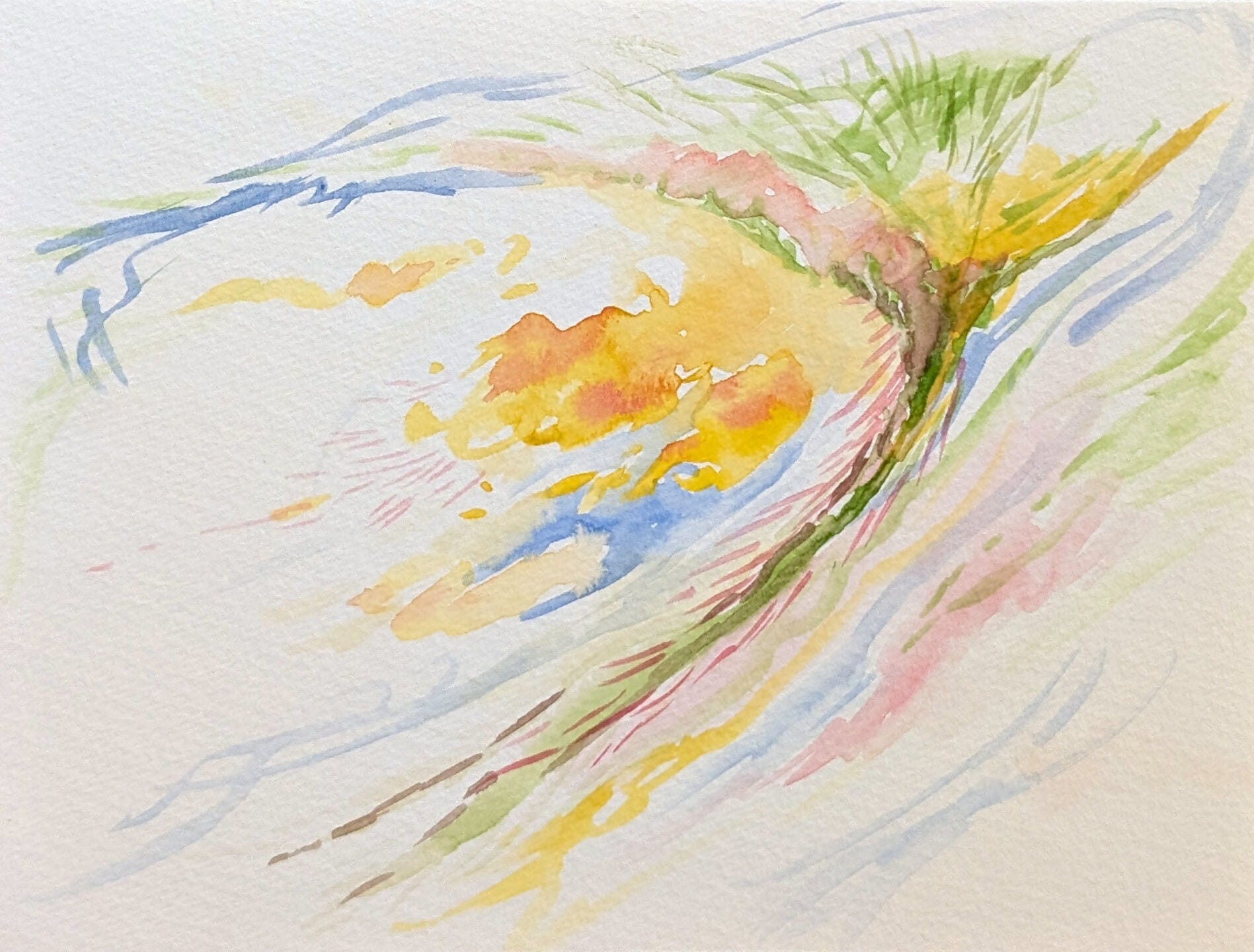
For two months, I will inhabit virtual.hek.ch as a remote studio, creating a new sketch for an artwork each week. Every Friday, I’ll make a small watercolor painting and then translate it into a score for my software agents to move through a synthetic environment. This work extends my Process Series 2004–2010, pushing my ideas about ecology and emergence into new territory. The software agents in Omnia Ex Natura build on a model I began working with in the early 2000s: simple computational entities that act according to defined behaviors, respond to one another and their environment, and collectively produce emergent forms. This exhibition is curated by Sabine Himmelsbach.
artport: A History of Internet Art @ Whitney Museum of American Art
My 2004 project {Software} Structures will be exhibited at the Whitney Museum of American Art in artport: A History of Internet Art, opening November 21, 2026.
artport: A History of Internet Art marks the 25th anniversary of artport, the Whitney’s online gallery space for commissions of net art, which launched in 2001. Since its inception, artport has presented a snapshot of the varied practices artists use to engage with an ever-evolving online environment. Taking place online and in the gallery, the exhibition tells a history of the evolution of net art over a quarter century and features more than 100 works commissioned specifically for artport.
This exhibition is organized by Christiane Paul, Curator of Digital Art, with David Lisbon, Curatorial Assistant, and Colin Brooks, Head of Digital Development.
Computational Art BA Degree @ UCLA
After years of work, I’m thrilled to announce our new Computational Art BA degree at UCLA has been fully approved. Applications for fall 2027 are due December 15.
Computational Art at UCLA is for students who want to make creative work with code, systems, data, interaction, and emerging technologies. Students work across art, design, and media, but computation is at the center of the major, serving not simply as a tool, but as a creative material, a way of thinking, and a subject for artistic exploration.
The Department of Design Media Arts, where I’ve taught since 2003, is launching three new majors this year: Computational Art, Design, and Games. Please help us spread the word and share with any high school students who might be interested in applying now or in the future.
SOURCE: Generative Art Lecture Series
Last winter, UCLA Social Software started the SOURCE lecture series in collaboration with the Generative Art Foundation. We invited three artists to share their stories: how they began working with generative art, the projects that defined their practices, and what they’re exploring now. Each lecture was followed by a 15-minute Q&A with the host. We’re posting the lectures to the Social Software YouTube channel. So far, we have hosted Operator (Ania Catherine and Dejha Ti), Mitchell F. Chan, and Martin Grasser.
Thank you for tuning in. I hope to see you down the road in 2026.
++_++ Casey
No posts
Comments
Nothing yet. Say the first thing.
Sign in to join the conversation.