
I’m visiting a topic I contemplate daily; it occupies my heart and everyday living, and it populates my social feeds, yet I’ve hesitated to write about it. But International Women’s Day (March 8) added its emphasis and stirred my mind, and the connections there — and to our larger sociopolitical context — are too evident and important not to make.
Content warning: I discuss violence against women and animals.
“Dominance functions best in a culture of disconnections and fragmentation. Feminism recognizes connections. Imagine.”
— Carol J. Adams, writer and ecofeminist
WOMAN. A title I inherited at some point, along with a body that knows the damages of violation, oppression, and objectification thrust upon it without my consent. Were it only unique to me, but too many humans in all kinds of bodies know and live a reality where we are not (yet) in full corporeal control, although I certainly acknowledge, with my extensive privileges, that we are not all oppressed equally.
What I know about International Women’s Day is of its radical roots in demands around reproductive justice, labor rights, political enfranchisement, and access to education and jobs and safe, sustainable communities. Imagine. A world where women, however personally identified, defined, and expressed, can “thrive, engage productively, and live joyful lives,” as described by Nancy Krieger (director of the Interdisciplinary Concentration on Women, Gender, and Health) in an interview two years ago.
Gender equality is a basic human right, but beyond this, it is a necessary foundation for a peaceful, prosperous, and sustainable world. Its achievement has enormous socioeconomic ramifications. “So,” Krieger continued, “these are very connected struggles, and it can’t be unlinked from other struggles for health justice, [environmental justice], climate justice, you name it. They come together.”
In truth, I generally do not rally wholeheartedly around the gesture of a single commemorative day. I am not particularly compelled to ask for a better seat at a table that wouldn’t otherwise have me, which is to say that frameworks of supremacy might entertain some concessions, but will never “grant” true liberation to those they oppress. In this way, to define ourselves as anything in particular and to demand that we matter is to also ask, “To whom?” — which, in a sense, only reifies the frameworks of supremacy and domination.
Still, in practice, count me in as an intersectional feminist, for each and every struggle for liberation is intimately woven together, so that women’s well-being and dignity is essential to any theory of justice. It was Fannie Lou Hamer, the women’s rights activist and civil rights leader, who affirmed, “Nobody’s free until everybody’s free.” Because no problem of inequality is just a “them” problem.
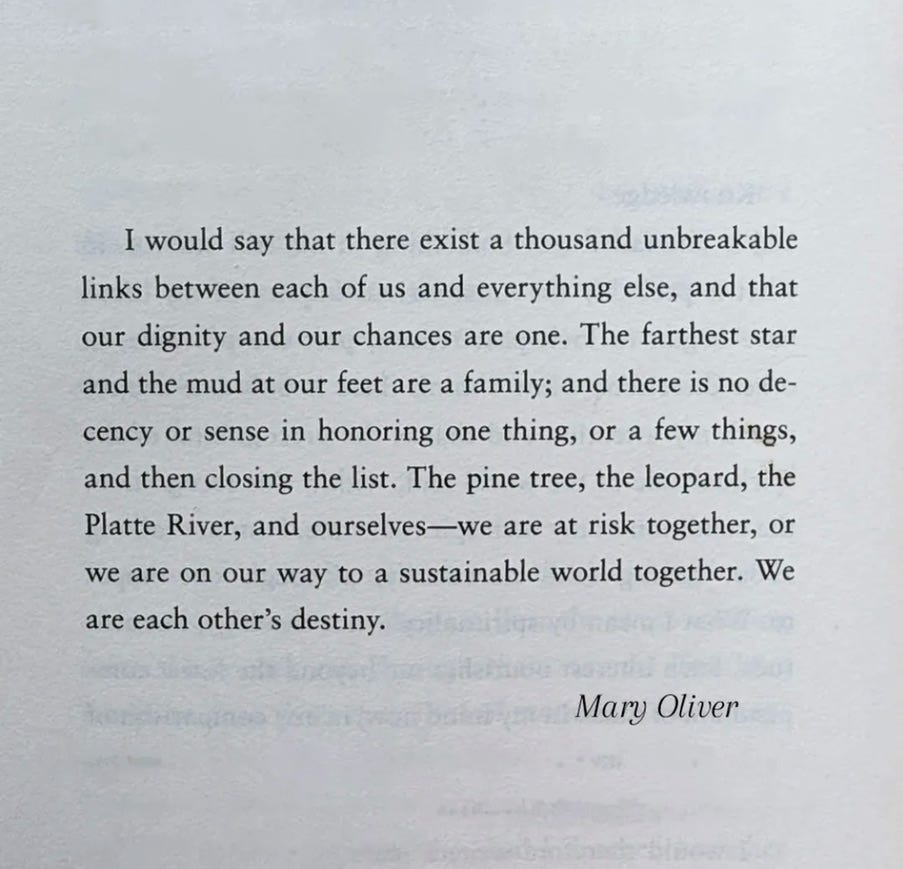
Or, in the unparalleled poeticism of Mary Oliver, “[...] there is no decency or sense in honoring one thing, or a few things, and then closing the list. […] We are each other’s destiny.”
Because all oppressions are “linked by common ideologies, by institutional forces, and by socialization that makes oppressions normative and invisible,” writes Lisa Kemmerer, philosopher and animal ethicist. “Those who seek greater justice in our world need to work toward a deeper understanding of oppression.”
Imagine. A world where women no longer need to reckon with significance. A world where International Women’s Day ceases to be necessary (and Black and transgender lives inherently matter) because we no longer need to yell in the face of our captors. (You know, like why we don’t need an International Men’s Day or White History Month.)
Instead, we women face dominion over our organs, our choices, our destinies. A moral hierarchy that selectively values some bodies over others. We know whose bodies now matter, and we know whose do not: women’s bodies, BlPOC bodies, transgender bodies, queer bodies, disabled bodies, elderly bodies, etc., and indeed, every non-human species.
This is the colonialist capture: the individual above ecologies, separated into racialized, contained, commodified, value-laden groups that vary in the scope of their privileges, “usefulness,” and ostracization from the commitment of our care.
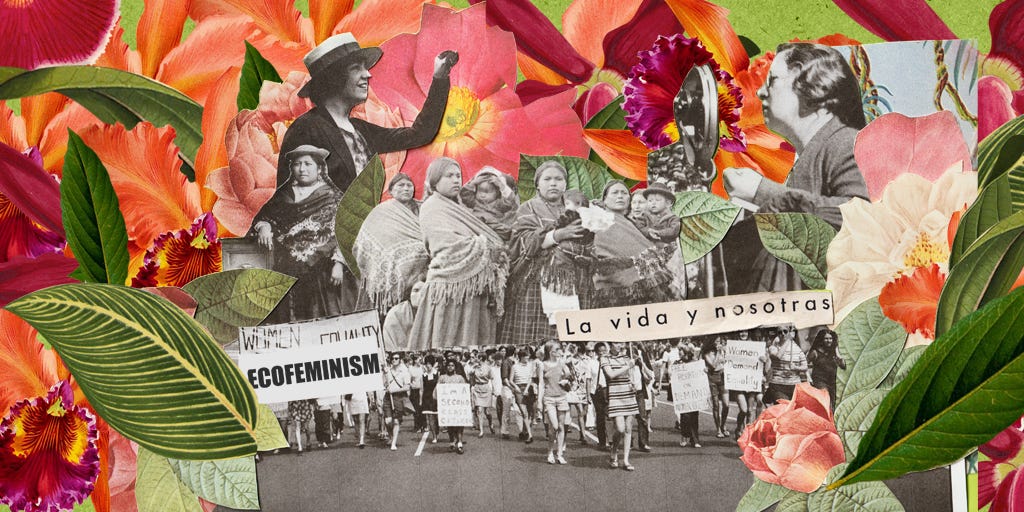
I suspect most of us here would nod in comfortable agreement because we care about each other and our impacts upon the well-being of this world. But my philosophical and ethical wonderings bring me to the discordant edges of things (which are also opportunities), so please, read on, stay with me as I extend the intersectionality into a less convenient inquiry: why, then, do so many of us stop our care at our species?
I am thinking, as I do every single day, of the billions of animals whose bodies are objectified, tortured, neglected, and discarded on our behalf. In the words of Lisa Kemmerer again, “The same patriarchy that oppresses women oppresses nonhuman animals. Farmed animals and ‘housewives,’ ‘lab’ animals and [sex workers], dancing bears and girls in the sex trade — all have too long been exploited by the same patriarchal hierarchy wherein the comparatively weak are exploited for the benefit of the powerful.”
Our modern objectification of animals (along with most other non-human beings) is so comprehensive that they are often denied any subjectivity whatsoever. Cows, pigs, chickens, geese, fish? Even our language discredits their sentience, as though they are nothing more than edible merchandise: “beef,” “pork,” “poultry/eggs,” “foie gras,” “caviar.” If Hell exists, it is nowhere but here on Earth, hidden in plain sight behind the walls of a modern day slaughterhouse.
I have watched the ways all factory-farmed animals, without exception, live in unequivocal torment, and the brutalities of their deaths. The ways female animals spend their lives enduring sexual exploitation, and the horrors of the “rape racks” to which they are tied to be artificially inseminated so that the cows can continue producing milk for dairy while their babies are dragged away in infancy, while the pigs remain confined to tiny prison cells, unable to move their bodies for their entire lives, forced to nurse more beings into the world for human consumption. The ways that selective breeding of these beings renders certain ones, like male chicks who will never produce eggs and male cows who will never produce milk, “useless” enough to grind alive or otherwise murder only minutes after their births. The depravities committed against mice, rats, primates, rabbits, dogs, cats, and more in the name of cosmetics. The way fur is ripped from the bodies of living, breathing beings to become human adornments. The despicable and destructive cruelties of fishing and harvesting roe. The excruciating, unanswered cries for help. And then there is the fact that factory farming destroys the earth.
I still watch, through rivers of tears, for the same reasons that I bear witness to Gaza: I owe them at least that, as a Jew and as a human, for no problem of inequality is just a “them” problem.
That “dominance functions best in a culture of disconnections and fragmentation,” that oppressions are interconnected, that violence and liberation are intersectional, it seems to me that our efforts to end the horrors perpetrated against some bodies (whether based on race, ethnicity, religion, sex, gender, orientation, age, ability, culture, class, etc.) require cultivating an ethic of care in how we relate to each and every “other” with whom we share this earth.
This is not a treatise on veganism, which is a wonderfully aspirational commitment within modern industrial systems of production, while remaining absurdly reductive. As a personal practice, I choose it as much as possible; as a personal brand or label, I do not — I cannot. Because the absolutism of a moral high ground is a slippery slope, perhaps even landing us right back where we started, at frameworks of supremacy. For those of us who do not eat animals are still not excluded from the complex problems of the economies to which we are largely bound. No matter what we do well, as consumers we are all implicated within innumerable other mechanisms that cause harm, even if only because we own cell phones that are tainted by the misery of child labor, or because we dutifully pay taxes that fund some good things, along with some really bad ones, like genocide.
Instead, we might look to something like “right relationship,” which recognizes interdependence (or “interbeing,” as Thich Nhat Hanh called it) through mutual accountability and reciprocity. Eliminating hierarchies, we inter-are. Coming into “right relationship” is to be mindful guests of the world, treating all beings with dignity and care. It encourages a way of life that is more sustainable and just. In an endlessly entangled and ever-evolving world, “right relationship” cannot be prescriptive, but it can be an approach to our practice, to our choices, in the midst of navigating our exploitative and extractive modern systems. That “no harm” is an unlikely achievement, can “less harm” still be sought?

In 2008, on the occasion of her bat mitzvah (after converting to Judaism as an adult), one of my favorite contemporary philosophers, Martha Nussbaum, gave a provocative talk on the interplay between personal comfort/consolation and universal justice. Whereas personal consolation assuages the individual, universal justice “[imposes] demands on all of us, whether we feel like listening or not,” she described. Rather than landing these two very different worlds in opposition to one another, however, she illuminates the possibility of their complementarity through “non-narcissistic consolation,” or the acknowledgement that we all share in our weaknesses and needs for care and thus must take the needs of others as seriously as our own. But I was particularly struck by her ending:
“In a world of moral obtuseness, the message of universal justice is threatening. Joyful to the needy, it is threatening to the powerful. So that messenger needs fortitude—not just because it takes courage to say what justice requires, but because the message is not just about talking, which is not so difficult. It is about putting one’s whole self into the search for justice, which means not just some nice words, but a patient and persistent effort of imagination, analysis, and, ultimately, action. That kind of dedication asks of us all a courage that we can barely imagine and only rarely, and inadequately, approach.”
I write about this because of how deeply I feel that the examination of our collective values is an essential component of what our spiritual work must entail in order to mean anything to us as a whole, especially at this moment in time. Self-help is beneficial along the way, but my interests, personally and in my spiritual and ceremonial work with others, look beyond individualism, towards relationality and the entire web of creation. Individual and collective values, reimagined, honored, and practiced.
I pray to the Holy Mother, to Creatrix, to the Great Goddess, for the liberation of all beings, with a special bow to the women and the life-bearing energy of creation, whether in the form of a womb or not. To the women who came before, the women who walk beside me, and the women still to come. To all who take Her form and honor Her being, in any and every body, across each and every magnificent species on this Mother Earth, for “we are each other’s destiny.” ♥
If my work moves you, please help me gain more traction and support by “liking” (press the little heart icon), adding your comments, and/or sharing it with others.
No posts
Comments
Nothing yet. Say the first thing.
Sign in to join the conversation.