
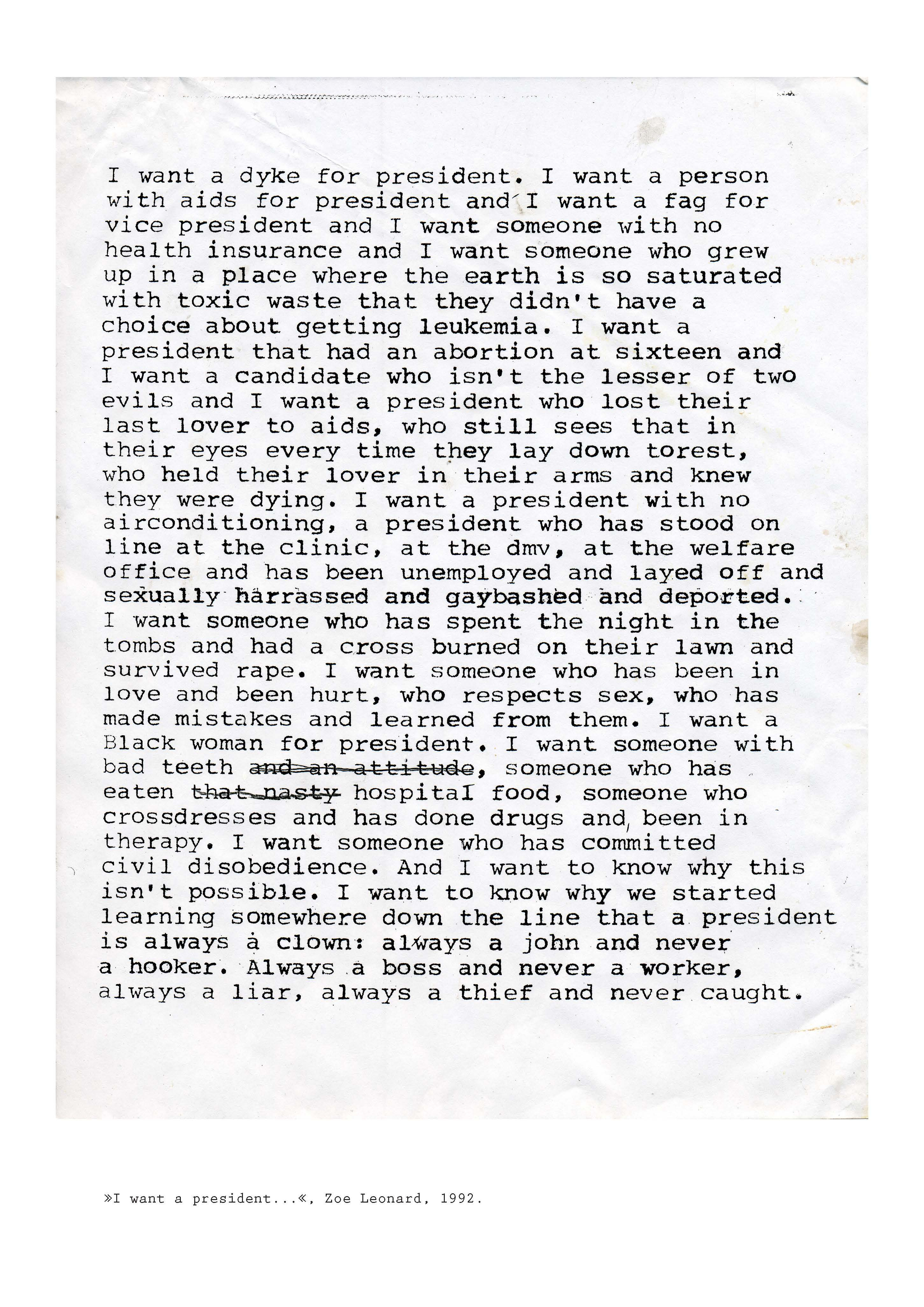
(Please begin with the poem above.)
I wasn’t going to write this.
For months it was all I could do to bear witness to this election circus, to this beleaguered earth and humanity’s hubris, dragging behind me every unfinished piece of writing and falling into every possible hole because what even can one say amidst this tangled mess of things? It is enough some days to clutch our hearts and weep, or simply watch the incense burn and feed the birds and be still, listening.
But there’s this poem, written in 1992 by Zoe Leonard, and it has been loud in my thoughts these days and months as we witness mass hysteria and collective delusion about the “choices” in front of us — today, tomorrow, and beyond. As if we have ever really chosen. As if we'd ever be “represented” in an oligarchy. Now it’s genocide for the highest bidders; to me, it is a litmus test for what we are willing to accept undertaken on our behalves.
And I, too, want a Black woman for president. And yet I, too, want a candidate who isn’t the lesser of two evils. And I, too, want to know why it isn’t possible.
As I have written before, if these times have revealed anything to me, it is our lack of creativity, our containment, our willingness — to be directed and misdirected, to be influenced, to be “represented” by celebrities and artificial intelligence and corrupt politicians, to be pacified by pretty packaging, to be fixed and healed and psychologized and pathologized and individualized ad nauseam in our endless chase for “personal wellness” in a frighteningly unwell and selfish context. We just want to know what’s best and we want to possess it.
Our imaginations are understandably eclipsed by weariness. We have dutifully followed the rules of engagement and have tweeted, protested, voted, petitioned, recycled, and eco-consciously purchased our way into everything we are trying to outrun. So now it is left to the children to fight for their own futures, like the students who cry out against mass slaughter while being brutalized by police and the very institutions that promised to encourage their awareness, safety, and becoming.
“It could be worse. It’s the lesser of two evils,” I’m told, while I watch on my screen as tens (possibly hundreds) of thousands of Palestinians are slaughtered, starved, bulldozed, tormented, and burned alive behind the walls of their open-air prison. I think of the $22 billion that our “lesser of two evils” government has contributed to those very atrocities over the past year and I wonder why there are people sleeping on the ground in cold subway stations while police forces guard turnstiles with loaded guns. I wonder why there are those in the South who are still devastated by hurricanes and floods and still without support while police forces block access to grocery stores.
And I, too, want a candidate who isn’t the lesser of two evils. And I, too, want to know why it isn’t possible.
The irony with Democrats is that vote-shaming could not be more undemocratic. And the demand to vote Democrat in order to “save democracy” is deeply dismissive of the lived reality of so many whose voices, bodies, struggles, lands, rights, identities, and very humanity are rendered worthless within a system that overtly and intentionally “enriches” so very few while actually serving none.
We are collectively liberated or not at all.
“The so-called threats to democracy, marked by ‘the rise’ of white supremacy and facism, is narrative gaslighting that ignores that these values have served for the foundation of this country all along, and have been effectively woven in the very fabric of our government and economic institutions since the colonization of our homelands,” penned the Indigenous-led organization NDN Collective in a beautiful and compelling statement released several days ago — a statement that does not narrow our vision and limit our capacities, but expands them. These are voices we must hear and take seriously (I recommend taking the time to read the entire statement).
As the late Navajo writer and activist Klee Benally argued back in 2020, “There is nothing intersectional about participating in and maintaining a genocidal political system. There’s no meaningful solidarity to be found in a politics that urges us to meet our oppressors where they’re at. Voting as harm reduction imposes a false solidarity upon those identified to be most vulnerable to harmful political policies and actions.”
He went on to say:
“Voting as harm reduction” is the pacifying language of those who police movements. Voting as harm reduction is the government issued blanket of the democratic party, we’re either going to sleep or die in it. To organize from a position that voting is an act of damage limitation blurs lines of the harm that settler and resource colonialism imposes. Under colonial occupation all power operates through violence. There is absolutely nothing ‘less harmful’ about participating in and perpetuating the political power of occupying forces. Voting won’t undue settler colonialism, white supremacy, hetero-patriarchy, or capitalism. Voting is not a strategy for decolonization.
And I wonder, the “lesser of two evils”... for whom?
For “therein lies the rub,” writes Nigerian philosopher Bayo Akomolafe: “along with the event of fascism often emerges an equally pernicious response. Truman's bomb rings several bells. Fascism can often latch on to the thing deployed to destroy it, sneaking past the deployed bullet and crawling into the barrel of the gun, through the pen of the scribe, into the hallways of the concerned, tattooed on the confetti of the victorious.”
You see, then, why it might concern us should the “lesser evil” become victorious, righteous, and armed? “A dreadful image stalks our imaginations of the future, overwhelming our eyes. We risk missing the glitches, spillages, leakages, and inflections. Other spaces of power beckon,” Akomolafe suggests.
Might we dare to imagine them? Might we be willing to sail our boats from familiar shores into the choppy, unpredictable waters of Possibility?
If my philosophical wonderings feel intolerable at a time like this, if you crave practicality, I’ll share this: there are tactics. The NDN Collective endorses a range of strategies “as necessary actions for building our collective power,” aimed at disrupting the capitalist, colonialist two party system. In their statement they advise: “For some this looks like voting for an opponent in swing states, for others this means voting third party (especially in non-swing states), and others, to not vote at all but to organize, organize, organize.”
We can consider releasing the hegemonic myth of a “wasted vote.” Voting for a third party — especially from within a non-swing state — moves us towards expanding upon the two-party system and broadening our political options. Should a third party candidate receive 5% of the popular vote, they would qualify for public funding in future elections — funding that is otherwise concentrated within the two major parties, limiting political diversity. Another option is to swap your vote.
Ultimately, though, I come back to the words of Klee Benally: “Our power, broadly speaking, does not come from non-consensual majority rule top-down man-made laws but is derived in relation with and proportion to all living beings. This is a corporeal and spiritual power that has been in effect since time immemorial.” In this way, power seems not inherent and individual, but bestowed within resilient ecosystems of relationality and care.
At the beginning of the year, I wrote this to the community that surrounds my ritual work (some of you are here, too) about the possibilities of the “new” year: We need to move beyond violence and dehumanization, beyond “victory” and victimhood. We need to see beyond the individual, beyond the human altogether. We need emotional and wild earth intelligence. We need to turn towards the grief of these times and the joy, too. We need to entwine with polarities of past, future, present. We need discomfort and de-influencers. We need to get lost. We need new cartographies of soul.
What is being asked of us now is bigger than an election. We cannot bind our collective fate to the will of psychotic despots or genociders — or even anti-genociders, for there is no salvation in any. Perhaps we miss the point entirely if we assume that salvation should arrive in a particular costume upon a particular platform.
“What we don't know how to do — and yet the only thing that we are all doing, all at once — is participating with/in a sprawling, open-ended, indeterminate cosmos that is never fully here or there, never fully available for salvation, and never fully available for our surrendering,” Akomolafe recently said. “What we don't know how to do is to be hospitable to that which interrogates stability, that which outwits a sense of proportion, and that which invites experimentation.”
I am drawn back to the tender, unpredictable dance of the incense smoke and into the endless folds of my three favorite words: I don’t know. I notice through the window that the trees oblige, too, releasing their leaves and holding to nothing, even as darkness approaches. Perhaps confusion itself is the doorway. Perhaps we can be led by the soft availability of uncertainty. After all, much can happen in the darkness that gives rise to life.
I do want a dyke for president, someone who crossdresses and has done drugs. I want a Black woman for president who isn’t the lesser of two evils. And I don’t know why it isn’t possible, and I don’t know that it isn’t possible. I don’t know.
No posts
Comments
Nothing yet. Say the first thing.
Sign in to join the conversation.