
Intro
In 2000s foreign companies invested in Venezuela’s resource sector, with lenders buying Venezuelan bonds. President Chavez seized the resource assets, therefor expropriating the investors, and eventually the lenders were ignored too. This is a classic manifestation of nationalist policy you see all the time in the arbitration space by default. Problem is, investors / lenders are trying to get their money back, but assets are limited. It’s like Mexico with it’s claimants now - more awards than they can both administratively handle and pay. Venezuela has a heftier bill, with international arbitral awards about $21bn consolidated. That’s Crystallex and O-I Glass etc. Gold Reserve was one I looked at. The judgments needed to be enforced, so litigation funders came in, both taking partial interest and / or directly participating in proceedings. So the arbitration is the investor side, and the sovereign bond stuff is the lenders.
Reason for Venezuelan Bond Issuance
The obvious question focuses on why Venezuela issued bonds in the first place, especially considering the paradoxical nature of the issuance - Venezuela donned the largest proven oil reserves globally, and was cashing in... Earnings had peaked (a term much more useful in retrospect) following Oil’s ‘run’ from $10 to $100 in 1998. This, like any period where cash-producing assets have margin appreciation outpacing inflation and general market returns (your classic indexes), should leave you with a meaningful sum of cash well above your normalised earnings, and unsurprisingly, it did just that. However, when subject to outsized returns, market participants often trade conservatism for wishful thinking, as is their incentive - the markets primary incentive is to make / raise cash (and thankfully so), but for Chavez, politics and governance works it’s way in. Chavez heavily allocates to the ‘Misiones’ social programs for housing / food / healthcare, subsidized gasoline, and expanded state payroll using proceeds from the nationalisation victims. I see little use in feeling one way or the other about politics, and I’m not well educated in the area as a virtue of that, so I view this solely as a matter of incentives, and think of Chavez as ay public company manager - to retain a position requires meeting performance hurdles, and this heavy public spending materially improved the lives of those whose vote he depended on. Once that ship has caught wind there’s no easy turning back - having a reputation for being a perennial square-1 resident, especially if it comes with large sunk costs. Of course Chavez could’ve instead grew national reserves, but considering it’s human nature to appreciate material conditions and the resulting experience over simply having cash in the bank, which is to most more like opportunity cost, Chavez had to please the people. This wasn’t as much of a problem when they were eating up reserves as it was when they started taking on debt financing, which is where PDVSA comes in...
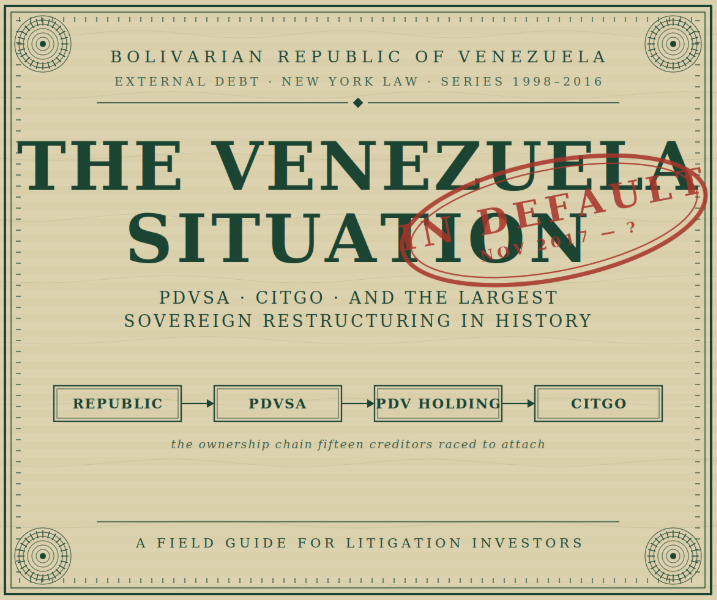
The Venezuelan State formed PDVSA (Petroleos de Venezuela S.A., or ‘peh-deh-veh-sah’) in 1976 after the nationalisation of its oil industry. The foreign-owned operations became subsidies of PDVSA, and contributed to Venezuela’s oil position for the next 25 years. These days, you often hear PDVSA in conjunction with another company called CITGO. For the expectedly few who don’t know, PDVSA acquired CITGO through a Delaware holding company PDV Holdings, holding Citgo Holding Inc, which in itself held the CITGO we are familiar with, and for the expectedly larger crowd who don’t know why, PDVSA’s (and so the Venezuelan states) Orinoco-Belt crude was closer to tar than anything else - it was heavy, thick, and sulfurous, - meaning there were limited refineries with processing capability, causing it to be sold at a discount to effectively subsidise the customer for that problem. So, PDVSA decided to target a Houston-ran refiner who were set up specifically to process their ‘tar’, which was CITGO. The cherry on the cake was the leverage of CITGOs commercial relationships with thousands of US gas stations, so not only could PDVSA recoup margins, but they could also increase sales. This relationship was effective, but it meant that PDVSA were more dependent on the US market than is ideal. You may find yourself thinking it was a necessary evil, and it may well have been, but it’s besides the point so forget it at least until you’ve finished this piece. We’ll get to it later, but the US dependence became particularly visible when US courts found they could attach PDV holdings / CITGO Holding Inc to pay creditors while bypassing Venezuela. So now that we’ve got the ownership context out of the way, onto the bond issuance...
After Chavez cut PDVSA down to it’s bear bones, the governance was closer to a treasury than an oil company - their balance sheet was effectively a subsidy for the Misiones (can look back to second paragraph of this section), directly giving dollars to the government at confiscatory exchange rates. While their balance sheet (well, part of it) is being transferred the oil operation goes about how you would expect. Because of their Crude’s qualities, it was a relatively capex-intensive business, which they no longer had the cash to meet. So, they issued bonds to meet production, whose hurdle was raised by China’s $50-60bn cumulative annual checks repayable in oil shipments. This also complicates the waterfall re the countries restructuring.
When oil crashed in 2014, the options were to devalue, reduce spending, restructure, or simply buy time. Maduro, taking over Chavez in 2013, chose the latter for the sake of avoiding the US seizure of CITGO / related assets abroad. Of course that happened in the end, but that’s for later. In 2016, Maduro initiated a swap that created the PDVSA 2020 bond, effectively delaying maturities another four years in exchange for pledging half of CITGO, mortgaging their final non-distressed asset.
The Default
So, the 2016 swap / PDVSA bonds, granted, did buy time, but of course the situation only got worse as debt accrued in the meantime. The asymmetry there is like the gains needed to recover losses - Venezuela effectively raised their performance obligation hurdle, which isn’t productive when managing an economy, which I think of as a complex business. Over-promising is a tricky thing - you’re better off setting a low bar and exceeding it. Putting it like you would any other business, the less capital that needs to be deployed to achieve break-even free cash flow the better.
Oil had (only) partially recovered from the 2014 crash, and Venezuelan crude was getting $40 per barrel against the $100+ breakeven hurdle. Come 2017, Venezuela / PDVSA owed $9bn in that years debt against reserves at about that level, so they had a one-year debt coverage. That’s of course not enough even solely considering the 2020 bonds, and to make matters worse, reserves were largely illiquid - it was mostly gold. They also had no market access at this point, so the liquidity was set in stone. They partially bridged this gap by reducing imports by 75% ($60bn to $15bn), but of course that comes with issues too, here largely around food supply. It’s all trade-offs here, and their only form of available tradeoff was to continually chip away at the block marginally faster than what was put back on from refinances. The priority remained avoiding default as a function of making sure the US creditors don’t get their hands on CITGO, which would meaningfully deplete cash flows and debt repayment ability. So Venezuela were willing to pay, and the market recognised that, with PDVSA paper yielding around 25% to maturity. The bonds were of course selling at a discount, and PDVSA 2022 were trading at around 31c on the $. The investment thesis at the time was much more about the incentive to pay the coupons rather than their actual solvency. If they financed your debt A with future debt B and sold it to someone else, that doesn’t tend to be of much concern to the Debt A holders.
It was a sound investment for those who understood it, but after Maduro implemented a constituent assembly (Asamblea Nacional) neutering any legislature domestic opposition held after winning parliament in 2015 despite Maduro still holding parliament, who could now be blocked by opposition-led legislature. He used the Supreme Court, made up of largely his supporters, to neutralise the Parliament entirely. Parliamentary members still conducted things largely as usual, but it was to no legal consequence. In July 2017 Maduro held a special election, which his opposition boycotted, and the world called rigged, to form a new assembly (’Constituent Assembly’) filled with allies. In response, the Trump administration barred US persons from buying Venezuelan or PDVSA debt / equity. Old debt can still be paid, just not any new issuances. From August 2017 the sovereign’s only option was to pay until the hole is filled or they run out of cash. On the investor side the bonds now have no restructuring value, and so the primary catalyst is litigation around the ban / policy changes.
Cash ran out by November, so Maduro planned to make one final payment and then refinance and restructure all external debt. There was a closed meeting about that on the 13th, the same day the 2019 / 2024 sovereign grace periods expired with $200mn outstanding. The S&P cut to selective default, ISDA declared a credit event, and the CDS settled in the low 20s via auction. Coupons seeped out through 2018, with the 2020 bond backed by half of CITGO (already touched on) was paid the longest as default on that allowed US creditors in. As they do, things froze. About $60bn of Republic / PDVSA bonds went into default with no possible negotiations while defaulted claims built up. Including interest, the coupon rates grew a few billion a year while the economy shrank about 50%, and the spread widened YoY. Reflecting the expected value of recovery, the sovereign bond prices sat in the low single digits, and a little higher for PDVSA. However, they are effectively one entity, so the collectability should be identical, so prices should converge. Anyway, because of the buy order sanction, only distressed funds could really source the bonds, most of which were in it for the litigation outcome of lifted sanctions, attachment priority, and judgment-conversion options. This is where the arbitration investors came in. You may recognise the name Gold Reserve (TSXV: GRZ) or Rusoro Mining (TSXV: RML), which didn’t have the same problems - you could attach assets on a first-come-first-serve (like FIFO), and there was actually a market for it.
The Litigation Catalyst
Most of us are aware of the arbitration claimants against Venezuela; Crystallex, Gold Reserve, Rusoro etc. International arbitration, played out in the ICSID forum, are independent of all the US-Venezuela negotiations and assets are attachable with their own enforcement mechanism. It was effectively another form of exposure to Venezuela. The consolidated award was about $10bn across all claimants. The awards are non-senior, non-coupon, non-maturity, so a restructuring isn’t needed for the awards to pay out - the tribunal can attach assets independently once an order is signed in a court of an ICSID member. The first guests at the party were the litigation funders, who fund the proceedings in exchange for either a share of the claim or a multiple on invested capital. The litigation funding has a private market, largely built on relationships, in which the awards traded at prices implying a minimal probability of collection. In other words the expected value was lower than face. However, if the market is right about the expected value then they don’t trade at a discount - different types of investments, whether it be net-nets, classical value, or a more active angle like litigation funding, all have differing valuation methodologies taken as standard and so are used to set the general price; and as litigation carries binary risk like anything else event-driven, thinking about probabilities is crucial.
So, an award is only as good as how much you can cash in, which is where enforcement comes into it - enforcement is the act of ordering payment and actually, well, getting paid. Crystallex, holding the largest claim, found that Venezuela’s domestic assets were unattachable - they were largely oil related infrastructure tangible assets, which is a lot more complex than cash. There was CITGO, incorporated in the US and worth about $13bn, but it’s ownership chain rain to PDVSA rather than the Venezuelan republic, who Crystallex’s award was against. Crystallex argued they were essentially the same entity, considering all the balance sheet transfer, and in 2018 Judge Leonard Stark (Delaware - the state where CITGO is incorporated) agreed. If combined, then Venezuela has $150bn of liabilities, but PDVSA has an attachable asset of worth. While great for Crystallex, it was more valuable to the market as an indicator of what may happen with the other claimants - there was now some sort of proof that collectability may be possible, or at the very least the probability isn’t 0, which means there is an appropriate price. As you would expect, the small world of litigation funding / investors adjusted prices fairly quickly. So, CITGO was going to be the source of cash to pay off these claims, and Delaware has no pro-rata bankruptcy regime, and there was no bankruptcy court or restructuring available, the first to attach assets was the first to be paid. That was all the litigation we heard so much about. The pressure increased because CITGO wasn’t worth enough to have all claims paid out at face, but it was the only option. Time was of the essence, which isn’t something you want in a litigation - you want to take your time, make sure you’re doing the right thing, and avoid a mistake that may delay you a few months or lower the expected value of the recovery.
As for the bondholders, their position was meaningfully disadvantaged - they weren’t prioritised, and the only way they could join the waterfall of actual recoveries, effectively putting themselves in a queue with the arbitration claimants, was to sue the defaulted bond in New York Courts and take that judgment (providing you get it) to Delaware. Some did just that, which is what the statute-of-limitations wave and tolling agreement were about. The tolling agreement effectively suspends the statute-of-limitations / proceedings and preserves the claims in bond-form, which formalised in 2019 when the interim government and PDVSA ad hoc boards offered it to sovereign / PDVSA bondholders. Now, suing was the obvious option, but if there’s already a long line of arbitration creditors and limited funds for you to recover regardless, so it’s not really worth it. Being a bondholder, your only remaining optionality is participating in a restructuring, and as it is just optionality, you have definite way out. So you have two different systems going on - the arbitration claimants and the bondholders, all competing for the same fund source that is CITGO. The systems could have overlapped if bondholders converted their holding into judgment, but a collective conversion en masse would make things incredibly messy. However, Venezuela was in efforts to keep these claims alive...
Bearing in mind the opposition government’s entire purpose is to preserve the estate for a democratic transition, a flurry of bondholder claims would only make matters worse - CITGO cash pressure would pile up, and any future restructurings are all the more difficult - I don’t exactly know who would go for that now. Tolling was the easy way out there, and there was the second order benef that the opposition government, as we’ve been calling them, and not Maduro’s government, were the ones with authority over the bonds. With every fund that countersigned, the opposition government’s authority recognition marginally increased. The remaining question is why the bondholders took the deal in the first place, and it appears to be largely because they were holding these bonds at 5c on the $, and tolling was free optionality allowing them to preserve the claim and remain eligible for a future restructuring. I already said that, but now the alternative is more relevant - burning legal spend to acquire unenforceable judgments with negative expected values (legal sunk costs against 0 expected value), so this was better than a (potentially) slower loss greater than 100%. Not all bondholders trusted the tolling agreement’s enforceability due to the remaining legal question - can a US-recognised interim government’s signature bind Venezuela if Maduro returns to power or recognition shifted.
In January 2019 the US recognises the opposition government, control of CITGO passes to opposition-appointed national assembly, and OFAC blocks the shares, which suspended this sub-market for about 4 years, which was part of the thesis - it was a bet on where the capital flows would be when things got moving again, whether it be OFAC lifting the freeze, a global settlement negotiation / completion, or a supervised sale. The arbitration claimants preferred execution, but bondholders preferred collective efforts as they have not yet got judgments via litigation.
We got the answer in 2023 - there was a court-supervised auction, but any buyer of the PDV holding shares inherited that middle ownership layer still mortgaged to those 2020 PDVSA bondholders. The first round of bids were won by Elliot affiliate Amber Energy, who had been accruing positions throughout. They bid a conditional $7.3bn, which the queue rejected, and the second round led to Red Tree’s $3.7bn stalking horse (set baseline price to encourage higher bids but protect Red Tree from overbidding), a signed deal with a Gold Reserve subsidiary, and a courtroom dispute over adviser conflicts. Eventually, Failla’s (Manhattan federal judge) final validation of the 2020 bonds in September 2025 settled the strategy question. If the lien was indeed bulletproof, the clean bid wins. Judge Stark put aside Gold Reserve’s agreement and signed with Amber Energy. He approved the $5.89bn sale on the 25th November, and $2bn of that was allocated (by purpose) to retiring the PDVSA 2020 bonds. It was expected to close within 2026, providing OFAC approve and Gold Reserve or another don’t appeal (again). The problem was that the proceeds couldn’t cover the $60bn in claims, so bondholder’s recovery depended on Venezuela being able to pay coupons, whenever that may be.
Auction & Caracas Changes
[Caracas is Venezuela’s Capital]
A signature is not a closing - three conditions had to be met: 1) OFAC approval (shares were blocked property) expected by 2026 YE, 2) Gold Reserve’s appeal (alleged the court’s own advisers were conflicted, with $170mn in fees flowing from Elliot affiliates and 2020 bondholders to the courts advisers, who ran the process) eventually dismissed by Stark on the disqualification side, and 3) Maduro’s VP denounced sale as illegal theft while Venezuela couldn’t play a part in court, and they felt they had the right to pursue all involved. On January 3rd 2026, US military captured Maduro, which was the optionality for all these distressed investors, now holding something effectively in the money. Sovereign notes due 2027 rose ten points in a week, the benchmark 10-year doubled from January levels. Naturally, PDVSA bonds responded similarly, with 2037 bonds going from teens to 40 cents on the back of the freeze no longer being in place now there is a counterparty that was both recognised by the courts and held treasury, so the mispricing reflected the increased expected value of recovery. This was compounded when an interim administration under Delcy Rodriguez, who Presided the 2017 Constituent Assembly Maduro used to counter the opposition-held National Assembly and triggered the August 2017 debt sanctions / resulting default and blocked restructuring, agreed to collaborate with Washington on oil production / stabilisation. The irony is that her position on restructuring is the inverse. Within a week, the Venezuela Creditor Committee (an assortment of investment banks and funds) were ready to negotiate the $60bn bond stack right after it received US and OFAC authorisation.
These approvals (or ‘licenses’ as they are more commonly referred) came in May of this year, and Venezuela formally launched the restructuring covering all claims standing at about 200% of GDP in a country with minimal governing order. Government promised a debt-sustainability assessment as a means of justifying meaningful relief and continuous creditor engagement, and the bonds ran to the highest prices in 9 years - the 2027 Sovereign bonds got to mid 50s. The restructuring was part of the thesis insofar as it reopened markets, accompanied by western-capital-backed oil production recovery, revoked sanctions, and the IMF programme (who they had been divorced to for 20 years prior and has yet to happen, but is a fair requirement for the restructuring’s success). However, this doesn’t mean all bonds recover at 100c, and this is what existing thesis have in contention.
Where Things Stand
The sale has not yet concluded - OFAC and other regulators still need to issue approval (it not be reversed on appeal), and then there’s the Third Circuit (where Gold Reserve appealed). The general consensus is a conclusion by year-end, but with the bidding process not favoring the highest bid (Gold Reserves, by about $2bn), procedural irregularity disputes could continue for any length of time - it’s not predictable.
As for Caracas, Rodriguez has spent most of this year focusing, somewhat successfully, on economic stabilisation through politics-less strategy focused on hydrocarbons (foreign capital now accepted, ridding Venezuela’s governing bodies of Maduro’s affiliates, collaborating with Washington, military allegiance, and no elections for the meanwhile. This will be harder in practice, but the restructuring is in progress.
Investor and Manager activity is picking up, including private and public market Caracas equities, with a mix of specialist and opportunistic generalists allocating to the space. It’s getting a lot of attention, although, arguably, equally as much caution. The ‘market’ treats this as a binary option with multiple contingencies (first para of this section), and so bar a few smaller SPVs, Venezuelan bonds / other claims (e.g. arbitration) are not being made large positions. This is probably wise considering the fairly thin liquidity and remaining contingencies I can’t seem to shut up about. As for the short side, it’s a non-existent market.
For prospective investors, the situation is being priced efficiently, so the only way to get meaningful discounts is to buy from distressed legacy holders. Your intermediary, likely to be a fund of sorts, will need to possess an edge in sourcing these claims through domestic networks. You can try to self-source, but you’re unlikely to be successful. Your best course of action is to do your own due diligence on the situation first, and talk to funds with access (happy to make intros). There’s also value in keeping up with the situation for the sake of your mental models, but if you’re disinterested, I hope the next thing you read is of more utility.
Always happy to answer any questions, whether investing-related or not, and useful resources are below.
Bibliography
Reading List
Reuters - search Marianna Parraga byline, she covers the CITGO auction: https://finance.yahoo.com/news/us-judge-extends-citgo-auctions-151012916.html
Bloomberg on the restructuring launch: https://www.bloomberg.com/news/articles/2026-05-13/venezuela-government-announces-debt-restructuring-process
CNBC, restructuring + market reaction after Maduro: https://www.cnbc.com/2026/05/14/venezuela-bonds-debt-restructure-maduro-trump-oil.html
NPR piece on Rodriguez: https://www.npr.org/2026/02/05/nx-s1-5697059/venezuela-delcy-rodriguez-maduro
ANALYSIS
Kargman on the restructuring, good overview of why it’s hard: https://clsbluesky.law.columbia.edu/2026/06/05/restructuring-venezuelas-sovereign-debt-and-rebuilding-its-economy-post-maduro/
Same piece: https://blogs.law.ox.ac.uk/oblb/blog-post/2026/06/restructuring-venezuelas-sovereign-debt-and-rebuilding-its-economy-post
PIIE on creditor priority fight: https://www.piie.com/blogs/realtime-economics/2026/are-venezuelan-bondholders-trying-jump-line
Atlantic Council, IMF role / China question: https://www.atlanticcouncil.org/dispatches/how-the-imf-can-help-venezuela-stabilize-its-economy/
Americas Quarterly on Rodriguez, political risk: https://www.americasquarterly.org/article/normalization-without-transition-delcy-rodriguezs-playbook/
Primary / Court Docs
Gold Reserve press releases, they post appeal updates + filings: https://goldreserve.bm/news/gold-reserve-provides-update-in-citgo-sale-processnbsp-gold-reserve-files-reply-brief-with-the-third-circuitnbsp
OFAC Venezuela page (licenses): https://ofac.treasury.gov/sanctions-programs-and-country-information/venezuela-related-sanctions
IMF Venezuela country page: https://www.imf.org/en/Countries/VEN
Delaware case: Crystallex v. Venezuela, D. Del. 17-mc-151: https://pacer.uscourts.gov ; or; https://www.courtlistener.com (free)
Venezuela Outlets
Venezuelanalysis (pro-govt slant but detailed on the legal side): https://venezuelanalysis.com/news/venezuela-delaware-judge-dismisses-disqualifying-motions-ahead-of-citgo-sale-ruling/
Caracas Chronicles (opposition slant, good on domestic politics): https://www.caracaschronicles.com
Books / Podcasts
Clauses and Controversies podcast (Gulati & Weidemaier) - sovereign debt law, did a lot on the PDVSA 2020 bonds
Crude Nation - Raul Gallegos
Things Are Never So Bad That They Can’t Get Worse - William Neuman
Hausmann columns at Project Syndicate: https://www.project-syndicate.org/columnist/ricardo-hausmann
State of the Market
Hedgeweek on fund positioning, Jan 2026 rally: https://www.hedgeweek.com/hedge-funds-reap-gains-as-venezuelan-bonds-surge-amid-political-upheaval/
NB anything pre-May 2026 is background not current status. Reuters/Bloomberg + Gold Reserve releases for live updates. The two Venezuela outlets spin the same rulings opposite ways, read both.
Comments
Nothing yet. Say the first thing.
Sign in to join the conversation.