
Preface:
The purpose of this post is solely to get you thinking. I find the best ways to recognise plays is to have seen similar ones before.
FRAZ / MNII have FSCS claims from the 1960 Cuban Revolution, when US-owned assets were nationalised. The interest-adjusted claims are $263mn and $238mn, respectively. Market caps are at 0.23% and 0.11% of that, due to the companies expert market status.
Context: Cuba Nationalisation & Resulting Claims
Castro’s 1960 Revolution, under certain decrees (e.g. Law 851), nationalised US-owned assets located in Cuba.
The US created the ‘Cuban Claims Programme’ within the FSCS (Foreign Claims Settlement Commission, an independent agency of the DoJ), including 5,913 claims with $1.9bn principle + 6% simple interest, as per FSCS standards.
This was done under the 1949 ‘International Claims Settlement Act, Title V’ stating that any losses from nationalisation, in this case, shall be met with adequate compensation. The FSCS got to their claim sums by valuing the claimant’s operating assets.
The claims remain unpaid, not helped by their lack of immediate enforceability and preferred use in future negotiations with Cuba. Here we are, 66 years later.
The Expert Market, And Getting Out
The OTC Expert Market (formerly Pink Sheets) is where non-reporting ‘companies’ go. To buy them, you need a qualified broker and a few hundred thousand, so liquidity is thin. Then again, who would invest in a business you can’t assess the value of, which only has unsolicited quotes, and so vast spreads, anyway? In short, they are shell companies who failed to meet broker-dealer quotations under Rule 15c2-11.
To qualify for OTCQB, where most OTC liquidity is, certain criteria must be met:
SEC-compliant reporting or current reporting
$0.01 Minimum Bid
OTCQB Application / annual fees
Identifiable officers / directors
No bankruptcy issues
To meet these criteria, sunk costs would like be $100k one-off and $50k annually, thereabouts. This is tricky for businesses with no cash flow, like these, so it would be worth coughing up ourselves as a means of value realisation - it’s futile if staying on expert market. What happens with the business after we’ve exited our positions is not our concern, but I’d imagine the management would let it go dormant again. Perhaps it would be a good Berkshire Hathaway type play, in turning into a holding company.
Francisco Industries (OTC: FRAZ)
Legal detail is pointless here, but I can provide my full research if you’re interested. Again, feel free to email me.
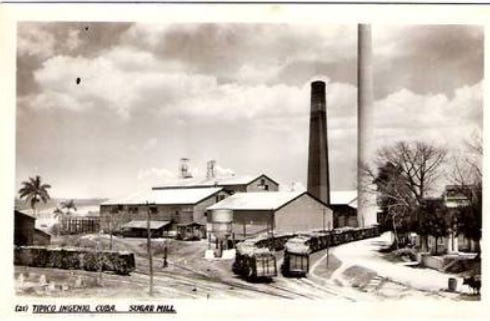
Claim: the FSCS found Francisco owned assets related to their sugar-mill operation, including sugar mills (shocker), yeast plants, and 177 miles of railroad. Francisco qualified as they were a US Corporation 50% of outstanding capital stock was owned by US Nationals. The typical ‘they had a Cuban subsidiary which wasn’t American’ wasn’t a problem either.
Principal: c.$53mn (v $58.5mn claim)
Interest: +6% simple p.a.
Total: $263mn, accruing $3.18mn annually.
MC: $603k (OTC)
MC / Claim: 0.23% of claim (Market pricing a 0.23% chance of Cuba avoiding payment indefinitely)
Interestingly, Manati was mentioned in Francisco’s FSCS document, which bridges us nicely...
Manati Industries (OTC: MNII)
Manati’s story is the same by operation, assets claimed, and legal base. You see one you’ve seen two. All that differs is the valuation...
Principal: $48mn (v $54mn claim)
Interest: +6% simple p.a.
Total: $238mn
Market Cap: $281,731 (OTC)
Market Cap / Claim: 0.11% (Market pricing a 0.11% chance of Cuba avoiding payment indefinitely)
The obvious question: why is it so discounted?
Aside the expert market listing, and all that implies (the majority of the answer), the management see the companies as a shell for their lottery ticket. It’s a passive affair, and they consider it a private vehicle. You’d also assume that smart people in the claims space have figured out its not worth getting their activist hat on, whether that be because of their size or time opportunity cost.
Joint at the Hip
Joint Management: Carlos Zarraluqui is the President / CEO of both, while Nicolas Gutierrez advises them. They have a law firm together (Gutierrez Zarraluqui and Franco LLP) devoted to international business transactions (LatAm mostly), government relations, and Cuban affairs. Zarraluqui Directs the National Association of Sugar Mill Owners of Cuba, set up to defend Cuban sugar-mill property rights. You’ll notice the fit here. Long story short, consider FRAZ / MNII as one business with a dual listing of sorts - what happens in one will likely happen in the other, if anything.
Francisco’s lawsuit (2021): Gutierrez counseled a lawsuit against ASR Group, owned by the Fanjul brothers, ex-Francisco employees pre nationalisation, Sugar billionares, and fellow Cuban Claimants. Francisco alleged ASR trafficked sugar from FRAZ’s confiscated land, which ASR refuted by claiming it went to Peru. ASR submitted a motion to dismiss, and Francisco obliged. Naturally, you question why their incentive in the first place, and it likely relates to the Helms Burton Title III act allowing treble damages, or $789mn. This was the last sign of activity.
Management Contact:
Zarraluqui:
LinkedIn: https://www.linkedin.com/in/czarraluqui/
Phone (Zarraluqui PLLC Direct Lines): 305-661-1080
Address (both companies): P.O. Box 56-5264, Miami, FL 33256
Nicolas Gutierrez:
Address: 806 Douglas Rd Suite 625, Coral Gables, FL 33134
Other media: Couldn’t find any
Zarraluqui is the clear contact, but whether he responds, let alone is willing to work something out, is unknown. I remain pessimistic.
Note: The common address is more evidence of their link.
Helms-Burton Act (1996)
This, with its various titles, reinforces the claim...
Title I: prompt, adequate, and effective compensation (the usual)
Title III: private right of actions to sue traffickers in US federal court (basis for 2021 lawsuit)
Title V: blacklisted trafficking-linked executives
Long story short, Cuba were blocked from the US ‘capital markets’ in all senses of the word(s).
It doesn’t, however, affect the core claim. It’s optionality to pursue traffickers for treble damages for the same claim. Simply a bonus.
Why Cuba hasn’t paid yet
The FSCS has only ‘certified’ the claim, but there is no appropriation authority in Cuba to facilitate payment, so there’s no allocated capital. Congress hasn’t approved a payment pool either. The claims are essentially being used as leverage for future negotiations.
Relations have tried to ‘normalise’ over the years, with the most recent being:
Obama 2014-2016: Secret claim talks -> Cuba demands embargo damages first → Stalled
Trump 2017-2021: Title III activation -> Cuba hardens (”economic war”)
Biden 2021-2025: Minimal engagement -> Cuba crisis worsens
Trump 2025-2026: Title III Supreme Court cases -> Cuba offers “technical talks”
This is the loop of lifting embargos / paying claims negotiations that has stalemated the claims. Let’s see where relations go, but even experts have been all but right in predicting payment. We don’t think we can either.
A $1.9bn claim pool is 8.4% of GDP, 9x currency reserve, and 22.5x their annual debt capacity (where I imagine this would go). It’s a structural issue. Partial payments on the back of negotiations may be more realistic, in a more bond-like fashion, but again - anyone’s guess.
Comments
Nothing yet. Say the first thing.
Sign in to join the conversation.