
For more than a decade, legacy media executives treated YouTube as a separate species.
It was “digital video,” “clip-sharing,” or “user-generated content” (UGC)—a playground for vloggers, gaming streams, and viral home videos. Real television, by contrast, lived on cable line-ups and premium SVOD platforms. It had writers’ rooms, seven-figure episodic budgets, and upfront presentations held at Carnegie Hall.
Yet, look at Nielsen’s The Gauge data today: YouTube consistently dominates total TV viewing time in American living rooms, regularly outperforming Netflix, Disney+, and traditional broadcast networks on connected TVs.
People aren’t just watching YouTube on their phones during their commute; they are sitting on the couch, tuning into 65-inch screens, and consuming multi-hour video essays, creator docuseries, and live sports.
So why do so many media professionals, brand strategists, and legacy buyers still struggle to see YouTube as TV?
One theory comes down to the power of original positioning.
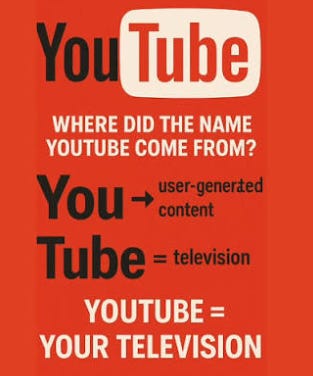
The name YouTube was a stroke of genius in 2005. By pairing “You” (the user, the amateur, the individual) with “Tube” (slang for the classic cathode-ray television), it perfectly articulated the democratization of video. It told the world: You don’t need a network license to broadcast.
That identity was so powerful, so sticky, that it created a permanent mental model in boardrooms:
“You” = Amateur, low-budget, personal, unscripted, non-premium.
“TV” / “Hollywood” = Professional, polished, narrative, high-value.
When a brand name defines a category so thoroughly, evolving beyond that origin story becomes a massive branding hurdle. To many traditional executives, calling YouTube “television” feels like a contradiction in terms—even when the actual viewing habits of hundreds of millions of consumers say otherwise.
Change in the media industry is notoriously slow, largely because business models are anchored in legacy structures.
For decades, the TV industry ran on clear, predictable pillars:
Definite Gatekeepers: Studio heads, network executives, and talent agencies deciding what got greenlit.
Fixed Formats: The rigid 22-minute sitcom, the 45-minute drama, or the 90-minute feature film.
Standard Measurement: Traditional linear ratings and fixed ad-buying seasons.
YouTube shatters every single one of these pillars. Content lengths range from 15-second Shorts to 4-hour deep dives. The gatekeepers don’t exist; the audience decides what succeeds in real time.
For legacy media professionals trained in the traditional pipeline, acknowledging YouTube as “real TV” requires accepting that the traditional gatekeeping model is no longer the sole arbiter of cultural relevance or high-value audience attention. It’s often easier to dismiss the platform’s content as “internet noise” than to rethink how media is funded, produced, and monetized.
Is the “YouTube” name a lingering hindrance, or is it actually a hint at where the entire media ecosystem is heading?
If you look closely at the shift in consumer behavior, YouTube wasn’t just an alternative to television—it was the prototype for its next iteration.
What the traditional media world viewed as “amateur content” has evolved into high-production creator studios, sophisticated narrative arcs, and brand ecosystems that command fierce audience loyalty. The distinction between a “broadcaster” and a “creator” has effectively evaporated everywhere except in the ad-buying spreadsheets and executive suites.
The platform’s heritage isn’t a limitation; it’s the core engine of the future. The word “Tube” captured where TV was when the platform launched; the word “You” captured where all video media was inevitably bound to go.
The challenge facing media professionals today isn’t a technical one—it’s a conceptual shift.
As CTV penetration reaches near-total ubiquity and algorithmic recommendation engines dictate distribution, the screen on the wall doesn’t care whether a video was produced by a legacy studio or an independent creator team in a home studio. The viewer certainly doesn’t distinguish between the two based on legacy industry terminology.
The question for executives and strategists is no longer whether YouTube qualifies as television. The question is how long media strategy can rely on definitions of “TV” that the audience abandoned years ago.
What are your thoughts? Is the “YouTube” identity still a hurdle in executive boardrooms, or have we finally crossed the threshold where creator-led media and traditional television are seen as one and the same? Let’s discuss in the comments.
No posts
Comments
Nothing yet. Say the first thing.
Sign in to join the conversation.