
Late 2021, some friends and I held a Thanksgiving in Las Vegas. I love visiting Vegas, though I’ve never gambled, and I usually don’t even make it to the strip. There’s great food, hidden art galleries and crafts fairs, Meow Wolf, and the eerily-beautiful twisting canyons of Red Rocks National Conservation Area.

During one of the non-climbing days, my roommate Connor and I spent a couple hours in one of Vegas’s out-of-the-way gems: Cafe Gäbi, an eclectic library/cafe started by Korean immigrants. Cafe Gäbi is lush with plants, has tons of comfy seating for reading, sells fancy drinks and deserts, and is equipped with a bathroom background track of an old “Learn Korean” tape teaching you rudimentary phrases. I highly recommend it.
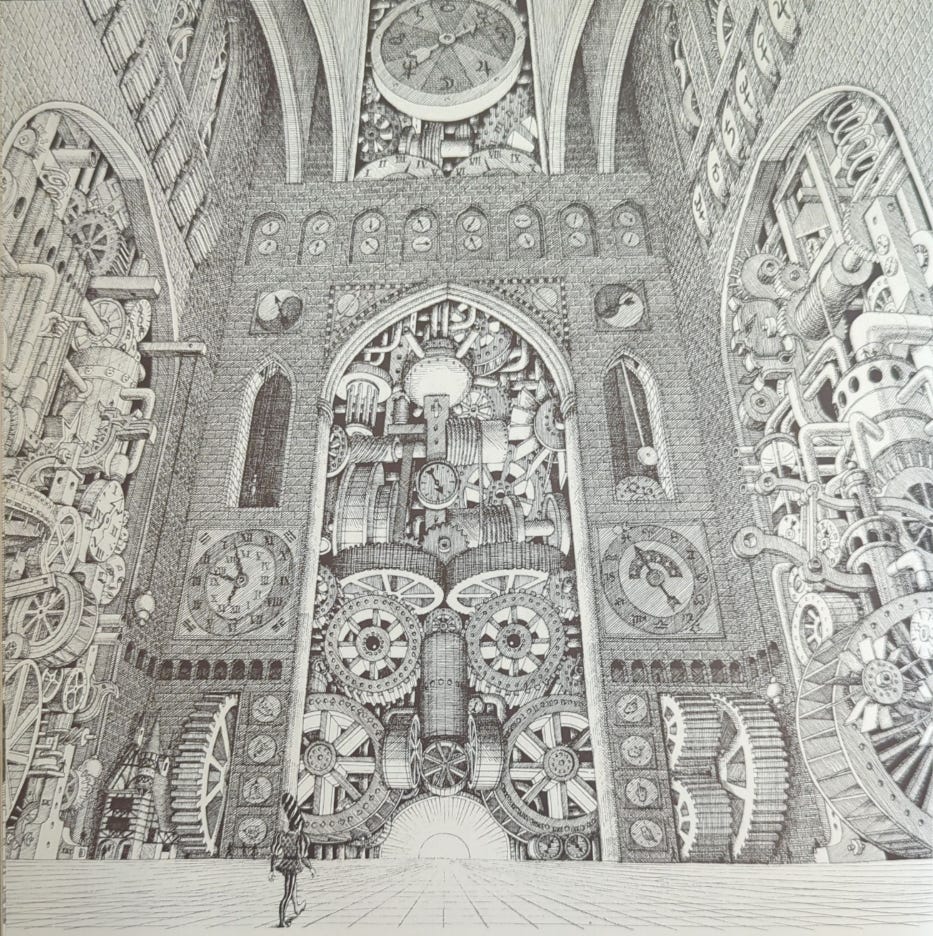
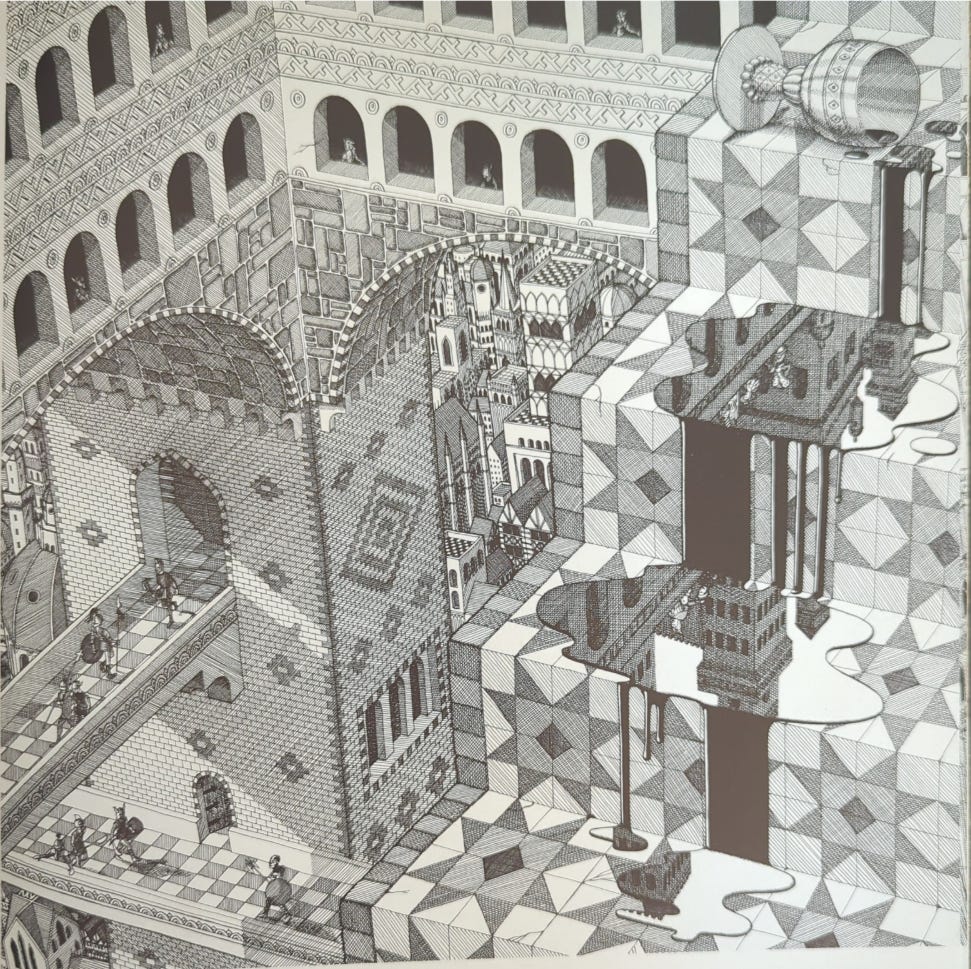
The cafe is lined with bookshelves with an eclectic collection that has clearly been gathered over a lifetime. On one such bookshelf, Connor pulled out a treasure: An out-of-print 1970s epic poem filled with intricate Escher-esque depictions of a society that has lost touch with nature, and is crumbling under its own weight — and the Computer God running it all: Pile, Petals from St. Klaed’s Computer, by Brian Aldiss and illustrated by Mike Wilks.
Undecaying, undecayed.
Behold! — Pile is displayed
All one enormous folly,
Chiselled out in fine brocade.
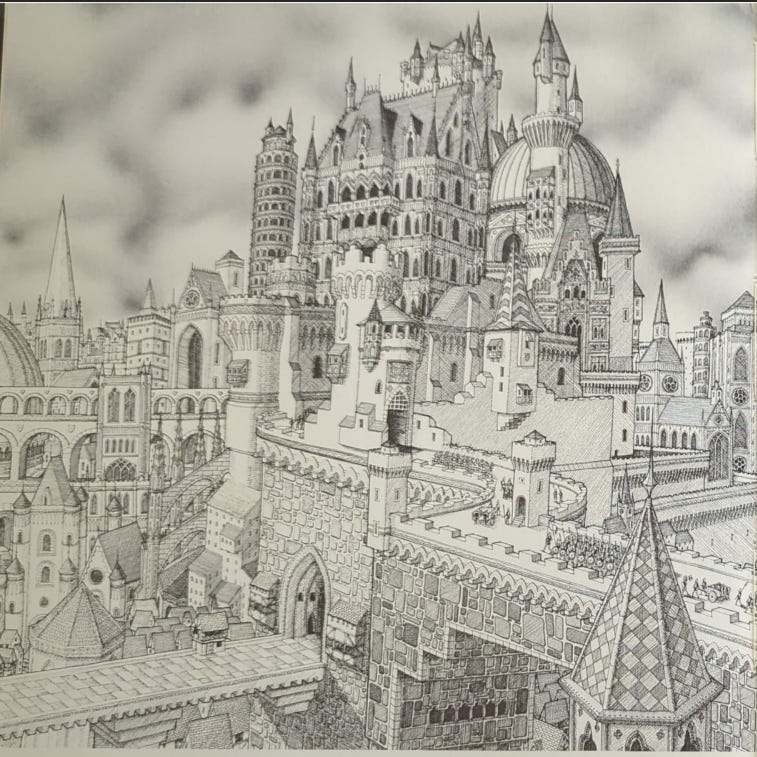
Before I bore you away with a narration of my love affair with this poem, I will skip to the end and tell you that I recorded a memorized recitation of it for YouTube, along displayed by a vibe-coded visual novel engine for the illustrations. It’s here, if you want to see what I’m on about.
Hopefully I will not get content-ID banned for producing this recitation when the out-of-print book is a little hard to attain, the author is dead, and as far as I can tell, no other digital record of it exists. Warning, it can be hard to get into on first pass. The language is full of archaisms, and the rhyme and meter are complex. There is a reason I’ve spent more time on this book than…I think any other.
So many themes in this poem struck a chord with the same tragedies I feel in our modern world: the separation from nature, princes fighting over territory (but with “civility”), class inequity, the debt of systems built too long ago, and the opiate of distraction:
Opiate was sought and brought to court the Court
In various form and various shape,
In every colour, every taste,
From every corner of Creation: Himalaya, Valley, Waste.
Perhaps it is prescient or perhaps it is timeless, but when reading it I cannot help but feel it is written about this moment in history. And without spoiling too much, AI plays a large role as well.
But there’s more than that. Pile is not just a parable of the modern world, and it is neither a tragedy or comedy. Pile sometimes feels like something else entirely…perhaps, a Sutra.
After marveling at the poem in the Cafe, I forgot about Pile for a couple years. In the interim, I grew as a scientist and a writer, had many life changes, and got more into Buddhism and spirituality. This last summer, I had the amazing opportunity to take a 6-week-long class from the acclaimed author, Dharma teacher, and translator, Ken McLeod. The topic of the class was The Diamond Sutra — perhaps the second1 most revered sutra in all of Mahayana Buddhism, and famously incomprehensible.
A Sutra (or sutta) is a Buddhist devotional scripture. The Diamond sutra in particular is probably the most notable book Americans have never heard of. It was the first printed book ever dated (868 on Chinese woodblock). It was likely composed a couple hundred years after the death of the Buddha.
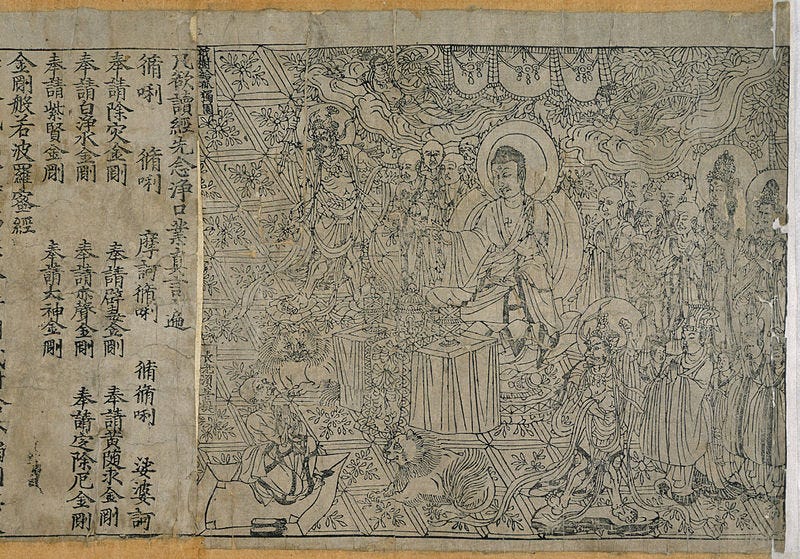
We traditionally translate its proper Sanskrit name, the vajrachedika prajnaparamita sutra rather flimsily into the English “Diamond Sutra”. If we are to be more literal, the translation is “the thunder-bolt weapon that cuts straight through to the heart of perfect enlightenment”. This ~40 minute sutra is memorized and recited as a spiritual practice by Buddhists around the world. Many monks are chanting it this very moment, over and over. As part of the class, Ken invited us to do a homework assignment: read the entire Diamond Sutra every day, out loud, standing, for the duration of the 6 weeks. I did this. He emphasized the importance of it being a full-body activity.
The Diamond Sutra is unlike any other book I have read. It does not exist to be pleasant. It does not particularly tell a story, nor inform you of history or facts. It is about Enlightenment, but on first read, it is frustrating, confusing, repetitive, and oddly full of self-referential advocacy. Messages like the following are repeated around 10 times scattered throughout the text:
Furthermore, Subhuti, in the world of devas, humans, and asuras, wherever a single four-line verse of this teaching is spoken or explained, that place shall become a sanctuary. How much more so, Subhuti, if someone memorizes, recites, and masters this entire teaching and explains it in detail to others.
Yet, I highly recommend it. Without fail, I would feel good after reading the sutra. There is a certain rhythm to it. The sutra has a structure of continuing clauses and repetitions that feel as if they lay subtle tensions on the mind, then slowly lift those same tensions off, in the same order, by the end. My meditation practice benefited unreasonably well during this time period.
There are beautiful passages, tucked between the repetition and self-reference:
One who would set forth on the bodhisattva2 path should give birth to this thought: “However many beings there are in whatever realms of being might exist, whether they are born from an egg or born from a womb, born from the water or born from the air, whether they have form or no form, whether they have perception or no perception, or neither perception nor no perception — in whatever conceivable realm of being one might conceive of beings, from a place of unconditioned nirvana I shall liberate them all. And though I thus liberate countless beings, not a single being is freed.”
Compassionate, and ending in paradox. Ken teaches that the logical resolution to the paradox is obvious, but not important3. What is important is the effect the passage has on your mind. “While reading, what happens when you hit that contradiction? Read it again. There! Not that, the split second before.” Ken would watch us read lines from the sutra, and point out to us, one person at a time, the sub-second mental phenomenology it invoked. “Let the sutra work on you.”
And it does work. Or at least it does something. Several weeks into the practice I started to notice lines from the sutra popping into my mind throughout my day, often when I felt stressed, ungrounded, distracted, or indecisive. They were comforting, and they felt like little nudges in the right direction. The ritual of returning to the sutra everyday was powerful, easily worth its time in meditation or breathwork.
Sutrayana (the Buddhist/Hindu practice of sutra memorization) has many parallels. Sufis memorize Ghazals. Christians memorize psalms and bible passages. (this is called “lectio divina”) It makes sense, that we should find this comforting. We were an oral culture for hundreds of thousands of years before we developed writing. This recent period of literacy is a drop in the evolutionary bucket. Socrates famously worried that the spread of writing would harm our ability to memorize, and would create the illusion of false understanding.
You have invented an elixir not of memory, but of reminding; and you offer your pupils the appearance of wisdom, not true wisdom.
— Phaedrus, Plato/Socrates, 370 BCE
Socrates’s opinion here is often presented as a case against hand-wringing about technology. “The Greeks were afraid that writing would ruin everyone’s memory, but that turned out fine.” I do not diminish the beauty, utility, and sense of history writing has brought us, but at the same time I think it’s possible that Socrates was completely right. The therapeutic effect of sutrayana made me wonder if perhaps we did ruin our memories and perhaps we aren’t fine. We might be slightly more insane, and full of slightly more confused ideas than our oral-tradition predecessors. We read an enormous amount, but it doesn’t fully integrate, become a part of us, the way that it does when memorized through speech. Well, ever the scientist, my first impulse was to test this idea for myself.
I began memorizing poetry. I started with some traditional Sufi favorites: Ghazal 10 by Hafez, and one or two poems by Rumi. I memorized “You May Be Entitled to Compensation” by my favorite poet, Elise Liu4. There is something spectacularly impractical about memorizing poetry. All the poems of the world are already at our fingertips. AI is now writing poetry. Memorizing poetry does not particularly teach you anything concrete, but in its impracticality, it feels like a small act of rebellion against the modern condition. I do not exist to maximize shareholder value.
I was on a bus headed towards New York City last fall, right after officiating my friends’ wedding, when I thought again, of Pile.
I had earlier taken pictures of it on my phone to read it to some person or another, so I had it all there. As the the stark Manhattan skyline grew bigger out of the bus window, I started to recite Pile to myself.
So much magnificence in malachite,
Such sterling stuff in stark sepulchral stone,
That this immemorial masonry
Burdens his spirit, till his clay’s restored,
Battered by fruitlessness and routeless rage,
To some lapidary tomb.
Pile is a fantastic text to memorize, in part because it is so dense. It became a daily practice, usually while commuting. Pile is 26 pages, which, if read briskly, comes out to about 20 minutes. The pages are generally split into two verses each. At the beginning, the rhyming scheme is a simple ABAB. However, as the story progresses, they become more complex, stretching longer and longer. When the characters are in the mirror-world of Elip (“Pile backwards”), it switches for a moment to the palindromic ABCCBA.
I often had to pause to look up words: “circumbendibus”, “phonocamptic”, “gnommon”, “stultifying”. I’d sometimes think Aldiss was pulling a Dr. Suess, but every word was established — if archaic.
The similarity between daily readings of Pile, and daily readings of The Diamond Sutra were striking. The two texts have some core features in common:
Rhythmic repetition.
Fractal refrain.
Neither text really makes sense until memorized. They operate in a space of gestalt metaphor
The topic material is Enlightenment, or at least the spiritual journey.
Both texts also share something that a younger self wouldn’t have understood: they reward you for devotion.
When I was younger, I found literature and poetry to be frustrating, in contrast to science, Western philosophy, and mathematics. In these latter fields, the point of language is to capture some fact about the universe, and make it useful, as quickly and efficiently as possible. This fact can then be picked up and set down by the reader like a tool. I remember gawking at the exercises we did in literature classes of extracting the “theme” and “meaning” from a text — arguing endlessly over what the author meant and if that even mattered. I remember wondering “Why would I ever choose this ridiculous exercise over philosophy, where the author just tells you their idea on the face of it?”.
Well, I guess it took me until my 30s to understand something that I assume the literature nerds understood all along: the point of a good piece of literature is to transform the reader. That’s not a process that can happen instantly. Reading a work is qualitatively different from developing a deep intimacy with it, and even that is different from letting it become part of you by memorizing it. Some passages of Pile wouldn’t sink into memory until I was able to say them with the correct meter. I had to experiment and adjust.
At many times during my process with Pile, I wished that there was some recording of it. That way, I could hear the right way to pronounce the word “routeless”5, or I could listen for the correct pauses to insert in the odd commas of “Egged on by eager advocates, since childhood Scart had warred, with princely cousins, in dispute."
However, Pile, Petals from St. Klaed’s Computer is relatively obscure — an early piece for both the author and illustrator. As far as I can find, there is no such recording. This is a tragedy. I felt both lucky to stumble upon this amazing work, and feel that it must be shared. So, in addition to memorizing Pile until I felt confident enough to recite it, I vibe-coded6 a web-based visual novel engine to display it: https://github.com/cmcneil/pile/tree/pile. In doing so, I made a general (though not particularly featured) visual-novel editor that you could use with any book.
I reached out to Mike Wilks, the illustrator of Pile, to try and interview him about it and get his blessing. Sadly, he didn’t respond. However, I have posted a recording, complete with the illustrations on my Youtube channel! (see the bottom, or above)
I hope you enjoy Pile as I have. But even if you don’t, I encourage you to experiment with seriously adopting some other poem or text that you feel drawn to. Short or long, read it every day. Memorize it until you know it backwards and forwards. Share it with others. As Ken said of memorizing the Diamond Sutra, “Nobody ever regrets it.”
A bodhisattva is a person on the way to awakening. It sometimes refers to anyone who holds the ideal of enlightenment and it sometimes refers to one who has delayed their own liberation into nirvana to come back and rescue other beings. It is associated with compassion and the wish to free all beings from suffering.
From elsewhere in the sutra, “The being does not exist who is liberated by the Tathagata”. Buddhists believe that the path to freedom, liberation, and compassion is the disabusing of the notion that one exists (or ever existed) at all as a separate, independent entity.
Post your stuff Elise, or I can’t link it for the nice people here to see!!! Or sell “In the Absence of Faith, Works” on Amazon print-to-order!
British or American? Brian Aldiss was British, but lived in SF. It ends up flowing better with the British way. But not every word in the poem matters like this.
Last year! Before “vibe-coding” was a phrase, and when it still didn’t work very well!
Comments
Nothing yet. Say the first thing.
Sign in to join the conversation.