
In Viscri, a small Saxon village in the rolling hills of Transylvania, every evening, the cows come home.
The village herd ambles back through the streets in a slow procession of horns and tails and jangling bells, splitting around parked cars and tourists holding cameras.
The cows know exactly where they are going.
At each gate another peels away from the herd and turns into her own yard, as confidently as a commuter stepping off the correct train platform. One by one they disappear into houses and courtyards to be milked by their owners before the milk is taken down to the village collection point.
Outside one house is a nice SUV. Outside the next, a horse and cart. Further down the road, there was a faded blue tractor that looked old enough to remember the fall of communism.
The whole thing felt gloriously medieval and modern all at once.
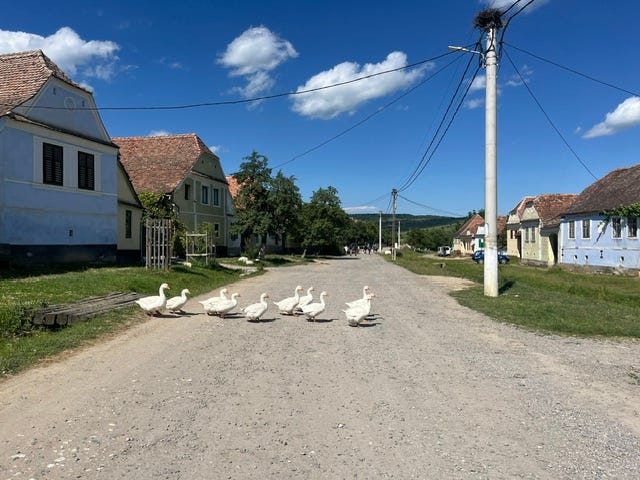
Viscri showed me what happens when people remain woven into the landscapes that feed them.
These were not anonymous animals in anonymous fields producing milk for anonymous consumers hundreds of miles away. These were village cows walking themselves home to village families where the milk travelled a few hundred metres to the collection point rather than hundreds of miles down a motorway.
There was something wildly radical about watching a food system small enough that everyone involved still knew each other.
The evidence of this was everywhere, not just at Viscri.
Tomato plants tumbled out of buckets in front gardens. Courtyards overflowed with beans climbing strings and herbs spilling from cracked pots. Behind many houses stood orchards heavy with fruit. These were not ornamental trees or a community initiatives. It was just fruit trees doing the perfectly ordinary job of feeding people.
As we drove through the villages I noticed scraps of land everywhere given over to small-scale food production. A strip beside a fence, or a corner near a bus stop. And almost always there was someone tending it. An old woman bent over beans, a man staking tomatoes, caring for what will nourish them and their families.
Food was not hidden away in distant industrial estates or arriving anonymously in lorries at three in the morning. It was visible and embedded in daily life, growing in full view of the people who would eventually eat it.
Abundance, I realised, was remarkable in Romania.
We visited a one hundred hectare meadow. That’s about 140 football pitches of flowers stretching towards the horizon, alive with butterflies and bees and the low electric hum of summer.
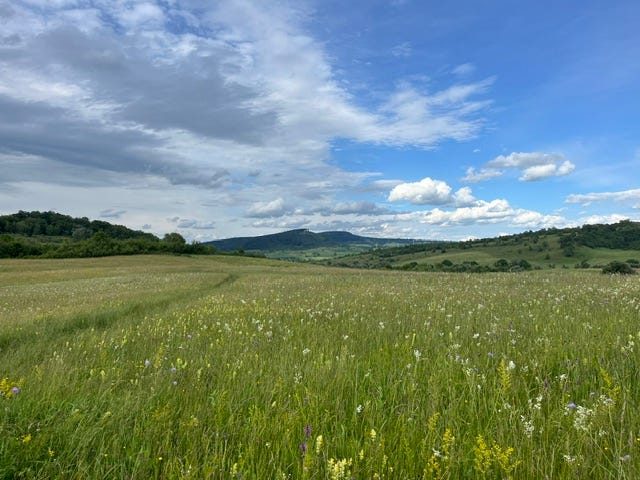
The scale of it is difficult for a British audience to compute.
Our surviving meadows are islands of memory scattered across the countryside. Since the 1930s, the UK has lost around 97% of its species-rich wildflower meadows. More than three million hectares in England alone have been ploughed, reseeded, fertilised or built over. What remains covers less than one percent of our land area.
Many of the species-rich hay meadows I visit for work are measured in single figures. They are 3 or 5 hectares if you’re lucky.
The 100 hectare meadow in Romania wasn’t remarkable because it existed. It was remarkable because I had forgotten that this is what ordinary once looked like.
It was the noise of the meadow I remember the most. Or perhaps more accurately, the shock of hearing it.
The meadow buzzed, hummed and fizzed and rattled.
There was a constant ticking sound I couldn’t quite put my finger on. Grasshoppers, perhaps. Crickets. Beetles colliding with stems. Wings catching against seed heads. A symphony of abundance.
I found myself unexpectedly emotional because somewhere underneath the wonder was grief. Grief for what we have lost. Grief for what we have forgotten enough to stop missing.
There is a phrase in conservation called Shifting Baseline Syndrome.
Each generation accepts the world they inherit as normal. If fish populations decline by half, that becomes abundance. If birds disappear, silence becomes ordinary. If insects vanish from windscreens and summers grow quieter each year, eventually nobody remembers that they were ever loud.
The baseline shifts again and again and again.
I was born in 1986. I have spent nearly my entire career in conservation and standing in that Romanian meadow I had the uncomfortable realisation that even I have forgotten what abundance sounds like.
I have become used to fragments, A good nature reserve here. A successful restoration project there. Romania reminded me that abundance is not supposed to be exceptional. It is meant to be normal.
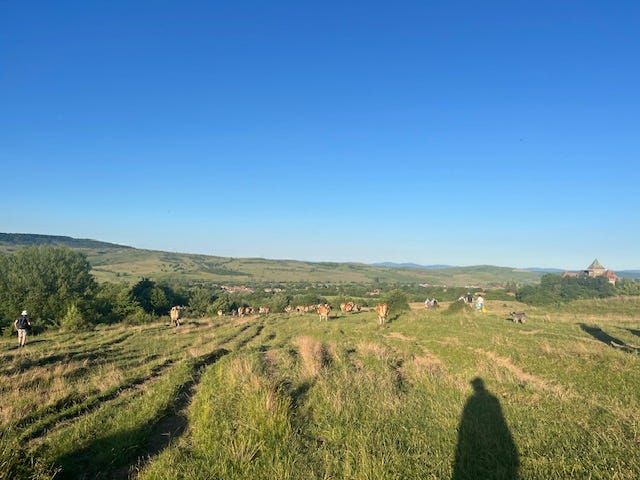
Saying all this, I’m careful not to romanticise Romania.
The conversations there were reassuringly familiar. Farmers worried about economics and bureaucracy, while conservation organisations doing good work worry about funding. There were arguments over subsidies, tensions between NGOs and farmers, questions over productivity, livelihoods and the future of rural communities.
The very systems we celebrate — low-input, low-intensity farming and centuries-old relationships between people and place — are under pressure. The same forces that transformed British landscapes are arriving there too. Young people are leaving villages searching for something better, farmers are wanting to consolidate, and economics is pushing people towards efficiency and simplification.
There is no ecological utopia waiting somewhere east of Europe for us to discover. There are simply people trying to make a living from land while holding onto enough of it to pass on.
Oddly, I found that reassuring. Not because I want Romania to lose what it has. Quite the opposite. But because it reminded me that these challenges are not uniquely British failures. They are the consequence of economic systems that rarely reward abundance if abundance comes at the expense of efficiency.
Which means the solution probably isn’t nostalgia. We cannot simply wind the clock backwards and go back to the ‘good old days’. The question is how we build a future where nature once again has a place in a working landscape and a working economy.
Because if abundance existed once, in landscapes shaped by people rather than untouched by them, it can exist again.
Through farmers being rewarded for stewardship.
Through local food economies.
Through restoration creating jobs and skills and businesses.
Through communities benefiting from landscapes that are richer, healthier and more resilient.
Through remembering that people are not separate from nature, but part of it.
That leaves me with an unexpected feeling.
Hope.
Perhaps Wiltshire can hum again. Perhaps our chalk streams can spill back onto their floodplains. Perhaps our meadows can grow larger.
Perhaps one day a child will walk through a field buzzing with insects and drifting with butterflies and know that this is simply what summer sounds like.
If this piece resonated with you, I’d love to hear your thoughts.
Comments
Nothing yet. Say the first thing.
Sign in to join the conversation.