
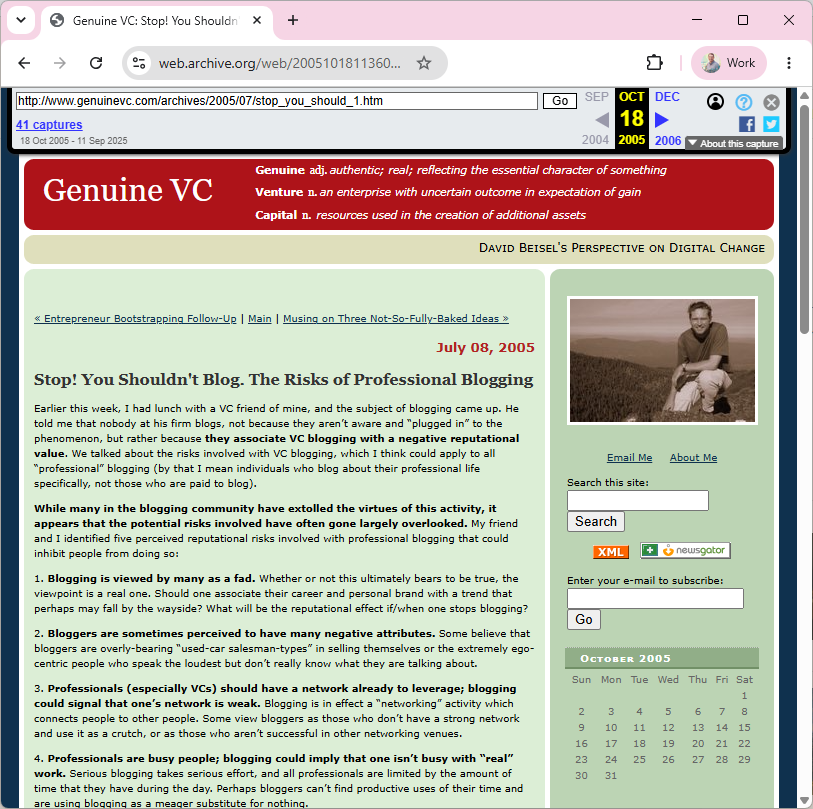
In March of 2005, I started a blog called GenuineVC as a broad commentary on digital change. In the twenty-odd years since, I have been writing publicly in one venue or another: at GenuineVC, on Medium, on the NextView blog, more recently at Venture Upward (a focused Substack written as career advice for up-and-coming VCs), and now here at Carried Away. A few months into writing the original GenuineVC blog, I wrote a post exploring whether I, as a venture capitalist, should be doing any of this kind of public writing at all. It’s hard to imagine, but it was quite an unusual thing for a VC to be doing at the time. And I was trying to be intellectually honest about why my own behavior might be wrong.
Reading back at that post, “Stop! You Shouldn’t Blog. The Risks of Professional Blogging,” two decades later is its own strange experience.
In it, I enumerated five risks of consistently writing professional articles on the web as a VC. First, that blogging was a fad. The view was widespread enough at the time to be a real one. Second, that bloggers carried a stigma. Some saw us as “overly-bearing used-car salesman-types” in selling ourselves, or as “extremely ego-centric people.” Third, that blogging signaled a weak professional network: those of us writing publicly didn’t have the relationships to source deals the right way and were using the blog as a crutch. Fourth, that it could imply one wasn’t busy with “real” work. And fifth, that the digital record was permanent. Anything I published would be findable forever.
Around the same time, journalists reported the same views about blogging on the record from established VCs. One called the practice “stupid.” Another said it wasn’t an effective way to source deals. A third said it took time better spent on engaging with portfolio companies. Another VC early blogger recalled hearing the same things about himself secondhand: “He doesn’t have enough to do.” “He’s not spending his time doing his job.” “What a waste of time.”
What none of us in 2005 saw clearly was the complete inversion that would follow. Years later, the practice didn’t just survive its early skepticism. Blogging became the competitive default as VC content marketing.
Of the most prominent venture capital firms today, one runs a podcast network, a publication, and a dedicated “new media” team. Another publishes a longform content site and produces a regular podcast hosted by its lead partner. A third has built a regular publishing rhythm with the explicit ambition of becoming a Harvard Business Review for startups. And of course even the podcast that began as a student’s twenty-minute interview series (which I’ve appeared on) became a venture fund of its own.
Some of the firms with significant editorial properties today have partners who, twenty years ago, didn’t think blogging was an “effective deal-sourcing mechanism.” The inversion is so clear that one of the largest firms today has been referred to as “a media company that monetizes through VC.”
The skeptics back then were just early to the wrong side of an inversion they did not see coming.
The firms that once dismissed VC blogging built editorial machines around it. The activity I once defended against skepticism is now the competitive default.
From that vantage point, here is the same resistance I encounter today when I argue that AI is going to take our jobs.
The specific objections raised today are their own arguments. AI can’t replicate human judgment. Founders want a human in the room. The model won’t see the outlier the partner can. Pattern matching is a craft that won’t transfer to a system.
But the shape of the dismissal is consistent with what I heard in the mid-2000’s. The structure of the response when something new touches the craft of our profession is the same in every case I can remember. This isn’t real work. The people doing it aren’t serious. We’ve always done it the other way.
Plenty of unconventional positions have not aged well. The informative part is the shape of the early dismissal, which is consistent across cases. When I recognize that shape in conversations with peers now, it’s unsettling. None of these arguments is new and each one has been raised against practices I now take for granted.
In another one of my early blog posts, I described where blogging was on the Gartner Hype Cycle and predicted that mainstream skepticism of blogging would arrive shortly. Merely four days later, the New York Times published a piece titled “A Blog Revolution? Get a Grip.” From that post, a line I still believe: history only becomes clear in retrospect.
The mistake that I made two decades ago wasn’t missing the trend. Rather, the error I made was not appreciating how impactful it would be in changing our business, and not embracing it even more.
So now, the question with AI upending venture capital isn’t whether the rhyme will hold. The question is how much every VC should commit, including myself. I personally won’t make the same mistake twice.

No posts
Comments
Nothing yet. Say the first thing.
Sign in to join the conversation.