
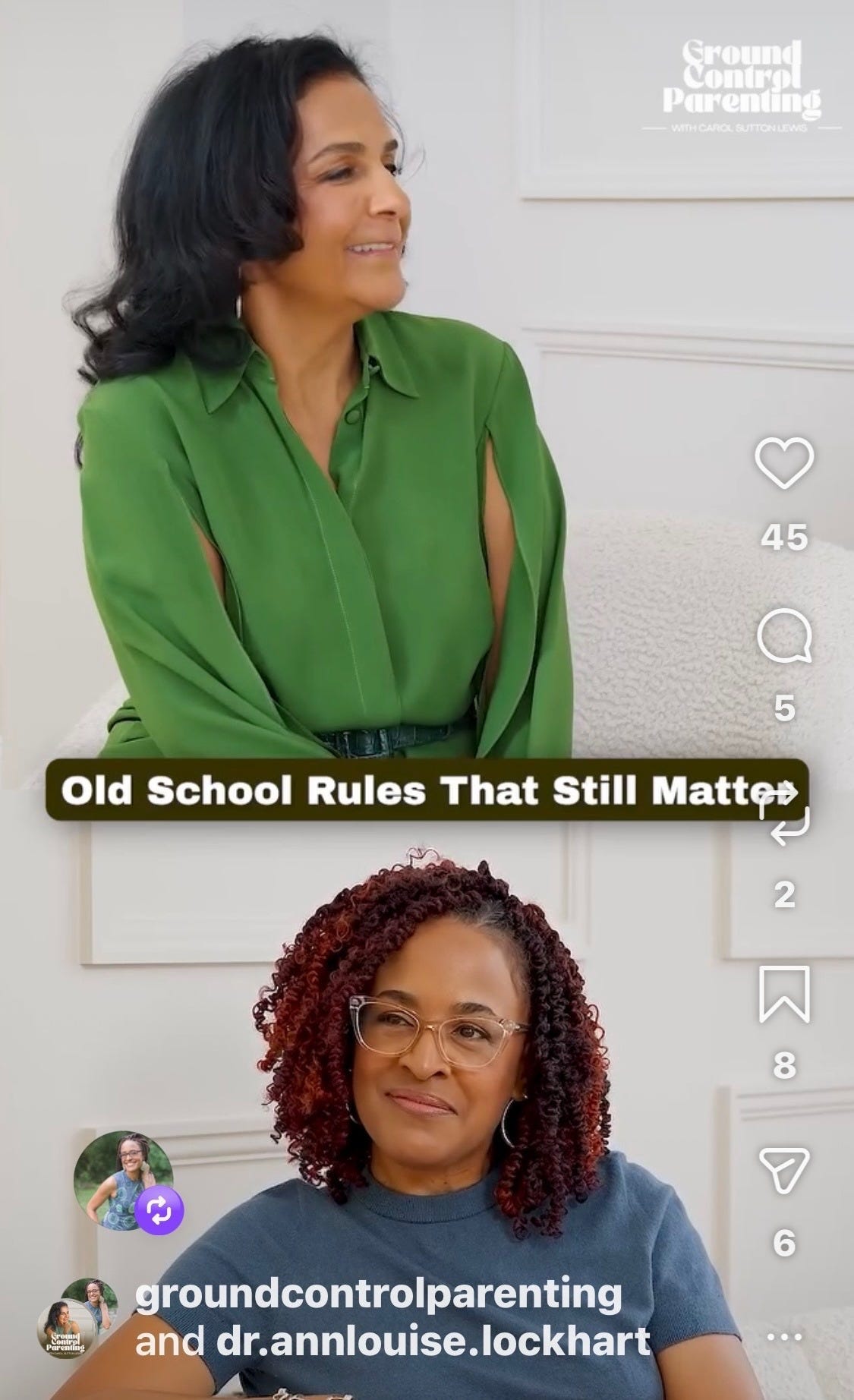
One of the things I love about Ground Control Parenting is that it gives me a front-row seat to conversations about the values we grew up with and which ones are worth passing on to our kids.
A recent conversation with child and family psychologist Dr. Ann-Louise Lockhart, a frequent GCP guest, brought this question into sharp focus. I asked her to share an example of old-school wisdom she grew up with that still feels relevant today. Her answer was quick and thoughtful:
Knowing how to speak to people. Knowing that you speak differently to a child than to a parent, differently to a senior than to a peer, differently to a leader than to a stranger. Knowing how to shake someone’s hand, how to look them in the eye, and how to communicate with awareness and intention.
This is such a strong answer. These skills are not just about manners or politeness, though those values matter too. They help our kids understand context, respect, and how to move through the world with empathy and awareness. This is a form of code-switching that will help develop their social intelligence. And we can help our kids with this.
This brings me to an example that regularly sparks debate: should children address adults by their first names, or by “Mr.” , “Mrs”. or “Ms.”?
Many schools and families have moved firmly into the first-name-only camp. To them it promotes warmth, friendliness, and approachability. And those are all good things.
But I am definitely old school on this one: As I see it, teaching a child to default to “Mr., " " Mrs. ", or “Ms.” is a way of signaling respect before familiarity. It’s a valuable lesson in empathy and awareness.
My husband and I insisted that our childrens’ young friends call us Mr. and Mrs. Lewis. If we were especially close to their parents, we were Aunt and Uncle. (Our kids have so many aunts and uncles! Is this a Black thing? 🤔 I think so.) We were definitely in the minority among school parents, and our kids never stopped telling us how annoying they found it. But we held tight to this one, even as they assured us that lots of their friends’ parents wanted to be called by their first names. Our message to them was simple. Adults are Mr., Mrs., or Ms., unless they specifically say otherwise. We explained that for many adults, including their own parents, being addressed by their last name is a sign of respect, even if our kids think it is old-fashioned, silly, or embarrassing. (Parents who insisted on Mr. and Mrs. were definitely NOT cool.)
As kids grow, they’ll constantly have to adjust how they speak depending on who they’re talking to. A friend. A teacher. A coach. A grandparent. A boss. A neighbor. Learning to make those distinctions doesn’t make them inauthentic. It builds social fluency.
In a screen-oriented world, skills like addressing people properly and looking people in the eye when meeting them don’t get nearly as much practice. Texting flattens tone. Social media blurs boundaries. Group chats don’t require eye contact, timing, or reading a change in expression. Because so much of our kids’ communication now happens on screens, they have fewer natural opportunities to learn these nuances.
That’s why teaching these skills at home matters more than ever.
Sometimes that looks like gently correcting a child when they speak too casually to an adult, even if you are comfortable with first names. Tone still matters. Sometimes it means modeling how you greet neighbors, workers, teachers, or elders. Sometimes it means explaining why we speak differently in different situations instead of simply insisting that they do.
Our kids learn this first by watching us. Long before they follow instructions, they absorb tone. They notice how we speak to a variety of people in different forms and tones. They learn, when we offer information instead of shaming or correction. They benefit from practicing (in low-stakes moments) learning how to greet an adult, answer a question, introduce themselves, shake a hand, look someone in the eye. It may feel old school, but it still works.
Most importantly, we can help our kids understand that how we speak can open doors, build trust, and help people take us seriously, especially in spaces where they may already be underestimated. When kids understand that the goal is connection rather than compliance, this may make something shift. They can begin to see that learning different forms of communication is a tool, not an outdated exercise.
For some kids, this comes easily. For others, it has to be taught clearly and repeatedly, and that’s okay. Social skills aren’t character traits. They’re learned skills.
Good communication isn’t one-size-fits-all. It’s about understanding context, showing respect, and connecting authentically with different people in different spaces and at different moments.
Helping our kids develop these nuanced skills is a gift. The world rewards clarity, confidence, and connection. Knowing how to communicate effectively and well is an old-school value worth passing on.
Thoughts? Did I lose you at “Don’t call me by my first name?” 🤣 I’d love to hear.
Thanks, as always, to Paramount for its sponsorship and to Seneca Women Podcast Network for their support. And of course, thank you for reading, for listening, for subscribing, and for sharing this newsletter with anyone you think might need it.
Working hard on Season 8, coming soon! Meanwhile, peruse the archives for some gems you may have missed, including this past season’s episode with Dr. Lockhart on Raising Resilient Kids: Emotional Intelligence 101.
Enjoy,
No posts
Comments
Nothing yet. Say the first thing.
Sign in to join the conversation.