
“We don’t just do ecstatic dance. We dance for life.”
The moment I heard Lizzie speaking these words, I was being reminded - once more - of what is truly essential to me. The dance has never been merely about music or movement anyhow. Dance literally saved my life. It became the place where I go to move through different pieces of my life - where I can dive deeper into my emotional landscapes such as my own intensity, messiness, grief, joy, anger and uncertainty. Because we are “more together than alone,” as Mark Nepo so poignantly says.
Over the years many people have asked me what it means to read a room as a DJ. Often the answer is framed as a technical skill: watch the dance floor closely, notice when energy drops, bring a stronger track, increase the tempo, push the room back into motion.
But for me, reading a room begins somewhere far deeper.
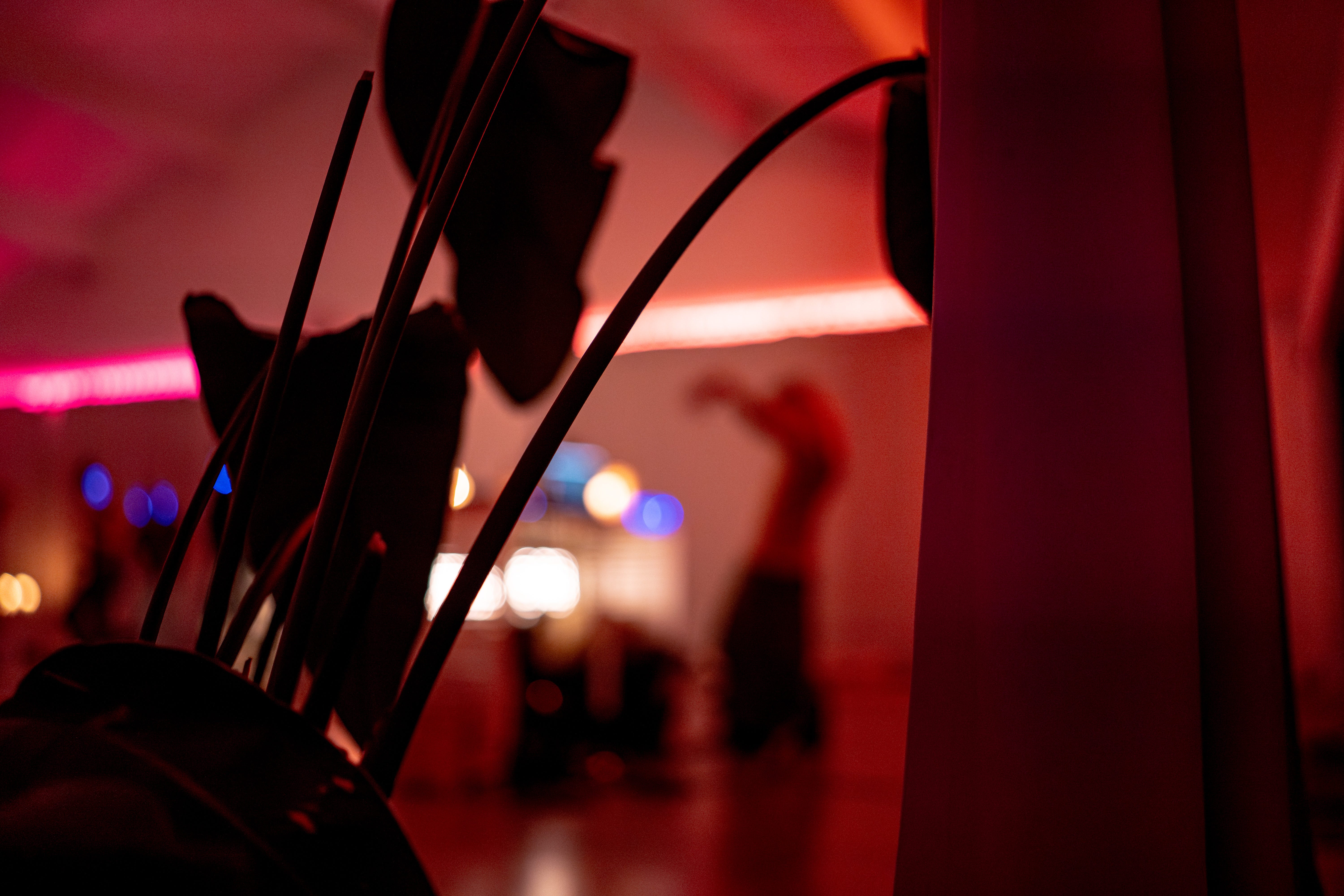
Photo by Harry Oak
When I arrive at a dance, I first tune into the space itself. The people in the room form only one part of what shapes the dance. Every gathering carries a much larger field. The organizer brings a certain intention. Every community has its own story. Every room a unique atmosphere. Even the sound system shapes how the music lands in our bodies. And then of course, the earth herself - the animals, the plants, all our relations - the deepest holders of it all.
People arrive with their own emotional landscapes. Some step in excited. Others bring grief, exhaustion, tenderness, or uncertainty. We also carry the rhythm of the day with us: the conversations we had, the tasks we completed, the thoughts still circling through our minds. A full moon night carries a different atmosphere than an ordinary weekday. Dancing outdoors shifts the whole experience. A storm changes how we feel. News travels through our bodies long before we speak about it.
All of these energies are already present in the room before the first track begins.
When I begin a set, my intention is to meet the dancers exactly where they are. From this meeting point the music begins to flow. When people feel at ease in a space, their bodies soften. They can begin to move more freely again. Because when we gather, dance becomes an ongoing exchange. A field of co-creation.
The dancers shape the music just as much as the music shapes the dancers. Each movement, each breath, each moment of courage or vulnerability feeds back into the field. Slowly the room begins to weave itself together.
Ecstasy moves through us, but has nothing to do with intensity.
Our nervous system needs to feel safe before we can actually open up to life - or to any experience at all. This also means that we cannot learn anything when we feel unsafe or in a state of anxiety.
It is quite obvious when you observe a dance floor: once people begin to relax into the space, their movement also begins to look different. When people recognize or feel comfortable with the music being played, they also more easily feel safe and seen. And of course, each culture responds differently to certain sounds, rhythms, and melodies.
So once people feel at ease, the energy in the room can start to ground, rise, soften, gather again, or expand in unexpected directions. Like mycelium underneath, dancers also start to give each other information. People’s heartbeats start to align. And there are many scientific reasons why we now know that simply gathering with people from a place of relaxation gives us many good feelings.
Sometimes the room grows into a powerful shared field. Dancers sense that they move as one organism, breathing and shifting together. At other times the dance remains quiet, inward, intimate. People travel through their own landscapes inside the music. Or through all the layers in between.
Every form of dancing holds its own depth and wisdom - and its own magic.
For me the essential orientation has always remained the same. I stay in service of the co-creative process that unfolds between the dancers, the music, and my own listening. I often think of it as placing our dancing prayers in the center of the room and letting everyone move around them, the way people once gathered and moved around the fire.
Reading a room also involves paying attention to what visibly unfolds.
For instance, sometimes a large group of dancers starts to move toward the edges of the space. Many DJs interpret this moment as a loss of energy and immediately try to correct it by pushing the music into higher intensity. But our bodies often ask for something different.
A dance floor naturally disperses and gathers again. Energy spreads outward and later returns toward the center. These quieter phases actually allow the dancers to integrate their experiences. They create room for grief, reflection, tenderness, and depth.
In recent months quite a few people have written to me about their experiences on dance floors. Several described how difficult it feels to stay present when intensity rises too quickly — when the music climbs higher and higher while they clearly need space to breathe.
Another example: sometimes people sit at the sides, not moving a lot. But then at the end they come up to me and tell me they went on a huge internal journey. Moving through old ancestral wounds, meeting a voice inside that tells them they can trust, receiving visions of where to go next, and so much more.
These messages made me reflect again on the wider culture that shapes ecstatic dance.
Our broader culture constantly pushes toward stronger stimulation. Faster peaks. Brighter signals. Higher emotional waves. When energy drops we often feel compelled to lift it immediately. When silence appears we rush to fill it.
This rhythm of acceleration has also entered the dance floor. Even dancers now expect the dance to continuously climb upward. Asking for louder music, faster transitions, and more dramatic peaks.
But have you ever truly taken time to observe nature? We belong to her. Nothing in nature moves in straight lines toward greater intensity. After winter must come spring. After summer must come autumn. Without these rhythms, life could not sustain itself.
When a dance floor allows rhythms of expansion and contraction, gathering and dispersing in waves of activation and rest, you will immediately feel it in the atmosphere. It gives people the space to listen more carefully to their own bodies. And deeper layers of emotion and awareness can start to emerge.
The dance floor begins to breathe again.
For many years I believed my ability to read rooms came mainly from professional experience.
Later I recognized a deeper layer.
Since childhood my nervous system learned to scan environments carefully. I watched people closely. I sensed subtle changes in mood - and even potential dangers. My body tried to understand what was happening in the room before anyone spoke about it. In many ways this sensitivity developed as a survival skill.
Over time my sensitivity naturally found her way into my work.
But learning to DJ also taught me something important. If I focus only on others while reading a room, I lose my own center. My awareness moves outward and my body begins to adapt and please instead of listening.
The deeper art for me lies in staying connected to my own inner ground while sensing the field of the room. Listening to what unfolds among the dancers while remaining faithful to the thread of music that moves through me.
The real practice happens when these two streams meet.
And of course, this practice extends far beyond DJing. It brings me into the creative flow of life.
In many ways the dance floor mirrors the larger challenge of living in the world today. Many people are constantly scaning their environments: trying to adapt, trying to belong, trying to remain safe within complex social fields.
But life asks more of us than endless adaptation.
We are being asked to remain connected to our own center while staying in relationship with others. To listen carefully to the collective field without abandoning the truth of what moves within us.
The dance floor becomes a place of rehearsal for how we maneuver through the world. A place where we practice how to move through intensity without losing ourselves. How to stay present with joy, grief, stillness, and connection at the same time.
We do not simply dance for ecstasy. We dance for life!
For many years I danced for life. But there was also a layer that I discovered underneath it all. I realized I do not need to be a savior. Because life also dances with me, for me, and through me.
So now I find myself dancing through life.
Because the dance is everywhere - in the small moments with my kids, in the spaces between conversations, and in the way I move with the changing rhythms of life.
And somewhere along the way I fell deeply in love with life. As I began to see that the dance floor was never separate from life.
In recent months I have been writing more about these deeper layers of dance culture. A previous article explored how the nervous system shapes what happens on a dance floor. The next reflection will look at what I call beat culture and how our relationship with rhythm and intensity continues to evolve.
For those who feel called to explore these questions more deeply in practice, Léon Beckx and I also work with these themes inside the Conscious Dance DJ Training, where music, awareness, and collective fields meet in the living laboratory of the dance floor.
Because life is our dance floor.
And what a miracle it is to be part of it.
No posts
Comments
Nothing yet. Say the first thing.
Sign in to join the conversation.