
If you’re new here, welcome to Rising Tide Writers, a community of 1.9k aspiring and published writers. I’m Caroline Madden, author of The Marriage Vendetta (2025 HarperCollins/Bonnier) and The Village (forthcoming April 2027). It took me more than a decade to get my first book deal, and in this newsletter I’m sharing all the things I wish I’d known back when I was getting buried under rejections!
Hey fellow writers,
The ‘acceptance and delivery’ portion of my advance for The Village landed this week—woohoo🍾— and to celebrate, I decided to take a spur-of-the moment trip with my two kids.
I’m so grateful for my book deals, as they completely changed my life — and my children’s lives — and made little adventures like this possible.
On Thursday, the three of us headed off on a ‘mystery tour’ (my son wanted our destination to be a surprise 😍) to a lovely hotel where we swam, had ice cream at a quaint duck pond café and then ordered room service while watching The Hobbit in bed — our idea of heaven!
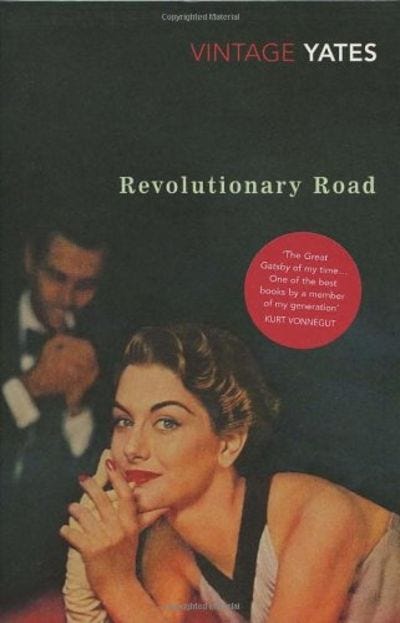
Then I raided the collection of novels in the hotel… and in between the Da Vinci Code and The Art of War, I discovered Revolutionary Road by Richard Yates. For the last few weeks, my fiction-writing battery has been running low but as I began reading Revolutionary Road, I could feel my love of writing being reignited ❤️🔥
The writing and storytelling in Yates’ 1961 debut is just so exceptional — it’s like an Americana Madame Bovary — and it made me want to be a better writer.
We’re back home now and for the first time in weeks, I’m invigorated and dying to dive back into Book 3, a feminist anti-romance. So if you’re feeling a bit stuck with your work-in-progress, a 24-hour change of scene and an exceptional book might just snap you out of it!
I was also inspired this week by the writer Stéphanie de Geus’s post about finding her way back to herself through play. In it, Stéphanie included a Stuart Brown quote that stopped me in my tracks:
“The opposite of play is not work. The opposite of play is depression.”
As a single parent trying to hit deadlines while keeping all the plates spinning, I struggle to make time for creative play.
But I’m going to pin that Stuart Brown quote up in my office nonetheless, because if I don’t make time for play, I won’t be able to write.
I was honoured to appear as a guest on Stephanie’s podcast recently, where we chatted about my shockingly long journey to a book deal (I started writing seriously two decades ago), but also about creativity and the need for creative breaks. You can listen to it here — I hope you find it inspiring.
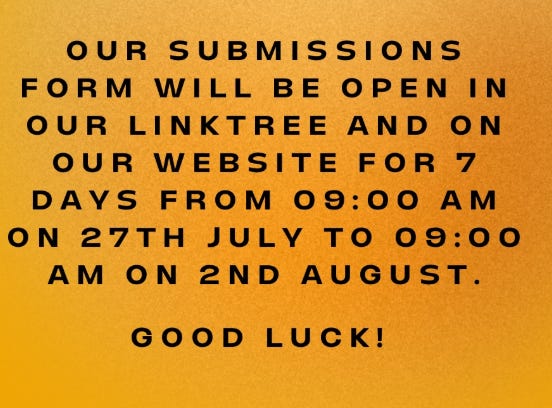
Get your manuscripts ready, because Verve Books is opening to unagented writers on July 27th! Although they’re a UK-based publisher, they will also accept submissions from international writers.
Verve is seeking new adult fiction and non-fiction for publication in 2028 onwards, and they’ll accept manuscripts that have previously been self-published.
Encouragingly, the publisher was asked on Instagram if they’ll be selecting books based on the writer having an online following, or purely on the quality of the writing, and Verve replied that their selection will be based on the quality of writing — that’s what we like to hear!
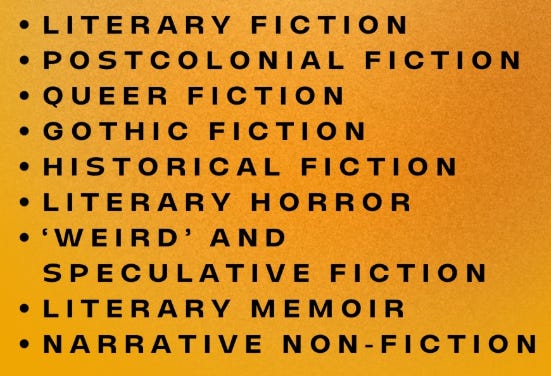
They’re especially keen to see writing in the following genres:
A lot of writers plunge straight into scenes and write them instinctively. I used to. Until, that is, I watched Lisa Cron’s ‘Anatomy of a Scene’ mini-course. In this course, Lisa does a deep dive into what a scene actually is and how it needs to work in order to be effective.
Her course made me realise that I’d never given individual scenes anywhere near the level of thought necessary.

I started applying Lisa’s approach and this change proved pivotal: it was one of the factors that helped me leave behind my growing pile of unpublished manuscripts, and go on to land two book deals.
I now check and double-check that all my scenes are doing their job; they are never included ‘just because’. They serve a function, and I make sure I know what that function is.
Lately, I’ve been helping a friend (a published author) refine the opening chapters of her new novel and I sent her some thoughts on getting her scenes working as effectively as possible.
She has applied these suggestions brilliantly and the improvement is amazing, so I thought… why not share my approach to scene writing here in case you find it useful too?
With that in mind, here are the things I always ask myself before writing a scene:
Comments
Nothing yet. Say the first thing.
Sign in to join the conversation.