
At the beginning of the year, I sent an email out to my “volunteer network” (long-time friends I had made through volunteering, people I currently volunteer with, colleagues from grad school who work in nonprofit, etc.) in search of inspiration.
I have a long (too long) list of topics I want to write about here in The Volunteer Lens, but something about the new year made me curious about what ideas others might have. Plus, I had kept TVL kind of under wraps, and was particularly nervous about introducing this project to people who operate in the same space and know me personally. I considered sending this email an act of “ripping off the band-aid,” and hopefully getting some positive feedback, without going fully public.
I received a lot of kudos (tysm) and some gems that I want to develop into collective advice for the volun-curious in a future piece, but the insight that jumped right into my soul was from a former grad school classmate, Carrie McDonald.
Carrie has worked in nonprofit spaces forever and in volunteer management for two decades. What she shared is so important that I honestly cannot believe that I do not see this written about more often (or idk maybe the algorithm is failing me). Carrie shared her thoughts on how volunteering is a third space for so many people. This is particularly true for her volunteers, who, for the most part, are retired folks who love gardening. For them, her nonprofit offers a place to learn, be useful, socialize, and feel a sense of belonging.
This got me thinking about my own volunteer history and if/when/how volunteering has served as a third space for me, which is what I sat down to write today. But then, in somewhat typical Caroline fashion, I found a few articles that prompted me to write beyond personal reflection.
So - let’s get into it.
First things first: defining wtf we’re talking about.
When it comes to defining words and systems that involve people, I like to draw from multiple sources. In my experience, there are usually at least 3 definitions that deserve consideration: the succinct definition, the academic explanation, and (perhaps most important) the people’s definition (aka the cultural definition).
From Wikipedia:
In sociology, the third place refers to the social surroundings that are separate from the two usual social environments of home ("first place") and workplace ("second place"). Examples of third places include churches, cafes, bars, clubs, libraries, gyms, bookstores, hackerspaces, stoops, parks, and theaters, among others.
From the abstract of Dr. İlkim Markoç’s research article titled Twitter in the Context of Oldenburg’s Third Space Theory:
Third Places are spaces where people can participate in a social network by discussing everyday events with the community, apart from home or work, as Oldenburg (1989) defined. Coffee shops, libraries, parks, and open spaces are the third classically defined places by Ray Oldenburg. According to Oldenburg's definition, third places have the features which are objective, inclusive, communicative, accessible, having a regular visitor, prominent in social ties, providing fun, psychological comfort and emotional support.
For those of you who love original sources, here is Dr. Ray Oldenburg’s original 1989 book referenced in the abstract quote above.
And last, but certainly not least, from the heart of the internet and Reddit user Clojiroo:
Third places still are common in some cultures. Free doesn’t matter.
Peak British pub culture is a good example of third places. Even in the tiniest hamlet there will be several and it’s where everyone goes when not at home or work.
And that’s all that really matters: it’s a space that people congregate at that isn’t home or work. It doesn’t need to be free.
We just didn’t use digital entertainment non-stop 30 years ago. We left our homes to spend time with other humans doing things.
And you didn’t need to just speak to a random stranger. You hang with groups of friends. And those friends have their own circle of friends. And you end up meeting new people through shared acquaintances.
Melding these definitions together, I present to you the definition of third spaces for this Substack Article.
Third spaces exist outside of the home and work and offer people social connection, belonging, and fun/entertainment.
For Carrie’s volunteers, her organization is a literal third space: a physical location where they can interact with other volunteers outside their home, build social ties, feel a sense of purpose, and pass the time.
Many volunteer opportunities serve as literal third spaces. Becoming a regular volunteer at any nonprofit turns that place into a third space for you. Places like community gardens, food banks, libraries, and senior centers attract regular volunteers who build strong connections with nonprofit/organization staff, fellow volunteers, and clients/people receiving services from that nonprofit. Often, regular volunteers create bonds with each other (and the greater third space) so strong that they transcend the space itself, creating networks of people across communities who host potlucks at their homes with each other or organize food trains when someone is ill or in need.
I have never been much of a “direct service” volunteer. As someone with a day job (and now a toddler), I do not have the flexible, but still predictable, schedule needed to volunteer my time regularly with a single organization. My volunteerism has largely been more “committee-based,” the type of work that is typically managed after standard work hours.
At first blush, this type of volunteer experience may not fit as a third space. These days, many committees meet remotely, sometimes across large areas, without any real plan to see each other “in real life.” Looking back at our definitions, there is an emphasis on physical space in conversations about third spaces that is absent for volunteers in this type of work.
But, as a volunteer of this variety, I respectfully push back on that. Although many of my committee volunteer experiences were absent a physical space to gather, I have been able to cultivate social connection, find a sense of purpose and belonging, and (broadly speaking) have fun doing the work asked of me.
I may have been volunteering from my physical first space (my home office), but the work was different from what I was paid to do. I was allowed to build skills and ask questions that did not have a place elsewhere. And I met like-minded people who were similarly passionate about the mission.
I also found emotional third spaces at work (a third space within my physical second space) that gave me a sense of purpose and belonging beyond my formal role. Serving as a volunteer for internal ERGs, leading virtual mindfulness sessions, and contributing to communities within my larger org really grounded me and is probably the real reason (other than money) that I stayed there as long as I did.
While it’s not always a physical third space, volunteering is my emotional and social third space, without question.
This might seem like a side-quest, but stick with me.
Somewhere along the way, volunteerism exited the conversation about civic service and participation. I follow a lot of people across the nonprofit space and civic service locally here in Austin, Texas, and I have never seen any of them post about volunteerism as civic service.
I recently submitted a proposal for a panel of nonprofit employees and volunteers to a leadership summit hosted by a young professionals organization here in Austin. My submission wasn’t selected, but the truly disappointing thing is that there are a grand total of zero speakers, panels, or conversations on the agenda about volunteerism, philanthropy, or advocacy.
Understanding, of course, that the leadership summit is trying to cater to a wide audience (“young Austinites”), I am still shocked that organizers did not see a benefit to bringing these conversations to young folks in our community (especially when I know for a fact there were at least two panel proposals submitted that were dedicated to furthering the conversation about philanthropy as civic engagement and the organizing group is a civic leadership group).
It seems everyone, everywhere, is writing about the loneliness epidemic and the anxious generation. Third spaces (physical third places) are closing with no replacements in the pipeline, putting our collective well-being into dangerous imbalance. Discussions about what can fill your life in the spaces between work and home are critical to mending our social fabric, and yet those conversations seem to only be happening in academic circles and niche organizations.
We do ourselves and future generations a disservice by not creating multigenerational spaces to talk about connection and belonging.
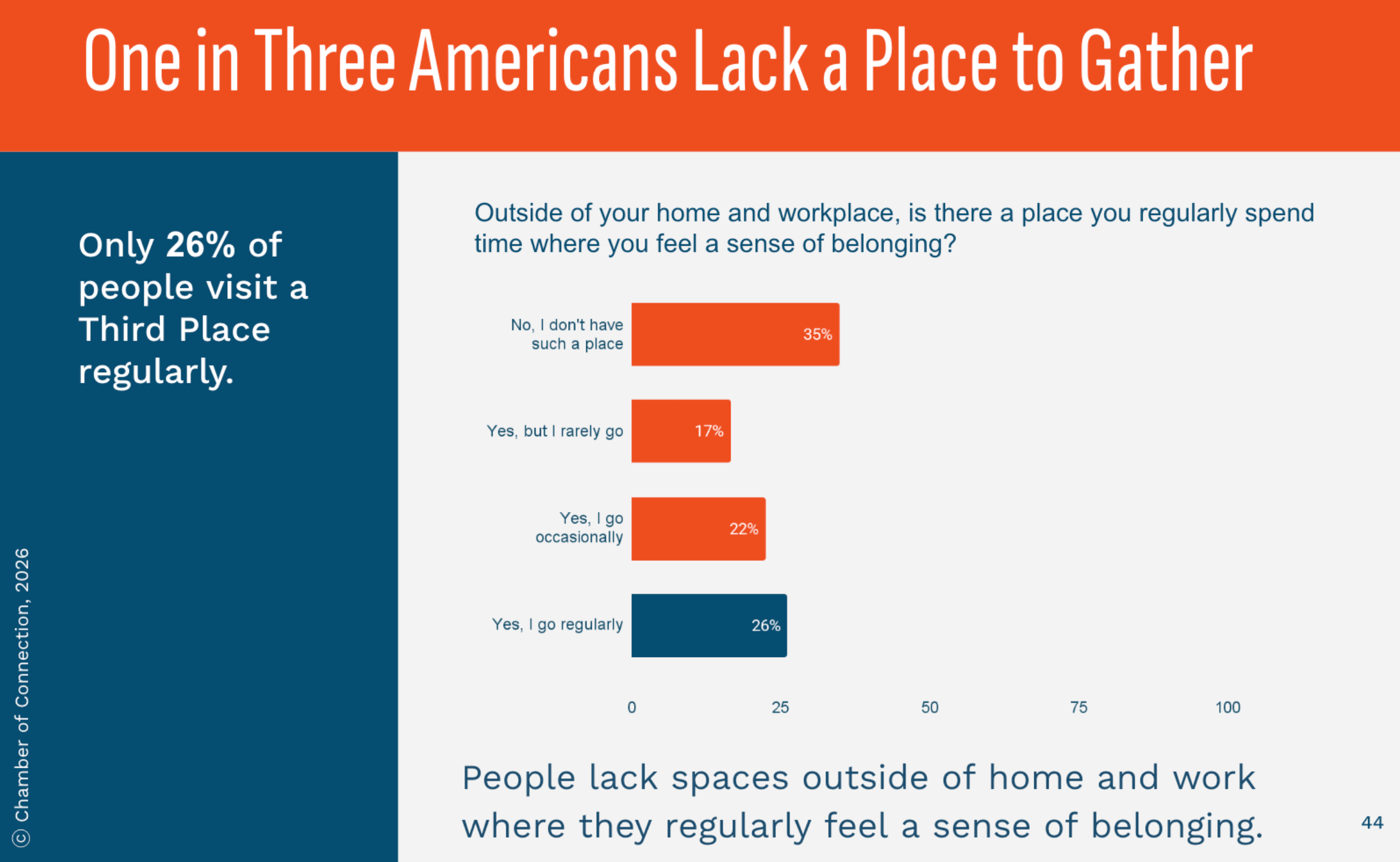
If you’re curious about how volunteering can be your third space or how to design volunteering opportunities that optimize for social connection, this article is fantastic.
I also recently applied to be a welcome committee volunteer with the U.S. Chamber of Connection, which is referenced in the article and has a really beautiful mission, including creating more third spaces in communities. They have an upcoming webinar on May 13th about creating Third Places that I encourage you to register for if you’re curious!
And finally, this summary from Americorps’ research on volunteering and civic life in America is worth reading.
Do you have a volunteer third space?
How can I/we/everyone create greater conversations about volunteerism as civic engagement and service? Particularly in our local communities?
How can employers better support employees who are dedicated volunteers? What companies already do this well? (And I don’t just mean companies that have robust corporate volunteering programs, though that’s great too.)
Point me to your favorite resources!
Comments
Nothing yet. Say the first thing.
Sign in to join the conversation.