
This week, I’m sharing a guest letter from my friend Matt Holder, Director of First Recovery in Oak Ridge, Tennessee. I hope it moves you.
This had to feel like the Morning of the Impossible.
Anyone had a morning like this?
Imagine the scene:
The sun is just beginning to bleed over the horizon in Jerusalem. Three women—Mary Magdalene, Mary the mother of James, and Salome—are walking toward a destination of deep grief. They are carrying spices to anoint a body. They are driven by a singular, heartbreaking devotion.
“And they were asking each other, ‘Who will roll the stone away from the entrance of the tomb?’ But when they looked up, they saw that the stone, which was very large, had been rolled away.” Mark 16:3–4
But as they walk, a conversation starts. It isn’t a theological debate; it’s a practical, terrifying dilemma. They ask one another, “Who will roll the stone away from the entrance of the tomb?”
They were walking toward a miracle, but all they could see was a barrier. They were facing a two-ton reality of cold, hard stone. In the Second Temple period, these tombs often used a golel—a massive, disc-shaped rock set in a sloped track. It was designed to roll down easily into a groove to seal the dead, but to move it back uphill required the collective strength of several grown men.
These women were resilient, but this task was fundamentally beyond human strength. They were staring at a physical, legal, and military barrier. There was a Roman seal on that stone. There were armed guards. In our modern context, this was the equivalent of a high-security vault.
What a Hindsight of Devotion.
There is something vital in the fact that they only asked about the stone on the way. It tells us that they were driven by love, not logistics.
Had they focused on the logistics, they never would have left the house. If they had sat down to “problem-solve” the two-ton stone, they would have stayed in bed, paralyzed by the impossibility of the task.
How many of us have stayed paralyzed because we were staring at the “stone” instead of starting the walk? We focus on the “how” before we have even encountered the “Who.”
Then comes the shift. Mark writes: “And looking up…”
This is the hinge of the Gospel. It signals a transition from a grief-stricken, downward gaze to a new, supernatural reality. They didn’t arrive and start pushing. They didn’t arrive and start strategizing. They looked up and realized that the action was already complete. God had moved before they even arrived.
And here is the theological truth we must grab hold of today: The stone wasn’t moved to let Jesus out. The Resurrection had already happened! He didn’t need an open door to exit a physical tomb. No, the stone was moved to let the witnesses in. It was moved so they could see the empty space where death used to reside.
This had to feel like a Two-Ton Weight of the Soul.
Mark makes a specific point to note that the stone was “very large.” This isn’t just a descriptive detail; it is intentional. It magnifies the impossibility so that it can further magnify the power of God.
I think about that “very large” stone often. Recently, I was in my yard trying to move a concrete flowerpot. It wasn’t even a tomb-sized stone, just a simple garden ornament, and I couldn’t budge it. I stood there, sweat on my bald head, thinking: “I can’t even move this... how could anyone move a stone like the one at the tomb?”
In that moment of frustration, the question changed. It moved from “How will this be fixed?” to “Who can fix this?”
For many of us, that “stone” isn’t made of limestone; it’s made of addiction, ego, and trauma. This brings me vividly to the end of my own substance use—the terrifying threshold of Step One. Step One confronts us with two jagged, uncomfortable truths: We are powerless, and our lives have become unmanageable.
For years, I carried a figurative two-ton rock. When I first started using substances—especially those opiates—it felt like the solution, not the problem. I remember taking those pills for a back injury and thinking,
“Wow, this is how a normal person must feel.” It worked as a “painkiller” for more than just my spine; it numbed the emotional pain, the trauma, and the deep-seated insecurities that I didn’t know how to carry.
The problem with a “solution” like that is that it works... until it doesn’t.
My Illusion of Control.
I tried to quit a thousand times. I meant it every single time.
I would make it days, weeks, or even years, but I always found myself back at the base of that two-ton stone, trying to push it uphill with my own fading strength. I always held on to something, I’m different, It will be different or I don’t need to follow that suggestion. My way will work! It didn’t always turned out disastrous with more pain, suffering, trauma guilt, shame, disappointment, dishonesty, and more consequences.
Even now, eight years into a journey of sobriety and wellness, the “addiction wheels” can still turn. Just yesterday, my wife Melinda had a medical procedure. She was given fentanyl for the pain. For a brief, flickering moment, the old ghost whispered in my ear. It sounded “good.”
In the past, I would have been buried by the shame of that thought. I would have hidden it, and in hiding it, I would have given it power. But I’ve learned that being ashamed of a thought is a poison to my well-being. That experience gave me a fresh perspective on that Sunday morning eight years ago when the disease had progressed to the point where I was using against my own will.
I knew the drug tests were coming. I knew the legal walls were closing in. I could see my physical health deteriorating in the mirror. My mental, emotional, and spiritual health felt beyond repair. I knew I was breaking the hearts of the people I loved. My life was so lonely and painful. I just wanted those few seconds of relief. I knew it was killing me. And still, I could not stop.
That is the definition of powerlessness. That is standing before a sealed tomb with no way to move the rock.
Think about the “Look Up” Moment:
At my lowest point, I believed the only option was to stop existing. I thought the stone was the final word. But that was exactly when God moved.
I had been stuck for months, paralyzed by my return to use. Looking back, the solution seems so simple, yet it was the hardest thing I’ve ever done: Surrender. I had to stop asking how I was going to fix my life and start asking Who could save it.
I cried out for help from the front seat of my car. It wasn’t a polished prayer. It wasn’t “churchy.” It was a raw, guttural cry for mercy. And in that moment of surrender, the stone began to roll.
My stone didn’t disappear overnight. It was a process, not a magic trick. At first, I thought the problem was the substance. Eventually, through the Steps and the grace of God, I realized the problem was me. God used the recovery process to do what I couldn’t do through sheer willpower. He didn’t just move the stone; He handed me a broom and said, “Now, let’s clean up your side of the street And keep it clean.”
Can you identify Your Stones?
Today, as I stand here at the fifty-year mark of my life and the eight-year mark of my sobriety, the weights I carry look different, but the process remains the same. Recovery isn’t a destination; it’s a daily journey of “looking up.” I don’t have the absence of cravings but the support and wisdom to do something different. By the grace of God those lessons appear to have been learned.
Every day, God invites us to identify the new stones.
• Is it the stone of Ego, where you think you have all the answers?
• Is it the stone of Resentment, where you are holding onto a grudge that is only poisoning you?
• Is it the stone of Control, where you are white knuckling your life, your children, or your career?
• Is it the stone of Relapse or recurrence of use? Maybe no one knows but you. Every time you look in the mirror.
• Maybe it’s the stone of Judgement? You’re a good person that does selfless deeds but you know deep down you judge the people God is calling you to serve.
What is holding you back?
Perhaps it’s a habit you can’t stop. Perhaps it’s a guilt that won’t let go. Perhaps it’s the weight of unresolved trauma that has been sealed in the dark for far too long. Many successful people (people who look like they have it all together) are walking around with a two-ton weight strapped to their souls.
You don’t have to wait until you “get your life together” to bring your boulder to God. If the women had waited until they were “strong enough” to move the stone, they never would have seen the Resurrection. They went to the tomb while they were weak. They went while they were worried.
God’s sending you an Invitation. And everyone is invited to this table.
Mary walked to the tomb wondering how. She left the tomb knowing Who.
For many years, I asked how—how to be a better person, how to be a better son, brother, friend how to be a professional…Could I be a husband or father? How will I stay sober.?
Today, I live knowing Who.
Stop staring at the weight of the stone and start looking up. No matter how large the stone is, no matter how “very large” Mark describes it, it is a pebble in the hand of the Almighty.
I invite you to spend a few moments in prayer. If you don’t know how to pray, start with two words: “Help me.” Or even, “Thank you.” God doesn’t require training or perfection to pray. Our Lord and savior requires a heart that is tired of pushing the stone alone.
Bring your burdens. Bring your thanks. Bring your two-ton rocks. The ground is dry, the stone is moved.
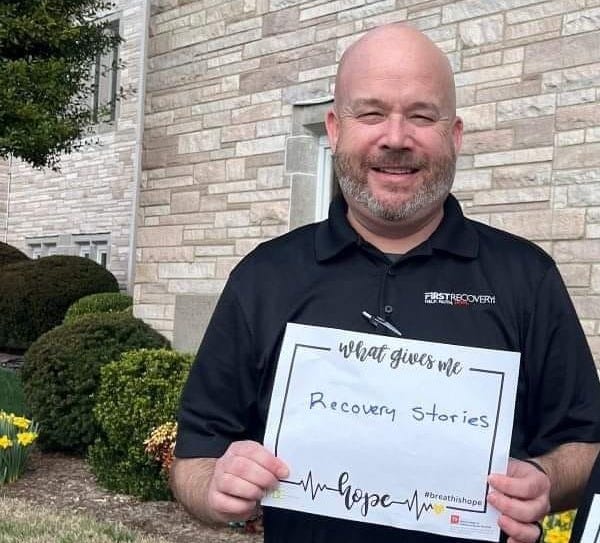
Matt Holder is the Director of First Recovery, a Christ-centered 12-step ministry dedicated to supporting those suffering from substance misuse and addiction and aiding their families. First Recovery embodies the love of God by providing needed assistance to overcome difficulties and regain hope.
*
Thank you for being a part of this circle.
With hope for your journey,
Caroline
No posts
Comments
Nothing yet. Say the first thing.
Sign in to join the conversation.