
Let me start with this caveat. When I wrote this I was feeling gratitude and love for the ordinary. Sometimes you just wake up and you are in love with life. Happy for no reason. I guess that’s what joy is.
I made a decision to LOVE my ordinary days, consciously and intentionally.
I got up without an alarm. Walked the dogs on the beach. Came back and read something I’m actually into right now. Planned my day. Took a shower, got dressed, made breakfast, and had my tea service.
Then, I worked on client deliverables that stretched me the rest of the morning. Had lunch with my husband. Took a bike ride in the middle of the day because I could. Kept working. Watched something in the evening. Went to bed.
No meetings (those are the best days). No launches to plan. No conferences to look forward to (or dread). No big trip on the horizon. No hiring announcement. Nothing to get excited about, in the way we usually mean it.
And that’s precisely why it was perfect.
Here’s what I’ve come to believe: you reach a peace-filled, awakened state when you love your ordinary days. Not your best days. Not your peak days. The days that make up most of your life.
The rhythm and cadence of the everyday — that’s your life. The launches and conferences and trips are the punctuation. The ordinary days are the sentence.
I used to have this backwards. Grinding through the ordinary to get to the extraordinary, and then getting confused when the extraordinary doesn’t deliver the feeling I expected.
A lot of us have spent most of our lives treating the actual substance of it as something to be gotten through.
The biggest shift for me has been the tea ceremony. I know how that sounds. I’ve heard “slow down and smell the roses” for thirty years and it never landed. We went on our first transatlantic crossing on the Queen Mary 2 last year, where I got inducted into the actual British tea ceremony, and I loved it so much I decided to bring it home with me.
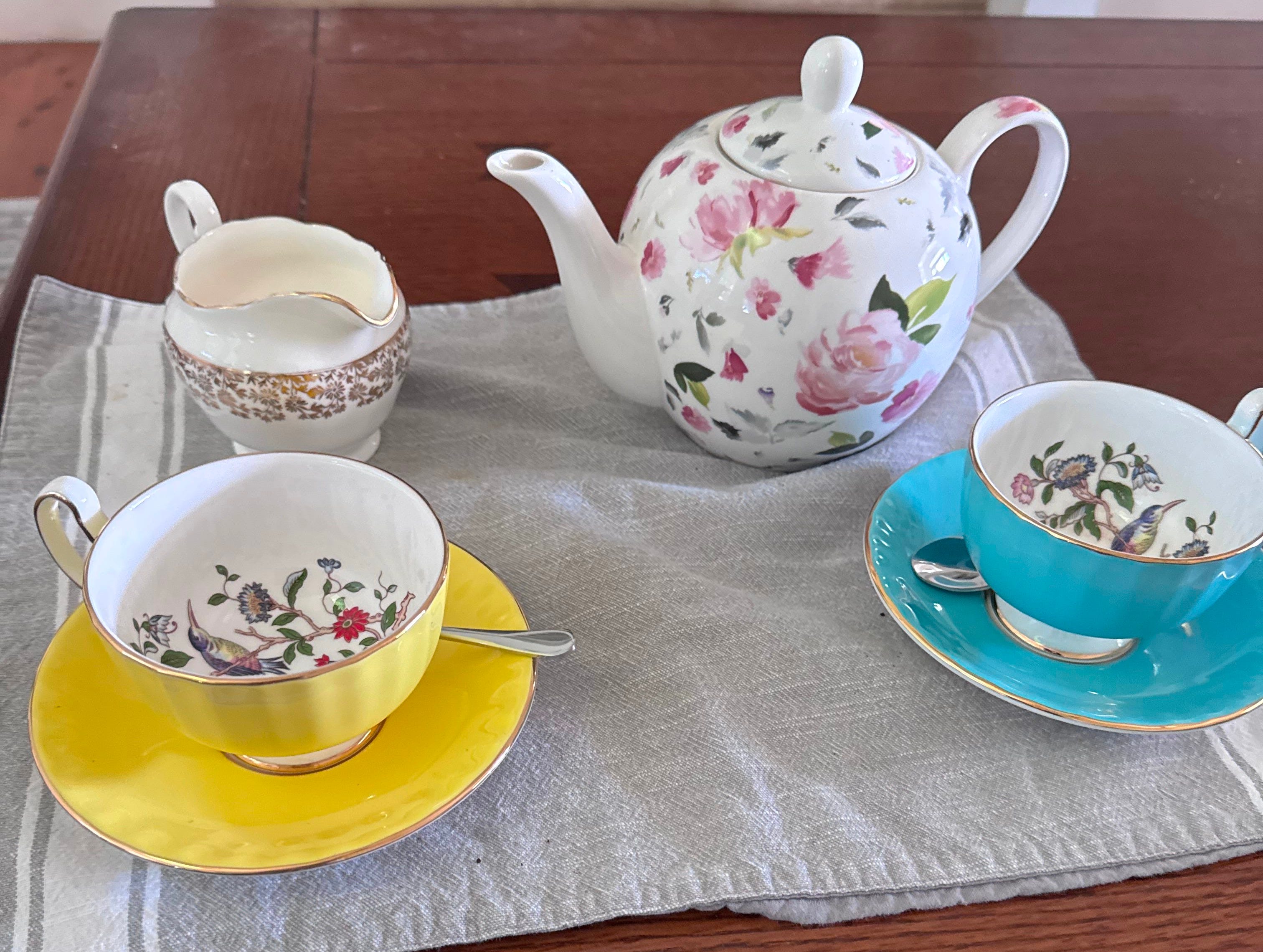
I steep loose tea in a traditional pot. I serve it in bone china. I have the special milk, the special spoon, the whole ritual. I aerate the milk so I can drink less but feel like I’m drinking more. Mid-morning and mid-afternoon, I stop and do this.
What it does is force a pause. The pouring. The sipping. The fact that you can’t rush bone china without feeling ridiculous.
For a Type A person like me, always onto-the-next-thing, guilty of neglecting my own body and health for the sake of external demands and external validation, the afternoon team became a forcing function.
Walks alone didn’t do it. I’d already walked for years. Walking while mentally running my to-do list is not the same as stopping.
The tea ceremony is my forcing function. Yours might be something else. Sitting in the car with your kid on the way to baseball practice. A long commute. A dog that needs walking at a specific time.
My recommendation here is that you find the natural pauses life is already giving you, and actually take them.
If you count yourself among those who can’t seem to slow down, I’m going to be direct with you the way I needed someone to be direct with me: this is leading to burnout and your nervous will pay the price. It will catch up with you. And one day you’ll look up and realize you missed your kids growing up, or your marriage has quietly fallen apart, or your body has a diagnosis attached to it.
And even if you’re lucky and none of those things happen, if you don’t appreciate what you have while you have it, you’ve missed the entire point.
Life isn’t easy. But I believe life is meant to be played as a game. And games are multifaceted. They have temporary winners and temporary losers, people temporarily ahead and temporarily behind. When you lose sight of that, when you take yourself and your current season too seriously, expect more than the present moment is giving you, you are negating your very existence.
Freedom comes when we REALLY embody the truth of our mortality.
The method is simpler than it sounds. When I feel a magic moment — when I feel full, complete, or that specific quality of joy — I acknowledge it. And then I look back and notice what I was doing when the feeling arose. And I try to create the conditions for it again.
After experimenting with this for a while, here is the pattern that’s emerged for me:
Getting up without an alarm. Walking the dogs at the beach. Reading what I actually want to read before the day demands anything from me. Tea service, mid-morning and mid-afternoon. Lunch with my husband. A bike ride along the beach. Cooking from the original Julia Child books — that’s been a current obsession. Audiobooks that play like a movie in my mind while I clean the house (I recommend The Red Rising saga). The porch swing. The farmer’s market on Sunday. Paddleball at the beach. Swimming. Rescuing turtles when they need it. Recording my podcast. Client meetings that actually mean something to me. Catching up with friends. Weekends with family.
I work ten to twelve hour days easily. I’m not describing a retired life. I’m describing a working life where the work lights me up and the pauses are protected.
I don’t know if work-life balance is a real thing. I think what’s real is intentionality about what you do, who you do it for, and whether the rhythm of your week has actual pauses in it — but pauses that you don’t feel guilty about.
Without getting too far into astrology and predictive timing — though regular readers know I don’t shy away from any of it — we all move through phases where life naturally speeds up and naturally slows down. I happened to enter a period where things were being slowed down for me whether I liked it or not. People left. Circumstances changed. Kids grew up. A move across the country meant the friend group I’d had was no longer.
Life will give you these openings. And they tend to get progressively louder if you don’t listen. Ignore them at your peril.
The moment I started saying out loud — wow, that was a perfect weekend. Wow, today was a perfect day — more of them showed up. I don’t think that’s magical thinking. I think that’s attention. What you name, you notice. What you notice, you make room for.
I’ll leave you with the inventory I ran through this week, because I think the specificity matters more than the sentiment:
“How blessed I am to have a dishwasher that works. To have a beautiful pot to cook in. To have a husband who loves me, respects me, and gives me space. To have supportive parents, and brothers and sisters-in-law I actually like. To have three healthy kids who are independent and thriving. To have three stepkids I’m proud of. To have had the grandparents I had. To have lived long enough to know what I know now.”
To have had the employers who taught me, the books that shaped me, the chance to travel. To live in a time where AI can help me run a business more easily and more cheaply than has ever been possible for someone like me. To have my own office. To have an Uplift standing desk. To have not just a MacBook Pro but a Mac Mini doing AI work on my behalf. To have fountain pens. To give myself the gift of beautiful notebooks because I love writing on good paper.
To live seven minutes’ walking distance from the beach, and to actually use that fact.”
There is so much to be grateful for. Most of it is ordinary. That’s the point.
If you take one thing from this: find your forcing function. Whatever makes you stop. Use it. The ordinary days are the ones you’re going to have the most of — which means they’re the ones that add up to your life.
Comments
Nothing yet. Say the first thing.
Sign in to join the conversation.