
Chris Bollen is one of favorite writers, and he seems to have disappeared, (Chris? Chris?) although today in the NYT he is one of numerous “thriller” writers who was asked for his best of list. So he’s somewhere and I do hope he resurfaces soon! Havoc went into numerous printings and compared to his previous novels, a departure…read all about it!
Peter Handel: Your new novel, Havoc, described as a “horror story,” represents somewhat of a departure from the lengthy, complex thrillers you published previously. Tell us a little about Havoc—the essential plot of the story, and how you came to write it.
Christopher Bollen: I never believed in lightning strikes of inspiration—the kind where the entire story comes all at once in a blinding flash—but that’s exactly what happened with Havoc. At the tail end of the Covid pandemic, as soon as it was possible to escape the U.S., I booked a trip to Egypt that included a boat trip up the Nile. Before embarking, I was staying a few days at the grand Winter Palace Hotel in Luxor, and one afternoon I was sitting in their back garden, and I happened to eavesdrop on a table near mine where an old American woman in a kaftan was berating a young waiter about the way the chef had prepared her lunch. It was clear to me she was a

long-staying guest. And the story came to me in an instant: an old American woman living out of grand hotels at the tail end of the pandemic, causing trouble. And of course she needed a nemesis.
PH: And what a nemesis your protagonist, octogenarian Maggie Burkhardt, has in this book: Otto Seeber, an 8-year-old terror with a mind for revenge and mayhem. Did you have any particular inspiration for him? A niece or nephew, by chance? Because that Otto is one pint-sized piece of work! What were you feeling when you wrote about all his sociopathic behavior?
CB: I don’t really have children in my life. No nieces or nephews, and in New York City where I live, my friends with kids mostly divide their lives between family and friends, so my insight into children is somewhat limited. But I vividly remember being a child, and how un-harmless, clever, and mischievous they can be. I really wanted Otto to be an 8-year-old, and therefore not an adult trapped in a child’s body like so many over-precocious children in literature and films. So that meant making him vulnerable as well as conniving—a terror, yes, but also a little boy. In other words, the same human depth I gave Maggie.
So that’s where it all started. Truly, I didn’t immediately think of it as a novel. I really thought, oh, when I have some free time, I’ll write it as a short story, and when I began a few months later, that’s how I envisioned it. But Havoc kept growing and gaining momentum and broke out of its cage. I think it was an opportunity to explore age—the end of life, the fright and resignation that comes with old age, and certainly I didn’t want a character who goes gently into that good night.
PH: Havoc features what I think is your first unreliable narrator, Maggie, who is clearly full of deception as she relates her past family life and alludes to the deaths of her husband and daughter. One gets the impression you had a most enjoyable time creating such a devious personality.
CB: People are always saying, write what you know, which might explain why contemporary literature is filled with so many aimless, lukewarm youngsters. Stepping into the shoes of an 81-year-old Wisconsin widow running from trouble was the most freeing and exciting experience in my writing life. I could get away from myself (an aimless, lukewarm, once-youngster) and dive into a character that, on the surface, doesn’t seem to have a lot in common with me. But more than that, Maggie is fun because, yes, she’s deceptive and ruthless and perhaps psychotic, but she’s also smart, funny, witty, and full of loss and remorse and regret. In other words, a total person.
PH: But she’s also frightened, both overtly and otherwise, and she lies her ass off to everyone, including herself—mostly to herself, it seems to me. Nonetheless, you feel she is also a sympathetic character, don’t you—in spite of her own sociopathic behavior—while Otto is an unrepentant little shit.
CB: Well, it wasn’t just a case of writing a fun villain. She allowed me to find a new perspective to tackle ideas about life and aging that just would have sounded incredulous in a young character in their prime. So it was freeing on all fronts. I really felt for Maggie as I wrote her, even as she was sabotaging people’s lives.
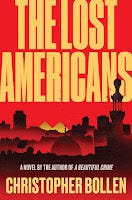
PH: During our previous conversation, for CrimeReads, focusing on your fifth novel, The Lost Americans—much of which is set in Egypt—you mentioned your youth and your obsession with Egypt. When you finally went there, how did it feel?

The entrance of the Luxor Temple in Luxor, Egypt.
CB: I never intended to write a second Egypt novel. A second Venice novel, sure, count me in. But Egypt? The funny thing is, with The Lost Americans being set in Cairo and Havoc set in Luxor, I almost felt like I was writing about two different countries. Which is partly a testament to the diversity of Egypt. But also, the city of Cairo is geopolitical, it’s international, it has its eyes on the present and future (despite the Pyramids looming in the distance). Luxor is very much a city built around ancient Egypt and the tourism of the Valley of the Kings and the temples. So Havoc really felt like tourist Egypt, an Egypt of the past, the stuff of Tutankhamun and the gilded tombs of the pharaohs. Obviously, the political realities of the country [find their] way in. But this was actually much more the Egypt I dreamt about in my childhood. I have to say, I was as blown away by the tombs in the Valley of the Kings as Maggie is in the novel. They really are these extraordinary, all-encompassing works of art and magic. That’s Egypt. Everything feels touched by wonder.
PH: And I’d say you were touched by wonder as well—you’ve told me that when you were growing up you were a huge Egypt “fan.” Was there some seminal childhood moment, an aha! when some internal quasi-psychic voice said to you, “Egypt will occupy a large part of your consciousness when you grow up”? Or just those dreams?
CB: Actually, I can never really predict what will work for a novel or not. So many times, when traveling to a new country, I’ve thought, this will make a perfect backdrop for a story. And it just doesn’t spark. Two years ago I spent a month in Madrid, certain I’d walk away with a fresh novel idea in my head. Madrid was amazing, I found it alive and interesting, but it just didn’t induce this friction that I need for all the pieces to fit. So, I really never know what will end up speaking to me. I can say, though, that like Egypt, Venice always meant a lot to me, even as a kid before I visited, and it too didn’t fail when it came to generating wildly good ideas for stories.
PH: I do think there is an underlying theme in your books—at least in the ones I’ve read: Your protagonists, in their own unique way(s), all strike me as being, to some extent, on the “outside” of the society they inhabit. In The Lost Americans, I would suggest that both your “shadow” protagonist, the dead Eric Castle—a weapons tech for a U.S. defense contractor, who operates in a realm far from most people’s reality—and Omar—a friendly, gay Egyptian (helping Eric’s sister, who’s come to Cairo to investigate her brother’s death), who is well aware of his limitations in a homophobic society—are outsiders. And in A Beautiful Crime (there’s that first Venice novel!), two American wannabe-con artists, Nick and his boyfriend Clay, surely don’t fit into the decaying palazzo they live in while running their scams. Is this a projection on my part, Chris? In Havoc, besides the misfit aspects of Maggie’s own life as a fugitive of sorts,
you include a gay couple, Zachary and Ben, who drive the plot in an unexpected way—again, gay people have (by necessity) often been forced to remain as outsiders in “society,” rather hiding in plain sight.
CB: You’re absolutely right. I’m always purposely coming from an outsider angle. That’s true of my second novel, Orient, too which was about a gay teenage orphan. It’s funny. When I was describing Havoc to a friend long before it was published, he said, “Oh, so you are finally embracing normalcy”—meaning, what can be so outsider about an 81-year-old Wisconsin widow in a ritzy hotel. But that’s just it: I think I wrote Maggie as if she were an outsider, so that colors the entire book. It probably has a lot to do with growing up gay in the time I did, where I felt like an outsider, so I was always rooting for that kind of character. The one who doesn’t fit in. In case anyone is worried I’ve embraced the norm (and I don’t imagine anyone is losing sleep worrying about that), the next novel I’m working on is about a gay American prostitute in Paris, a definite outsider. But really, all foreigners are outsiders, even Americans traveling in Europe. You are instantly the odd person out. It’s an unbalancing, which is the emotional and physical state where I like my characters to be.
PH: Finally, am I correct that you did not anticipate the enormous buzz around this novel? Best-of-the-year lists, the critical acclaim? Has all the attention on Havoc had any effect on what you might do down the road? Is horror a happy place for you now?
CB: For every novel, I always think, there’s an audience out there that will appreciate this—I’m just hoping the book finds them, or vice versa. Sometimes it does and sometimes it doesn’t. But I had a really strong feeling that Havoc would find its way—maybe because the set-up of an old woman vs. a little boy, old vs. young, is so compelling in itself. I’m so happy and grateful [for] the positive response. Sometimes, about a month after you publish a book and you get at most a little faint clapping, you think, oh well, that’s it. But Havoc seems to be taking on a life of its own.
You know what, Peter? Success can be as bad for writers as failure. Because you wonder if you can make the magic again, or if you should just reproduce the winning book in other forms. I’ve had so many debates with writer friends about whether “successful” writers really just keep writing the same book over and over. I don’t want to do that. I hope I keep going in risky unexpected directions, some of them sure to disappoint, but that’s how you keep alive as a writer. I think elements of horror will definitely come into play in future books.
No posts
Comments
Nothing yet. Say the first thing.
Sign in to join the conversation.